
STEADI: Intervene
How to Evacuate Safely When You Use a Walker or Cane
This guide helps older adults with walkers, canes, or fall history prepare for wildfire evacuation by identifying hidden fall risks in exit paths and setting a clear threshold to leave early — before mandatory orders — to stay upright and safe.
The moment that worries me is not the orange sky on the news. It is an older adult waking from a nap, reaching for a walker, turning into a dim hallway, catching one wheel on a rug edge, and trying to move faster because someone at the door is saying, “We need to go.”
For anyone who uses a walker or cane, or who has a history of falls, wildfire safety planning for older adults has to start there: with the ordinary route out of the house. The plan is not finished when the documents are copied or the evacuation bag is packed. It is finished when the person can move from the bed, chair, bathroom, or usual resting place to the car without being rushed, blocked, overloaded, or surprised by a threshold.
If an evacuation order is already in effect or conditions feel unsafe, do not stay home to rehearse. Leave if you can do so safely, and call emergency services or local officials if you cannot get out. The planning below is for the calmer window before fire season, before a red-flag day, or while an advisory is still early enough that movement can stay steady.
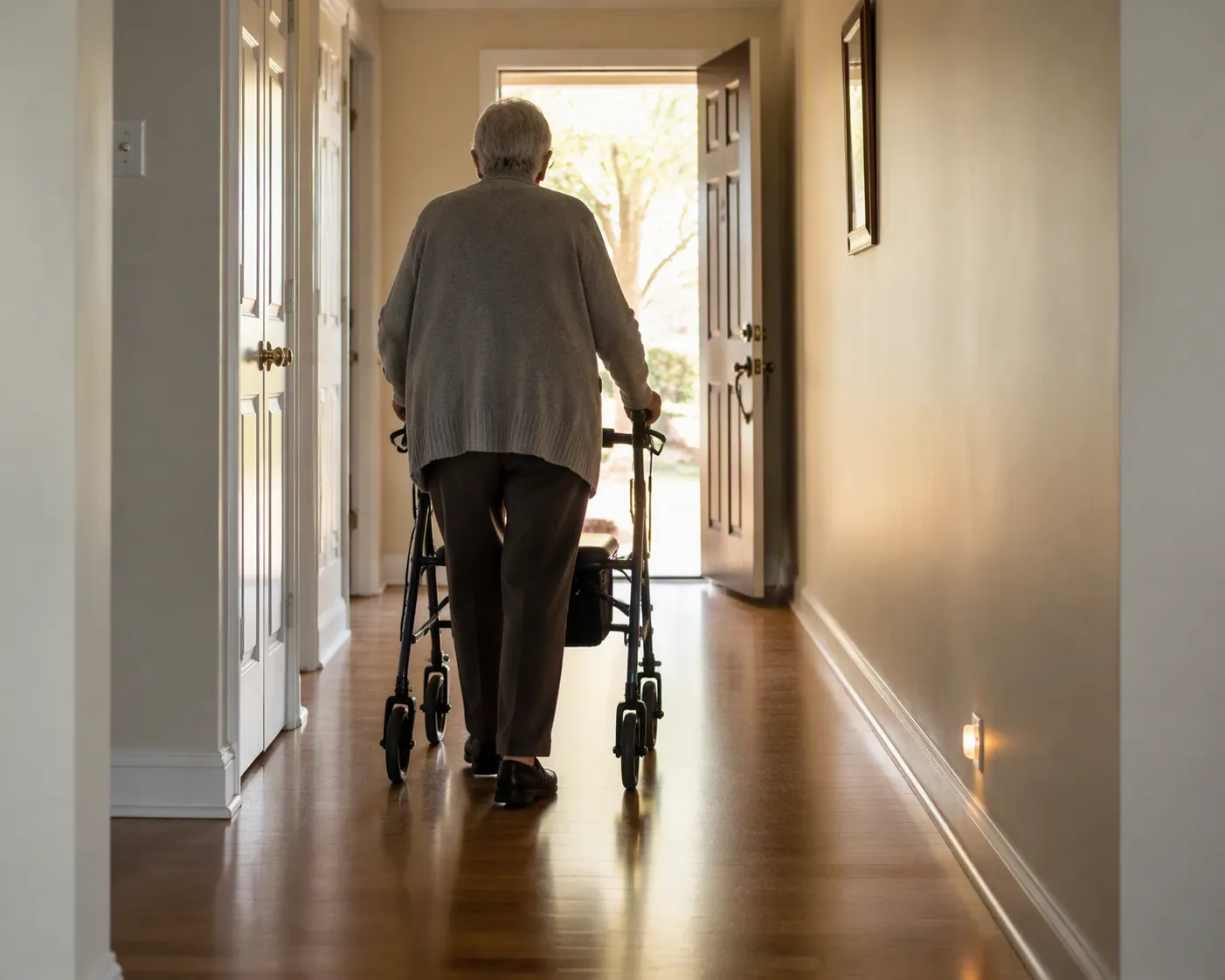
A wildfire evacuation is also a fall-risk event
Most families think about the wildfire first: Where is it? Which road is open? What should be packed? Those questions matter. But for an older adult with limited mobility, the evacuation itself creates a second hazard. The same loose rug that is merely annoying on a normal afternoon becomes a real obstacle when someone is hurrying toward the door with a cane in one hand and a bag in the other.
The trouble spots are rarely dramatic. A porch step without a good handhold. A hallway lamp cord that has slowly migrated into the walking path. Shoes near the garage door. A walker that fits through the front door but turns awkwardly at the side door. A threshold that catches the front wheels unless someone approaches it straight on. A caregiver who plans to “come get Mom,” but has not said which door they will use, where they will park, or what happens if they are delayed.
That is why the evacuation route belongs inside the fall-prevention plan. It should be walked, cleared, lit, and assigned before anyone is frightened, breathing smoky air, or trying to make decisions in a crowd of ringing phones.
Walk the route from the place evacuation will actually begin
Do not start the plan at the front door. Start where the older adult is most likely to be when the call comes: in bed, in a recliner, at the kitchen table, in the bathroom, or in a favorite chair near the television. A plan that begins at the doorway skips the hardest part for many people.
Use the actual mobility aid. Not a mental picture of the walker. Not the cane that stays in the car. Not a wheelchair “if needed.” The person should use the same walker, cane, rollator, wheelchair, brace, shoes, and glasses they would rely on during a real evacuation. If they usually need a minute to stand, that minute is part of the plan. If they need to sit before getting into the car, that resting place is part of the route.
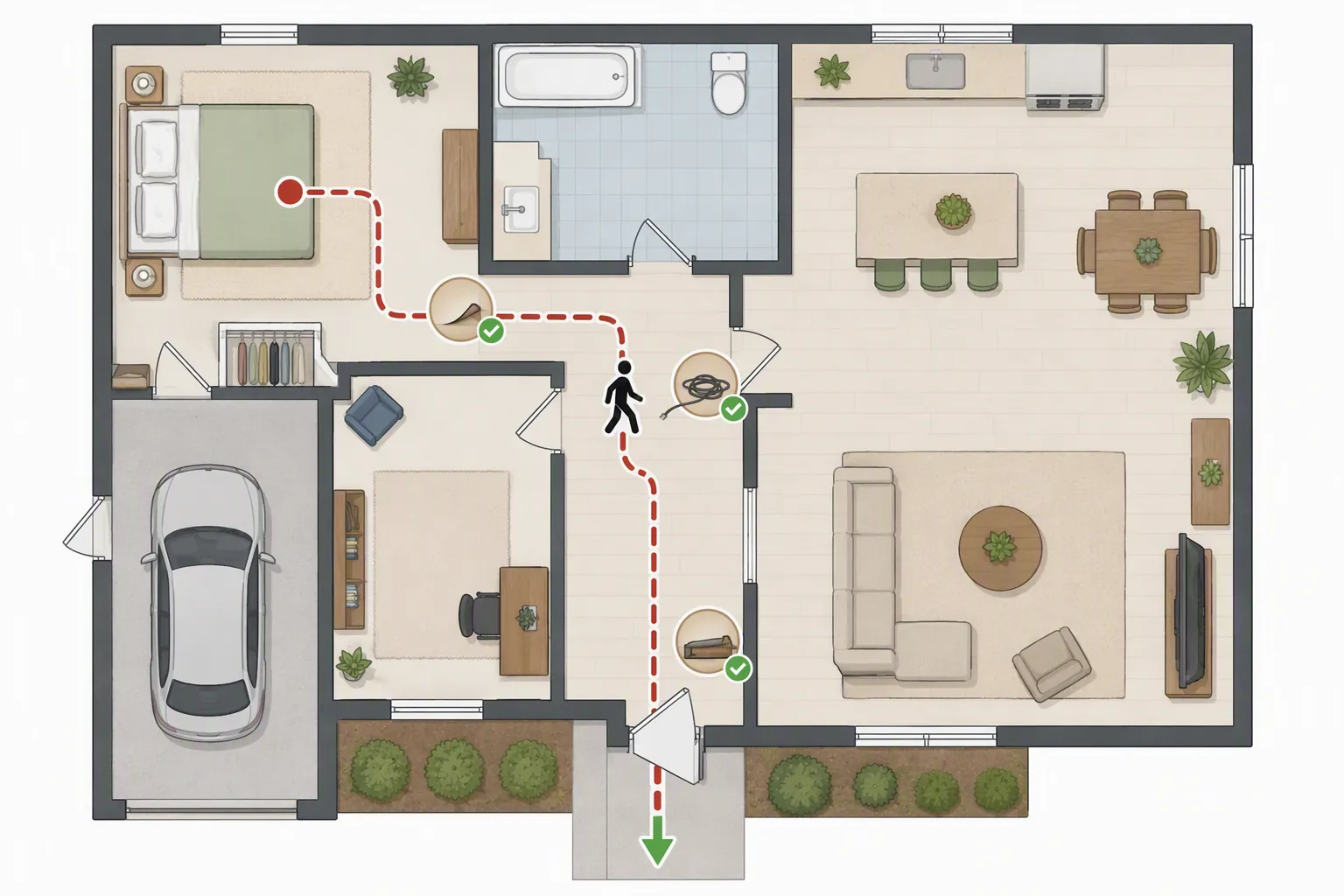
One careful walk-through will usually reveal more than a long family conversation. Have one person observe quietly while the older adult moves at a normal, safe pace. Watch the feet, wheels, hands, lighting, and turning points. Do not rush the test. The point is to find what would fail under pressure.
| Part of the route | What to test | What to fix before it becomes urgent |
|---|---|---|
| Bed, recliner, or usual chair | Can the person stand safely and reach the walker or cane without stretching? | Keep the mobility aid in the same reachable spot; move low furniture, baskets, or cords away from the first steps. |
| Hallway | Can the walker move without clipping walls, rugs, shoes, pet bowls, or cords? | Clear the walking lane and remove loose rugs instead of telling someone to “watch out.” |
| Doorway and threshold | Do wheels, cane tips, or feet catch at the threshold? | Use the easiest exit as the main plan; repair or avoid a threshold that causes hesitation. |
| Porch, garage, or side path | Is there a step, slope, cracked pavement, poor lighting, or no place to pause? | Add lighting, clear outdoor clutter, and choose the exit with the steadiest surface. |
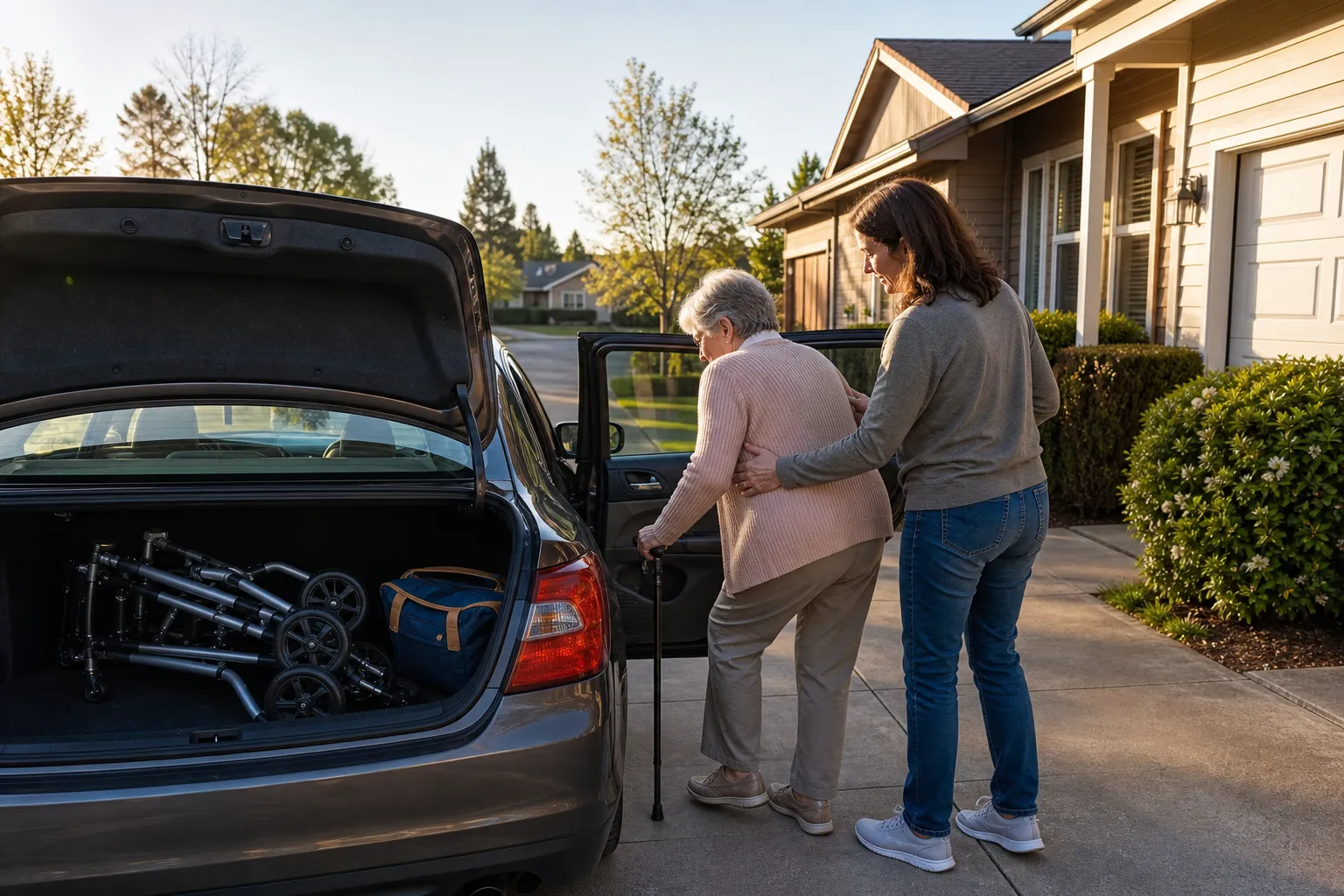
| Car transfer | Can the person turn, sit, and bring legs into the vehicle without being pulled? | Practice with the actual car; decide where the walker or cane goes before the door closes. |
Choose the safest exit, not the most familiar one
Many people assume the front door is the evacuation door because guests use it. Sometimes the garage is safer because the car is closer. Sometimes the front door is safer because the garage has a step down, stored boxes, a narrow turn, or poor lighting. Sometimes a side door looks convenient until someone tries to get a walker through it while also turning toward the driveway.
The right exit is the one that works with the person’s body and equipment on an ordinary day. It should require the fewest turns, the fewest obstacles, the best lighting, and the least carrying. If two exits are possible, name a primary exit and a backup. Then keep both routes clear, not just the front hallway visitors see.
Remove the small hazards that become big during a rushed exit
A fall-prevention wildfire plan is refreshingly physical. It does not depend on anyone remembering a long speech. It asks whether the route is clear tonight, whether the lights work, and whether the walker can cross the threshold without a fight.
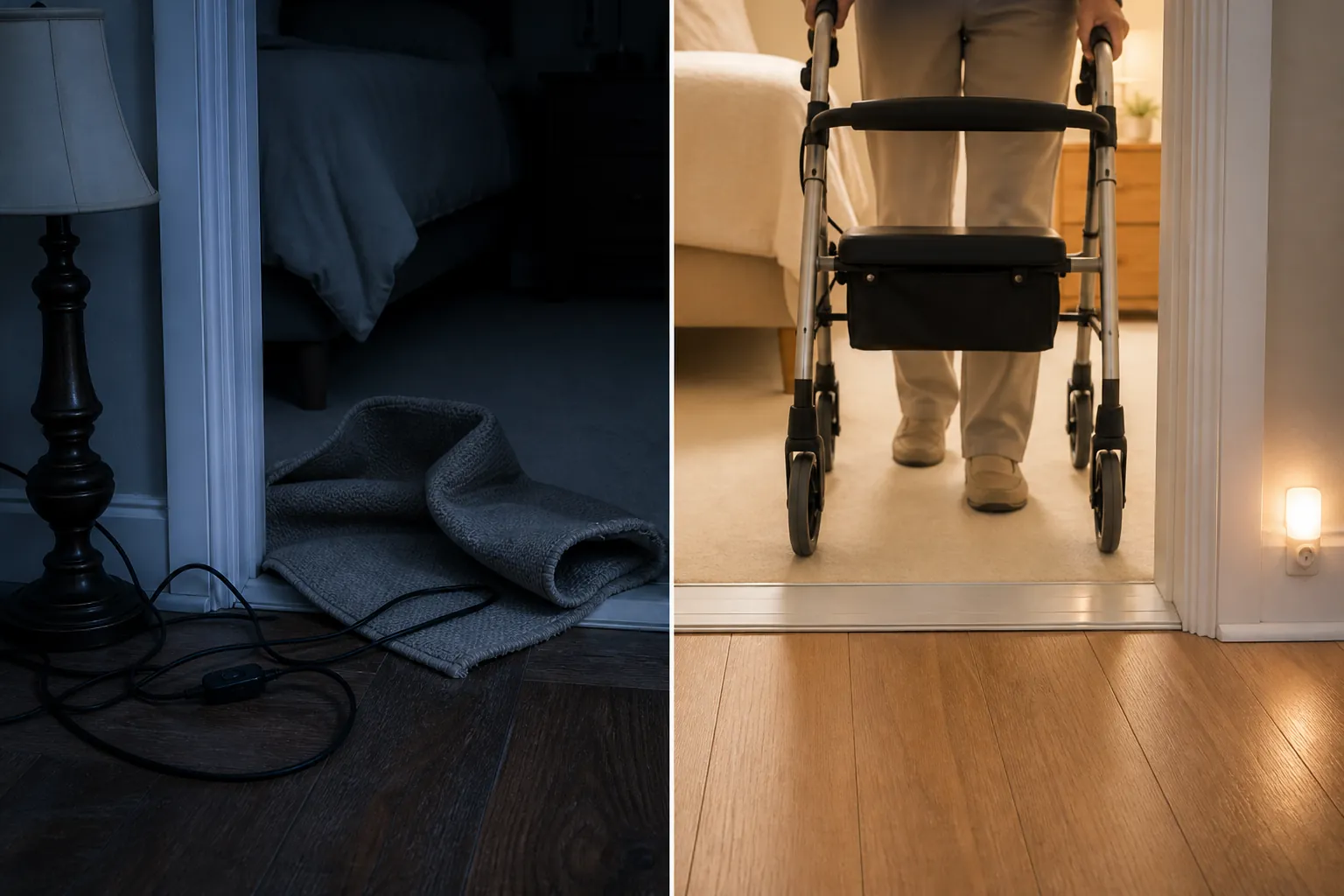
- Remove loose rugs from the evacuation path, especially near the bed, hallway turns, doorways, and bathroom.
- Move lamp cords, oxygen tubing, charging cables, pet beds, shoes, laundry baskets, and plant stands out of the walking lane.
- Keep the evacuation bag somewhere reachable but not in the path of the walker, cane, or wheelchair.
- Add nightlights or motion-sensor lighting along the route from bed to exit and at the door used for evacuation.
- Check outdoor lighting at the porch, garage, driveway, gate, and any uneven walkway.
- Clear the car-side path too. A perfect hallway does not help if trash bins, hoses, or garden pots block the last few steps.
- Store the walker, cane, wheelchair, glasses, hearing aids, shoes, and phone charger in predictable places, especially overnight.
The bag deserves a place, but it should not become the center of the plan. A walker user who is asked to carry a heavy duffel has just lost one of the main benefits of the walker: two steady hands on the grips. If supplies must travel, put them where a helper can grab them, in a basket that fits on the walker only if it is already safely used that way, or pre-load nonessential items in the car during high-risk weather.
Practice the awkward parts, not just the easy hallway
The hallway may be fine. The trouble may come at the exact spot where no one pays attention: the turn from bedroom to hall, the door that swings toward the walker, the small lip between kitchen and garage, the step from porch to walkway, or the transfer into a taller vehicle.
Practice those points slowly. If someone reaches out to pull the older adult forward, pause and solve the setup instead. Pulling can throw balance off, especially when the person is already managing a cane or walker. A better plan may be to use a different door, move the car closer while conditions are still calm, place a sturdy chair near the exit for a brief pause, or have the helper carry every item except the mobility aid.
Name the helper, the door, and the ride
“Someone will come” is not a plan. The older adult should know who is expected, how that person will make contact, which door they will use, and what transportation is being used. The helper should know the route inside the home, where the mobility aid is kept, where the evacuation bag is, where medications are stored if they are part of the grab-and-go plan, and how the person gets into the car safely.
This is especially important for adult children who live nearby but not in the same house. It is easy to say, “I’ll pick you up,” and much harder to do that safely if the driveway is crowded, the garage opener fails, the walker is behind a chair, or the older adult has already tried to carry a bag to the door alone.
- Primary helper: the person who will call first, arrive first if needed, and take responsibility for transportation.
- Backup helper: a neighbor, relative, friend, or local contact who can act if the primary helper is delayed.
- Primary exit: the door that has been tested with the actual mobility aid.
- Backup exit: a second route that is also kept clear and lit.
- Transportation: the exact car or service, with a practiced transfer if the vehicle is high, low, or difficult to enter.
- Communication: the first call, the backup call, and what the older adult should do if no one answers.
If the older adult lives alone, the backup matters as much as the primary helper. A neighbor who can knock, check the hallway, and carry the bag may be more useful in the first few minutes than a family member who cares deeply but is driving from across town.
Set the leave-early threshold before anyone is arguing
The decision to leave early can feel like giving up control. I see it differently. For a person who needs extra time to stand, walk, transfer, manage medications, or avoid a fall, leaving early is how control is preserved. It keeps the person moving in daylight if possible, with clearer thinking, steadier footing, and a helper who is not yet racing the clock.
Waiting for a mandatory evacuation order leaves less room for the very things that keep a mobility-impaired person safe: slow turns, seated rest, careful car transfer, checking that the cane made it into the car, and locking the door without rushing. By the time everyone else is also leaving, the family may be managing traffic, phone calls, pets, smoke concerns, and anxious neighbors at the same time they are trying to prevent a fall.
The threshold should be plain enough that no one has to debate it under stress. Different communities use different alert systems and wording, so build the rule around the local system the household actually receives. The point is to choose an early stage, not the final push.
| If this happens | The mobility-first response |
|---|---|
| A local alert says to prepare to evacuate | The older adult changes into safe shoes, places the mobility aid within reach, turns on route lighting, and calls the named helper. |
| A nearby area is told to evacuate | The household treats this as the likely leaving point, especially if the older adult needs help, uses a walker, or has fallen before. |
| The primary helper may be delayed | The backup helper is contacted before conditions become urgent. |
| The older adult feels unsteady, short of breath, confused, or unable to manage the route calmly | The plan moves from waiting to leaving or calling for assistance. |
| A mandatory order is issued | The household should already be ready or gone; if not, leave if it can be done safely and seek emergency help if it cannot. |
Families sometimes resist this because they do not want to overreact. But an early departure does not have to be dramatic. It can mean going to a relative’s house, a hotel outside the affected area, or another prearranged safe place while the older adult can still move at a normal pace. The dignity is in not being forced to perform a difficult exit in the worst conditions.
Keep the go-bag useful, light, and out of the walking path
Documents, medications, phone chargers, glasses, hearing aid supplies, keys, cash, and emergency contacts all matter. Alerts and communication plans matter too. They support the evacuation, but they should not make walking harder.
A good evacuation bag for a walker or cane user is not judged by how much it holds. It is judged by whether it can be retrieved without bending dangerously, whether someone else can carry it, and whether it stays out of the wheels. If the older adult must move alone for any part of the route, the safest bag may be a small crossbody pouch, a walker basket already used safely in daily life, or a pre-packed container kept by the exit for the helper to grab.
- Do not hang a heavy bag from one side of a walker unless that setup has been tested and does not tip or pull.
- Do not place the bag in front of the door, on the floor beside the bed, or in a hallway turn.
- Do keep essential items in a consistent, reachable place.
- Do decide which items the helper carries and which items the older adult keeps on their body.
- Do keep shoes, glasses, phone, hearing aids, and mobility aid as close to the person as the bag itself.
When you rehearse, watch for hesitation
A rehearsal does not need to be theatrical. No alarm sound, no stopwatch, no pretending the fire is at the end of the street. Walk the route on a normal day and notice where the older adult slows, looks down, reaches for a wall, lifts the walker, turns sideways, or waits for someone else to tell them what to do.
Hesitation is useful information. It may mean the lighting is poor, the threshold is too abrupt, the route is too narrow, or the person is unsure which door is the plan. Fix the reason. Do not train the person to hurry past it.
After the walk-through, make the plan visible in simple language. A note near the phone or refrigerator can say: “Use front door. Walker by bed. Bag on bench. Call Maria first. If prepare-to-evacuate alert comes, leave for Daniel’s house.” The exact wording should fit the household, but it should be short enough to read when people are anxious.
The plan is ready when the exit is calm
For an older adult who uses a walker or cane, the safest wildfire evacuation is the one that starts while the hallway is still clear, the helper is still reachable, the car transfer can still be done carefully, and no one is asking the person to move faster than they safely can.
The test is simple. Can this person get from the place they usually rest to the car using the actual mobility aid, along a clear and lit route, with a named helper and a decision to leave before movement becomes rushed? If not, the missing piece is not another supply list. It is the rug, the threshold, the dark porch, the unnamed ride, or the late decision that still needs attention.
Related reading
Noticed something outdated or inaccurate on this page? Flag a correction. We review every report against CDC, NIA, and AARP HomeFit guidance before updating a page.
Part of the Fall Prevention section.