
STEADI: Intervene
Wildfire Evacuation Plan for Seniors at Fall Risk
A wildfire evacuation plan for a senior at fall risk has to be tested against the walker, cane, or wheelchair they use — doorways the device fits, walking aids kept in multiple rooms, and rehearsed transfers into the car. Here's what to verify before an evacuation order comes, and what to do if a fall happens mid-evacuation.
Start a wildfire evacuation plan for seniors at fall risk with the device, not the folder. Put the walker, cane, rollator, or wheelchair in the senior’s hands and try the actual route from bed to the door, then from the door to the car. If the walker clips the bathroom threshold, if the wheelchair cannot turn through the laundry-room exit, or if the cane is usually parked across the room at bedtime, the plan is not ready.
This guide is for the older adult who can move on an ordinary afternoon but is not steady enough to be rushed through smoke, darkness, barking dogs, alarms, and a caregiver’s panic. It is not the same problem as evacuating a fully non-ambulatory parent; that needs a different plan for lifting, transport equipment, backup power, and responders. If that is your situation, use the companion guide on a wildfire evacuation plan for a senior who can’t walk. Here, the danger is narrower and easy to underestimate: a senior who can walk may fall because the evacuation happens too fast, too late, or without the aid they actually need.
This article is planning guidance, not medical advice. If a clinician, physical therapist, occupational therapist, fire department, emergency manager, or home-health team has given instructions for your parent’s mobility, oxygen, medications, or transfers, those instructions should control the plan.
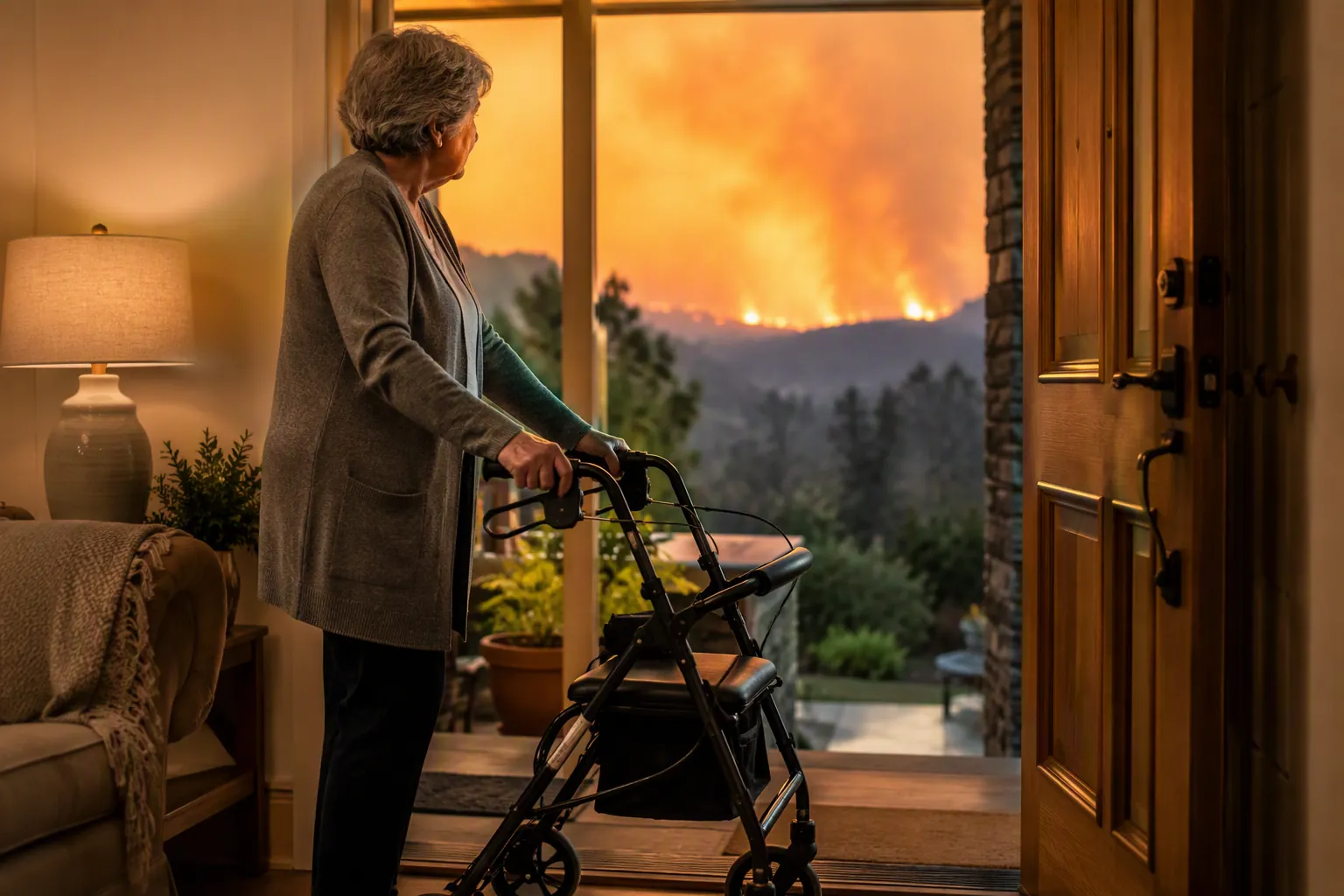
The route has to work with the device, not around it
The U.S. Fire Administration’s older-adult fire safety guidance gives the check that should sit at the center of this plan: if you use a walker or wheelchair, check all exits to be sure you can get through the doorways. The same page notes that adults age 65 and older had a fire-death risk 2.5 times greater than the general population in 2020, which is reason enough not to treat exit fit as a minor detail. [1]
Do not measure the doorway and call it done. Test the route with the device loaded the way it is used: walker basket attached, wheelchair footrests in place, oxygen tubing if used, shoes on, glasses on, and the caregiver standing where they would stand. A hallway that feels wide when empty can become awkward when a rollator turns, a dog gate swings open, and someone is trying to hold a flashlight.
| Route point | What to verify | What failure looks like |
|---|---|---|
| Bed to standing position | The senior can reach glasses, shoes, cane or walker, phone, and flashlight without crossing the room unaided. | They must stand first and then search for the device. |
| Bedroom doorway | The device clears the door while the senior is tired, stiff, or turning slowly. | The walker catches on trim, rugs, cords, or a half-open door. |
| Hallway turn | The turn can be made without backing up repeatedly or lifting the walker. | The caregiver has to pull the device or twist the senior’s shoulders. |
| Exterior threshold | The senior can cross the threshold with the device, shoes, and lighting expected during evacuation. | The front wheels stop at the sill or the senior has to step down without support. |
| Door to car | The surface is lit, clear, and stable enough for the walker, cane, or wheelchair. | Gravel, hoses, leaf piles, wet mats, or uneven pavement force a rushed workaround. |
Run this from more than one exit. Wildfire evacuation may make the usual front door unusable because of smoke, heat, a blocked driveway, a fallen branch, or responders directing traffic. If only one exit works with the walker or wheelchair, that is not automatically a failure, but everyone needs to know that the plan depends on that exit staying available.
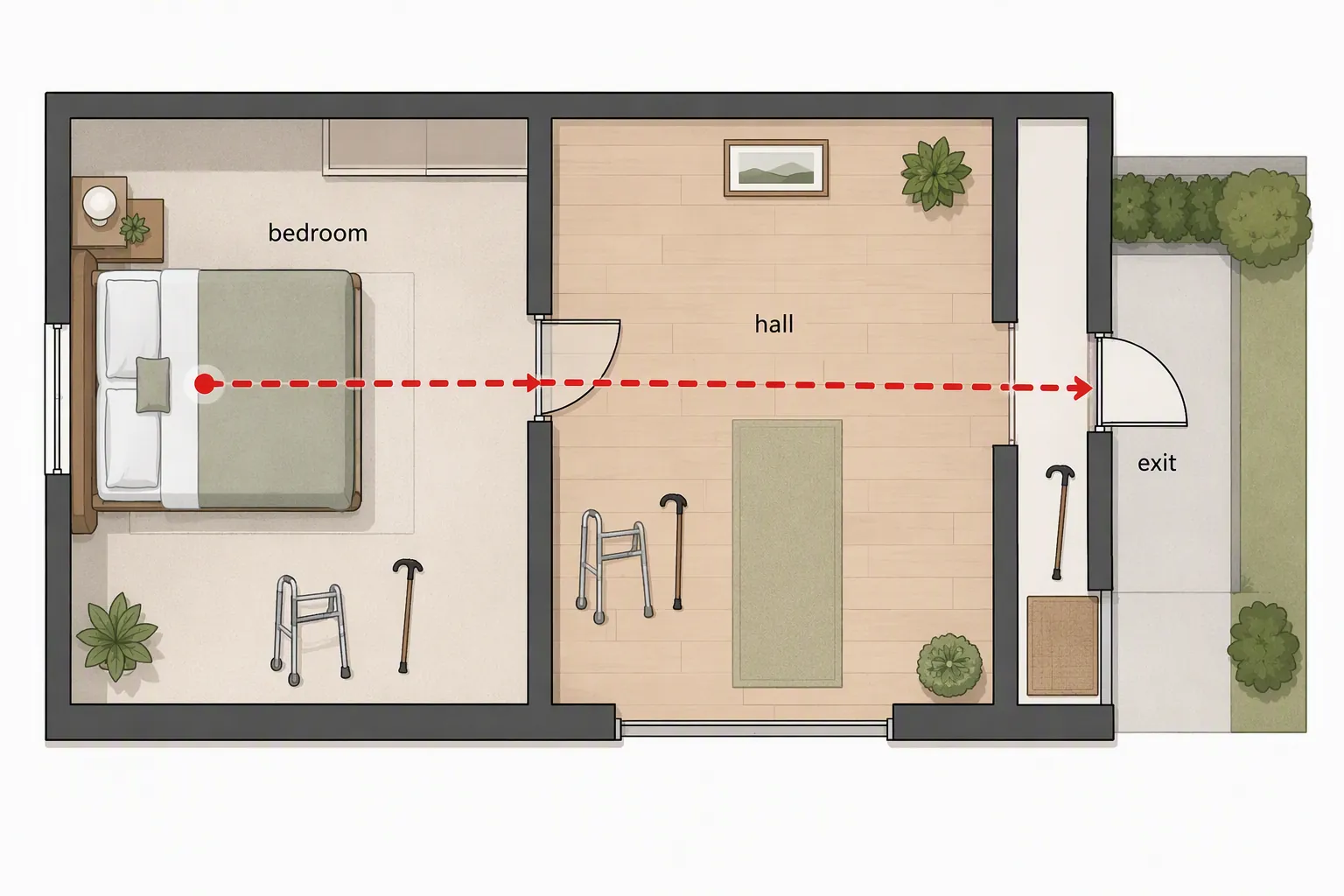
Clear one primary route, then make it boring
The safest evacuation route for a fall-prone senior is not the route with the prettiest furniture arrangement. It is the one with the fewest decisions. Remove throw rugs, pet bowls, low stools, extension cords, decorative baskets, unstable plant stands, and anything that narrows a turn. If the senior uses nearby surfaces for support, replace wishful handholds with real ones; a towel bar is not a grab bar. For more on that specific home hazard, see Towel Bar vs. Grab Bar.
Then leave the route alone. A cleared path that gets refilled with laundry baskets, deliveries, holiday decorations, and a folded exercise bike is not a route. It is an intention.
Walking aids belong in more than one room
The California Department of Aging advises older adults to keep walking aids near them at all times, keep extra walking aids in different rooms, and identify two people who can check on them after a disaster. That guidance matters because evacuation does not wait for a senior to be in the “right” chair beside the “right” walker. [2]
If your parent uses a cane in the kitchen, a walker at night, and a transport chair for longer distances, name those differences in the plan. Do not collapse them into “mobility aid.” The device that works for a short, calm walk to the mailbox may not work for a smoky walk to the car with a warning alert sounding on two phones.
- Bedside: primary nighttime device, shoes, glasses, flashlight, phone, and any pendant or alert device.
- Bathroom: a safe way to stand and reach the device after toileting, because nighttime evacuation may start there.
- Main sitting area: the aid the senior actually uses while watching TV or resting.
- Kitchen or dining area: a cane, walker, or stable support plan that does not depend on furniture edges.
- Near the exit: backup cane, labeled walker, folded transport chair, or other device that can be grabbed if the primary aid is not reachable.
Extra devices do not have to be expensive duplicates of everything. The point is to eliminate the worst first step: an unsteady person crossing a room without support because the cane is “just over there.”
Night readiness is fall prevention
CAL FIRE’s evacuation guidance tells residents not to wait for a mandatory evacuation order, to keep shoes and a flashlight near the bed for night evacuations, to know how to open the garage door manually, and to keep at least half a tank of gas in the vehicle. For a senior at fall risk, those are not convenience details. They decide whether the first steps happen barefoot, half-awake, and in the dark. [3]
Bedside setup should be boring enough to find by touch. Shoes should be stable, closed-heel if that is what the senior normally needs, and kept in the same place every night. The flashlight should be reachable without standing. Glasses should be where they always are, not in a drawer under the charger cord. If the senior uses hearing aids, dentures, a phone, or a medical alert device, decide what travels and what gets left if the order is urgent.
Do one nighttime drill before fire season or during a calm week. You do not need theatrical smoke or a timer. Turn on the usual night lighting, start from bed, and move to the exit with the actual device. Watch for what changes: stiffness after lying down, confusion from waking suddenly, a robe dragging near the walker wheels, a dog underfoot, a hallway that is darker than anyone remembered.
The garage door and car are part of the fall-risk route
A plan that ends at the front door is not an evacuation plan. The senior still has to reach the vehicle, get seated, and leave before the road network becomes crowded or dangerous. That is where many families discover the hardest part too late: the walker folds awkwardly, the passenger seat is too low, the driveway slopes, the caregiver blocks the handhold, or the senior panics halfway down into the seat.
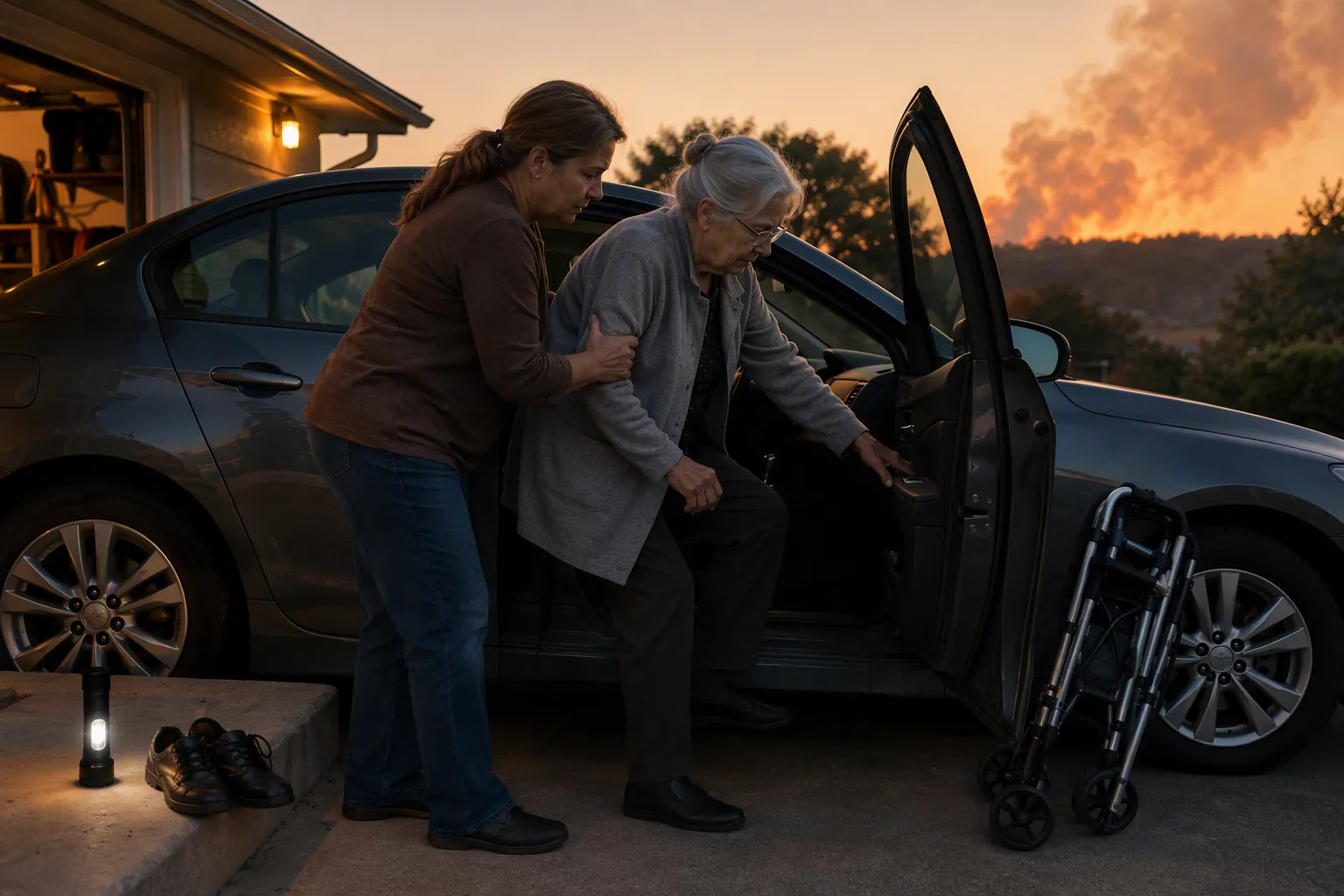
Practice the car transfer on a normal day with no deadline. Use the vehicle that would actually be used, parked where it would actually be parked. If there are two likely vehicles, practice both. The caregiver should learn where to stand without pulling on the senior’s arm, where the walker goes during the turn, and whether the senior needs the seat moved back before sitting.
- Open the passenger door fully and check whether it stays open on the driveway slope.
- Move the seat to the position that gives the senior the easiest controlled sit.
- Decide whether the senior backs up to the seat with the walker, turns before sitting, or uses another transfer method recommended by their clinician or therapist.
- Practice where the caregiver places hands, and where they do not. Pulling a frightened adult by the arm can make both people unstable.
- Fold and load the walker, rollator, cane, wheelchair, cushion, or footrests in the order you will use under pressure.
- Confirm that the caregiver can close the door, load the device, and get into the driver’s seat without leaving the senior unsupported in the driveway.
This is also the moment to find out that the senior cannot climb into a high vehicle, that the rollator does not fit once the go-bag is in the trunk, or that the garage door opener fails when power is out. It is better to learn that with clear air and daylight than while an evacuation warning is changing to an order.
Support people need access before the warning
Ready.gov’s older-adult guidance says to plan how assistive devices will come with you and to make sure someone in the support network has an extra key and knows how to use lifesaving equipment. That is the difference between a neighbor who can actually help and a neighbor standing outside a locked door calling your phone. [4]
At least two support people should know the evacuation route, the device locations, the manual garage-door method, the pet plan if pets are present, and which medications or equipment cannot be left behind. If one helper is an adult child who lives across town, the second should be closer: a neighbor, building manager, nearby relative, or friend who has agreed to check in when a warning is issued.
For seniors who need accessible transportation, arrange it before evacuation time. United Spinal Association’s wildfire preparedness resources emphasize accessible transportation planning, backup batteries for power-dependent medical devices such as CPAP, oxygen, and power wheelchairs, and a personal emergency evacuation plan. Those details overlap with medical and disability planning, but they still affect fall risk because a delayed ride can pressure everyone into unsafe last-minute movement. [5]
If your county, city, utility, paratransit agency, or emergency management office offers an assisted-evacuation or access-and-functional-needs registry, ask what it does and does not provide. Registration may help responders identify needs, but it should not be treated as a guaranteed ride at the exact moment a wildfire moves toward the neighborhood.
Keep the go-bag useful, but do not let it become the plan
A go-bag matters, but it cannot compensate for a walker that does not fit through the exit. Pack the bag after the mobility route is workable, then store it where it will not become a tripping hazard or force the caregiver to leave the senior standing unsupported.
The American Red Cross advises older adults to keep at least 30 days of medications and extra assistive items such as a cane or eyeglasses, and to review the plan every six months. [6] For broader supply planning, use an emergency evacuation checklist for seniors living alone or a severe weather emergency checklist for seniors for the 3-day go-kit and longer stay-home supplies. This wildfire-specific plan should stay focused on what must happen fast: device, shoes, light, route, car, keys, and helper.
Power loss deserves a separate check if the senior uses oxygen, CPAP, a ventilator, a power wheelchair, refrigerated medication, an adjustable bed, or a stair lift. A 2023 scoping review on older adults and disaster preparedness found that older adults are more likely to face life-threatening evacuation challenges, may be less likely to receive disaster warnings, and can be stranded by outages when they rely on oxygen, ventilators, CPAP, or power wheelchairs. [7] For the home-power side of that problem, use the room-by-room power outage safety checklist for seniors and what to check first when your parent’s power is out.
Leave early enough that walking speed is not the test
CAL FIRE’s warning not to wait for a mandatory order is especially important for a senior who moves slowly or needs help transferring. [3] Leaving earlier protects more than travel time. It reduces the pressure on the caregiver to pull, lift, shortcut, skip shoes, leave the walker behind, or ask an unsteady person to hurry down a driveway.
Choose a trigger that happens before the final order if local authorities allow it: evacuation warning, nearby fire growth, power shutoff, poor air quality, a caregiver needing to drive in from another area, or a senior becoming too tired for a safe transfer later in the day. The trigger should be written down, but it also has to be understood by the people who will act on it.
| If this is true | Do this before conditions worsen |
|---|---|
| The senior cannot safely walk faster than usual | Leave at the evacuation warning stage if possible, not after everyone else is on the road. |
| The car transfer takes two people | Call the second helper early enough to arrive before smoke, darkness, or road closures complicate the move. |
| The garage door requires manual opening during outages | Practice and assign that job to one specific person. |
| The senior uses oxygen, CPAP, or a power wheelchair | Confirm batteries, chargers, vehicle space, and destination power arrangements before evacuation time. |
| The senior has fallen recently | Do not make speed the safety standard; make a controlled route and transfer the standard. |
If the senior falls mid-evacuation, the plan changes
There is not a strong source base documenting falls specifically during wildfire evacuation. The safer rule here is a practical synthesis from fire-safety, older-adult disaster, night-evacuation, and disability-preparedness guidance: when a fall happens, the plan stops being “keep moving” and becomes “stop, reassess, and get help.” [1][2][3][5]
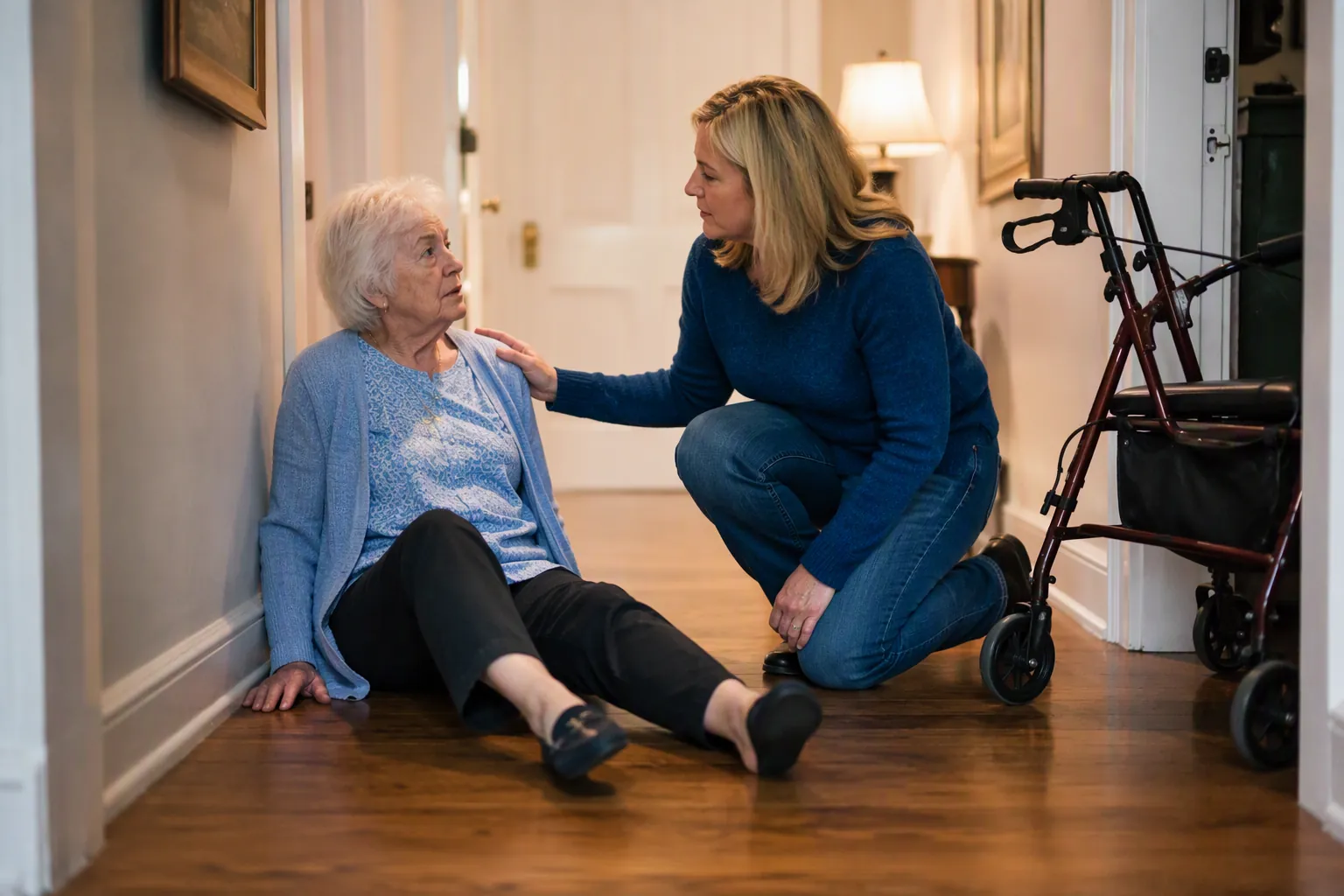
Do not drag a fallen older adult through a doorway. Do not pull them up by both arms because smoke is frightening or because the car is close. A fall may mean pain, dizziness, injury, confusion, or a second fall for the caregiver. If the senior cannot get up safely using their usual method, call 911 or local emergency services and say plainly that an older adult has fallen during a wildfire evacuation and needs help getting out.
The caregiver’s job in that moment is to make the scene as safe as possible without creating a second patient. Move immediate trip hazards if you can do that without leaving the senior unsafe. Keep the senior low and still if getting up is uncertain. Bring the phone, flashlight, shoes, medications, and mobility device within reach if they are nearby. Unlock the door for responders if it is safe to do so. If smoke, heat, or fire conditions are already dangerous, follow emergency dispatcher instructions.
This is why the rehearsal matters. If everyone has already practiced the route and car transfer, a fall is less likely to be caused by a known obstacle. If a fall still happens, no one has to pretend the original plan is intact. Safety and emergency help come first.
What to verify before fire season
- The senior can move from bed to the primary exit using the same walker, cane, rollator, or wheelchair they would use during evacuation.
- At least one backup exit has been tested, or the family understands that only one exit is mobility-usable.
- Walking aids are reachable in the bedroom, bathroom area, main sitting area, and near the exit.
- Shoes, flashlight, glasses, phone, and essential alert devices are reachable from bed.
- The manual garage-door release has been practiced by the person most likely to use it.
- The vehicle has gas, the passenger-seat setup is known, and the transfer has been rehearsed without rushing.
- At least two support people have access, keys or entry instructions, and a clear role.
- Medication, eyeglasses, backup cane, chargers, batteries, and medical-device supplies are packed or staged without blocking the route.
- Everyone knows that a fall changes the plan: stop, reassess, and call for help rather than forcing the evacuation forward.
For a senior at fall risk, the wildfire evacuation plan is not finished when the go-bag is packed. It is finished when the route works with the real device, the aids are where the senior will actually need them, the car transfer has been practiced, and the family knows that a fall during evacuation overrides the instinct to push forward.
References
- Fire Safety for Older Adults — U.S. Fire Administration/FEMA
- Disaster Preparedness Disaster Tip Sheets — California Department of Aging
- Go! Evacuation Guide — CAL FIRE Ready for Wildfire
- Older Adults — Ready.gov, March 26, 2026
- 9 Wildfire Preparedness Resources for People with Disabilities — United Spinal Association
- Older Adults — American Red Cross
- Disaster Preparedness Among Older Adults: A Scoping Review — PMC, 2023
Related reading
Noticed something outdated or inaccurate on this page? Flag a correction. We review every report against CDC, NIA, and AARP HomeFit guidance before updating a page.
Part of the Fall Prevention section.