
Why Wildfire Smoke Is More Dangerous for Seniors
Understand why wildfire smoke poses unique dangers to older adults, including higher risks of hospitalization and long-term health decline, and learn a layered protection strategy to reduce harm in senior living environments.
Wildfire smoke is more dangerous for seniors because it can turn an already fragile balance into an acute health event. For an older adult with COPD, heart disease, asthma, diabetes, or reduced stamina, smoke is not just an unpleasant smell outside the window. Fine particles can reach deep into the lungs, trigger inflammation, strain the heart and breathing system, and push a chronic condition past the point where rest and an inhaler are enough.
The age cutoff matters, but age alone is not the full explanation. Adults 65 and older are more likely to live with chronic heart or lung disease, which is why the EPA identifies them as a group at increased risk from wildfire smoke exposure.[1] The particles most often measured in wildfire studies are PM2.5, fine particles small enough to travel deep into the respiratory tract. Wildfire PM2.5 also appears to be more harmful than equal amounts of typical urban PM2.5 because it contains more oxidative and proinflammatory components.[2]
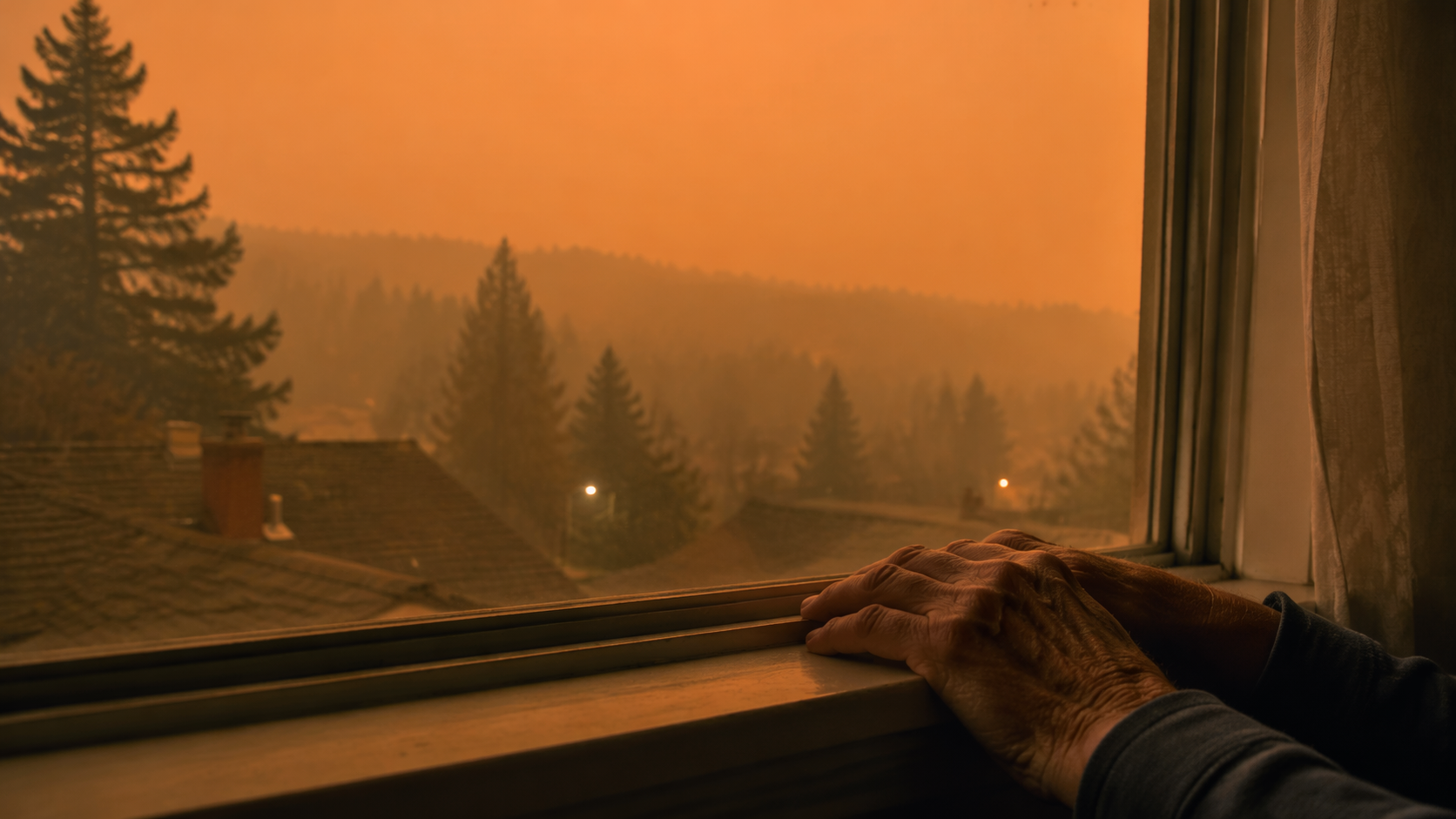
That distinction is the part many generic smoke advisories miss. A healthy adult may feel throat irritation, a headache, or a cough and recover quickly once the air clears. An older adult may start the same way, then develop a bad night of breathing, rising rescue inhaler use, chest tightness, dizziness, weakness, or confusion. In a senior who already walks carefully, that weakness or lightheadedness can also raise fall risk. Smoke exposure does not need to cause a dramatic collapse to change the week; it can cancel walking, reduce appetite, disturb sleep, and make a stable condition suddenly unstable.
The risk shows up quickly in hospitals
The clearest evidence is not abstract. It shows up in emergency departments, hospital admissions, and mortality studies. During intense smoke days in the Western United States, respiratory hospital admissions among Medicare enrollees increased by 7.2%.[3] A meta-analysis found wildfire smoke PM2.5 exposure was associated with a relative risk of 1.07 for asthma emergency department visits and 1.06 for asthma hospital admissions.[2] A national analysis cited by AARP found emergency room visits averaged 17% higher than normal on days when the AQI exceeded 101 because of wildfire smoke, and asthma-associated emergency department visits in New York increased 81.9% statewide on the worst AQI day in June 2023.[4]
Those numbers do not mean every older adult will end up in the hospital. They do mean smoke days are capable of moving a large number of vulnerable people from “managing at home” to “needs urgent care.” That is the practical threshold caregivers care about: not whether smoke is generally unhealthy, but whether it can trigger the next exacerbation.
The longer-term evidence is also concerning, though it should be read carefully. After smoke from a Montana wildfire, impaired lung function was observed in 33.9% of study participants at two years post-exposure.[3] Long-term exposure within 50 km of wildfires over 10 years was associated with a 4.9% higher hazard of developing lung cancer.[2] These findings do not prove that every smoky season creates permanent damage in every senior, and many studies include older adults as a subgroup rather than studying only people 65 and older. But they make it hard to treat repeated smoke exposure as a short inconvenience that ends when the sky clears.
Staying indoors only works if the indoor air is actually protected
“Stay inside” is a starting point, not a plan. Many older adults live in buildings that leak outdoor air around windows, doors, vents, hallways, wall units, bathroom fans, elevator shafts, and common areas. A senior apartment can look sealed and still smell like smoke by dinner. A nursing home can have staff and medical routines in place and still lack meaningful indoor particle monitoring.
The senior living evidence is blunt. In a study of four Idaho nursing homes, indoor particulate matter reached levels up to 17 times the healthy threshold during wildfire events, and one facility let in 100% of outdoor smoke. KFF Health News also reported that there are no federal regulatory standards for indoor air quality in nursing homes, and facilities are not required to monitor or report indoor PM2.5 levels. In the Mountain West, about 25% to 30% of skilled nursing facilities are more than 30 miles from a regulatory-grade outdoor air quality monitor.[5]
For caregivers, that means the building’s brochure is not enough. Ask specific questions before and during smoke season: Does the facility monitor indoor PM2.5? What filter rating does the HVAC system use? Are portable HEPA units available for resident rooms or common areas? Who decides when outdoor activities are canceled? Are windows kept closed during smoke events? What happens if a resident’s oxygen saturation drops, inhaler use rises, or shortness of breath worsens?
Build one cleaner room before trying to fix the whole home
The most useful caregiver move is to create at least one cleaner room where the older adult spends the most time during smoke events. In many homes, that is the bedroom or living room. The goal is not laboratory-perfect air. The goal is to lower particle exposure for enough hours of the day that the lungs and heart get a break.
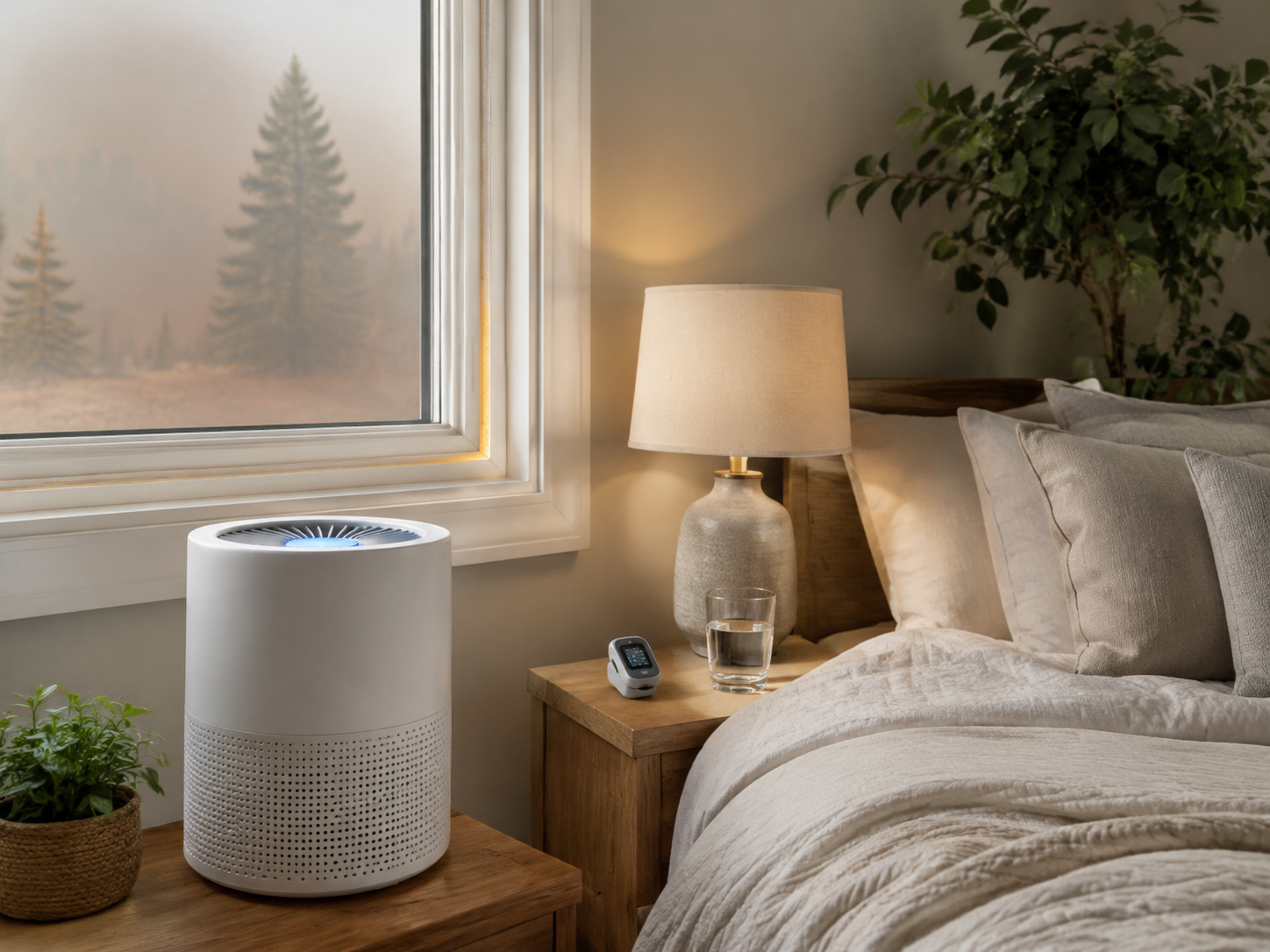
A portable HEPA air cleaner is usually the simplest tool. Oregon State University Extension reports that portable HEPA air cleaners can reduce indoor particle concentrations by up to 45% during wildfire smoke events.[6] Placement matters. Put the unit in the room where the person sleeps or rests, keep doors and windows closed as much as possible, and run it continuously during smoke periods. If the unit has an “auto” setting that quiets down when particles fall, consider using a steady fan speed during active smoke so it keeps filtering even when sensors underread the room.
Match the purifier to the room size, not the whole home. A small unit in a large open-plan living space may not exchange enough air to matter. A correctly sized unit in a closed bedroom can be much more useful, especially overnight. Avoid ionizers, ozone generators, and “fresh air” modes that intentionally bring outdoor air inside during smoke episodes unless a qualified HVAC professional has verified the system is filtering that air appropriately.
| Action | Why it matters during wildfire smoke |
|---|---|
| Run a portable HEPA cleaner in the main resting room | Reduces fine particle concentration where the senior spends the most time |
| Close windows, doors, fireplace dampers, and obvious leakage points | Limits the amount of outdoor smoke entering the cleaner room |
| Use HVAC filtration if the system can handle an upgraded filter | MERV 13 or higher filters can capture fine PM2.5 particles, while many standard home filters do not |
| Cut indoor particle sources | Prevents cooking, candles, vacuuming, and smoke-like indoor activities from adding to the burden |
| Track symptoms and oxygen readings when appropriate | Helps catch a chronic condition shifting into an acute problem |
Do not let the HVAC filter become a false reassurance
Central HVAC can help, but only if the system is using a filter that captures fine particles and can operate safely with that filter. MERV 13 or higher filters can capture fine PM2.5 particles, while standard home HVAC filters in the MERV 1 to 4 range generally do not.[6] The catch is airflow. Some older systems cannot handle a high-efficiency filter without strain, so caregivers should check the system manual, ask building maintenance, or speak with an HVAC professional before forcing an upgrade.
If the parent lives in senior housing, ask maintenance for the actual filter rating and replacement schedule. “We change the filters” is not the same as “we use a filter that captures fine smoke particles.” Also ask whether the system recirculates indoor air during smoke events or brings in outdoor air. Fresh air is normally valuable; during heavy smoke, unfiltered outdoor air can make the indoor problem worse.
Indoor habits can undo good filtration
During smoke days, the home needs to stop making its own particle pollution. Vacuuming, frying or broiling food, burning candles or incense, and using gas stoves without venting can significantly worsen indoor particle levels.[6] This is especially frustrating because these are ordinary household routines, not obvious hazards. But when outdoor smoke is already pushing particles inside, adding indoor particles can erase part of the benefit of filtration.
- Use a microwave, slow cooker, or simple no-fry meals during heavy smoke instead of frying or broiling.
- Skip candles, incense, wood-burning fireplaces, and any indoor smoking.
- Delay vacuuming unless the vacuum has a good HEPA filter and cleaning is truly necessary.
- Run kitchen and bathroom exhaust only when needed, since exhaust can pull replacement air through leaks.
- Keep medications, water, phone chargers, and mobility aids in the cleaner room so the senior does not need to keep moving through smokier areas.
Masks help only when the fit and the person’s health allow it
Once the indoor plan is in place, the next question is how to reduce exposure when the older adult must leave the cleaner room or go outside. A well-fitting respirator can reduce inhaled particles, but this is not as simple as handing an N95 to someone with heart failure, COPD, dementia, claustrophobia, or limited hand strength.
Fit matters more than good intentions. A respirator that gaps at the cheeks or nose does not provide the same protection. Surgical masks and cloth masks may block some larger droplets or ash, but they are not reliable protection against fine wildfire PM2.5. If a senior can tolerate an N95 or similar respirator, practice before a crisis day: put it on, check the seal, walk across the room, and see whether breathing feels manageable.
For some older adults, especially those with significant cardiopulmonary disease, a respirator may feel too restrictive. That does not mean there is no protection plan. It means the priority shifts even more strongly toward avoiding outdoor trips, using delivery or family pickup, moving appointments when medically safe, and keeping the indoor cleaner room functioning.
Watch the body, not just the AQI number
AQI is useful for deciding when to start precautions, but an older adult’s symptoms deserve equal attention. A parent can worsen before the public dashboard looks terrifying, especially if the apartment is leaky, the bedroom purifier is undersized, or a chronic condition is already flaring.
Caregivers should know the person’s baseline before smoke season if possible: usual breathing, usual walking distance, usual rescue inhaler use, usual oxygen saturation if they already monitor it, usual appetite, and usual alertness. The useful question during smoke is not “Are you fine?” It is “What changed today?”
- Call the clinician promptly if rescue inhaler use increases, coughing or wheezing worsens, oxygen readings fall below the person’s usual range, or shortness of breath appears with ordinary tasks.
- Treat chest pain, severe trouble breathing, blue lips, fainting, sudden confusion, or one-sided weakness as urgent or emergency symptoms.
- Take dizziness and new weakness seriously, especially in someone who already uses a cane, walker, oxygen tubing, or nighttime bathroom trips.
- Ask the clinician in advance whether any medication plan should change during smoke events, particularly for asthma, COPD, heart disease, or oxygen use.
This kind of monitoring is not about hovering. It is about catching the turn early. In older adults, the warning sign may be less dramatic than expected: sleeping in a chair because lying flat feels harder, skipping meals because breathing takes effort, moving less because walking to the bathroom is exhausting, or seeming “off” after a poor night of air.
A realistic smoke plan for an older adult
The plan should be simple enough to use on a bad air day, when everyone is tired and the hallway smells like smoke. Start with the room, then the building, then the body.
- Choose the cleaner room: usually the bedroom or living room, with a door that closes and the fewest obvious leaks.
- Put a correctly sized HEPA purifier there and run it continuously during smoke events.
- Close windows and doors, reduce drafts, and avoid activities that create indoor particles.
- Check HVAC filter ratings or ask senior housing maintenance for the actual filtration plan.
- Limit outdoor trips; use a well-fitting respirator only if the senior can tolerate it safely.
- Track symptoms against the person’s normal baseline and escalate care when breathing, alertness, oxygen readings, or strength change.
For seniors, wildfire smoke risk is real, immediate, and different from the risk faced by a younger healthy adult. The answer is not panic, and it is not blind trust that four walls are doing the job. The safer approach is layered: lower indoor particles, reduce unavoidable exposure, and watch closely for the point where a chronic condition starts behaving like an acute one.
References
- Who Is at Increased Risk of Health Effects from Wildfire Smoke Exposure? EPA.
- Comprehensive review of wildfire smoke health effects PubMed Central.
- Wildfire smoke exposure and human health: Significant gaps in research for a growing public health issue PubMed Central, 2023.
- How to Protect Yourself From Wildfire Smoke AARP.
- Indoor air quality in nursing homes and long-term care risks KFF Health News.
- Protecting Indoor Air from Wildfire Smoke Oregon State University Extension.
Related reading
Noticed something outdated or inaccurate on this page? Flag a correction. We review every report against CDC, NIA, and AARP HomeFit guidance before updating a page.
Part of the Fall Prevention section.