
Why Storms Create a Dangerous Fall Risk for Seniors — and How to Prepare
Storms and power outages create a cascade of fall risks for older adults — darkness, cold-induced stiffness, disrupted medication routines. This article explains why these hazards multiply fall risk and what specific preparations can prevent a fall when the lights go out.
The dangerous part of a storm for an unsteady older adult is often not the thunder. It is the first ordinary task after the lights go out. Someone stands up from bed at 2 a.m., reaches for the walker that was moved earlier to clear space, tries to remember where the flashlight is, and starts toward the bathroom through a hallway that suddenly has no visual edges.
That is the real problem with storm preparedness for older adults: the home changes faster than the older adult's body can adapt. The floor plan is familiar in daylight. In a blackout, the same route can become a set of guesses - where the rug begins, where the doorframe is, whether the cane is beside the bed or still by the recliner.
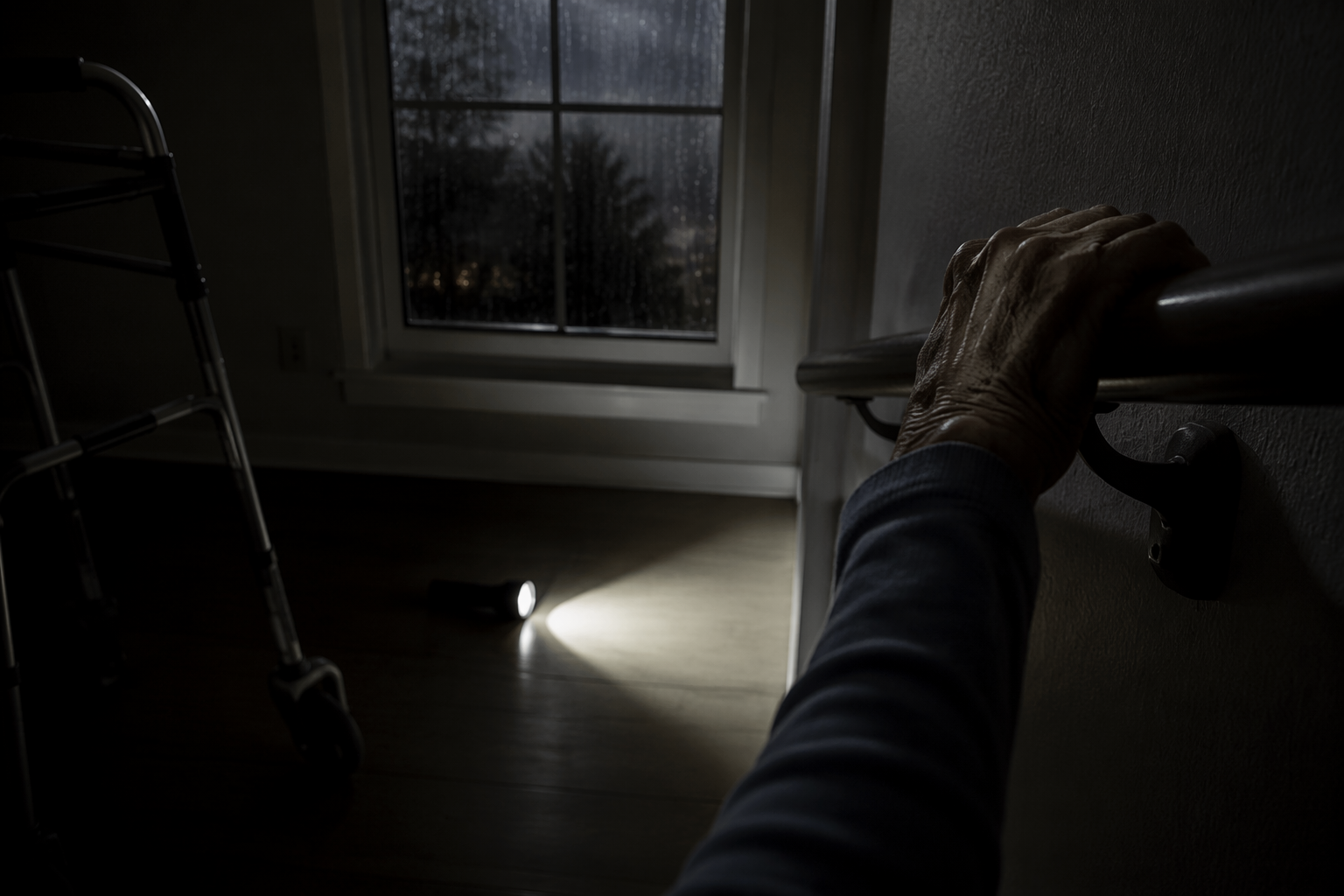
Storms Turn Familiar Rooms Into Fall Hazards
A fall during a storm usually has a chain behind it. Darkness removes visual cues. Storm noise makes it harder to hear a caregiver, phone alert, sump pump alarm, or a spoken warning. Cold rooms can make stiff joints slower to respond. Medication and hydration routines slip when meals, sleep, and bathroom timing are disrupted. The mobility aid that works well in a normal routine may be in the wrong room when the outage starts.
That chain matters because older adults are already starting from a high baseline of fall risk. The CDC reports that one in four older adults falls each year, and 37% of falls result in an injury that requires medical treatment or restricts activity for at least one day.[1] A storm does not have to create a new weakness. It only has to remove the supports that were quietly compensating for one.
Power outages are also medically serious beyond the immediate trip hazard. A 2026 PLOS Medicine study linked power outages lasting more than 8 hours with increased emergency hospitalizations for cardiovascular and respiratory conditions among adults over 65, estimating 4,246 excess hospitalizations in 2018 alone.[2] Because that figure is based on 2018 data, it is best read as a conservative signal rather than a complete measure of today's risk.
Sensory changes make the blackout problem sharper. The National Council on Aging reports that older adults with hearing loss are nearly three times as likely to fall, and those with vision impairment have almost twice the fall risk.[3] Emergency-preparedness guidance for older adults also notes that hearing loss affects about 25% of people 65 and older, while vision impairment affects 28% of people 71 and older.[4] During a storm, those are not abstract health facts. They affect whether someone hears an alert, sees a threshold, finds the flashlight, or notices water on the floor.
Start With the Basic Storm Plan, Then Add the Fall Plan
The basic emergency kit still matters. Water, shelf-stable food, medications, batteries, a radio, phone charging, documents, and emergency contacts are the floor, not the whole structure. The Red Cross recommends that older adults prepare to stay home for at least two weeks after an emergency.[5] If a parent may be at home that long, the question is not only whether supplies exist. It is whether the home can be moved through safely while those supplies are being used.
| Storm preparation item | Fall-prevention question to add |
|---|---|
| Flashlights and batteries | Can they be reached from bed, chair, bathroom, and medication area without walking in the dark? |
| Food and water | Are they stored between waist and shoulder height, not in a basement, garage, or high cabinet? |
| Medications | Is the schedule written down in large print in case the usual routine is disrupted? |
| Phone and backup power | Is the charging station outside the walking path, with cords taped down or routed behind furniture? |
| Mobility aids | Is the walker, cane, or rollator parked where the person actually stands up during the night? |
| Warmth | Are blankets, layers, and safe heat options reachable without using a step stool or crossing clutter? |
This is where many emergency checklists stop too early. A flashlight in a drawer is not the same as light where a hand naturally reaches. A case of water in the garage is not useful if the safest walker path is from the bedroom to the kitchen. A charged phone across the room may as well be across the street if the person needs it after a fall.
Prepare the Night Route First
The bed-to-bathroom route deserves the first pass because it combines urgency, darkness, sleepiness, and often medication effects. Before a storm warning becomes an outage, walk the route exactly as it will be used: from the side of the bed where the person gets up, to the bathroom, to the sink, to the toilet, and back. Do it with the overhead lights off, using only the backup lighting you plan to leave in place.
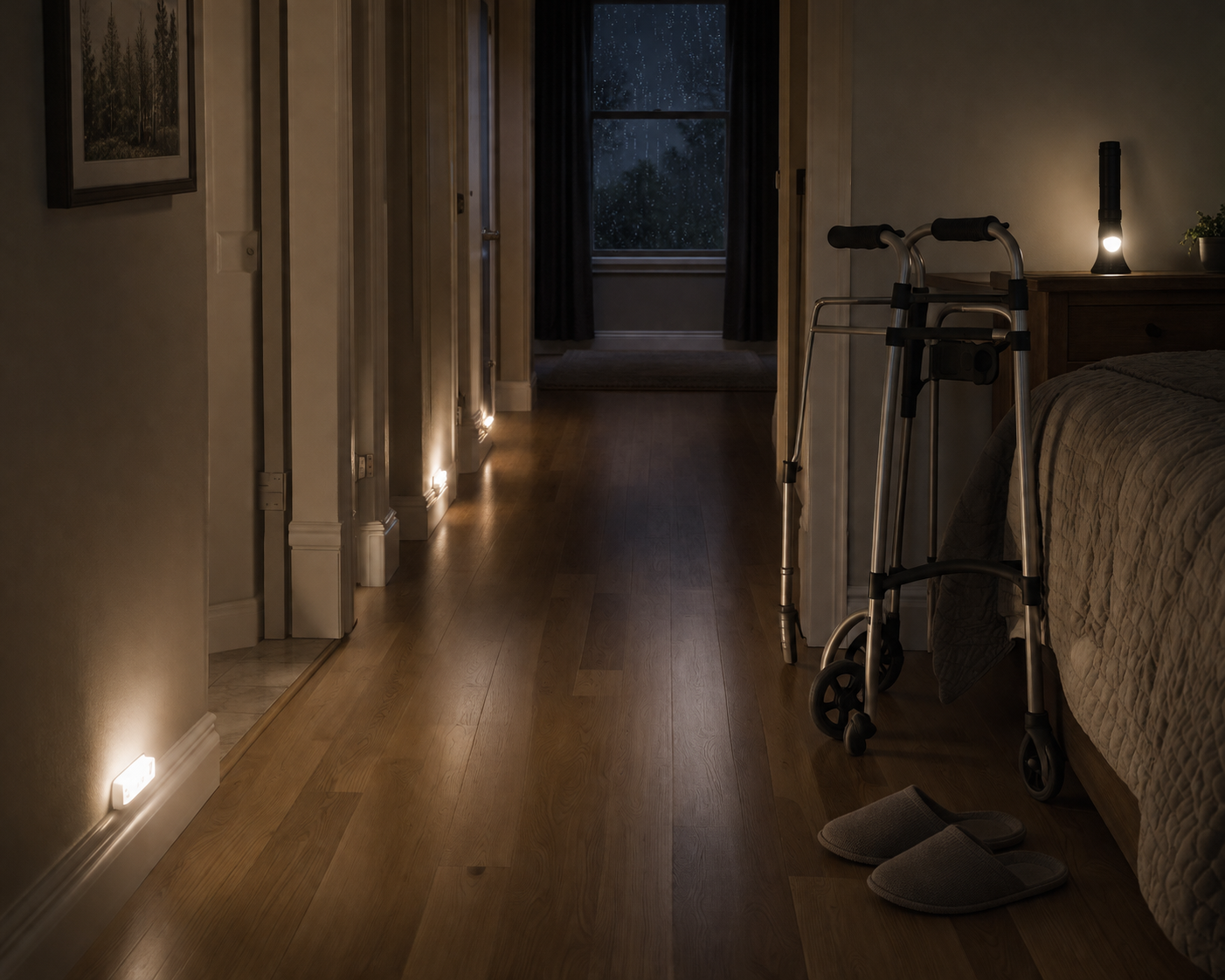
Put battery-operated lights where they reduce decisions: beside the bed, at the bathroom door, near the toilet, and along any turn in the hallway. If plug-in nightlights are part of the normal setup, assume they will fail during an outage unless they have battery backup. A headlamp can help some people, but it should not replace fixed lighting along the route; it requires the person to remember it, find it, and put it on correctly while already unsteady.
Park the mobility aid where the first hand reaches. If the walker usually lives by the recliner during the day, that does not solve the 2 a.m. bathroom problem. For a parent who uses both a cane and walker, decide which device is safest in darkness and make that the night device. If a second cane or walker is realistic, duplicate the aid rather than depending on someone to move it from room to room during a storm.
Footwear belongs in the same setup, not across the room. Non-slip slippers or shoes should be placed where feet land when getting out of bed. Socks without grip are a bad compromise on smooth floors, especially if the person is cold and moving stiffly. If the older adult resists shoes in the house, choose the least annoying safe option before the storm, not during the argument that happens after the power goes out.
Clear the Walkways You Will Actually Use
Storm preparation often creates its own fall hazards. Extension cords appear. Buckets come out. Flashlights, coolers, towels, bottled water, and pet supplies migrate into hallways. The house may be better stocked and less safe to walk through.
Clear only the routes that matter first: bed to bathroom, bed to phone, chair to bathroom, chair to kitchen, kitchen to medication area, and living area to exit. That is enough to make the work manageable after a long day. For a fuller everyday review, use a room-by-room fall checklist such as the site's CDC STEADI home fall-prevention checklist, then come back to the storm version and ask what changes when lighting, heat, hearing, and routines are disrupted.
- Move bottled water and shelf-stable food out of basements, garages, and high cabinets if the older adult will need to reach them.
- Route charging cords behind furniture or tape them down where they cannot cross a walker path.
- Remove throw rugs from emergency routes, even if they stay in place during normal weeks.
- Keep towels or absorbent mats ready near entry doors, but not loose in the middle of a path.
- Place trash bags, buckets, and storm supplies against walls, not at turns or doorway edges.
Make the Medication and Communication Station Boring
The medication area should be deliberately plain: the day's medication list, the pill organizer, water, glasses, hearing aids if used, a flashlight, a backup battery, and emergency contacts. Keep it on a stable surface that can be reached without bending low or walking around furniture. If refrigerated medication is involved, the plan needs to be discussed with a clinician or pharmacist before storm season, not improvised with a cooler after the outage begins.
Write down the routine in large print: medication name, dose, time, and what to do if a dose is missed or a meal is delayed. Include the pharmacy phone number, prescriber, emergency contact, and any device needs, such as oxygen, CPAP, hearing aids, or a powered recliner that the person depends on to stand. A storm breaks routines; a written routine gives the household something to return to.
The communication station needs the same discipline. Keep the phone, backup battery, charger, flashlight, and contact list in one place. Label the battery pack if several people in the house use similar devices. If the older adult has trouble with touchscreens, write the simplest possible call instructions on paper. In a blackout, the best device is the one the person can use while tired, anxious, and sitting down.
Cold, Heat, and Breathing Problems Can Change Mobility
Storms do not only remove light. They can remove heat, air-conditioning, elevators, refrigeration, powered medical equipment, and reliable transportation. The age pattern in major disasters is one reason older adults need plans that are more specific than a standard household checklist. Adults 75 and older made up 6% of New Orleans' population in 2005 but accounted for 50% of Hurricane Katrina deaths; during the 2021 Texas winter storm, people 60 and older accounted for 60% of the 246 deaths, mostly from hypothermia during prolonged power outages.[6]
Those figures should not be used to frighten a family into doing everything at once. They should sharpen the planning question: what condition would make this home unsafe for this person? For one parent, the answer may be no heat because stiffness and hypothermia risk rise quickly. For another, it may be no power for oxygen equipment, no safe way to climb stairs, or no way to keep medication at the required temperature.
Generator safety is a hard boundary. Improper generator use is associated with approximately 500 deaths and 15,000 emergency room visits annually, and older adults over 65 are especially vulnerable because pre-existing conditions can make carbon monoxide exposure more dangerous.[7] A generator must never be used indoors, in a garage, on a porch, or near windows. If safe generator setup is not already understood and possible, do not treat a generator as the backup plan.
Decide Beforehand When Home Is No Longer the Safer Place
Sheltering in place can be safer than a rushed, poorly supported move, especially for frail older adults. AARP's disaster-resilience materials cite a 2011 study finding higher death rates among nursing home residents evacuated during hurricanes than among residents who sheltered in place.[6] That evidence is useful, but it comes from facility settings. It does not mean every older adult at home should stay home through every storm.
The decision point should be written down in advance. Evacuation or emergency help is not a matter of preference if there is flood risk, structural damage, fire risk, unsafe indoor temperature, carbon monoxide danger, a medical device without backup power, unreachable medications, or no safe way to transfer, toilet, hydrate, or communicate. A fall-prevention plan is for a home that remains structurally and medically usable. It is not a substitute for evacuation orders or emergency services.
If the household is in a region with predictable hazards, use the more specific plan too. Tropical storms raise different problems than ice storms; earthquakes change exits and furniture risks; wildfire smoke can keep someone indoors while reducing stamina. The site's guides on fall prevention during a tropical storm, earthquake preparedness for seniors, room-by-room earthquake preparation, and wildfire smoke safety can sit beside the general storm plan rather than replace it.
A Short Pre-Storm Walkthrough That Actually Helps
When time is short, do the walkthrough in the order the older adult will live through the outage. Start where they sleep. Then move to toileting, medication, food and water, phone access, and exit. Do not start in the garage unless the garage is part of the safe walking route.
- Stand at the bed: place light, footwear, glasses, hearing aids, phone, and the safest mobility aid within easy reach.
- Walk to the bathroom: remove rugs and clutter, add battery lighting, and check that doorways are wide enough for the walker.
- Sit where the person usually sits: make sure the cane or walker is not stranded across the room.
- Go to the medication area: place the written schedule, water, flashlight, and contact list together.
- Check food and water: move essentials to reachable shelves and avoid storage locations that require stairs.
- Check cords and charging: keep backup power available without running cords across walking paths.
- Check the exit: clear the route and decide what conditions mean leaving or calling for help.
Product choices can stay simple: stable flashlights, battery nightlights, labeled backup chargers, non-slip footwear, reach-friendly storage, and mobility aids in the right places. If a family is considering new equipment, keep the question product-neutral: does it reduce a real task risk for this person, in this room, during an outage? The site's guide to evaluating home safety products for seniors is a better next step than buying a pile of gadgets after a warning alert.
Storms do not create random fall risk so much as expose weak points in the home routine. The safest preparation combines the ordinary emergency supply plan with a fall-prevention environment plan: light where hands reach, clear paths where feet travel, medication routines that survive disruption, communication that can be used while seated, and a written line for when staying home is no longer safe.
References
- Facts About Falls, Centers for Disease Control and Prevention, https://www.cdc.gov/falls/data-research/facts-stats/index.html
- Power outage hospitalization data, PLOS Medicine, 2026, https://doi.org/10.1371/journal.pmed.1004923
- Get the Facts on Falls Prevention, National Council on Aging, https://www.ncoa.org/article/get-the-facts-on-falls-prevention/
- Emergency Preparedness for the Elderly, Choose Energy, https://www.chooseenergy.com/blog/energy-tips/emergency-preparedness-elderly/
- Older Adults, American Red Cross, https://www.redcross.org/get-help/how-to-prepare-for-emergencies/older-adults.html
- Disaster Resilience Tool Kit, AARP, November 2022, https://www.aarp.org/livable-communities/tool-kits-resources/info-2022/disaster-risks-to-older-adults.html
- Older Adults and Disaster Preparedness and Response, American Association for Geriatric Psychiatry, https://aagponline.org/patient-article/older-adults-and-disaster-preparedness-and-response/
Related reading
Noticed something outdated or inaccurate on this page? Flag a correction. We review every report against CDC, NIA, and AARP HomeFit guidance before updating a page.
Part of the Fall Prevention section.