
How long does wildfire smoke last for older adults?
Wildfire smoke affects older adults across three distinct timelines — outdoor air clears within days, indoor smoke VOCs can linger for weeks to months, and cardiorespiratory health risks can persist for up to three months. This article breaks down each duration and gives caregivers clear safety thresholds to protect their parent.
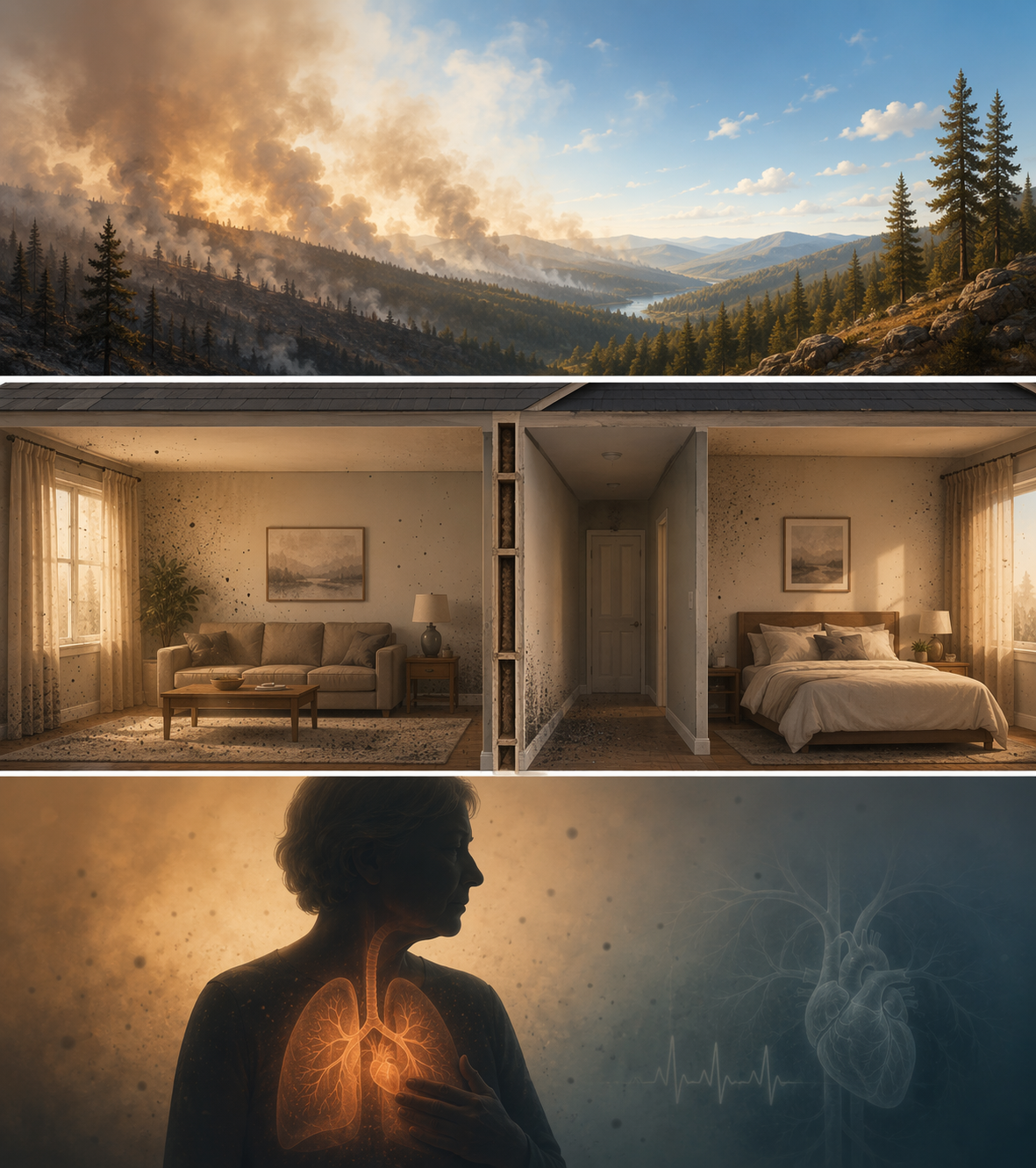
Wildfire smoke does not have one expiration date. For an older adult, the outdoor air may look better first, the house may keep releasing smoke-related chemicals after that, and the body may stay more vulnerable for weeks after the visible haze is gone. A safer answer to “how long does wildfire smoke last for older adults?” is: days to weeks outdoors, weeks to months indoors, and up to three months for some cardiorespiratory risks.
That distinction matters when you are deciding whether your parent can open windows, walk to the mailbox, turn off the purifier, or stop being watched so closely for breathing or heart symptoms. The mistake is using the first clock — the sky clearing — to make decisions that belong to the second or third clock.
The outdoor smoke clock usually moves first
Outside, wildfire smoke can remain in the air for days to weeks, depending on wind, weather, terrain, fire behavior, and how much smoke is still being produced. Fine particle pollution, especially PM2.5, can also travel hundreds of miles from the fire source, so a parent does not need to live near flames to breathe wildfire smoke. [1]
This is the part people tend to watch most closely because it is visible. The smell weakens. The horizon returns. Local alerts improve. Those are useful signs, but they are not enough by themselves for an older adult, especially one with asthma, COPD, heart disease, diabetes, a prior stroke, or reduced mobility. EPA identifies adults 65 and older as a higher-risk group partly because they are more likely to have chronic heart or lung disease. [2]
For outdoor decisions, the better tool is still the air quality reading, not the view from the porch. If the Air Quality Index is still elevated, a clear-looking sky can give false confidence. If the AQI has stayed below 100 for at least 48 hours, that is a more reasonable point to consider short, low-exertion outdoor trips for many older adults, while still adjusting for the person in front of you. A parent who becomes short of breath walking across the room does not need the same plan as a parent who usually walks a mile comfortably.
The first outdoor trips should be boring on purpose: a brief walk to the car, a medical appointment, a few minutes outside when the AQI is favorable. Heavy yard cleanup, long walks, and errands that require waiting outdoors should come later. Smoke exposure is not just a yes-or-no condition; dose matters, and older adults often have less reserve when the air is still recovering.
The indoor smoke clock can keep running after the sky clears
The more useful, and less obvious, timeline is inside the home. Colorado State University and NIST researchers found that volatile organic compounds from wildfire smoke can attach to indoor materials such as carpets, drapes, drywall, and other household surfaces, then slowly release back into indoor air for weeks to months after the initial smoke event. [3]
That finding changes the household decision. Once outdoor air improves, the question is no longer only “Can we open the window?” It becomes “What did the smoke touch while the house was exposed, and what is still releasing from those materials?” A home can feel normal and still have smoke-related compounds moving out of soft surfaces.

This is where caregiving gets practical quickly. If a parent kept windows open during smoke, if the HVAC system pulled in outside air, if the house smelled smoky for days, or if ash entered the home, indoor recovery may take longer than the neighborhood forecast suggests. Carpets, upholstered chairs, curtains, bedding, closets, and painted walls deserve more suspicion than hard, wipeable surfaces.
The response is not to panic-clean the whole house in one exhausting weekend. It is to keep the cleaner-air routine going after the outdoor emergency has eased. Run a properly sized HEPA air purifier in the rooms where your parent sleeps and spends the most time. Replace or check HVAC filters according to the system and filter rating. Damp-wipe hard surfaces instead of dry-dusting ash back into the air. Wash exposed bedding, throws, and washable curtains. Vacuum with a HEPA-equipped vacuum if available; if not, be careful about stirring settled particles.
The harder call is when to stop running filtration around the clock. There is no universal date that fits every home. A lightly exposed apartment with sealed windows is different from a smoke-filled house with old carpets and heavy drapes. For an older adult, a cautious approach is to keep bedroom and main-room filtration running continuously for at least the first several weeks after a significant smoke event, then taper only if outdoor AQI remains good, indoor smoke odor is gone, cleaning is complete, and symptoms are not returning when the purifier is off.
The Marshall Fire experience is a useful warning, though it should not be treated as a universal prediction. In a survey of survivors after the 2021 Boulder County fire, 55% reported at least one symptom six months after the fire, and 33% still reported symptoms at one and two years. [4] That was one community and one fire, so it does not prove every household will have lingering symptoms for that long. It does show why “the fire ended” and “the indoor environment has fully recovered” are not the same statement.
The body’s smoke clock may be the longest one
For older adults, the most important lingering risk may not be what is still in the air today, but what the recent exposure already set in motion. A Harvard Chan School and Mount Sinai study published in May 2025 found that medium-term exposure to wildfire smoke PM2.5 was associated with increased cardiorespiratory hospitalization risks for up to three months after a fire ended. [5]
That three-month window is the best current evidence for delayed cardiorespiratory risk, but it should be read carefully. The study is recent, and this kind of medium-term wildfire-smoke research is still emerging. It does not mean every older adult remains in danger for exactly 90 days, and it does not mean smoke exposure is the cause of every later symptom. It does mean caregivers should not drop their guard the first week the AQI improves.
The symptoms worth watching are not exotic. New or worsening shortness of breath, wheezing, chest tightness, unusual fatigue, dizziness, palpitations, swelling, confusion, or a noticeable decline in walking tolerance should be taken seriously. A parent who says “I’m just tired” after smoke exposure may be right, but that does not make the change meaningless. In older adults, vague symptoms can be the first sign that the lungs, heart, or oxygen levels are under strain.
This is also where fall risk enters the picture. The evidence in this article does not prove a direct wildfire-smoke-to-falls rate. The practical chain is simpler: smoke can contribute to breathing strain, dizziness, fatigue, and confusion; those problems can make an older adult less steady; a less steady person is more likely to stumble, misjudge a step, or rush to sit down. During and after a smoke event, it is reasonable to treat new unsteadiness as part of the safety picture, not as a separate unrelated issue.
Some supporting evidence is sobering, but it should stay in its lane. In a 2020 Stanford Woods Institute expert panel, Dr. Kari Nadeau estimated that adults 65 and older may face up to a 40% increase in stroke rate during wildfire smoke events; that figure is an expert estimate from the panel, not a peer-reviewed published result. [6] Stanford researchers have also reported that wildfire smoke PM2.5 can be about 10 times more toxic than PM2.5 from fossil fuel sources. [6]
At the population level, Yale School of Public Health researchers estimated that approximately 11,415 non-accidental deaths per year in the contiguous United States are attributable to wildfire smoke PM2.5, with greater impacts on older adults. [7] That number does not tell you what will happen to one parent after one fire. It does explain why the cautious household decisions — filtration, fewer outings, symptom monitoring, and medical follow-up — are not overreactions.
A caregiver timeline for safer decisions
The useful question is not “When is wildfire smoke over?” It is “Which part of the risk am I making a decision about?” Outdoor movement, indoor cleanup, and health monitoring each need a different clock.
| Timeline | What may still be happening | Caregiver decision |
|---|---|---|
| Days to weeks outdoors | Smoke and PM2.5 may remain in the air or travel from distant fires, depending on wind and weather. | Use AQI, not sky color. Consider short outdoor trips after AQI stays below 100 for at least 48 hours, and keep exertion low at first. |
| Weeks to months indoors | Smoke-related VOCs may slowly release from carpets, drapes, drywall, upholstery, and other indoor materials. | Keep HEPA filtration running in sleeping and main living areas, clean exposed surfaces and fabrics, and taper purifier use only when odor, AQI, and symptoms all support it. |
| Up to three months for health effects | Cardiorespiratory risks may remain elevated after the fire ends, based on emerging medium-term evidence. | Watch for breathing, heart, fatigue, dizziness, confusion, or walking-tolerance changes, and contact the doctor promptly if symptoms appear or worsen. |
For a relatively healthy older adult, an AQI below 100 for two stable days may be enough to restart brief necessary trips outside. For someone with COPD, heart failure, recent pneumonia, unstable angina, a prior stroke, or a history of severe smoke sensitivity, the safer threshold may need to be stricter and set with a clinician. The same AQI number does not carry the same risk for every body.
Inside the home, the decision should be slower. If the house smelled smoky, do not turn off filtration just because the county alert expired. Let the cleaner run where it matters most: bedroom first, then the chair or room where your parent spends the day. If there is only one purifier, move it less often and prioritize sleep; overnight breathing matters, and older adults may not notice symptoms while they are resting.
For the health timeline, put a reminder on the calendar rather than relying on memory. A check-in at one week, one month, and three months after a significant smoke event is reasonable. The check-in does not need to be formal every time. Ask whether walking feels harder, whether rescue inhaler use changed, whether sleep is worse, whether there has been chest discomfort, dizziness, new confusion, or a fall or near-fall. If the answer changes, the doctor should know the timing of the smoke exposure, not just the symptom.
The cleanest way to think about it is this: outside usually clears first, the house may lag behind, and an older body may lag behind both. You do not need one reassuring number. You need the right clock for the decision you are making.
References
- AirNow.gov, AirNow.gov.
- Who is at Increased Risk of Health Effects from Wildfire Smoke Exposure?, U.S. Environmental Protection Agency.
- Wildfire smoke may linger in homes long after initial blaze, Colorado State University.
- Wildfire smoke inside homes can create health risks that linger for months, The Conversation, 2025.
- Cardiorespiratory effects of wildfire smoke particles can persist for months, Harvard T.H. Chan School of Public Health, May 2025.
- Health Impacts of Wildfire Smoke, Stanford Woods Institute for the Environment, 2020.
- Long-term exposure to wildfire smoke associated with higher risk of death, Yale School of Public Health, 2024.
Related reading
Noticed something outdated or inaccurate on this page? Flag a correction. We review every report against CDC, NIA, and AARP HomeFit guidance before updating a page.
Part of the Fall Prevention section.