
Wildfire Smoke Safety Checklist for Older Adults
This phased checklist helps family caregivers protect older adults before, during, and after wildfire smoke events by addressing respiratory risks and the increased fall risk from smoke-related symptoms like dizziness and fatigue.
If wildfire smoke is in the forecast, the job is not to make the whole house perfect. The job is to keep one older adult breathing, hydrated, medicated, oriented, powered, and steady on their feet until the air improves or the home stops being workable.
Use this as a phased caregiver checklist. Some items are best done before fire season, but if smoke is already nearby, start with the clean room, medications, indoor-air controls, and symptoms.
| Phase | Caregiver actions |
|---|---|
| Before fire season | Choose a clean room; buy the right HVAC filter if the system can handle it; get a HEPA purifier sized for that room; stock N95 or P100 respirators; ask about emergency medication refills; plan backup power for CPAP, oxygen, hearing aids, and phones. |
| When smoke arrives | Check AirNow.gov; close windows and doors; move the older adult into the clean room; run the purifier; set HVAC to recirculate if appropriate; avoid frying, vacuuming, candles, fireplaces, and other indoor particle sources. |
| During a prolonged smoke event | Keep meals simple, hydration visible, medications on schedule, and walking paths clear; watch for dizziness, tiredness, chest pain, shortness of breath, confusion, new weakness, or unsteady walking. |
| If evacuation becomes possible | Pack medications, documents, masks, chargers, hearing-aid batteries, mobility aids, medical-device supplies, and a written care list; confirm transportation before the older adult is already exhausted or symptomatic. |
| After the smoke clears | Check filters, ash, and indoor dust before normal routines resume; reenter slowly, restore lighting, remove trip hazards, and treat cleanup as a fall-risk task, not just a housekeeping task. |
Why older adults need a different smoke checklist
Wildfire smoke safety for older adults cannot stop at “stay indoors.” Adults 65 and older are among the groups the CDC identifies as more likely to be affected by wildfire smoke, and the symptoms the CDC lists include coughing, trouble breathing, wheezing, chest pain, dizziness, and tiredness.[1]
Those last two symptoms matter in a very practical way. Dizziness and tiredness can turn a nighttime bathroom trip, a step around an oxygen tube, or a walk from bedroom to kitchen into a fall risk. Smoke can also disrupt the routines that usually keep an older person stable: inhalers get used more often, meals get skipped because cooking feels inconvenient, the house gets hot because windows stay shut, and everyone sleeps badly.
The best plan therefore protects more than lungs. It protects medication access, device power, hydration, communication, mobility, and the caregiver’s ability to make decisions while tired. A 2023 scoping review of wildfire research and older adults found that difficulty maintaining care, accessing medications, and staying connected were important barriers; it also found that 69.3% of the 75 peer-reviewed articles collected data about older adults rather than from them.[2]
That gap shows up in real homes. An older adult may understand the alert and still refuse a mask, forget not to open the window, become anxious when moved from a favorite chair, or need help getting to a cooler place. The checklist has to fit the person, not just the pollutant.
Before smoke arrives: build the clean-room plan
The clean room is the center of the plan. It should be the room where the older adult can spend many hours with the least strain: usually a bedroom or living room with a door, few leaky windows, enough outlets, space for a chair or bed, and a clear path to the bathroom.
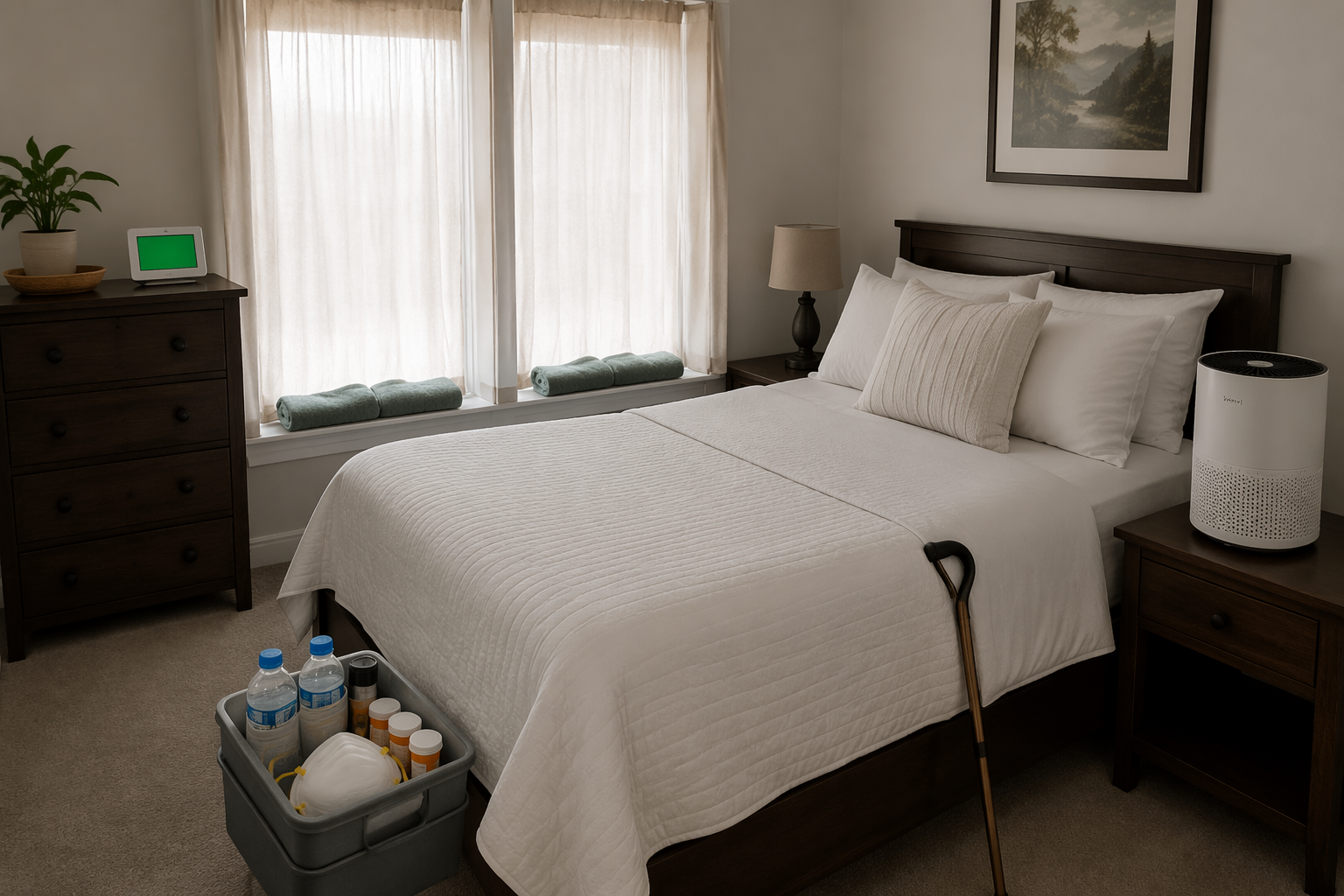
AirNow recommends choosing one room in the home to keep as clean as possible during a smoke event, ideally with a portable air cleaner and with doors and windows kept closed.[3] The American Lung Association gives the same basic sequence: select a room, close it off from smoky air, run a properly sized air cleaner, and avoid activities that add particles indoors.[4]
Do not wait until the sky is orange to figure out whether the purifier cord reaches the outlet or whether the bedroom door can close around an oxygen tube. Set up the room once in normal weather, then leave the supplies together.
- Put the HEPA purifier where air can move around it, not jammed behind a chair or curtain.
- Keep water, medications, phone charger, flashlight, spare glasses, hearing-aid batteries, tissues, and a written medication list in the room.
- Move throw rugs, low baskets, footstools, and loose cords out of the walking path.
- Add a night-light or battery lantern before the power flickers, not after.
- Make sure the chair height works for the older adult; a soft low chair can become a transfer problem after several hours of fatigue.
A commercial HEPA air cleaner in a sealed room can reduce indoor particle concentrations by up to 45%, according to Oregon State University Extension guidance.[5] That number is useful because it connects a product to a setup: the room has to be closed off, the cleaner has to be running, and the room has to stay as free as possible from new indoor particles.
If the home has central HVAC, check the current filter before the season starts. EPA guidance says people can consider upgrading to a filter rated MERV 13 or higher if the system can accommodate it, and the system fan may be used to recirculate and filter indoor air.[6] The important phrase is “if the system can accommodate it.” A filter that strains the equipment or gets ignored because nobody knows where it goes is not a plan.
Write the filter size on a note inside the utility closet or in the caregiver’s phone. If the older adult changes filters independently, make the replacement visible and easy to reach; if they should not climb or bend to reach the return vent, assign that job now.
Stock only what the plan can actually use
A good smoke kit is not a pile of products. It is the set of things that keep the clean room running and the older adult’s care routine intact.
| Supply | Why it matters for an older adult |
|---|---|
| Portable HEPA purifier | Creates a cleaner-air zone when the room is closed and indoor particle sources are controlled. |
| Correct HVAC filters | Supports whole-home filtration if the HVAC system can handle the filter rating. |
| N95 or P100 respirators | Useful if the older adult must briefly go outdoors, but only if the mask fits and the person can tolerate it. |
| Medication list and refill plan | Prevents a smoke event from becoming a missed-inhaler, missed-heart-medication, or missed-insulin problem. |
| Water and easy meals | Reduces dehydration and avoids cooking methods that worsen indoor air. |
| Chargers, batteries, and backup power plan | Keeps phones, hearing aids, CPAP, oxygen equipment, and mobility-related devices usable. |
| Lighting and fall-prevention items | Keeps the clean room safe when fatigue, dizziness, or power interruptions make movement riskier. |
Ask the doctor, pharmacist, or insurer about emergency refill options before the first smoke alert. Some guidance recommends keeping extra medication on hand for emergencies, but insurance refill limits can make that harder than it sounds. If the older adult uses oxygen, nebulized medications, insulin, anticoagulants, heart medications, or rescue inhalers, this conversation is not optional.
Respirators deserve a realistic note. N95 and P100 masks can help reduce inhaled particles when someone must be outside, but many older adults cannot get a good seal, tolerate the breathing resistance, remember proper use, or safely walk while masked. For a person with COPD, heart disease, dementia, panic, or balance problems, the safer first move is usually to avoid outdoor exposure when possible and keep the indoor plan strong. CDC wildfire safety guidance tells people with heart or lung disease, older adults, children, and pregnant people to take special care to avoid breathing smoke.[7]
When smoke arrives: shrink the house to the safest zone
When the forecast or AirNow map shows smoke affecting the area, stop treating the whole house as equally usable. Move the older adult’s day into the clean room early, while everyone is still calm and the person is not yet short of breath or dizzy. AirNow directs people to use AirNow.gov for current air quality and smoke information.[3]
- Close windows and exterior doors.
- Close the clean-room door and run the HEPA purifier continuously.
- Set the HVAC to recirculate if the system has that option and it is safe for the equipment.
- Avoid frying, broiling, burning candles, using fireplaces, smoking, and vacuuming unless the vacuum has high-efficiency filtration.
- Keep bathroom trips, meals, medication times, and device charging predictable.
EPA notes that staying indoors with windows and doors closed can reduce exposure to outdoor air pollution, and the agency states that staying inside with windows closed typically reduces exposure by at least one-third.[6] That is helpful, but it is not magic. Smoke can still enter through leaks, open doors, ventilation settings, and daily habits. Indoor choices matter more as the event lasts longer.
The hardest household rule is often the simplest: do not add pollution indoors. A caregiver may be tempted to cook comfort food, vacuum ash tracked in by shoes, or light a candle because the house smells smoky. During a smoke event, those are not neutral choices. Use microwaved, cold, or quickly assembled meals when possible, and save heavier cleaning for later.
If the older adult must go outside for a medical appointment, evacuation step, or unavoidable errand, keep the trip short, use the best-fitting respirator they can safely tolerate, and build in seated rest. A mask that increases panic or makes walking unstable can create a different emergency.
During prolonged smoke: manage the person, not just the air
The second or third smoky day is when plans usually fray. The clean room gets cluttered. Water bottles sit unopened. The older adult is tired of being confined. The caregiver starts stretching medication times around phone calls, work, pets, and alerts. This is where wildfire smoke safety becomes ordinary caregiving under pressure.
Hydration and food
Put fluids where the older adult can see and reach them. Do not rely on thirst, especially if the person has memory changes, takes diuretics, limits fluids for a medical reason, or avoids drinking because bathroom trips are tiring. If a clinician has given fluid restrictions, follow those and ask what to do during heat or smoke.
Use meals that do not worsen indoor air: sandwiches, yogurt, fruit, prepared salads, microwaved foods, or meals cooked before the smoke arrives. If the older adult has diabetes, heart failure, kidney disease, swallowing problems, or low appetite, the goal is not a perfect emergency menu. The goal is to prevent skipped meals and medication problems.
Medication and symptom checks
Keep the normal medication schedule visible. Smoke days are not the time to discover that the rescue inhaler is empty, the pill organizer was filled incorrectly, or the oxygen supplier’s number is buried in an email account only one person can access.
- Check breathing: new wheezing, unusual shortness of breath, persistent coughing, or needing rescue medicine more often than the care plan allows.
- Check heart symptoms: chest pain, pressure, palpitations, faintness, or unusual swelling if heart disease is already part of the picture.
- Check thinking: new confusion, agitation, sleepiness, trouble following familiar steps, or repeated attempts to open windows or go outside.
- Check balance: dizziness on standing, slower walking, furniture-grabbing, new weakness, or near-falls.
- Check temperature comfort: a sealed room can get hot, especially if power is interrupted or air conditioning is limited.
A large Medicare analysis published in JAMA Network Open in 2025 studied 10.3 million beneficiaries and found significant increases in respiratory hospitalizations when wildfire-related PM2.5 exceeded 25 μg/m³; cardiovascular hospitalization increases were suggestive rather than as clear. The data only ran through 2016, so it did not capture the severe wildfire seasons that followed.[8]
That limitation should make a caregiver more cautious, not less. If an older adult with COPD, asthma, heart disease, or frailty is worsening during a smoke event, do not wait for a perfect threshold. Call the clinician, nurse line, oxygen supplier, or emergency services according to the person’s care plan and symptom severity.
Fall-proof the room people are actually using
A clean room can become a cluttered room fast. Supplies migrate to the floor, cords cross the walkway, and the older adult starts making repeated trips because everything they need is in a different corner. Fix that early.
- Tape or reroute purifier and charger cords away from walking paths.
- Keep the cane, walker, glasses, phone, and water on the side the older adult actually uses.
- Use a stable chair with arms if the person has trouble standing.
- Keep a clear route to the bathroom, with lights ready for nighttime trips.
- Do not stack emergency supplies where they block a walker, oxygen tubing, or doorway.
If the older adult is more confused than usual, treat wandering and window-opening as safety problems, not misbehavior. Give simple explanations, reduce room changes, keep familiar objects nearby, and assign one person to check in at predictable times. Independence still matters, but smoke conditions narrow the margin for error.
When staying home may stop working
Evacuation planning should not begin when the older adult is already breathless, the caregiver is out of gas, and the power is down. Even if evacuation never happens, the act of preparing exposes weak points in the care system.
Pack the go-bag around the older adult’s daily dependencies, not around a generic disaster list.
- Medications, inhalers, diabetes supplies, oxygen-related paperwork, and a current medication list.
- Copies or photos of insurance cards, ID, advance directives, physician contacts, pharmacy information, and device supplier numbers.
- Hearing aids, spare batteries, glasses, dentures, chargers, phone power bank, and labeled cords.
- N95 or P100 respirators if tolerated, plus a backup plan for limiting outdoor time if they are not.
- Mobility aids, incontinence supplies, skin-care items, simple snacks, water, and a change of clothing.
- A one-page care note: diagnoses, baseline walking ability, cognitive concerns, allergies, communication needs, and what symptoms mean “call for help.”
Transportation needs a named driver and a backup. If the older adult uses a walker, wheelchair, oxygen, or has dementia, “we’ll call someone” may not be enough. Decide which vehicle can fit the equipment, who can lift what, and where the person can go if a shelter is too loud, too smoky, or not set up for their medical needs.
Power-dependent care deserves its own check. CPAP machines, oxygen concentrators, stair lifts, adjustable beds, nebulizers, refrigerated medications, phones, and hearing aids all turn a smoke event into a power-planning problem. If the utility offers a medical baseline or medical needs program, register before fire season and keep the account information with the emergency documents. Registration is not a guarantee that power will stay on, but it can affect notifications and planning.
After the smoke clears: reentry is still part of the checklist
Do not throw the windows open and start cleaning the minute the sky looks better. Check local air quality first, then bring the home back in stages. Smoke odor, ash, dirty filters, and fatigue can linger after the official alert improves.
- Check the HVAC filter and replace it if it is dirty or smoky.
- Inspect window sills, entryways, patios, and shoes for ash before tracking it through the house.
- Use damp cleaning methods where appropriate instead of stirring dust into the air.
- Keep the older adult away from ash cleanup if they have lung or heart disease, frailty, or balance problems.
- Restore normal furniture placement carefully so temporary cords, boxes, and supplies do not become trip hazards.
Reentry is also a good time to update the plan while the weak points are obvious. Maybe the purifier was too small for the room, the medication list was outdated, the mask was unusable, or the bathroom path was too dark. Fix those items before the next alert, not during it.
For an older adult aging at home, wildfire smoke safety is a managed household system. The cleaner air matters, but so do the inhaler, the water bottle, the charged hearing aids, the clear path to the bathroom, and the caregiver who can still execute the plan on day three.
References
- How Wildfire Smoke Affects Your Body, CDC.
- Wildfires and Older Adults: A Scoping Review, 2023.
- Be Smoke Ready, AirNow.gov.
- How to Create a Clean Room, American Lung Association.
- Protecting Indoor Air from Wildfire Smoke, Oregon State University Extension.
- Wildfires and Indoor Air Quality (IAQ), US EPA.
- Safety Guidelines: Wildfires and Wildfire Smoke, CDC.
- Vega et al. 2025, JAMA Network Open.
Related reading
Noticed something outdated or inaccurate on this page? Flag a correction. We review every report against CDC, NIA, and AARP HomeFit guidance before updating a page.
Part of the Fall Prevention section.