
Help an Older Adult Stay Safe and Steady During Severe Weather
Severe weather creates hidden fall risks for older adults — icy walkways, dark rooms during power outages, wet floors, and disorientation. This guide shows caregivers how to apply fall prevention principles before, during, and after a storm to prevent the most common injury.
The dangerous part of severe weather is often the ordinary step that suddenly is not ordinary: the tile inside the back door is wet, the porch light is out, the cane tip hits salted concrete and slides, or the power fails and the bathroom is now on the far side of a dark hallway. That is why severe weather safety tips for older adults have to include fall prevention, not just bottled water, phone chargers, and a list of emergency contacts.
The baseline risk is already high. The CDC reports that 1 in 4 older adults falls each year, that falls are the leading cause of fatal injury for adults 65 and older, and that falls account for 3 million emergency department visits annually.[1] A storm does not create fall risk from nothing. It changes the walking surface, the lighting, the routine, and sometimes the body’s balance system at exactly the wrong time.
Older adults are also disproportionately harmed in disasters more broadly. AARP reports that adults 75 and older made up 50% of Hurricane Katrina fatalities while representing 6% of the population, and that people age 60 and older accounted for 60% of deaths during the 2021 Texas winter storm.[2] Those figures do not prove that falls caused those deaths. They do show why a weather plan for an older adult deserves more attention than “stay inside and keep a flashlight nearby.”
Start With The Route, Not The Storm
Ready.gov and the Red Cross both emphasize emergency planning for older adults: communication plans, medications, supplies, support networks, and evacuation readiness.[3][4] That scaffold matters. But once the kit is packed, someone still has to get from the recliner to the bathroom at 2 a.m. without stepping on a cord, missing the last stair, or walking onto a slick porch because the dog needs to go out.
A useful storm plan follows the same logic behind CDC STEADI-style fall prevention: notice who is already at risk, look hard at the environment, and change the conditions before the fall happens. If you already use a home safety checklist, the weather version is not a separate project. It is the same work under worse conditions. A room-by-room foundation such as the CDC STEADI home fall prevention checklist becomes more urgent when wet shoes, darkness, ice, heat, and disruption are added.
Think in walking routes. Bathroom. Bedroom. Kitchen. Main chair. Front or back exit. Medicine storage. Phone charger. If the older adult cannot move safely between those points during the weather event, the household is not ready, even if the emergency bin is perfect.
How Severe Weather Changes Fall Risk
Different weather conditions create different fall mechanisms. Lumping them together makes the plan vague, and vague plans tend to fail in the hallway.
| Weather condition | What changes | Fall risk to plan for |
|---|---|---|
| Winter storm, ice, or snow | Outdoor surfaces, steps, railings, footwear, cane or walker traction | Slipping on walkways, porches, driveways, entry mats, and wet indoor floors |
| Power outage | Lighting, routines, cords, furniture placement, stair visibility | Tripping while moving through familiar rooms that are suddenly dark |
| Heavy rain or post-storm cleanup | Wet thresholds, debris, uneven ground, damaged railings | Falls after the warning has ended, when everyone relaxes too soon |
| Extreme heat | Hydration, dizziness, fatigue, medication sensitivity, pace of movement | Falls related to lightheadedness or weakness, not slippery surfaces |
| Evacuation | Transfers, footwear, mobility aids, crowds, unfamiliar routes | Rushed movement, missed steps, unstable transfers, separated equipment |
Winter weather gives the easiest example because the hazard is visible. NCOA describes “winterizing” the home for fall prevention: checking handrails, clearing walkways, and fitting ice grippers on assistive devices before the first freeze.[5] That timing matters. The morning after ice forms is a poor time to discover that the back step has no reliable handhold.
A local Missouri report from CoxHealth makes the pattern concrete without pretending it is national data. In 2024, CoxHealth treated 43 ice- and snow-related fall injuries with an average patient age of 65.[6] One hospital’s experience cannot tell us the national burden of winter falls. It does show the kind of predictable cluster families can prepare for: older adults injured by the same weather system, often in the same few days, often doing ordinary things.
Before The Storm: Make The Usual Path Boringly Safe
The best time to prevent a storm fall is before anyone is cold, rushed, worried about a warning, or trying to carry groceries over ice. NCOA’s emergency preparedness guidance uses a before, during, and after disaster framework; for fall prevention, the “before” period is where caregivers can remove the small traps that become big ones under pressure.[7]
Walk The Outdoor Route In Daylight
Start at the place the older adult actually uses, not the entrance guests use. If Dad always goes through the garage, the garage step matters more than the front porch. If Mom lets the dog out through the laundry room, that threshold is part of the storm route.
- Clear leaves, loose mats, tools, planters, hoses, and anything that can hide under snow or collect water.
- Check that handrails are firmly attached on steps the older adult may use during the storm.
- Put ice melt, sand, or traction material where the helper can reach it without crossing the slickest surface first.
- Decide which entrance is the safest storm entrance, then make that the default before the weather arrives.
- Move trash bins, packages, and yard items away from the walking line.
This is not about making the house look tidy. It is about making the correct route obvious when visibility is poor and patience is gone.
Prepare The First Six Feet Inside The Door
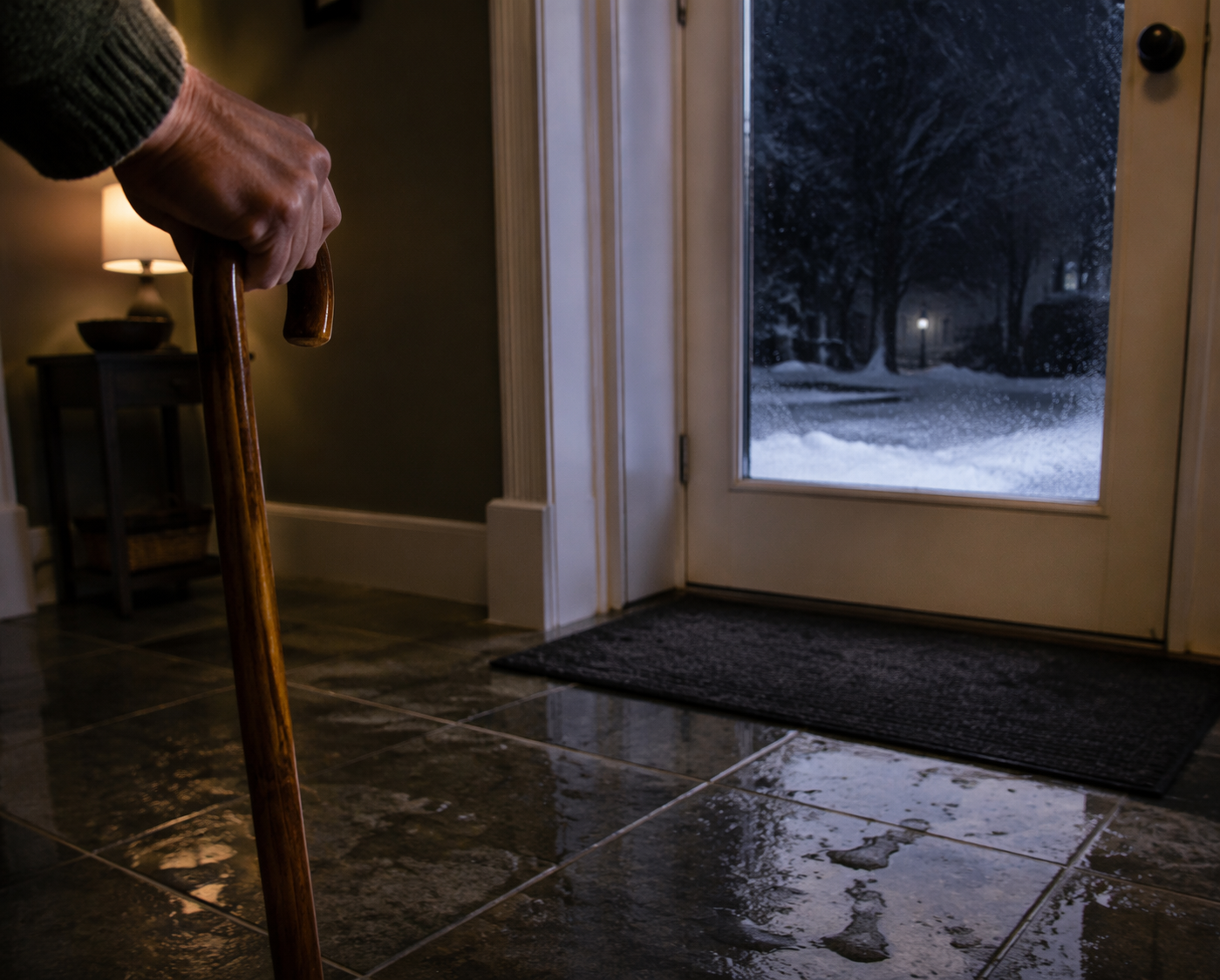
The entryway is where outdoor weather gets imported into the home. Snow melts. Rain drips off coats. A cane, walker, or shoe sole brings in water and grit. Then someone steps from a wet mat onto tile and assumes the floor is the same floor it was yesterday.
- Use a low-profile, non-slip entry mat that does not curl at the edge.
- Keep a towel within reach for wiping wet cane tips, walker legs, shoes, and the floor.
- Do not leave the towel on the floor after using it.
- Place a chair near the entry if the older adult needs to sit while changing footwear.
- Move decorative rugs out of the storm path if they slide, wrinkle, or bunch.
If you are choosing products such as non-slip mats, ice grippers, lighting, or traction aids, it helps to judge them by whether they solve a real movement problem in this specific home. A general home safety products guide can keep the shopping list from turning into a pile of gadgets nobody uses.
Put Light Where Feet Actually Go
A flashlight in a kitchen drawer is better than no flashlight. A flashlight already sitting on the nightstand is better. The difference shows up when the power fails and someone wakes up needing the bathroom.
- Put battery-powered lights or flashlights at the bedside, bathroom entrance, main chair, kitchen path, and primary exit.
- Use night lights with battery backup where possible.
- Keep replacement batteries in the same room as the light, not in a basement or garage.
- Avoid running extension cords across walking paths for lamps, radios, medical devices, or backup power.
- Mark stair edges or keep a dedicated light near stairs if the older adult cannot avoid them.
For a narrower plan focused only on outage conditions, use a power outage fall prevention checklist and adapt it to the rooms the older adult uses after dark.
Check Mobility Aids Before They Meet Ice
A cane or walker that is safe on dry carpet may behave differently on wet tile, icy concrete, or a salty garage step. Before winter weather arrives, check cane tips, walker glides, rubber feet, brakes, and the older adult’s footwear. If an ice grip or traction attachment is used, make sure the older adult knows when it is safe to use and when it must be flipped up or removed indoors.
Footwear is part of the route. Slippers may be fine for a normal evening and unsafe during a storm if the older adult needs to step onto a cold porch, into a garage, or across a wet entry. Put the safer shoes where they will actually be used.
Plan The Bathroom Trip
The bathroom route deserves special attention because it is predictable and often happens when the older adult is sleepy, hurried, or walking without glasses. During a storm, remove small furniture, baskets, loose rugs, pet toys, and charging cords from that path. If the bathroom is far from the bedroom, consider whether a temporary bedside commode, urinal, or clearer nighttime lighting is safer for the weather window.
This is the kind of change some older adults dislike because it feels like a loss of independence. Keep the reason specific: not “you are unsafe,” but “the hall will be dark if we lose power, and I do not want you crossing it half asleep.”
During The Storm: Slow The Movement Down
Many storm falls do not need a dramatic setup. They come from a small decision made too quickly: grabbing the mail before the sidewalk is treated, carrying a laundry basket down dim stairs, stepping over a cord because it will “only take a second,” or going outside to check a noise before anyone else wakes up.
The caregiver’s job during the storm is not to hover over every step. It is to reduce the number of risky steps and make the unavoidable ones slower, brighter, and supported.
If The Power Goes Out
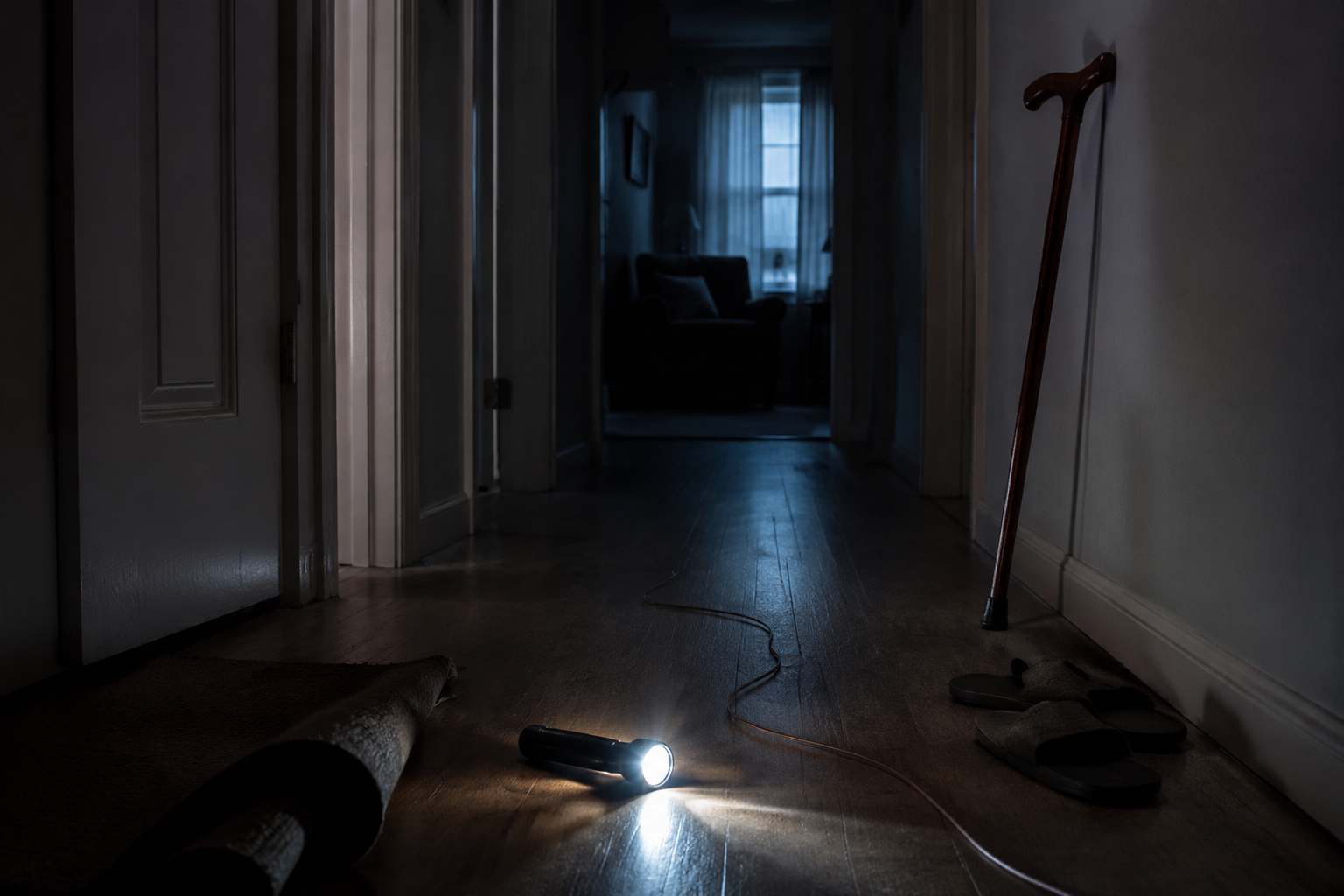
Darkness turns familiar rooms into unfamiliar rooms. The older adult may still know the house, but the body relies on visual cues for balance, foot placement, and stairs. Add a flashlight beam, shadows, a backup battery cord, and a moved chair, and the risk changes fast.
- Ask the older adult to pause before standing, especially after waking from sleep.
- Turn on a flashlight or battery light before walking, not after reaching the hallway.
- Keep one hand free for a railing, cane, walker, or stable surface.
- Move backup power cords, phone chargers, and oxygen or device tubing out of the walking line.
- Avoid stairs unless there is a strong reason to use them and enough light to see each step.
If you are the person checking in by phone, ask practical questions instead of general ones. “Is your flashlight on the nightstand?” is more useful than “Are you okay?” “Is the cord crossing the hall?” is better than “Be careful.”
If There Is Ice Or Snow Outside
The safest outdoor trip during ice is the one the older adult does not have to make. Bring in the mail later. Let the trash wait. Ask a neighbor, family member, or service to handle shoveling, pet needs, or supplies if that is available. A fall on a step is not a fair trade for a chore that could wait until daylight or treatment.
When going out cannot be avoided, reduce the load. Do not carry a heavy bag, shovel, or laundry basket while also using a cane or holding a railing. Use the safest entrance chosen before the storm. Step onto treated surfaces only. If there is no clear, supported route, the route is not ready.
If Floors Are Wet
Wet indoor floors are easy to dismiss because they look like housekeeping, not emergency preparedness. During a storm, they are part of the hazard. Wipe up tracked-in water quickly. Keep pets away from the entry while people are coming in. Put wet umbrellas, boots, and bags somewhere that does not narrow the walking route.
Be especially careful with towels. A towel placed flat for a moment can become a sliding surface or a curled edge. Use it, hang it, and get it off the floor.
If The Weather Problem Is Heat
Extreme heat belongs in a fall-prevention plan, but not for the same reason ice does. The surface may be dry. The risk may come from dizziness, dehydration, weakness, or fatigue. CDC guidance identifies older adults as more vulnerable during heat because bodies become less able to adjust to temperature changes with age, and chronic conditions or medications can affect heat response.[8] HealthInAging also warns older adults to take hot weather seriously and emphasizes hydration, cooling, and attention to symptoms.[9]
During a heat event, watch the transitions: standing up after sitting in a warm room, walking to the bathroom at night, stepping into a hot garage, or going outside to water plants. Encourage slower position changes, regular fluids if medically appropriate, cooler rooms, and avoiding unnecessary outdoor tasks during the hottest part of the day. If smoke or air quality alerts are part of the same weather pattern, the fall risk can also come from fatigue, shortness of breath, or reduced activity tolerance; a separate guide on fall safety during air quality alerts can help with that situation.
Evacuation Is Also A Fall-Prevention Problem
Evacuation planning for an older adult often focuses on where to go and what to pack. For someone with balance problems, the dangerous moments may be the transfers: getting from bed to chair, chair to car, car to shelter entrance, shelter cot to bathroom. Ready.gov and the Red Cross both advise older adults to plan around support needs, supplies, communication, and medical or assistive equipment.[3][4] Add fall prevention to that same plan.
- Keep the cane, walker, glasses, hearing aids, sturdy shoes, and medications together before movement starts.
- Choose the route with the fewest stairs and the best lighting, even if it is not the shortest route.
- Do not rush transfers into a car, wheelchair, or shelter chair because other people are waiting.
- Use a flashlight or headlamp during early morning, nighttime, or parking-lot movement.
- Avoid separating the older adult from the mobility aid “just for a minute.”
A rushed evacuation can turn a prepared older adult into an unsupported one. The packed bag helps only if the person can move safely with it.
After The Warning Ends, Inspect Before Normal Returns
The fall risk does not end when the alert expires. In some homes, that is when people start moving faster: checking damage, carrying spoiled food, clearing branches, mopping water, or taking the first trip outside after being cooped up.
Before the older adult resumes the usual routine, someone should inspect the walking routes again. Look for loose branches, uneven pavement, shifted mats, broken steps, damaged railings, standing water, slick mud, wet leaves, and poor lighting. Inside, check whether cords were moved during the outage, whether rugs were displaced, whether towels or buckets are on the floor, and whether furniture was pushed into a walkway.
Post-storm cleanup is not a good time for an older adult with balance concerns to carry heavy loads, climb, shovel, or test a questionable step. The first job is to make the route safe again. The cleanup can follow.
A Simple Mental Model For The Caregiver
When the forecast turns serious, do not try to solve every possible problem at once. Walk through four questions:
- What surfaces will change: ice, snow, rain, mud, wet tile, debris, or uneven ground?
- What lighting will change: outage, dim hallway, dark stairs, garage, porch, or evacuation route?
- What routines will change: sleeping location, bathroom route, meals, medications, pets, heat, or cooling?
- What movement should be delayed, assisted, rerouted, or avoided until conditions improve?
That is the practical center of severe weather safety for older adults. The storm may be outside, but the preventable injury often happens at the threshold, beside the bed, on the stairs, or in the hallway. Caregivers cannot control the weather. They can control many of the surfaces, lights, routines, and movement decisions that turn bad weather into a fall.
References
- Facts About Falls, CDC
- Disaster Resilience Tool Kit, AARP
- Older Adults, Ready.gov
- Older Adults Emergency Preparedness, American Red Cross
- Winterize to Prevent Falls, National Council on Aging
- Winter falls aren’t inevitable: How older adults can prevent injury during Ozarks cold weather, CoxHealth
- Emergency Preparedness 101: What to Do Before, During, and After a Disaster, National Council on Aging
- Heat and Older Adults Aged 65+, CDC
- Hot Weather Safety Tips for Older Adults, HealthInAging
Related reading
Noticed something outdated or inaccurate on this page? Flag a correction. We review every report against CDC, NIA, and AARP HomeFit guidance before updating a page.
Part of the Fall Prevention section.