
STEADI: Intervene
What a Wind Advisory Means for an Older Adult's Fall Risk
A wind advisory can mean gusts strong enough to push you off balance. Learn what the alert actually signals, why windy days matter for senior fall risk, and how to walk more safely when an outdoor trip can't wait.
A phone alert says “Wind Advisory,” and the practical question is not whether the storm sounds dramatic. It is whether an older adult should still take the walk, cross the parking lot, pick up the prescription, or keep the lunch plan.
For older adults, the plain safety answer is this: if the person has any balance problem, mobility limitation, vision issue, medication side effect, cane or walker use, fatigue, or history of falling, treat a Wind Advisory as a stay-indoors alert unless the outing is essential. That does not mean the person is helpless. It means the conditions are strong enough to interfere with walking and recovery from a stumble.

What the alert actually means
The National Weather Service describes a Wind Advisory as a situation where strong winds are occurring, but not strong enough to warrant a High Wind Warning. The NWS safety language tells people to secure outdoor objects and use caution when driving, so this is already an “act now” message, not just background weather trivia.[1]
The common threshold example is sustained winds of 31 to 39 mph and/or gusts of 46 to 57 mph. High Wind Warning thresholds are typically higher, such as sustained winds of 40 mph or more or gusts of 58 mph or more, but Wind Advisory criteria are set by local NWS offices and can differ by region.[2]
A Wind Advisory is also not the product used for every wind situation. Winds directly tied to severe thunderstorms, tropical cyclones, or winter storms may appear under different alert products. For a walking decision, though, the label matters less than the speed range: advisory-level wind can already be enough to change how a body moves outdoors.[2]
The important part: advisory winds can make walking unreliable
The Beaufort Wind Scale gives unusually useful plain language here. At 32 to 38 mph, Force 7, the NWS scale says “walking against the wind” is inconvenient. At 39 to 46 mph, Force 8, walking “generally impedes progress.” Those ranges sit inside or right alongside the typical Wind Advisory range.[3]
| Wind range | Beaufort language | What that can mean for an older walker |
|---|---|---|
| 32–38 mph | Walking against the wind is inconvenient | A cane tip, step timing, hat, coat, or bag can demand more attention than usual |
| 39–46 mph | Walking generally impedes progress | Forward motion may slow or stop; a gust can interrupt balance recovery |
| 46–57 mph gusts | Typical advisory-level gust example | The danger is not steady wind alone; it is the sudden push while turning, stepping off a curb, or opening a car door |
That is the piece many weather explanations skip. A healthy adult may experience a gust as annoying. An older adult using a cane, carrying a tote, wearing bifocals, or managing medication-related dizziness may experience the same gust as a balance problem with very little recovery time.
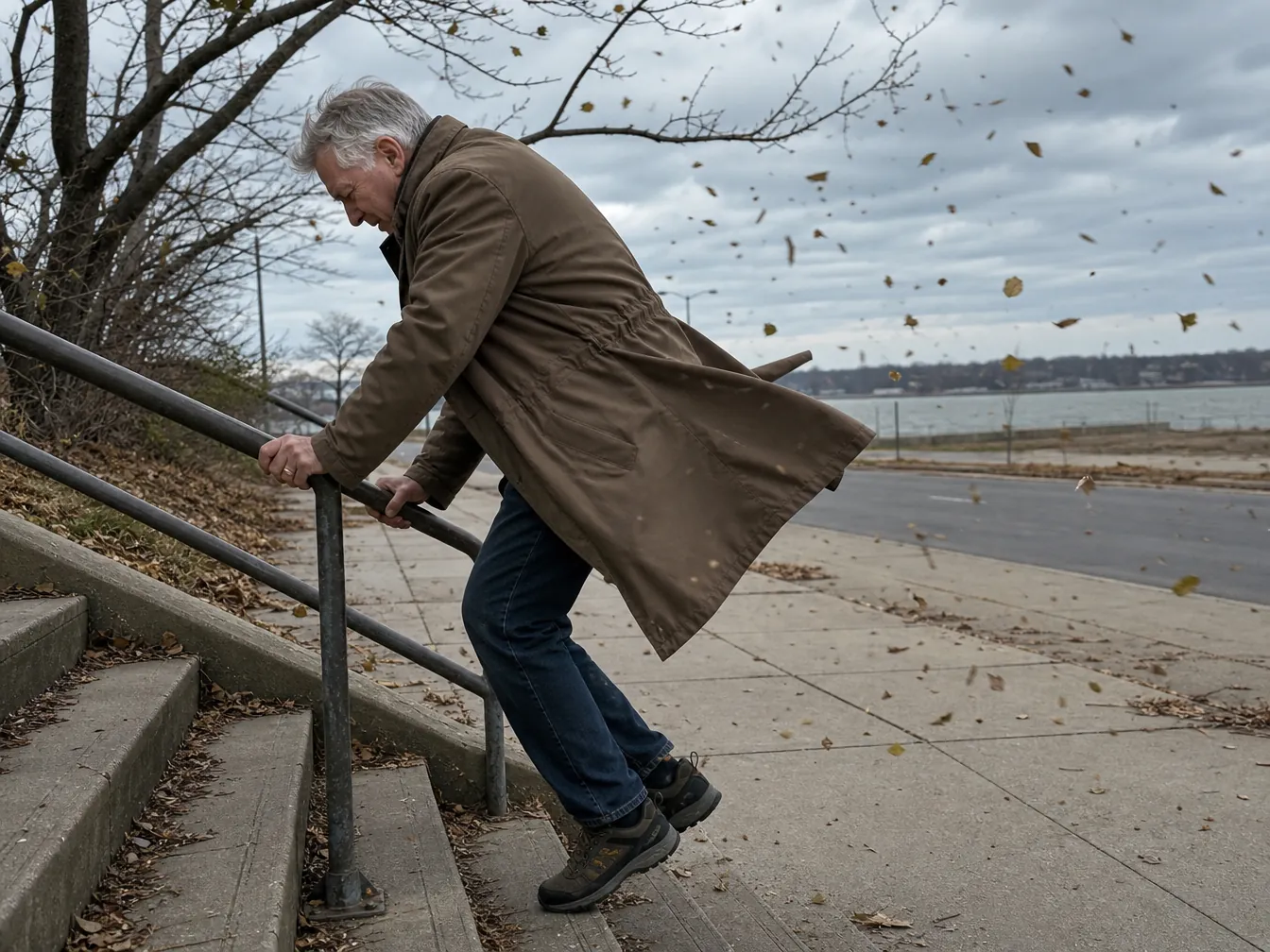
The most dangerous moment may not be a dramatic scene with branches flying. It may be the ordinary transition: stepping out of a car, crossing an open parking lot, turning sideways to protect the face, reaching for a loose hat, or trying to open a heavy door while wind pulls it. These are exactly the moments when an older adult has fewer spare hands and less time to correct a misstep.

The default decision: postpone non-essential outdoor trips
If the errand can wait, let it wait. A daily walk, casual shopping trip, social visit, yard task, or non-urgent pharmacy pickup is not improved by proving it can be done in advisory-level wind. The better decision is often the less dramatic one: stay indoors, reschedule, ask for delivery, or move the visit to a lower-wind day.
Adult children and spouses do not need to turn this into a debate about independence. The cleaner framing is: “The alert says the wind may interfere with walking. Let’s move the errand, not cancel your life.” That preserves choice where choice is real and removes avoidable exposure where it is not.
If the outing cannot wait, reduce the exposure
Some trips are not optional. Medical appointments, urgent prescriptions, caregiving duties, and time-sensitive needs may still require going out. In that case, the goal is risk reduction, not making the outing “safe.” Wind remains a moving hazard.
- Choose the lowest-wind window available. Check the hourly forecast, not just the daily headline. Avoid the peak gust period if there is any flexibility.
- Keep both hands free. Do not carry awkward bags, loose papers, umbrellas, or anything that forces one hand away from a cane, walker, railing, or car door.
- Use handrails every time they are available. NWS high-wind safety rules specifically call out handrails during high-wind conditions.[4]
- Stay away from roadways and train tracks while waiting or walking. NWS guidance warns that a gust can blow a person into traffic or into the path of a train.[4]
- Watch above and ahead, not only at the ground. Tree limbs, loose street signs, and unsecured outdoor objects can become debris hazards in strong wind.[4]
- Check the cane tip before leaving. A cane’s rubber tip should be replaced before it wears smooth, and non-skid footwear is recommended for safer footing.[5]
- Avoid exposed shortcuts. Open parking lots, long curb cuts, bridges, and building corners can create harder gusts than a sheltered route with rails, walls, or indoor connectors.
- Let someone else handle doors, carts, and packages when possible. The risky move is often the twist-and-reach while the wind is pulling in another direction.
If a Wind Advisory escalates or comes with broader storm conditions, shift from walking decisions to home and storm planning. A more complete home-prep path belongs in A Room-by-Room Severe Storm Safety Checklist for Seniors.
Why one windy-day fall deserves this much caution
Falls are not rare background events in later life. The CDC reports that more than one in four older adults falls each year, and that falling once doubles the chance of falling again.[6]
The research closest to weather alerts and older-adult falls is strongest for winter weather, not Wind Advisories specifically. That mismatch matters. A freezing-rain alert is not the same physical hazard as a dry, windy afternoon. Still, the pattern is useful: official weather-warning days can line up with higher fall-related injury rates in adults 65 and older.
In a Montreal study of adults 65 and older, freezing-rain alerts were associated with about a 20% increase in fall-related injuries, with an incidence rate ratio of 1.20 and a 95% confidence interval of 1.08 to 1.32. The association was higher in men, with an IRR of 1.31.[7]
An Ontario study found fall-related emergency department visit odds were elevated 5% to 8% for up to a week after snowfall of at least 0.2 cm. On freezing-rain alert days, odds were 31% higher in men and 15% higher in women.[8]
Those studies do not prove that a Wind Advisory causes falls. They do support a narrower, practical conclusion: official weather alerts can identify days when older adults face more injury risk outdoors, especially when the alert points to a hazard that changes footing, balance, or walking conditions.
A Guangzhou injury-surveillance study adds only suggestive background. In that five-year dataset, elderly fall injuries were the leading injury category at 49.41%, and monthly counts were positively correlated with monthly mean wind speed, with r = 0.187 and p < 0.01. That is a single-city correlation, not a direct test of Wind Advisories, so it should not carry the whole argument.[9]
When a fall happens anyway
If someone falls outdoors during a Wind Advisory, the first priority is not embarrassment, blame, or finishing the errand. Treat it as a fall event that needs a careful response: check for injury, avoid rushing the person upright, document what happened, and decide whether medical evaluation is needed. The next step is the crisis path in Your Parent Just Fell: A Caregiver's Guide to the First 72 Hours.
If the fall exposes a broader pattern—near-falls, fear of walking outside, trouble managing stairs, worn cane tips, poor lighting, or repeated balance corrections—move from weather-day judgment to fall-prevention assessment. That may mean using a broader fall prevention action guide or deciding whether an occupational therapist or CAPS professional should look at the home and daily routines.
The working rule can stay simple: during a Wind Advisory, postpone non-essential outdoor trips for older adults with fall-risk concerns. If the trip cannot wait, treat the outing like a controlled exposure to a balance hazard, with free hands, rails, sheltered routes, sound footwear, a checked cane tip, and no assumption that a checklist removes the risk.
References
- Wind Warnings, Watches and Advisories, National Weather Service.
- Warning Criteria, National Weather Service Caribou.
- Beaufort Wind Scale, National Weather Service.
- High Wind Safety Rules, National Weather Service Melbourne, FL.
- Tip Sheet: Winter Safety for Older Adults, HealthInAging.org, July 2019.
- Older Adult Falls Data, Centers for Disease Control and Prevention.
- Weather warnings predict fall-related injuries among older adults, Age and Ageing, 2015.
- The effect of weather on fall-related injuries in older adults: a population-based study, 2021.
- Analysis of characteristics and meteorological factors of elderly fall injuries in Guangzhou, China, 2014–2018, Heliyon, 2022.
Related reading
Noticed something outdated or inaccurate on this page? Flag a correction. We review every report against CDC, NIA, and AARP HomeFit guidance before updating a page.
Part of the Fall Prevention section.