
STEADI: intervene
What a Hawaii Wind Advisory Means for Older Adults
A Hawaii wind advisory is a fall-risk event, not just a weather alert. Find out what advisory-level winds mean for an older adult's fall risk, what must happen in the hours an advisory is active, and what should be ready before the next trade-wind event.
When a Hawaii wind advisory is active, the immediate question is simple: should an older adult still step outside? In Hawaii, the National Weather Service Honolulu uses a Wind Advisory for sustained winds of 30 to 39 mph and/or frequent gusts of 50 mph or more, for conditions that are occurring or imminent, typically within about 6 to 12 hours. A High Wind Warning is the next level up, with sustained winds greater than 40 mph or gusts greater than 60 mph.[1]
That advisory threshold is already enough to change movement plans. The National Weather Service’s high-wind safety guidance says the safest place during high winds is indoors, tells people to postpone outdoor activities, and warns pedestrians to stand clear of roadways because a gust may blow them into traffic.[2] For an older adult using a cane, walker, railing, or another person’s arm for balance, that warning is not background weather language. It is the fall-risk part of the alert.
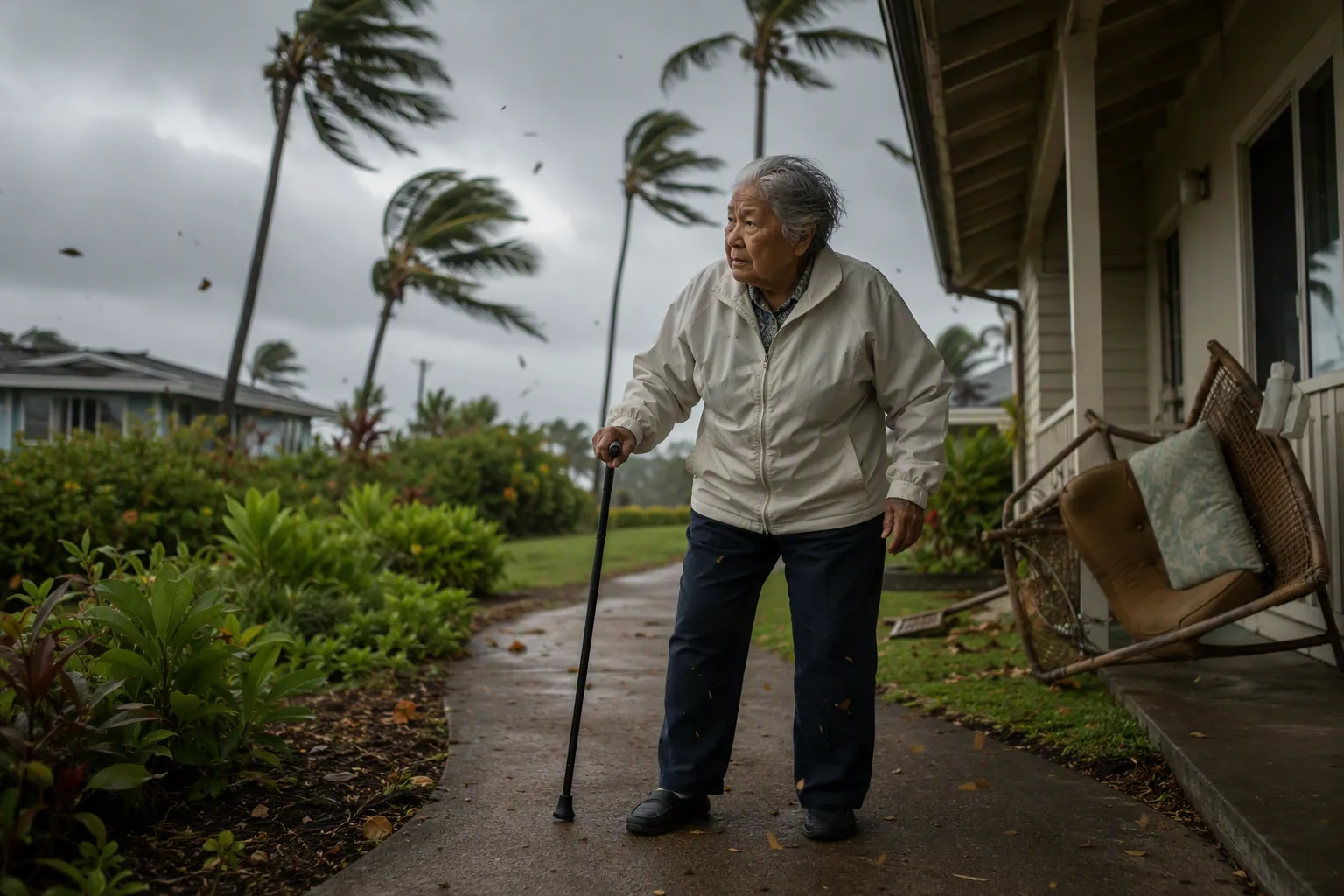
What changes for an older adult during a Hawaii wind advisory
The dangerous moment is often small: walking out to bring in a trash bin, crossing a wet exterior walkway to the car, checking lanai furniture, or stepping down a stair while holding a cane. The wind does not need to lift someone off the ground to matter. It only has to shift weight at the wrong second.
Falls are already a serious injury risk for older adults before weather is added. CDC reports that falls caused more than 38,000 deaths among adults 65 and older in 2021, making falls the leading cause of injury death for that age group; nearly 3 million older adults visited emergency departments for falls that year.[3] A wind advisory does not prove that a fall will happen, and no published study specifically quantifying wind-gust-caused falls among older adults was found in the sources reviewed here. The practical guidance is narrower: NWS warns that gusts can move pedestrians, older adults already face high fall stakes, and mobility aids can become part of the balance challenge when wind, wet surfaces, darkness, and rushing arrive together.
The fall hazards are not all outside
Wind makes outdoor walking less predictable, but it also changes the home environment. A loose chair, plant pot, cooler, or trash bin can make an older adult suddenly sidestep or bend. Blown leaves and small branches can hide uneven pavement. A gust can catch a screen door. If power goes out, familiar rooms and exterior paths can become low-light fall zones.
Temperature is a separate concern. The National Institute on Aging warns in its cold-weather safety materials that heavy wind can quickly lower body temperature and advises older adults to stay inside or in a warm place.[5] In Hawaii, cold exposure may not be the first worry in many neighborhoods, but wind, wet clothing, and a frail or medically vulnerable older adult can still make “just stepping outside” less casual than it sounds.
Act now: one decision at a time while the advisory is active
If the advisory is active now, do not start with a full storm project. Start with the next movement decision.
| Decision | Safer choice during the advisory |
|---|---|
| Can the errand wait? | Postpone it. Groceries, mail, trash bins, and lanai checks are not worth an outdoor fall during gusts. |
| Does something outside need to be secured? | Secure it only if conditions are still safe. If gusts are already strong, stay inside and move people away from glass doors or exposed exterior areas. |
| Does the older adult need to go outside? | Avoid going alone. Use the safest route, the most stable footwear, a handrail when available, and a companion if one can be there. |
| Is a cane or walker being used? | Check the rubber tips or wheels before stepping out. Worn tips, wet concrete, and sudden gusts are a bad combination. |
| Is the route near a road or driveway? | Stand clear of roadways and give traffic more distance than usual. NWS specifically warns that gusts may blow pedestrians into traffic.[2] |
Stay indoors if the task is optional
The safest place during high winds is indoors.[2] That guidance sounds obvious until someone decides the trash bin, newspaper, or porch cushion “will only take a minute.” A minute is enough time for a gust to hit at the top of steps or on a sloped walkway.
For adult-child caregivers checking from another part of Oahu, Maui, Kauai, or Hawaii Island, the useful text is not “be careful.” It is specific: “Please do not go out for the bin. I’ll call the neighbor,” or “Leave the lanai chair. Move away from the door.”
If outdoor movement cannot wait
- Use the route with the fewest stairs, slopes, wet leaves, and exposed corners.
- Use handrails on outdoor walkways and stairs. NWS high-wind safety rules specifically call out handrails during high winds.[2]
- Do not carry loose items that catch wind. Keep both hands as available as possible for the cane, walker, railing, or companion support.
- Pause before opening exterior doors. A gust can pull or push the door and shift balance.
- Avoid road edges, parking lots, and driveways when gusts are active. A small balance loss is more dangerous near moving vehicles.
- If a walker or cane feels unstable outside, turn back. Do not “test” the wind by going farther.
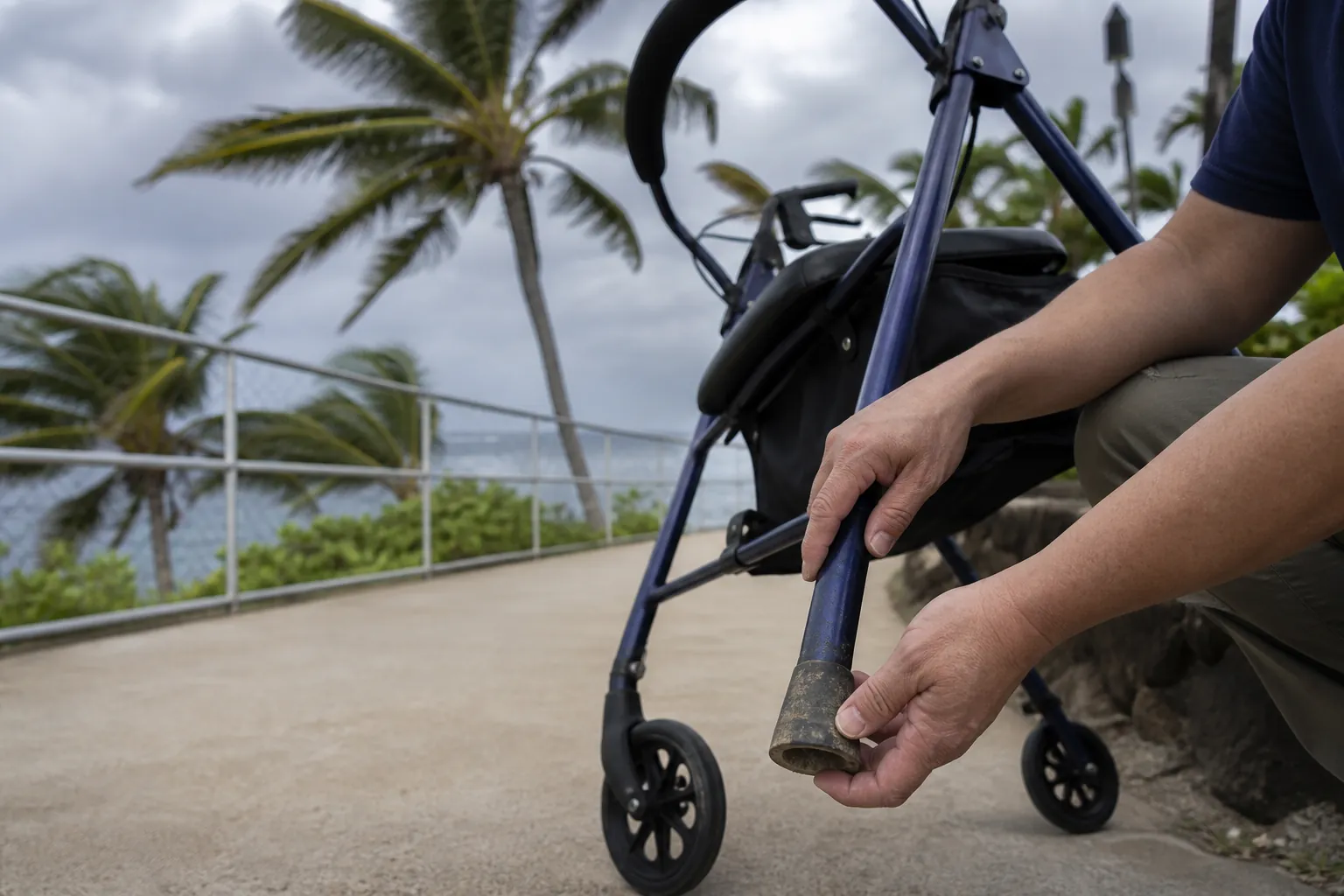
Bring the outside task inside the care plan
Loose objects should be secured before winds become unsafe. Once gusts are active, the safer choice may be to stop trying to fix the yard and instead keep the older adult away from exterior doors, windows, and outdoor walkways. The same judgment applies after the advisory: do not turn debris cleanup into a rushed balance test. If branches, wet leaves, or scattered objects are in the path, treat cleanup like a fall hazard, not just a chore. The site’s tornado cleanup fall-safety guide has a useful debris-clearing mindset even though Hawaii wind advisories are a different weather event.
If the power flickers or goes out
A wind advisory becomes a different kind of fall problem when lights go out. The older adult may know every step in the house, but darkness changes depth perception, makes rugs and cords harder to see, and turns the bathroom trip into the risky event.
Move flashlights to the person, not the other way around. A flashlight in the kitchen drawer does not help if the older adult is in the bedroom and the hallway is dark. Put one within reach of the bed, one near the bathroom path, and one near the main sitting area before conditions worsen.
For a fuller outage routine, use the site’s 72-hour power outage safety checklist for seniors and the room-by-room guide to fall-proofing a senior’s home before a power outage. If power remains out after the wind has passed, shift to what seniors should do if power is still out after a storm instead of improvising in the dark.
Plan ahead before the next trade-wind event
The best wind-advisory plan is mostly built on a calm day. Hawaiian Electric’s preparedness guidance lists outage supplies that matter directly for fall prevention: flashlights, batteries, a manual can opener, a battery-powered radio, an external battery pack, and special-needs items for elderly household members.[4]
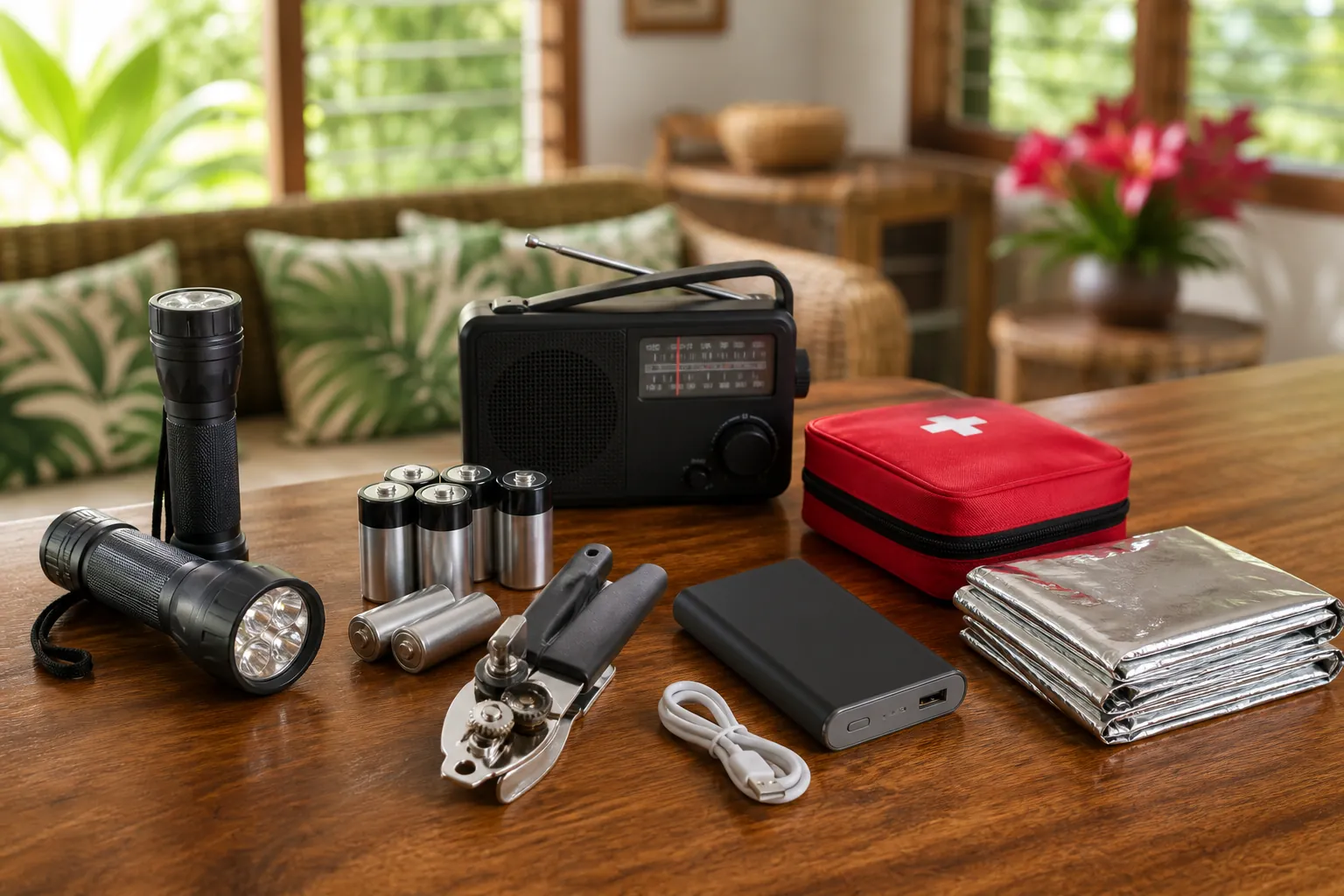
- Charge phones, hearing aids, medical devices, and backup battery packs before the advisory window reaches the home.
- Keep flashlights where the older adult actually walks at night: bedside, bathroom path, kitchen, and main sitting area.
- Store a manual can opener with food supplies so an outage does not force an unnecessary trip out.
- Keep a battery-powered radio available for updates if phones or internet service are unreliable.
- Prepare elderly or special-needs supplies before the event, including medication, mobility-aid accessories, incontinence supplies, and any device-specific backup needs.
- If someone depends on electricity for medical needs, review the utility’s medical-needs registration process before an outage threat, not during one.[4]
- Set a neighbor check-in plan: who calls, who knocks, and who is allowed to say, “Leave it outside; I’ll handle it later.”
- Trim weak branches and remove loose outdoor hazards before the next event. NWS wind-safety preparation guidance includes trimming tree branches away from a home and securing outdoor objects before high winds.[6]
If the older adult may need to leave home during a wind event or a related outage, plan the mobility route before the alert. A walker or cane changes evacuation timing, car transfers, and the amount of help needed at thresholds and curbs. The site’s guide to evacuating safely with a walker or cane is written for wildfire evacuation, but the mobility decisions carry over: do not wait until wind, darkness, and urgency are all present.
Caregiver check-ins that actually prevent the risky walk
A check-in during a wind advisory should ask about actions, not just feelings. “Are you okay?” often gets “I’m fine.” Better questions are harder to brush off.
- “Have you already brought in what you need, or is something still outside?”
- “Is the walkway wet or covered with leaves?”
- “Do you have a flashlight within reach where you are sitting?”
- “Are the cane or walker tips dry and in good shape?”
- “If the power goes out tonight, who is checking on you first?”
If the answer reveals a risky errand, solve the errand instead of repeating the warning. Call a neighbor. Delay the task. Move the appointment. Arrange a ride to come closer to the door. The fall-prevention work is often the negotiation that keeps someone from stepping onto a wet walkway in gusts.
After the advisory: do not rush the first trip outside
The first calm-looking hour can still be messy. Walkways may be wet. Palm fronds, branches, roof grit, and shifted lanai furniture can sit where the older adult normally places a cane or walker. If the person has been inside for hours and is eager to “just check,” make that first outside trip assisted.
Clear the walking path before clearing the whole yard. Good order matters: lighting first, stable footwear next, mobility aid checked, then the shortest route. Save bending, dragging, and branch pickup for someone steadier or for a calmer time.
If a fall happens during or after a wind advisory
Once a fall happens, the job changes. Stop treating it as wind safety and move into a post-fall decision path: check for pain, head impact, bleeding, dizziness, new confusion, inability to bear weight, or any injury that needs urgent care. Do not rush the person up just to get out of the weather if there may be an injury.
Use the site’s post-fall process and, when the situation is not immediately life-threatening, keep watching over the next few days. The 72-hour caregiver monitoring protocol was built for heat-related fall risk, but the monitoring habit is useful after any weather-linked fall: new pain, weakness, confusion, or reduced mobility can appear after the first check.
A Hawaii wind advisory is not a reason to panic. It is a reason to change movement, errands, lighting, and check-in plans until the advisory has passed.
References
- Product Questions, National Weather Service Honolulu.
- High Wind Safety Rules, National Weather Service.
- About Older Adult Fall Prevention, CDC.
- How to Prepare for a PSPS, Hawaiian Electric.
- Cold Weather Safety for Older Adults, National Institute on Aging, July 2024.
- Before a High Wind Event, National Weather Service.
Related reading
Noticed something outdated or inaccurate on this page? Flag a correction. We review every report against CDC, NIA, and AARP HomeFit guidance before updating a page.
Part of the Fall Prevention section.