
STEADI: Intervene
Winter Heating & Carbon Monoxide Safety for Seniors at Home
A plan-ahead winter heating and carbon monoxide safety audit for a senior's home — which space-heater, furnace, fireplace, wood-stove, and generator checks prevent home fires, and which carbon monoxide warning signs mean get to fresh air and seek medical care.
A useful winter heating check starts before the first hard freeze, with someone walking through the home and looking at what is actually being used for warmth. For older adults, the best winter weather safety tips for seniors at home are not vague reminders to “be careful.” They are visible checks: where the heater sits, what it is plugged into, whether the furnace and chimney have been inspected, where the generator would go during an outage, and whether smoke and carbon monoxide alarms work today.
The risk is large enough to deserve that kind of ordinary inspection. Ready.gov and the U.S. Fire Administration identify home heating as the second leading cause of home fires, and winter as the season when most home fires occur; for 2021, they cite an estimated 32,200 home heating fires, about 190 deaths, 625 injuries, and $442 million in property loss. [1]
This article is a home-safety guide, not medical advice. If carbon monoxide poisoning is suspected, do not try to observe symptoms at home, “sleep it off,” or troubleshoot the appliance first. Get to fresh air and seek medical care.

The quick heating and carbon monoxide walkthrough
If you are standing in a parent’s living room with a phone in hand, start here. This is the audit path; the sections below explain the checks that deserve extra attention.
| Area to check | Pass condition |
|---|---|
| Portable or space heater | At least 3 feet from anything that can burn; on a stable floor; plugged directly into a wall outlet; never covered; never on furniture; away from water. |
| Outlet and cord | No extension cord, no power strip, no cord under a rug, no warm or damaged plug. |
| Furnace and vents | Annual check by a qualified technician; vents and exhaust paths not blocked. |
| Fireplace, wood stove, chimney, flue | Annual chimney or flue inspection before seasonal use; ashes and combustibles handled safely. |
| Oven, range, grill, camp stove | Not used for room heat. |
| Generator | Outdoors only, at least 20 feet from windows, doors, and vents; protected from rain and snow; exhaust pointed away from the home. |
| Smoke and carbon monoxide alarms | Working alarms on every floor; tested this month; batteries replaced on a routine schedule. |
| Emergency threshold | For fire: leave and call 911. For possible carbon monoxide poisoning: fresh air and medical care. |
Portable heaters: audit the habit, not just the heater
Space heaters are often used for a sensible reason: one chair is chilly, one bedroom runs colder, or the person at home does not want to heat the whole house higher. The safety problem usually appears after the heater is made convenient. It gets nudged closer to the recliner. A throw blanket slips near it. Someone plugs it into a power strip because the wall outlet is behind furniture.
The first check is clearance. Keep portable heaters at least 3 feet from anything that can burn, including furniture, bedding, curtains, clothing, papers, and holiday decorations. Ready.gov and CDC winter-safety guidance both use the 3-foot rule for heating equipment and flammable materials. [1][2]
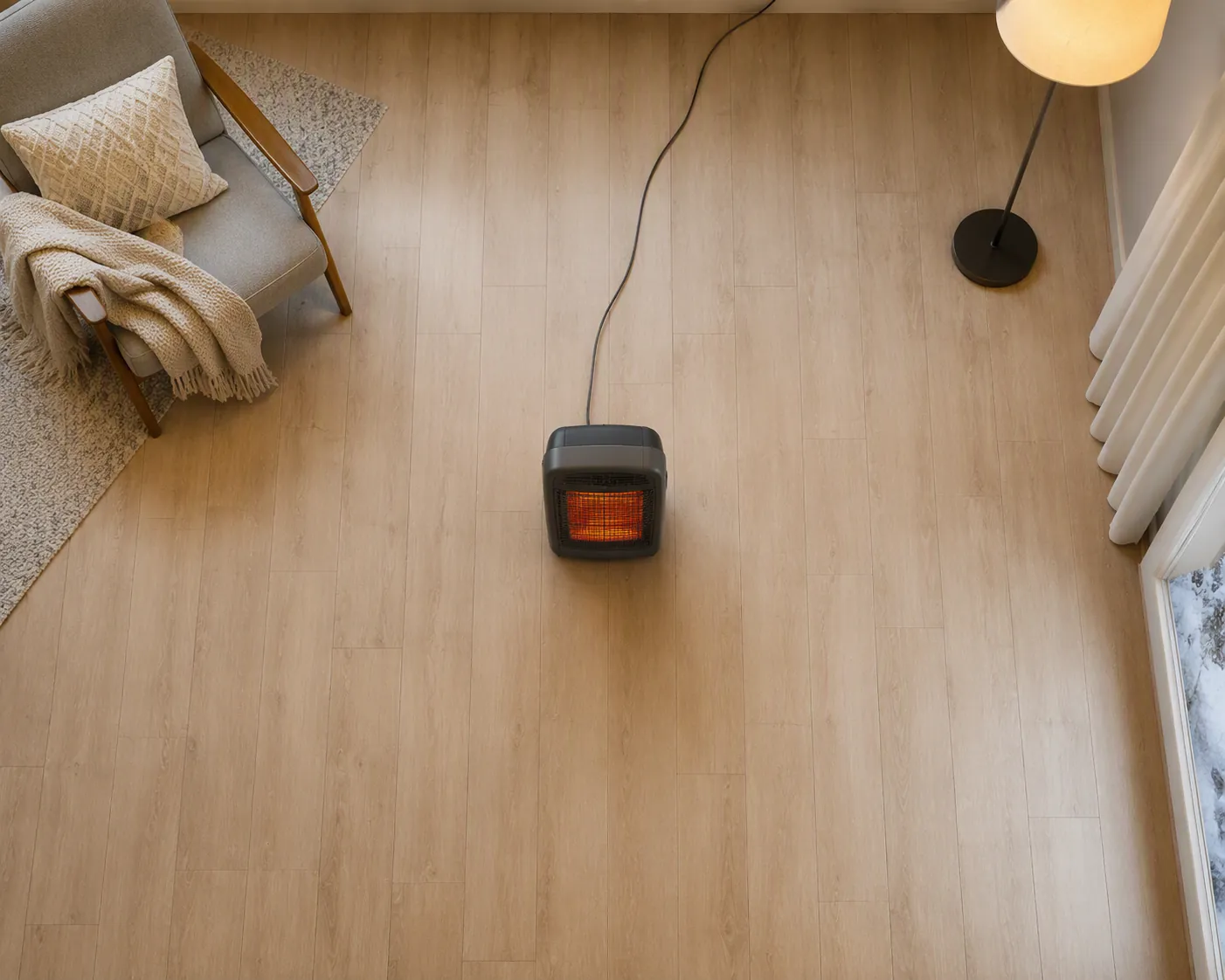
The second check is the plug. A portable heater should be plugged directly into a wall outlet, not into an extension cord or power strip. Cords should not run under rugs, where damage and heat can stay hidden. CDC guidance also warns not to cover a space heater, place it on furniture, or use it near water. [2]
Then look at the heater itself. A safer heater has an automatic shut-off feature, sits flat on a stable surface, and is turned off when the person leaves the room or goes to sleep. If the only outlet that reaches the comfortable chair requires a cord stretched across the room, the safer fix is usually moving the chair, using a different outlet, or improving the room’s regular heat—not adding another cord.
What to move during the visit
- Move newspapers, magazines, blankets, baskets, loose cords, and loose clothing out of the 3-foot zone.
- Move the heater off carpet if the manufacturer requires a hard, level surface.
- Unplug any heater connected to an extension cord or power strip.
- Check whether the plug, outlet, or cord feels warm during use; if it does, stop using that setup and have it checked.
- Place a reminder where it will be seen: heater off before sleep, before leaving the room, and before leaving home.
Furnaces, vents, fireplaces, and wood stoves need a calendar check
A furnace that turns on is not the same as a furnace that has been checked. CDC winter-weather guidance recommends having the heating system inspected and serviced by a qualified technician every year. HealthInAging, from the American Geriatrics Society’s Health in Aging Foundation, also advises older adults to have furnaces and chimneys professionally inspected before winter use. [2][3]
For an audit, the question is not whether the system “seems fine.” Ask for the date of the last service visit. If no one can remember, schedule one. Check that vents are not covered by rugs, furniture, storage boxes, or snow outside the home. A blocked vent can turn a working appliance into an exhaust problem.
Fireplaces, wood stoves, chimneys, and flues deserve the same treatment. Before seasonal use, the chimney or flue should be inspected. Soot, creosote, nesting material, cracks, or a blocked flue are not problems a family member can reliably rule out by looking from the hearth. [3]
The practical paperwork check
- Find the furnace service date.
- Find the chimney or flue inspection date if a fireplace or wood stove is used.
- Write both dates on the household winter checklist.
- If either check is missing for the year, schedule it before regular winter use.
The never-use-for-heat list
Some heat sources are unsafe even when they feel like a temporary solution. Do not use a gas oven or range to heat the home. Do not bring a charcoal grill or camp stove indoors. Do not run a generator inside a house, garage, basement, porch, shed, or other enclosed or partly enclosed space. CDC, Ready.gov, and HealthInAging all warn against these uses because they can create fire and carbon monoxide hazards. [1][2][3]
This is one place where compromise is dangerous. Opening a window or garage door does not make an indoor generator, grill, or camp stove safe. Carbon monoxide has no color or smell, and a person can become impaired before realizing the air is unsafe.
Generator placement during an outage
If a generator is part of the outage plan, decide its location before the outage. CDC guidance says generators should be used outdoors only, at least 20 feet from any window, door, or vent, and protected from rain and snow. [4]

“Near the door” is not a safe plan. Exhaust can enter through a cracked window, a door opened for a moment, a dryer vent, a basement window, or an intake vent. The audit should name the exact outdoor spot: far enough away, dry enough to operate safely, and positioned so exhaust moves away from the home.
If the older adult cannot safely move, fuel, start, or monitor the generator, that is part of the plan too. The safer answer may be a neighbor arrangement, a family call tree, or using the broader outage plan in the winter storm preparation checklist rather than assuming the generator will be simple to use in bad weather.
Smoke and carbon monoxide alarms are the backstop
Good habits reduce risk, but they do not replace alarms. CDC guidance includes battery-operated smoke and carbon monoxide detectors near heating areas and recommends checking batteries. The Council on Aging advises having smoke and carbon monoxide detectors on every floor, testing them monthly, and changing batteries twice a year. [2][5]

During the audit, press the test button on each alarm. Do not stop at looking for a blinking light. Check every floor, including the basement if the home has one. If the home has fuel-burning heat, an attached garage, fireplace, wood stove, kerosene heater, or generator plan, carbon monoxide coverage is not optional.
Write the test month on the checklist. If batteries are removable, set a twice-a-year replacement routine. If alarms are old, expired, missing, disabled, or too quiet for the person who needs to hear them, replace them. The detector check is not complete until the person at home can hear the alarm and knows what to do when it sounds.
Carbon monoxide warning signs: do not wait for them to become obvious
Carbon monoxide symptoms can look like flu, poor sleep, dehydration, medication effects, or ordinary winter fatigue. HealthInAging lists the warning signs of carbon monoxide poisoning as headache, weakness, nausea or vomiting, dizziness, confusion, blurred vision, and loss of consciousness. [3]
- Headache
- Weakness
- Nausea or vomiting
- Dizziness
- Confusion
- Blurred vision
- Loss of consciousness
The action standard is simple: get the person into fresh air and seek medical care. HealthInAging advises getting into fresh air right away and getting medical attention for suspected carbon monoxide poisoning. [3]
Weakness and confusion also appear in other cold-weather emergencies, including hypothermia. If you are sorting out cold exposure rather than a heating-equipment problem, use the companion guide on how to spot hypothermia in elderly parents. If carbon monoxide is possible, do not stay inside to decide.
If there is a fire
A fire is not a troubleshooting moment. HealthInAging and the Council on Aging both tell older adults to leave the house and call 911 in a fire. [3][5]
During the plan-ahead visit, make that possible. Clear the exit path. Check that doors open easily. Make sure a phone is reachable from the usual sleeping area. If mobility is limited, the fire plan should account for the real time it takes to stand, get a walker, move through a hallway, and open an exterior door.
Where this heating audit fits with the rest of winter safety
This audit is deliberately narrow. It covers heating equipment, exhaust, alarms, carbon monoxide symptoms, and fire response. For food, water, medications, communication plans, and power-outage supplies, use the broader winter storm preparation checklist for seniors at home. For outdoor traction, ice, steps, railings, and entryways, use the snow and ice fall prevention checklist. For detector batteries and household emergency supplies across seasons, the all-hazards disaster preparedness checklist is the better place to build the larger plan.
A home does not have to be cold to be safe. The goal is a warm room without hidden tradeoffs: no heater crowded by blankets, no furnace or chimney skipped for another year, no oven used as a furnace, no generator exhaust near an opening, and no missing alarm on the floor where someone sleeps. When those checks pass, risk is reduced. When there is smoke, fire, an alarm, or possible carbon monoxide symptoms, the checklist ends and the response begins: leave, get fresh air, call 911 when needed, and get medical care.
References
- Ready.gov #WinterReady, Ready.gov, https://www.ready.gov/winter-ready
- Preparing for a Winter Storm, CDC, https://www.cdc.gov/winter-weather/safety/index.html
- Tip Sheet: Winter Safety for Older Adults, HealthInAging/AGS, https://www.healthinaging.org/tools-and-tips/tip-sheet-winter-safety-older-adults
- Safety Guidelines: During & After a Winter Storm, CDC, https://www.cdc.gov/winter-weather/safety/stay-safe-during-after-a-winter-storm-safety.html
- Staying Safe During Winter Weather, Council on Aging, https://www.help4seniors.org/news/staying-safe-during-winter-weather/
Related reading
Noticed something outdated or inaccurate on this page? Flag a correction. We review every report against CDC, NIA, and AARP HomeFit guidance before updating a page.
Part of the Fall Prevention section.