
STEADI: Intervene
Winter-Proof Your Parent's Home Room by Room
Extreme winter weather multiplies fall risks for older adults through ice, snow, shorter days, and stiff joints. This room-by-room checklist, aligned with CDC STEADI and AARP HomeFit standards, helps you identify and fix the most predictable hazards before the first freeze.
Start at the door your parent actually uses in winter. Not the front door if everyone comes in through the garage. Not the pretty porch if the side steps are where the mail, groceries, trash, and snow boots meet. Stand there at dusk with your hands full and look down: ice near the first step, a mat that skids when a wet boot lands on it, a threshold lip, a porch bulb that works but leaves the bottom tread dark.

That is the practical answer to how to prepare elderly parents for extreme winter weather: do not begin with a storm kit in the closet. Begin with the walking route. Winter does not invent a new fall problem. It adds ice, snow, shorter daylight, cold-stiff movement, bulky coats, heavier footwear, and rushed transitions to the hazards already in the house.
The urgency is real without making the house feel like a disaster scene. More than one in four older Americans falls each year; falls account for 3 million emergency department visits and 1 million hospitalizations among older adults annually, according to CDC data cited by the National Council on Aging.[1] In winter, NCOA points to ice, snow, reduced daylight, joint stiffness in cold weather, and heavier footwear as added fall risks for older adults.[2]
Use this as a before-first-freeze walk-through. It follows the same common-sense spine as CDC STEADI fall-prevention guidance and AARP HomeFit-style home safety checks: clear the path, improve lighting, add stable support, remove trip points, and assign the work before someone is tired, cold, or embarrassed.[3][4] For the non-winter baseline, keep CareWise Guide’s room-by-room home fall-prevention checklist nearby; this winter version is the seasonal pass over the same house.
Before the First Freeze, Walk the Winter Route
Pick one route in and one route out. If your parent says, “I use all the doors,” choose the one used most often when the weather is bad. That is the route to fix first. The goal is not to make every inch of the property perfect. The goal is to make the path they will actually use boringly safe.
- Stand where the car parks and walk to the door your parent uses most.
- Do the same walk at dusk or after dark, not only at noon.
- Carry something in one hand, because mail, groceries, a purse, or a cane changes balance.
- Look for places where a wet boot would slide, catch, or land half on and half off a surface.
- Decide who removes snow and ice before the first storm, not during it.
Do not leave shoveling as an unspoken family hope. NCOA and AARP both advise arranging help rather than expecting an older adult to shovel snow.[2][4] That help can be a paid service, a neighbor, a family rotation, or a backup person for the day the usual helper is sick. Write it down with phone numbers. If the plan depends on one generous neighbor, it is not yet a plan.
The Outside Approach
Start where the feet touch winter first: driveway, walkway, steps, ramp, porch, garage threshold. Look for uneven slabs, loose railings, puddles that freeze overnight, and places where downspouts drain across the walking path. A path can be shoveled and still be dangerous if meltwater refreezes at the first stair.
- Move the safest parking spot as close as possible to the winter entrance.
- Keep ice melt, sand, or another traction material beside the door and in the garage, not buried in a shed.
- Check that handrails are tight, reachable, and usable with gloves.
- Replace dim exterior bulbs and add motion-sensor lighting where the first or last step falls into shadow.
- Mark stair edges if the tread blends into snow, concrete, or darkness.
Salt, sand, and cat litter appear in winter safety advice as traction tools, including in AARP and HealthInAging practical guidance.[4][5] Treat them as practical supplies, not magic. They need to be stored where someone can reach them before stepping onto ice, and they need to be applied by the person assigned to the job, not by the parent who is already trying to avoid a fall.
Lighting deserves a separate look because “the light works” is not the same as “the step is visible.” Stand below the stairs and look up, then stand above and look down. If the bottom step disappears, change the bulb, add a fixture, or add a motion-sensor light. Reduced daylight is one of the winter factors NCOA identifies, and it shows up first at thresholds.[2]
The Entryway
The entryway is where people make bad bargains: one foot on a mat, one foot on slick flooring, coat half off, keys in hand, wet bag on the wrist. If your parent uses a cane or walker, this is also where the device often gets parked too far away because there is no obvious place for it.
- Use a low-profile, non-slip mat outside and another non-slip absorbent mat inside.
- Remove decorative rugs that curl, bunch, or slide under a boot.
- Create a seated place to remove boots, with stable arms or a nearby support.
- Put a boot tray where melting snow will not spread into the walking path.
- Keep the cane, walker, or grabber at the entry your parent uses, not in the “proper” room.
A grab bar near an entry can sound excessive until you watch someone step in from ice, twist to close the door, and bend to pull off a boot. AARP includes grab bars among home modifications caregivers can consider for safer winter living.[4] For permanent installation, especially near stairs or a bathroom, use someone who can anchor it correctly. A towel bar, door frame trim, or wobbly bench is not a substitute.
Stairs, Halls, and the Night Route
After the entry, follow the route your parent takes when half awake. From bed to bathroom. From recliner to kitchen. From garage door to thermostat. Winter makes these routes harder because the house is darker earlier, floors are wet near entrances, and cold muscles do not respond as quickly.
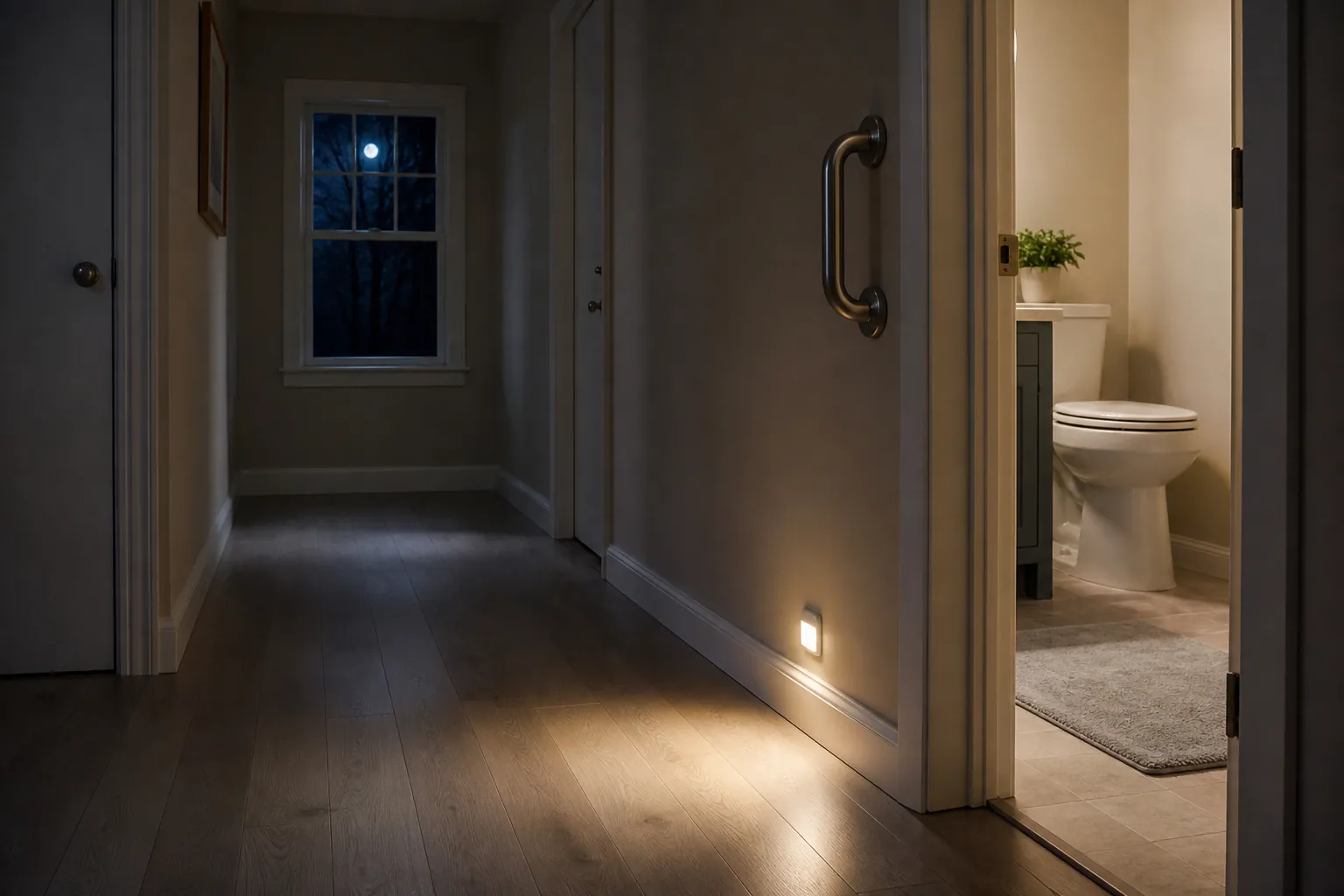
Nightlights are not an insult. They are a way to stop asking a half-awake person to make a balance decision in the dark. AARP and HealthInAging both include improved lighting and night visibility among winter safety measures for older adults.[4][5]
- Add motion-sensor nightlights from bedroom to bathroom, including turns and thresholds.
- Clear extension cords, shoes, baskets, pet bowls, and small rugs from halls.
- Make sure stair handrails run the full length of the stairs and feel secure.
- Use high-contrast stair-edge marking or glow-in-the-dark tape only where it helps the edge stand out.
- Put flashlights where the hand naturally reaches: bedside table, bathroom counter, kitchen, and main exit.
Glow tape can help a stair edge read clearly in dim light, but it should not become a decoration project. If tape peels, curls, or creates a raised edge, it has become a trip hazard. Use it sparingly and check it by running a socked foot lightly across the tread.
Storm darkness needs its own plan. If winter outages are common where your parent lives, pair this walk-through with CareWise Guide’s power-outage fall-prevention checklist. The overlap is intentional: backup lighting belongs in the walking route, not in a drawer nobody can find when the power fails.
Bathroom: Fix the Rushed, Wet, Half-Awake Moments
The winter bathroom problem is not only the tub. It is the trip from warm bed to cold floor, the quick turn at the toilet, the wet mat after a shower, and the decision to move fast because the room feels chilly. This is where a small support in the right place is worth more than another warning to “be careful.”
- Replace loose bath mats with non-slip mats that lie flat and do not curl at the corners.
- Install grab bars at the shower or tub and near the toilet where your parent actually reaches.
- Add a shower chair or bench if standing to bathe is tiring, unsteady, or rushed.
- Keep towels, toiletries, and clothing within reach so no one steps out wet to grab something.
- Use a nightlight that illuminates the toilet path without forcing a bright overhead light.
CDC STEADI emphasizes fall-risk screening and prevention steps rather than relying on willpower, and bathroom modifications fit that logic: reduce the moment when balance, speed, and slippery surfaces meet.[3] If your parent resists grab bars because they “look medical,” choose finishes that match the room, but do not negotiate away the support itself when the reach pattern shows it is needed.
A useful test is simple: ask your parent to show how they get in and out of the shower while fully clothed and dry. Watch where the hand goes. If it goes to a towel bar, sliding glass door, sink edge, or your arm, that is the place asking for real support.
Bedroom: Make Warmth and Balance Easy Before Standing
A cold bedroom encourages speed. Someone wakes up, wants the bathroom, and stands before their joints and balance have caught up. Put the fix within arm’s reach.
- Place a lamp, phone, glasses, and flashlight on the side of the bed your parent uses.
- Keep warm socks with non-slip soles at the bedside; remove slick socks from the winter rotation.
- Check that the path from bed to door is wide enough for a cane, walker, or steadying hand.
- Move laundry baskets, throw rugs, pet beds, and low stools out of the night path.
- Put the mobility aid where the first step happens, not across the room.
If your parent uses a walker during the day but leaves it in the hall at night, the house is set up for the wrong version of the person. Winter planning has to account for the tired, cold, half-awake version, because that is who gets up at 3 a.m.
Kitchen and Living Areas: Remove the Winter Clutter Line
Kitchens and living rooms collect winter clutter: boots drying near a vent, packages dropped by the door, blankets trailing from chairs, space heaters pulled into walkways, and cords crossing the floor. The fix is not a lecture about tidiness. It is giving wet, bulky things a place to go.
- Move frequently used pots, mugs, medications, and pantry items between shoulder and knee height.
- Create a landing spot for packages and groceries that does not block the walking path.
- Tape down or reroute cords; do not run them under rugs where they create a ridge.
- Remove low coffee tables, footstools, and magazine baskets from tight routes.
- Keep a sturdy chair available for putting on boots, not a rolling chair or soft ottoman.
Food and medication stocking matter during winter storms, but they are not the center of a fall-prevention walk-through. The fall question is more specific: can your parent reach what they need without climbing, stretching, or carrying a heavy load across a wet floor?
Heat, Detectors, and Outage Safety
Heating safety is a compact stop, but do not skip it. Cold can make movement stiffer, and unsafe backup heat can create a different emergency altogether. AARP cites National Institute on Aging guidance that older adults should keep indoor temperature at least 68°F; that NIA point is cited here through AARP and HealthInAging because the original NIA source path was not directly accessible.[4][5]
If a space heater is used, the Red Cross advises keeping it at least 3 feet from anything that can burn, plugging it directly into the wall, and using models with automatic shutoff.[6] The same winter check should confirm carbon monoxide detectors with battery backup are working on every floor, as AARP winter safety guidance recommends.[4]
- Set the thermostat plan before a cold snap, including who checks it if your parent lowers the heat to save money.
- Test smoke and carbon monoxide detectors and replace weak batteries.
- Move space heaters out of walkways and away from bedding, curtains, papers, and furniture.
- Place flashlights where they can be reached without crossing a dark room.
- Keep emergency contacts printed near the phone in case a cell phone dies during an outage.
Outdoor Trips Are the Backup Plan, Not the Safety Plan
Sometimes your parent still has to go out. Medical appointments, pets, mail, and stubborn independence do not disappear because the walkway is icy. Prepare for those trips, but do not let walking technique replace snow removal, lighting, rails, and traction.
- Use shoes or boots with good traction and a secure fit; loose winter footwear changes balance.
- Keep hands free by using a crossbody bag, backpack, or delivery help for heavier items.
- Ask your parent to use the cleared route, even if another door is closer.
- Reschedule non-urgent trips when ice has not been cleared.
- For unavoidable icy patches, use short steps with feet slightly outward, the “walk like a penguin” technique described in winter fall-prevention advice citing Cleveland Clinic guidance.[7]
Assigned-Action Checklist
Use this list after the walk-through, when family conversation tends to get vague. Every item needs an owner, not just agreement.
| Task | Owner | Deadline |
|---|---|---|
| Choose the winter entrance and clear-route plan | Family caregiver and parent | Before first freeze |
| Arrange snow and ice removal, including backup help | Family caregiver | Before first forecasted storm |
| Buy and place ice melt, sand, or traction material | Assigned family member or neighbor | Before temperatures drop below freezing |
| Replace loose entry and bath mats with non-slip mats | Family caregiver | This week |
| Add motion-sensor nightlights from bedroom to bathroom | Family caregiver | This week |
| Test exterior lighting, stair visibility, and backup flashlights | Family caregiver or handyman | Before daylight saving darkness becomes routine |
| Check grab-bar needs at entry, toilet, shower, and tub | Family caregiver with qualified installer or clinician input | Before icy weather |
| Test smoke and carbon monoxide detectors with battery backup | Family caregiver | Before using backup heat |
| Confirm thermostat plan and safe space-heater placement | Parent and caregiver | Before first cold snap |
| Print the family fall-prevention handout and emergency contacts | Family caregiver | After fixes are assigned |
For a printable companion, use CareWise Guide’s fall-prevention handout. If a fall has already happened, switch from prevention mode to the first-24-hours-after-a-fall guide and treat this winter checklist as the follow-up prevention work once immediate medical concerns are addressed.
References
- Get the Facts on Falls Prevention, National Council on Aging
- Winter Fall Prevention Tips for Older Adults, National Council on Aging
- STEADI - Older Adult Fall Prevention, Centers for Disease Control and Prevention
- How Family Caregivers Can Keep Loved Ones Safe in Winter, AARP
- Tip Sheet: Winter Safety for Older Adults, HealthInAging
- Winter Storm Preparedness, American Red Cross
- Essential Winter Fall Prevention Tips for Seniors, National Church Residences
Related reading
Noticed something outdated or inaccurate on this page? Flag a correction. We review every report against CDC, NIA, and AARP HomeFit guidance before updating a page.
Part of the Fall Prevention section.