
STEADI: intervene
Winter Storm Safety Tips Every Senior Living Alone Needs
Learn what specific supplies and backups a senior living alone needs during a multi-day winter power outage beyond a generic emergency kit — from medication refrigeration to medical device backup and a working communication plan.
A 72-hour emergency kit is a useful starting point for a senior living alone in a winter storm, but it is not the whole job. Water, shelf-stable food, a flashlight, a battery radio, extra batteries, a manual can opener, and a first aid kit help only if the person can reach them, read the labels, open the packages, keep medical equipment running, and get help when the house is becoming unsafe.
The standard baseline is still worth checking first: one gallon of water per person per day, no-cook food, a manual can opener, flashlight, battery-powered or hand-crank radio, extra batteries, and first aid supplies are part of federal and Red Cross emergency-kit guidance.[1][2] For an older adult living alone, that list should sit near the door, not in a basement, and it should be packed in something that can be rolled rather than lifted.
Recent storms show why the kit has to work for more than one cold evening. Winter Storm Fern in January 2026 left more than 1 million customers without power, with some rural areas reportedly dark for two weeks.[3] That does not mean every storm will behave that way. It does mean a senior’s plan cannot depend on someone being able to “just stop by” after the roads glaze over and cell towers are overloaded.
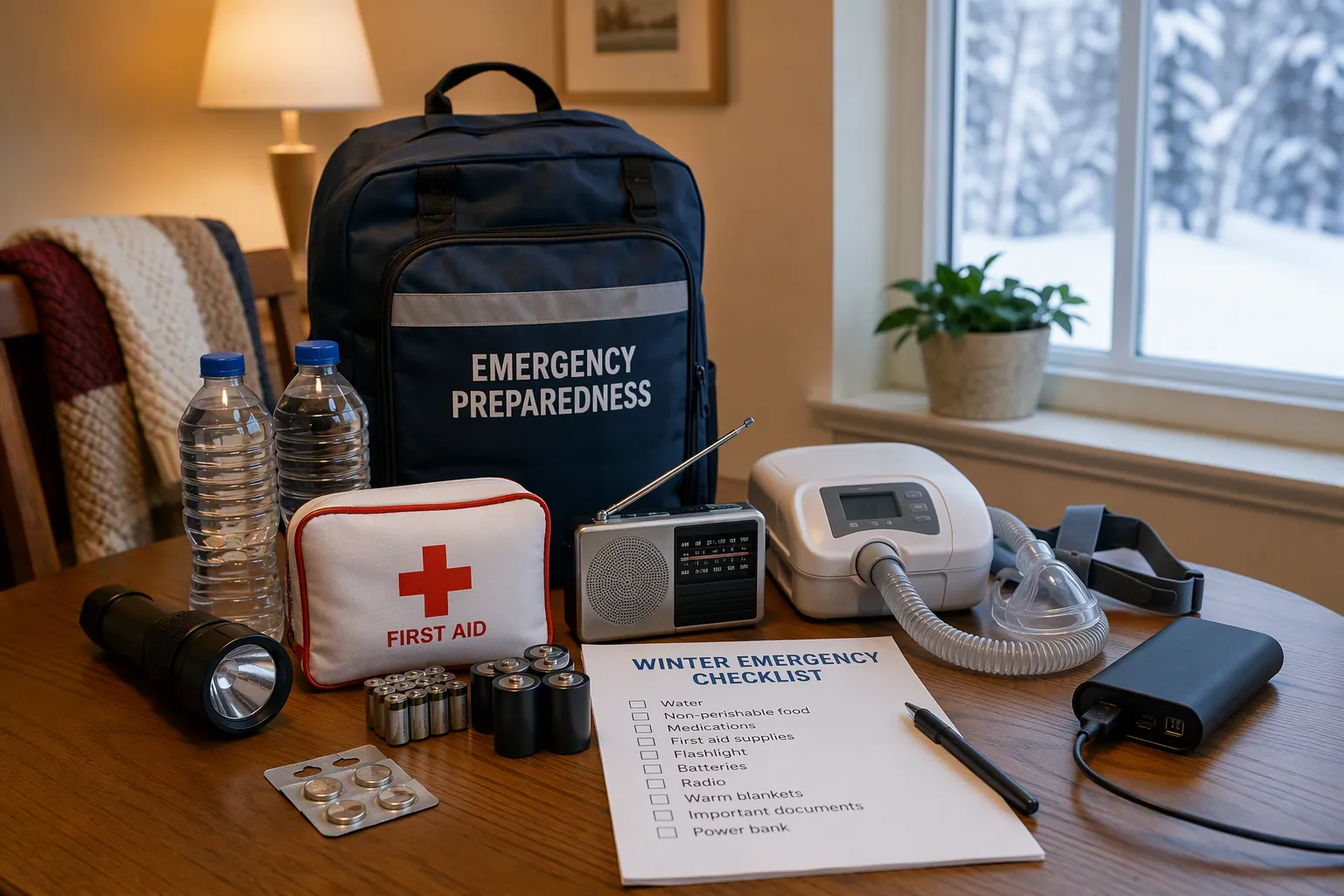
Start with the ordinary kit, then make it usable in the dark
The first audit is not fancy. Put the flashlight in the person’s hand and ask them to turn it on. Ask them to tune the radio. Ask them to open the food they are supposed to eat. If arthritis, low vision, tremor, or weak grip turns a supply into a puzzle, the supply is not ready.
- Store the kit in a wheeled container near a main exit, not down stairs or behind seasonal storage.
- Use large-print labels: “FLASHLIGHT,” “RADIO,” “MEDICATION COOLER,” “PHONE POWER BANK,” and “CALL LIST.”
- Tape simple instructions to devices that are easy to forget under stress, such as a radio, power bank, or backup battery.
- Choose food that does not require cooking, heavy lifting, sharp tools, or a strong grip.
- Keep one flashlight within reach of the bed and another inside the kit.
The same rule applies to blankets, gloves, hats, and warm socks. They should be where the person will actually be when the power fails, not in a closet reached by crossing a dark hallway. A fall during an outage is not a side issue; it can be the event that turns a manageable power loss into an emergency.
Write down the medical power plan before the first outage
Powered medical equipment needs a plan that is more specific than “charge it.” A CPAP machine, oxygen concentrator, powered recliner, medical alert base station, nebulizer, or powered mobility device has a real runtime, and someone should know what that runtime is before the weather alert arrives.
For each device, write the answer on paper in large print: how long the device runs on its internal battery, which backup battery works with it, how long that backup lasts, how to recharge it, and who to call if it fails. Ready.gov advises older adults who use medical devices or assistive technology to plan for power outages and contact their medical equipment or service providers about backup power options.[1]
| Dependency | What to verify before storm season | Where to write it |
|---|---|---|
| CPAP or BiPAP | Battery runtime, compatible backup battery, whether humidifier use shortens runtime | Large-print device card taped near machine |
| Oxygen concentrator | Backup oxygen supply, supplier emergency number, delivery limits during road closures | Medical equipment page in emergency notebook |
| Medical alert device | Whether the base station needs household power, cellular service, or landline service | Call-list page and device label |
| Powered wheelchair or scooter | Full-charge range, manual backup option, charging location that stays accessible | Mobility page near exit |
| Phone and tablet | Power bank capacity, charging cables, whether the senior can plug them in without help | Communication page beside phone |
A utility medical priority or life-support registry is also worth checking before winter, especially for someone using oxygen or other powered medical equipment. These programs do not guarantee immediate restoration, but they can help the utility identify households with medical dependencies during an outage.[1] The mistake is treating registration as the whole plan. It is only one layer.
If a generator is part of the household plan, the safety rule needs to be written as plainly as the medication list. The U.S. Consumer Product Safety Commission says portable generators should be operated outside and at least 20 feet away from the house, with exhaust directed away from windows, doors, and vents.[4] A generator in a garage, porch, breezeway, or near an open window is not a backup plan; it is a carbon monoxide hazard.
Medication safety needs its own cold-weather routine
Medication is where a generic kit often quietly fails. A senior may have food and water, yet still be in trouble because a refill is due, a refrigerated drug has warmed, or pills are in a cabinet that cannot be reached safely after the house goes dark.
Ready.gov recommends that older adults talk with a doctor or pharmacist about maintaining an emergency supply of prescription medicines and notes that most state pharmacy boards allow a three-day emergency refill without a new prescription.[1] For winter planning, the practical target is a seven-day supply when possible, arranged before the storm season rather than during the first serious forecast.
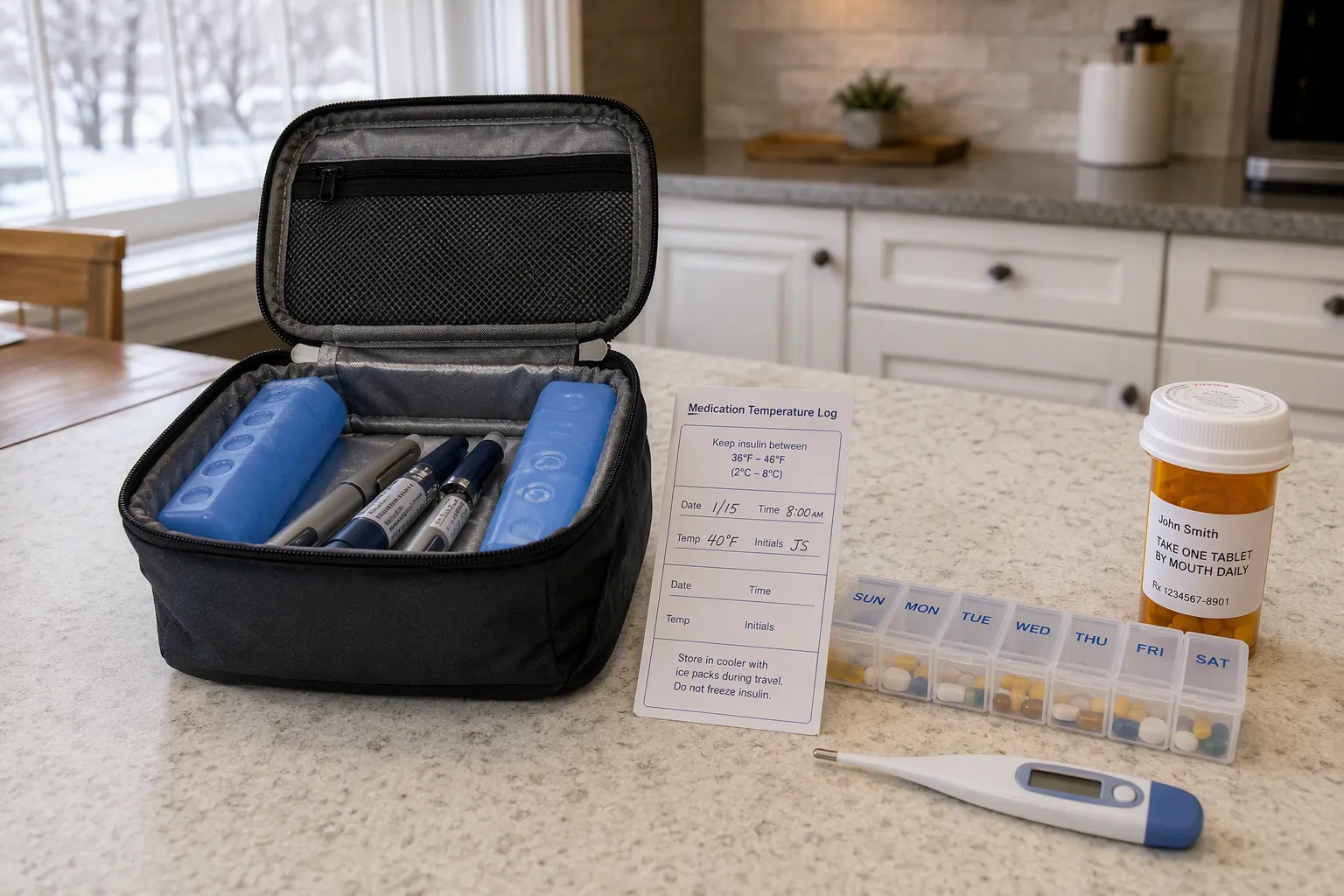
Temperature-sensitive medications need a separate plan. Outage guidance cited by PowerOutage.us warns that insulin can degrade above 77°F and that freezing temperatures can damage common medications.[3] Because the exact safe range can vary by drug and manufacturer, the safer household rule is this: ask the pharmacist how each temperature-sensitive medication should be stored during an outage, keep that instruction with the medication, and do not guess after exposure to heat or freezing.
- Keep a small insulated cooler bag and ice packs labeled for medication only.
- Add a simple thermometer or pharmacy temperature log strip so exposure is not judged by memory.
- Write the pharmacist’s after-hours number and the prescriber’s number on paper, not only in a phone.
- Store a current medication list in the kit, including dose, timing, pharmacy, prescriber, allergies, and medical conditions.
- Keep the pill organizer in the same area as the emergency notebook if doing so is safe for the person’s household.
If a medication may have frozen, overheated, or sat too long outside its labeled range, the decision belongs with a pharmacist, prescriber, or manufacturer guidance. A senior living alone should not be left to decide by looking at the pen, vial, or tablet in poor light.
Hearing, vision, and memory change the communication plan
A phone tree that depends on hearing one ringtone is fragile. The National Institute on Deafness and Other Communication Disorders reports disabling hearing loss in about 22% of adults ages 65 to 74 and 55% of adults 75 and older.[5] That makes extra hearing aid batteries part of the emergency kit, not an optional comfort item.
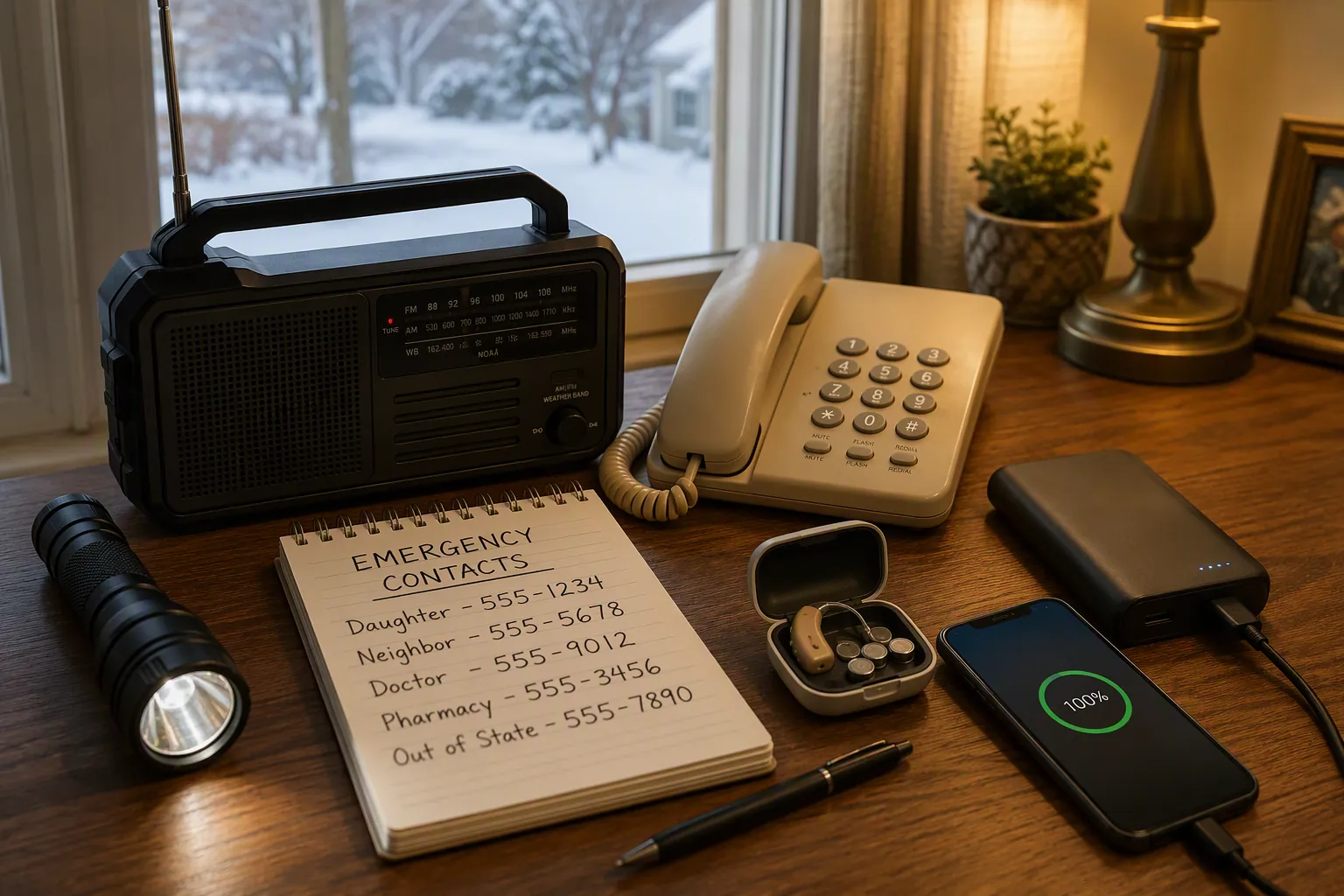
The communication setup should assume that one channel may fail. Cell service may be weak, the phone battery may be low, the senior may not hear an alert, or a medical alert base station may depend on household power. A working plan uses redundancy without making the older adult manage a complicated command center.
- Keep a charged power bank with the correct cable already attached or stored in the same pouch.
- Print emergency contacts in large type and place copies by the bed, by the main phone, and inside the kit.
- Add extra hearing aid batteries and label them with the battery size in large print.
- Test whether text messages, voice calls, landline calls, and the medical alert button work from the rooms the senior actually uses.
- If walkie-talkies are used with a neighbor, test the channel, range, volume, and charging routine before winter.
Daily storm check-ins should ask more than “Are you okay?” The Council on Aging of Southwestern Ohio recommends checking on heat, food, medication supply, and whether the older adult has fallen during severe weather.[6] Those questions are useful because they catch the failures people often minimize: the house is colder than expected, the easy food is gone, the pills are running low, or the person slipped but does not want to worry anyone.
Plan the exit before the home becomes unsafe
A warming center that exists only as a vague idea is not a contingency. Before winter weather, write down the nearest public warming center, the county emergency management number, 211, and any local voluntary wellness-check registry. Then decide how the senior would actually get there if the power has been out long enough that staying home is no longer safe.
For some seniors, leaving may be realistic if a neighbor, paratransit service, faith community contact, or local emergency program is arranged in advance. For others, travel may be dangerous without assistance. That is exactly why the communication plan has to activate early, while the phone is charged, the house still has some warmth, and the person can explain what is happening.
| If this is true | The plan should already say |
|---|---|
| The senior cannot drive in snow or ice | Who can transport them, and what backup number to call if that person cannot come |
| The senior uses a walker, cane, wheelchair, or scooter | Which mobility aid goes with them, and where it is stored near the exit |
| The senior uses oxygen or powered medical equipment | Whether the warming center can support the equipment, or who can confirm alternatives |
| The home has steps, a steep walkway, or poor outdoor lighting | Who clears the path, and whether emergency responders need access notes |
| The senior has no nearby family | Which neighbor, local agency, or wellness-check registry starts the help chain |
This is also the place to be honest about mobility backups. If the primary wheelchair or scooter is powered, the kit should include the manual backup that the person can actually use, or the plan should name who can help transfer and transport them. A cane in the closet is not a backup if the senior cannot safely reach it in the dark.
Heating costs and weatherization belong in the pre-storm checklist
Some older adults keep the heat low because the bill is frightening. That can shape storm safety long before the power fails, especially in homes with poor insulation, drafty windows, or an aging furnace. The Low Income Home Energy Assistance Program provides heating bill assistance and weatherization help for eligible low-income households, including seniors, but application windows and benefit amounts vary by state and year.[7]
Last verified: July 29, 2026. For current LIHEAP information, call the national energy assistance referral hotline at 1-866-674-6327 or check the state program before winter. This is not a same-day rescue plan; it is a way to reduce avoidable heating risk before storm season tightens.
Test the kit against the person, not the checklist
The most useful winter storm drill for a senior living alone is quiet and practical. Pick an ordinary afternoon. Turn off the lights in one room. Ask the person to find the flashlight, call the check-in contact, read the medication instructions, locate the warm clothes, and explain what happens if the power is still out tomorrow.
That test will show what a printed checklist cannot: the label is too small, the power bank is dead, the radio batteries corroded, the cooler is in the garage, the phone number is saved only in a mobile phone, the walker blocks the exit, or no one knows how long the CPAP battery lasts. Those are fixable problems in September. They are much harder to solve at 9 p.m. during an outage.
- Replace expired food, water, batteries, and first aid supplies.
- Recharge and test phone power banks, medical alert devices, and medical equipment batteries.
- Confirm prescription refill options, medication cooling instructions, and pharmacy emergency contacts.
- Update the large-print contact list and give copies to the senior, one nearby helper, and one remote family contact if appropriate.
- Confirm the warming center, transportation plan, and the point at which the check-in contact should call for help.
A good kit for a senior living alone is not measured by how many items fit in the bin. It is measured by whether the person can use it while tired, cold, worried, and alone, and whether someone else knows when the first plan has stopped working.
References
- Older Adults, Ready.gov, https://www.ready.gov/older-adults
- Survival Kit Supplies, American Red Cross, https://www.redcross.org/get-help/how-to-prepare-for-emergencies/survival-kit-supplies.html
- PowerOutage.us, https://poweroutage.us/
- Portable Generator Safety, U.S. Consumer Product Safety Commission, https://www.cpsc.gov/Safety-Education/Safety-Education-Centers/Carbon-Monoxide-Information-Center/Portable-Generators
- Age-Related Hearing Loss, National Institute on Deafness and Other Communication Disorders, https://www.nidcd.nih.gov/health/age-related-hearing-loss
- Winter Safety Tips for Older Adults, Council on Aging of Southwestern Ohio, https://www.help4seniors.org/
- Low Income Home Energy Assistance Program (LIHEAP), Administration for Children and Families, https://www.acf.hhs.gov/ocs/programs/liheap
Related reading
Noticed something outdated or inaccurate on this page? Flag a correction. We review every report against CDC, NIA, and AARP HomeFit guidance before updating a page.
Part of the Fall Prevention section.