
Are Balance Exercises Effective at Reducing Fall Risk for Older Adults?
Last reviewed: — Review date is particularly important for Medicare coverage, device specifications, and clinical guidance, which change frequently.
The Short Answer
Yes — balance exercises are effective at reducing fall risk for older adults, and the evidence behind that answer is now stronger than ever. In June 2024, the U.S. Preventive Services Task Force (USPSTF) issued a Grade B recommendation for exercise interventions to prevent falls in community-dwelling adults aged 65 or older who are at increased risk. A Grade B rating means the USPSTF has determined with moderate certainty that the net benefit is moderate — this is a clinically meaningful endorsement, not a cautious hedge.
Why Fall Risk Matters: The Scale of the Problem
Falls are not a minor inconvenience for older adults — they are one of the leading causes of injury, disability, and loss of independence. CDC data shows the scope clearly:
- More than 1 in 4 adults aged 65 or older fall each year — but fewer than half report it to their doctor.
- Falls generate approximately 3 million emergency department visits annually.
- Nearly 319,000 older adults are hospitalized for hip fractures each year, and 83% of hip fracture deaths are caused by falls.
- Falls are the most common cause of traumatic brain injuries among older adults.
There is also a compounding psychological dimension. Many older adults who fall — even without serious injury — develop a fear of falling that causes them to reduce activity. That withdrawal leads to muscle weakness and reduced coordination, which in turn raises the risk of a future fall. Exercise interrupts that cycle.
What the Research Shows
The 2024 USPSTF recommendation is grounded in a pooled analysis of 29 randomized controlled trials involving 14,475 participants. The findings are specific and consistent:
- Exercise reduced the rate of falls (incidence rate ratio 0.85, 95% CI 0.75–0.96) — meaning roughly a 15% reduction in how often falls occurred.
- Exercise reduced the number of people who experienced any fall (relative risk 0.92).
- Exercise reduced injurious falls (incidence rate ratio 0.84) — roughly a 16% reduction in falls that caused harm.
For historical context, a BMJ meta-analysis of 17 trials — referenced by Harvard Health — found even larger effect sizes: exercise programs reduced falls causing injuries by 37%, falls leading to serious injuries by 43%, and fractures by 61%. That analysis is from 2013, and the 2024 USPSTF review is the current authoritative benchmark, but the direction of evidence has been consistent for over a decade.
How Balance Exercise Reduces Fall Risk
The protective effect of balance exercise is not mysterious — it works through several well-understood physiological and psychological pathways:
- Improved proprioception: Balance training sharpens the body's ability to sense its position in space, which is a foundational component of staying upright on uneven or unexpected surfaces.
- Lower-extremity muscle activation: Exercises that challenge stability recruit and strengthen the muscles of the ankles, knees, and hips — the primary stabilizers during walking and weight shifts.
- Faster reaction time: Regular balance challenge improves the speed at which the body can correct an unexpected shift in weight, reducing the likelihood that a stumble becomes a fall.
- Dynamic stability: Balance training improves the ability to maintain control during movement — walking, turning, reaching — not just while standing still.
- Reduced fear of falling: A 2025 meta-analysis published in the European Review of Aging and Physical Activity found that consistent exercise significantly reduced fear of falling — itself a documented fall risk factor — by breaking the cycle of avoidance and deconditioning.
Which Exercise Types Are Most Effective?
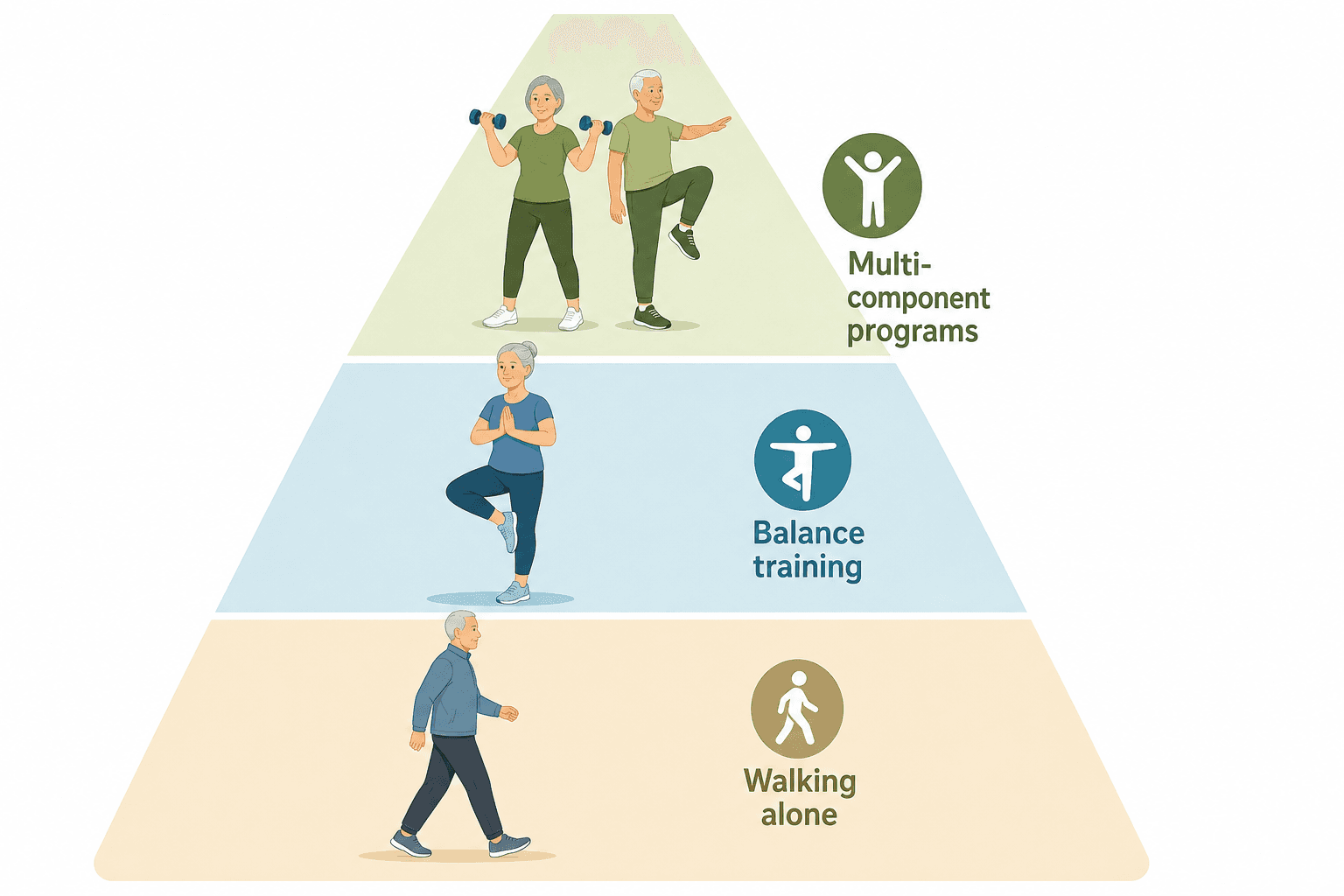
Not all exercise approaches produce the same results. The evidence points to a clear hierarchy, and understanding it matters for choosing a program that actually reduces fall risk rather than just improving fitness generally.
| Exercise Type | Evidence for Fall Reduction | Key Limitation |
|---|---|---|
| Multi-component programs (balance + lower-body strength) | Strongest and most consistent — reduces injurious falls, number of fallers, and fall incidence | Requires more structured programming than walking alone |
| Mind-body exercise (tai chi) | Strong — associated with 20–58% fall reductions across multiple RCTs; confirmed by 2025 Springer meta-analysis as among the most effective categories | Requires learning specific movement sequences; group classes may not be universally accessible |
| Balance training alone (no strength component) | Mixed — consistently improves balance measures (16–42% improvements per PMC 2019 review) but shows inconsistent effects on actual fall rates as a standalone intervention | Insufficient on its own to reliably reduce fall incidence |
| Strength training alone | Some benefit to muscle function but no clear evidence of reducing fall rates as a standalone intervention | Must be paired with balance challenge for fall-specific benefit |
| Walking alone (flat surface) | Insufficient — does not provide the balance challenge required to meaningfully reduce fall risk | Valuable for general health but not a fall prevention strategy on its own |
The USPSTF found that the most effective interventions combined gait, balance, and functional training with strength and resistance training. A 2023 systematic review published in Frontiers in Public Health confirmed that multi-component programs reduced medically attended injurious falls and the number of people who fell, while balance training as a single modality showed no evidence of reducing fall rates on its own.
How Much Exercise Is Enough?
The evidence-based dosage range, drawn from the USPSTF review and the 2025 Springer meta-analysis, is consistent across studies:
- Frequency: 2–3 sessions per week is the most common effective schedule across reviewed trials.
- Session length: At least 30–60 minutes per session.
- Minimum duration: At least 8 weeks of consistent participation before fall-risk benefits become measurable.
- Optimal timeline: The 2025 Springer meta-analysis found that balance capacity specifically requires at least 11–12 weeks of intervention to show measurable improvement. The most effective USPSTF trials ran 12 months.
- Ongoing maintenance: The Frontiers 2023 review noted that programs must be maintained on an ongoing basis — benefits diminish if exercise stops.
Is Balance Exercise Alone Enough — Or Do You Also Need Strength Training?
This is the most common misconception in fall prevention: that balance exercises by themselves are sufficient.
The Frontiers 2023 systematic review found that balance training as a single intervention showed no evidence of reducing fall rates on its own. The PMC 2019 review confirmed that balance measures improve with balance-focused exercise — but improved balance scores do not automatically translate into fewer falls unless the program also builds the lower-extremity strength needed to act on that improved awareness.
Walking alone has the same limitation. As the National Council on Aging notes, walking on flat surfaces does not provide sufficient balance challenge and does not build the leg strength required for meaningful fall risk reduction. A walking program has real health benefits — but it is not a fall prevention strategy on its own.
Who Should Exercise, and Are There Safety Concerns?
Exercise is protective, not risky — and the evidence supports that framing. The USPSTF found that adverse effects from exercise interventions in the reviewed trials were generally minor musculoskeletal discomfort. Serious harms were rare.
The National Institute on Aging makes this point directly: fear of falling should not be a reason to avoid activity. Staying active is itself protective — inactivity leads to the muscle weakness and reduced coordination that compound fall risk over time.
That said, some older adults benefit from a clinical assessment before starting an independent exercise program. The situations where a conversation with a doctor or physical therapist first makes sense include:
- A history of falls in the past year.
- Noticeable unsteadiness or difficulty with balance during everyday activities.
- Taking four or more medications, particularly those associated with dizziness, sedation, or blood pressure changes.
- Significant chronic conditions affecting mobility, such as Parkinson's disease, severe arthritis, or peripheral neuropathy.
- Recent hospitalization or a period of extended bed rest.
When to Consult a Doctor or Physical Therapist
A physical therapist can conduct a functional assessment, identify specific balance and strength deficits, and design an individualized program that accounts for existing health conditions and medications. This is particularly valuable for anyone who has already fallen or who is noticeably unsteady.
The USPSTF specifically recommends that clinicians use fall history and functional assessment to identify which older adults are at increased risk — meaning a doctor's visit is also an opportunity to have a structured conversation about exercise as a fall prevention tool, not just a general wellness recommendation.
For family caregivers raising the topic with an older parent: framing exercise as something that protects independence — rather than something imposed because of a fall — tends to be more effective. Older adults who understand that activity is what preserves their ability to live at home are more likely to engage consistently.
- Ask the primary care physician for a fall risk assessment at the next visit — this is a standard part of preventive care for adults 65 and older.
- Request a physical therapy referral if there is a history of falls or noticeable balance problems — a PT can design a program tailored to current functional capacity.
- Ask whether any current medications may be contributing to fall risk — medication review is a separate but important component of fall prevention.
- Look for community-based programs offering tai chi or balance-focused group exercise — structured group settings improve adherence and provide supervised progression.
Bottom Line
Balance exercises work — and the evidence supporting that conclusion is now anchored to the strongest clinical recommendation available in the United States. The 2024 USPSTF Grade B recommendation reflects consistent findings across decades of research: exercise reduces falls, reduces injurious falls, and reduces the number of older adults who fall.
The most important practical takeaway is that program design matters. Multi-component programs combining balance challenge with lower-body strength training produce the most consistent results. Tai chi is a well-supported option. Walking alone is not sufficient. And programs need to run at least 8–12 weeks, at 2–3 sessions per week, to produce measurable benefit — with ongoing participation to maintain it.
Read the Full Guide
FAQs provide a concise answer. For comprehensive coverage, see these related guides.
- Does Medicare Cover Medical Alert Systems?
Original Medicare does not cover medical alert systems, but Medicare Advantage plans, Medicaid waivers, VA benefits, and other funding pathways can meaningfully reduce the cost — this FAQ explains why Medicare excludes these devices and walks through every realistic option for families and older adults on fixed incomes.
- Are Home Monitoring Cameras Legal for Elderly Parents? A Privacy and Consent Guide
A practical FAQ for family caregivers navigating the legal and ethical questions around installing cameras in an aging parent's private home — covering federal and state consent rules, cognitive capacity, placement restrictions, and privacy-respecting alternatives.
- Is It Safe for Someone With Dementia to Drive?
A dementia diagnosis does not automatically end driving, but it begins a mandatory monitoring and planning process — this guide helps family caregivers understand stage-based risk, recognize warning signs, navigate professional evaluation, and prepare for the conversation before a crisis occurs.
Comments
Join the discussion with an anonymous comment.