
Glossary entry
Home Modification Costs for Aging in Place: What Families Need to Know
The Financial Math: One-Time Costs vs. Recurring Annual Costs
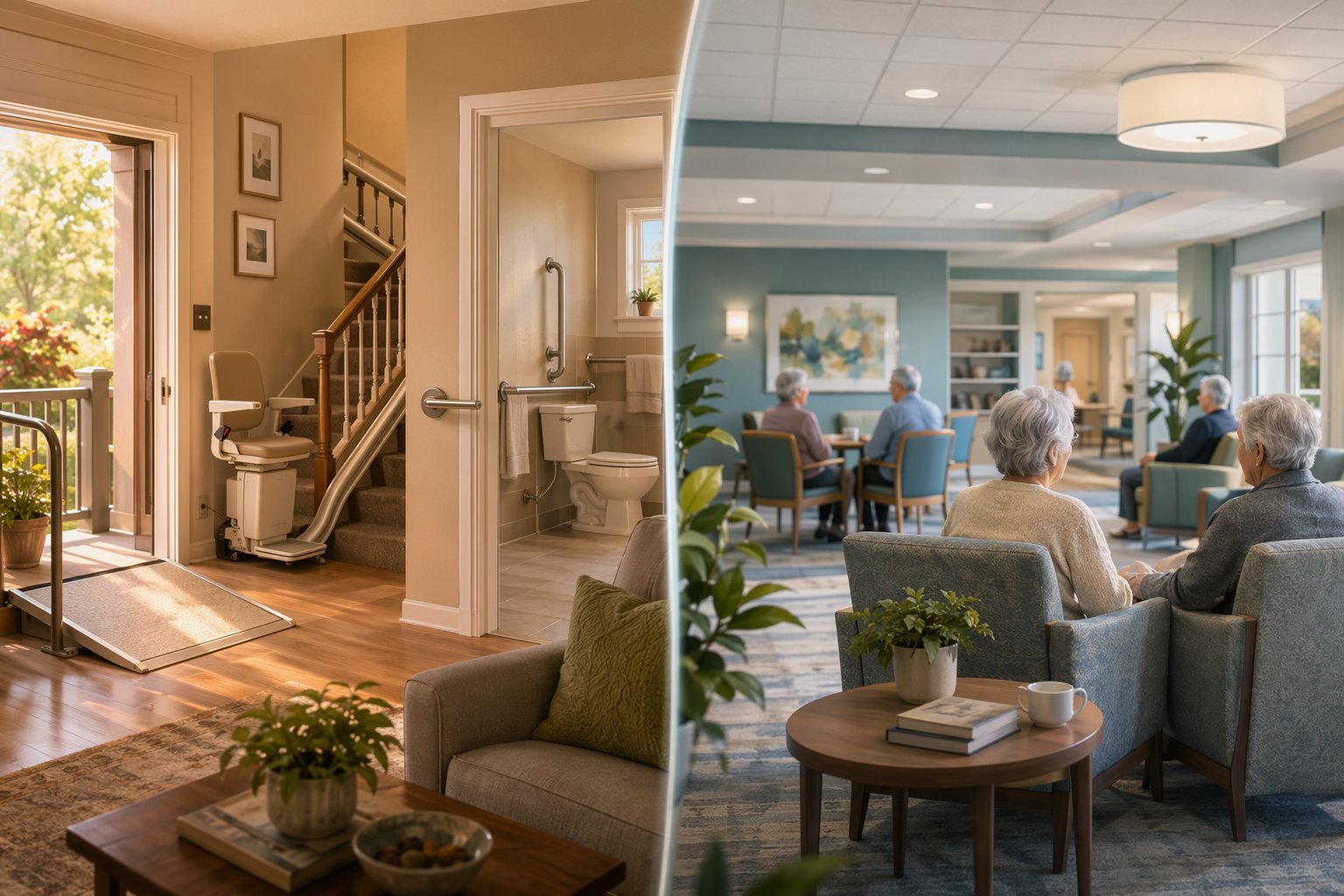
When a parent falls or is hospitalized, families often face a high-stakes decision in a compressed timeframe: invest in making the family home safer, or begin the process of finding an assisted living facility. The financial difference between these two paths is not subtle.
A comprehensive package of home modifications — grab bars, a walk-in shower, stair lift, widened doorways, and ramps — typically costs between $10,000 and $25,000 as a one-time investment. By contrast, assisted living in the United States averages $45,000 to $64,200 per year, according to data from the AHCA/NCAL cited by Choice Mutual. That is a recurring annual expense that increases with inflation and level of care.
Put another way: the one-time cost of making a home accessible is roughly equivalent to two to six months of assisted living fees. After that initial investment, the monthly cost of staying at home is limited to utilities, property taxes, and any in-home care services — not a five-figure facility bill that repeats every twelve months.
What Do Home Modifications Actually Cost?
Not every modification requires a contractor or a large budget. Many high-impact safety upgrades are surprisingly affordable. The table below breaks down common modifications by cost tier, drawing on data from NerdWallet and ElderLife Financial.
| Modification | Typical Cost Range | Notes |
|---|---|---|
| Grab bars (per bar, installed) | $100 – $400 | Retail cost is $30–$60 per bar; professional installation adds labor. |
| Lever-style door handles (per door) | $75 – $400 | Easier to operate than round knobs for those with arthritis or limited grip. |
| Handheld showerhead | $25 – $100 | Low-cost upgrade that reduces showering risk. |
| Raised toilet seat | $30 – $150 | Reduces fall risk during transfers. |
| Non-slip flooring (per sq. ft.) | $3 – $14 | Cost depends on material; luxury vinyl plank is a popular mid-range option. |
| Walk-in shower (custom) | $6,000 – $12,000 | Prefabricated units can be under $1,000; custom builds run higher. |
| Stair lift (installed) | $2,500 – $8,000 | Straight staircases cost less; curved tracks cost more. |
| Wheelchair ramp (modular) | $1,100 – $3,600 | Average cost is approximately $2,300. |
| Doorway widening (per doorway) | $600 – $2,000 | Necessary for wheelchair or walker access. |
| Adjustable kitchen countertops | $1,900 – $4,500 | Average cost is approximately $3,100. |
| Comprehensive modification package | $10,000 – $25,000 | Covers multiple rooms and priority safety upgrades. |
The HHS Office of the Assistant Secretary for Planning and Evaluation (ASPE) found that among older adults who added home features, roughly one-third paid less than $100 out-of-pocket, another third paid between $100 and $500, and only about 10% paid more than $1,000. However, that data comes from 2006, and costs for materials and labor have risen significantly since then. The key takeaway: even modest spending on targeted modifications can meaningfully reduce fall risk.
The Cost of Assisted Living and Nursing Homes
The financial weight of facility-based care is not a one-time expense — it is a recurring annual obligation that typically rises each year. Understanding these numbers is essential for an honest comparison.
| Care Setting | Average Annual Cost | Average Monthly Cost |
|---|---|---|
| Assisted living | $45,000 – $64,200 | $3,750 – $5,350 |
| Nursing home (semi-private room) | $90,000 – $105,000+ | $7,500 – $8,750+ |
| Nursing home (private room) | $100,000 – $120,000+ | $8,500 – $10,000+ |
These are national averages. Costs vary dramatically by state and metropolitan area. A private nursing home room in Manhattan can exceed $150,000 per year, while assisted living in a rural Midwestern town may be closer to $36,000. Geographic variation matters as much as the national figure.
The critical distinction is recurrence. A $15,000 bathroom renovation is paid once. A $5,000 monthly assisted living bill is paid every month, every year, for as long as the resident lives there. Over a five-year period, the cumulative cost of assisted living at the national average is $225,000 to $321,000 — compared to a one-time modification investment of $10,000 to $25,000.
Beyond the Price Tag: Non-Financial Factors to Consider
Cost is only one dimension of this decision. The emotional and psychological weight of leaving a long-time home is substantial for most older adults. According to Choice Mutual, over 60% of seniors say they have an emotional attachment to their home. The AARP reports that nearly 90% of adults over 65 want to remain in their current homes as they age.
Families should weigh several non-financial factors alongside the budget comparison:
- Independence and autonomy: At home, an older adult controls their schedule, meals, and daily routines. Assisted living facilities operate on institutional schedules that can feel restrictive.
- Familiarity and orientation: A known environment reduces confusion and anxiety, particularly for individuals with mild cognitive impairment. Knowing where the bathroom is, how the kitchen works, and which drawer holds the silverware matters more than most families realize.
- Proximity to family and community: Staying in the family home often means staying near neighbors, friends, and familiar services — the pharmacy, the grocery store, the place of worship. Moving to a facility may mean losing those connections.
- Quality of life and dignity: Many older adults associate moving to a facility with loss of independence and dignity. The psychological impact of that transition can be significant, even when the facility is well-run.
These factors do not always tip the scale toward home modifications. But they are real, and they deserve as much weight in the decision as the dollar figures.
When Home Modifications Make the Most Sense
Home modifications are not a universal solution. They work best for a specific profile of older adult and family situation. The ideal candidate for aging in place with modifications typically has:
- Moderate mobility needs: The person uses a cane, walker, or wheelchair but does not require 24/7 skilled nursing care. They can transfer with minimal assistance and manage basic activities of daily living with some support.
- Strong family or caregiver support: A family member lives nearby or can visit regularly. Modifications reduce the physical burden on caregivers — a systematic review found that weekly care hours decreased by 42% after home modifications, with informal care dropping 46% and formal care dropping 16%.
- A structurally suitable home: The home has a bedroom and full bathroom on the main floor, or the layout can accommodate a stair lift. The foundation and structure can support grab bars and ramps. Only about 10% of U.S. homes are adequately designed for aging populations, according to the U.S. Census Bureau.
- No need for 24/7 skilled nursing: If the older adult requires ongoing medical monitoring, wound care, or skilled nursing interventions that cannot be managed by a visiting nurse, a facility may be necessary regardless of the home's accessibility.
The evidence supports the effectiveness of home modifications for this profile. A 2025 systematic review published in PMC found that 65% of studies confirmed home modifications are effective for fall prevention, functional independence, and cost savings. One study in the review found a 39% reduction in falls in the intervention group, and a large Welsh study of 657,536 older adults found that fall odds decreased by 3% per quarter after home adaptations.
When Assisted Living May Be the Better Choice
Home modifications are not the right answer for every family. There are clear scenarios where assisted living or a nursing home is the safer, more appropriate option. Acknowledging this honestly is essential for a decision framework that families can trust.
- Advanced dementia or significant cognitive decline: When an older adult is at risk of wandering, cannot recognize hazards, or requires constant supervision, a memory care unit with secured exits and trained staff is safer than even the most well-modified home.
- Need for 24/7 skilled nursing care: If the person requires around-the-clock medical monitoring, ventilator support, or complex wound care that exceeds what home health agencies can provide, a skilled nursing facility is the appropriate setting.
- Unsafe or unsuitable home structure: Some homes cannot be made safe at a reasonable cost. A multi-story house with no main-floor bathroom, narrow hallways that cannot be widened, or a foundation that cannot support a ramp may make modifications impractical or prohibitively expensive.
- Significant social isolation risk: If an older adult lives alone with no nearby family or regular visitors, staying at home — even with modifications — can lead to dangerous isolation. Assisted living provides built-in social engagement, meals, and wellness checks.
- Caregiver burnout with no relief: If the primary family caregiver is experiencing significant burnout and there is no backup support system, the safety of both the caregiver and the older adult may be at risk. Facility placement can be a responsible choice for everyone's wellbeing.
The Hybrid Approach: Modifications Plus In-Home Care
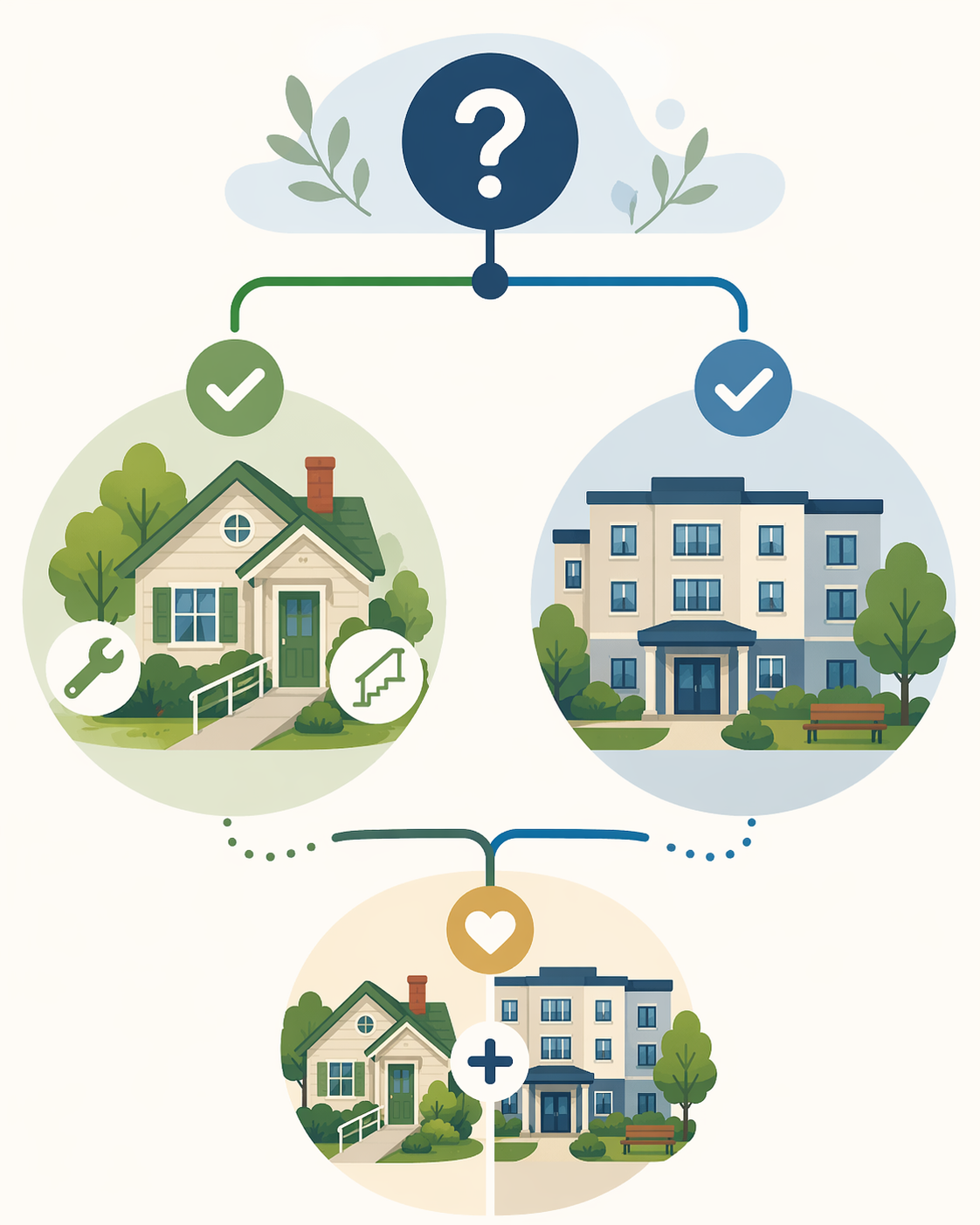
The choice between home modifications and assisted living is not binary. Many families find that a hybrid strategy — making key safety modifications while supplementing with paid in-home care — offers the best balance of cost, safety, and quality of life.
The logic is straightforward: modifications reduce the physical demands on caregivers, which means families can rely on fewer paid care hours. The Carnemolla & Bridge 2019 study found that weekly care hours decreased by 42% after home modifications. For a family paying $25 to $35 per hour for in-home care, that reduction can translate to significant monthly savings.
| Scenario | Monthly Cost Estimate | Annual Cost Estimate |
|---|---|---|
| Full-time assisted living | $5,350 | $64,200 |
| Home modifications (one-time) + 20 hrs/week in-home care | $2,000 – $2,800 (care) + $0 (mods paid) | $24,000 – $33,600 + one-time mod cost |
| Home modifications (one-time) + 10 hrs/week in-home care | $1,000 – $1,400 (care) + $0 (mods paid) | $12,000 – $16,800 + one-time mod cost |
| Home modifications only (family provides all care) | $0 (care) | $0 + one-time mod cost |
For many families, the hybrid approach costs significantly less than full-time assisted living while allowing the older adult to remain in a familiar environment. The one-time modification investment pays for itself within months if it reduces the need for paid care hours or enables a family caregiver to continue working.
This approach works best when the older adult's care needs are moderate and predictable. If needs escalate beyond what in-home care can manage, the family can transition to facility care later — but they will have delayed that expense, possibly by years.
A Decision Framework for Families
When the decision feels overwhelming, working through a structured set of questions can bring clarity. The following framework is designed for a family conversation — ideally including the older adult, the primary caregiver, and any other key family members.
- What level of care does my parent actually need right now? Be specific about mobility, medication management, toileting, bathing, and cognitive status. An occupational therapy assessment can provide an objective answer.
- Can the home be made safe at a reasonable cost? Get quotes from two or three CAPS-certified contractors for the priority modifications. Compare the total to 6–12 months of assisted living costs.
- Is there a family caregiver available and willing? Modifications reduce caregiving burden but do not eliminate it. Be honest about the caregiver's capacity, health, and other obligations.
- What does my parent want? Over 90% of older adults prefer to stay home. But preferences can change when safety is at stake. Have the conversation openly, without pressure.
- What are the funding options? Only about 6% of older adults who added home features had insurance or government programs pay any portion. However, VA grants (SAH up to $117,014, SHA up to $23,444), USDA Section 504 loans (up to $10,000 for very-low-income homeowners 62+), and some state Medicaid HCBS waivers may help. Medicare does not cover home modifications, though some Medicare Advantage plans offer limited coverage.
- What is the fallback plan? If we invest in modifications and care needs escalate, can we transition to facility care without financial ruin? Having a contingency plan reduces the pressure on the initial decision.
There is no single right answer for every family. But the data is clear: for the right candidate, a one-time investment in home modifications is dramatically more cost-effective than recurring facility costs, and it supports what the vast majority of older adults say they want — to remain at home, in familiar surroundings, with independence and dignity intact.
Browse more in the Glossary.