
In-Home Senior Care Cost in 2026: Hourly Rates, Monthly Projections, and State-by-State Guide
Last reviewed: — Review date is particularly important for Medicare coverage, device specifications, and clinical guidance, which change frequently.

The Real Question Families Ask: What Will In-Home Care Actually Cost Us?
You've had the conversation. Maybe it happened after a fall, a hospitalization, or a series of small incidents that made it clear your parent can't manage alone anymore. Now you're facing a question that feels impossible to answer with a simple search: how much is this actually going to cost?
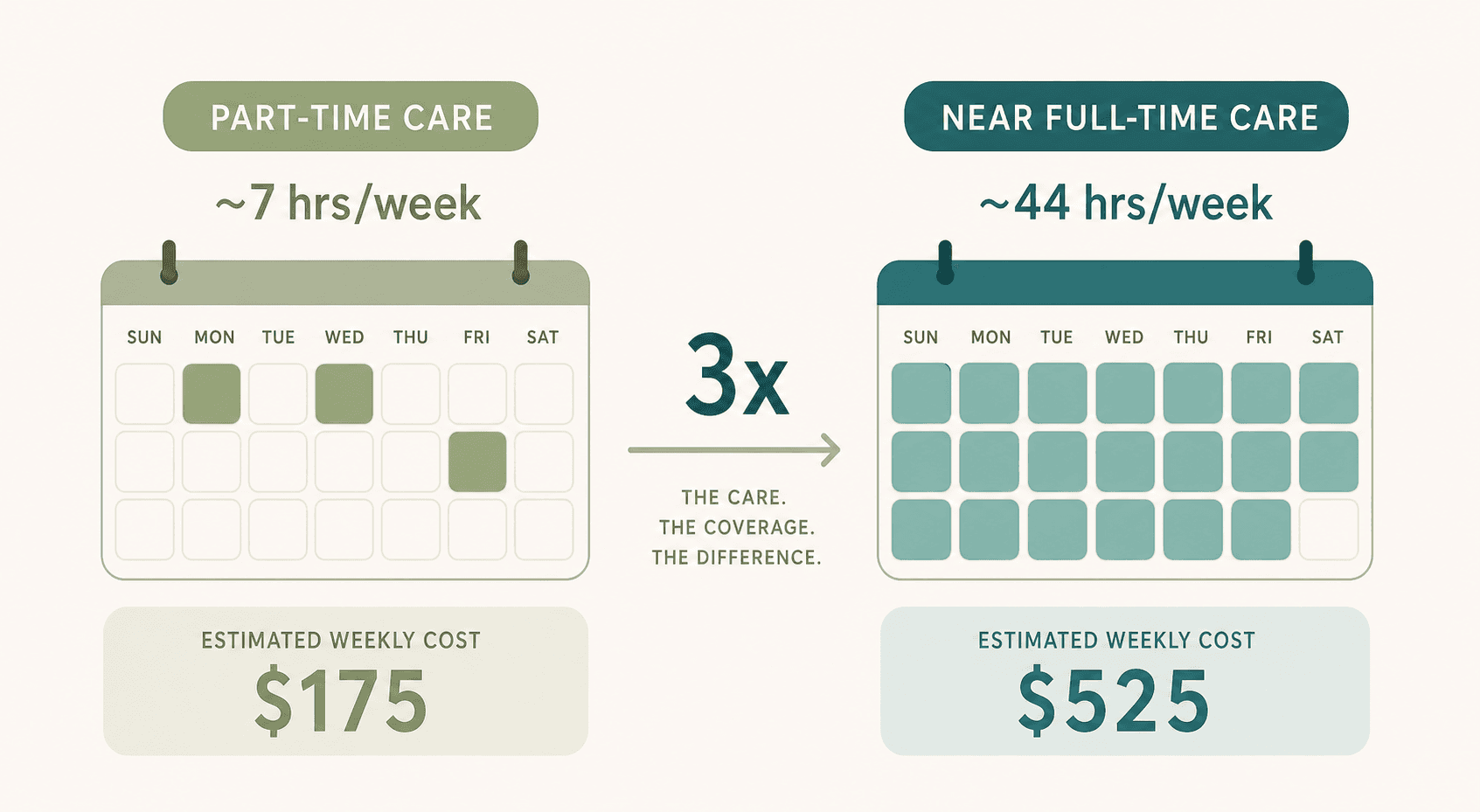
The short answer is that in-home senior care in 2026 costs a national median of $34 to $35 per hour. But that single number is almost useless for budgeting because it hides two massive variables: where you live and how many hours of care you need. The real range runs from about $23 per hour in parts of the South to $44 per hour in the upper Midwest and Pacific Northwest. And the difference between hiring a helper for 7 hours a week versus 44 hours a week is a roughly 3-to-1 swing in monthly cost.
This guide is built for the specific moment you're in: you need to know what care will cost for your parent, in your state, at the schedule your family can manage. We'll walk through the national baseline, the state-by-state breakdown, the difference between hiring through an agency versus directly, and how to turn all of it into a budget you can actually use.
National Median Cost of In-Home Care in 2026: $34–$35 Per Hour
Three major sources converge on a national median hourly rate of $34 to $35 for non-medical in-home care in 2026. CareScout's 2025 Cost of Care Survey (fielded July through November 2025, published early 2026) reports a median of $35 per hour, a 3% increase from $34 in 2024. A Place for Mom's 2026 Costs of Long-Term Care and Senior Living Report puts the national median at $34 per hour. SeniorLiving.org, citing CareScout data, also reports $35 per hour.
This national median is the right starting point for a rough estimate, but it masks enormous geographic variation. The same 30-hour-per-week schedule that costs $4,416 per month at the national median could cost $3,000 in Louisiana or $5,520 in South Dakota. That's why the state-level data in the next section is essential for building a realistic budget.
Monthly Cost by Care Schedule: From Part-Time to Near-Full-Time
The number of hours you need each week is the single biggest lever on total cost. The table below shows monthly costs at four common care schedules using the $34 per hour national median from A Place for Mom. These are the hours that correspond to real caregiving scenarios: a few hours of companionship and light help, daily assistance with meals and medication, a full workday of coverage, and near-continuous care.
| Weekly Hours | Daily Equivalent | Typical Scenario | Monthly Cost ($34/hr) |
|---|---|---|---|
| 7 hours | 1 hour/day | Companionship, light housekeeping, medication reminders | $1,031 |
| 15 hours | ~2 hours/day | Meal prep, bathing assistance, daily check-ins | $2,208 |
| 30 hours | ~4.5 hours/day | Coverage during a full workday, help with multiple ADLs | $4,416 |
| 44 hours | ~6.5 hours/day | Near-continuous care, significant mobility or dementia support | $6,478 |
The swing from 7 hours per week to 44 hours per week is more than 6x the cost — from roughly $1,000 per month to nearly $6,500. Most families fall somewhere in the middle, needing 15 to 30 hours per week for a parent who needs help with meals, medication management, and personal care but does not require round-the-clock supervision.
Full State-by-State Median Hourly Rates (2026)
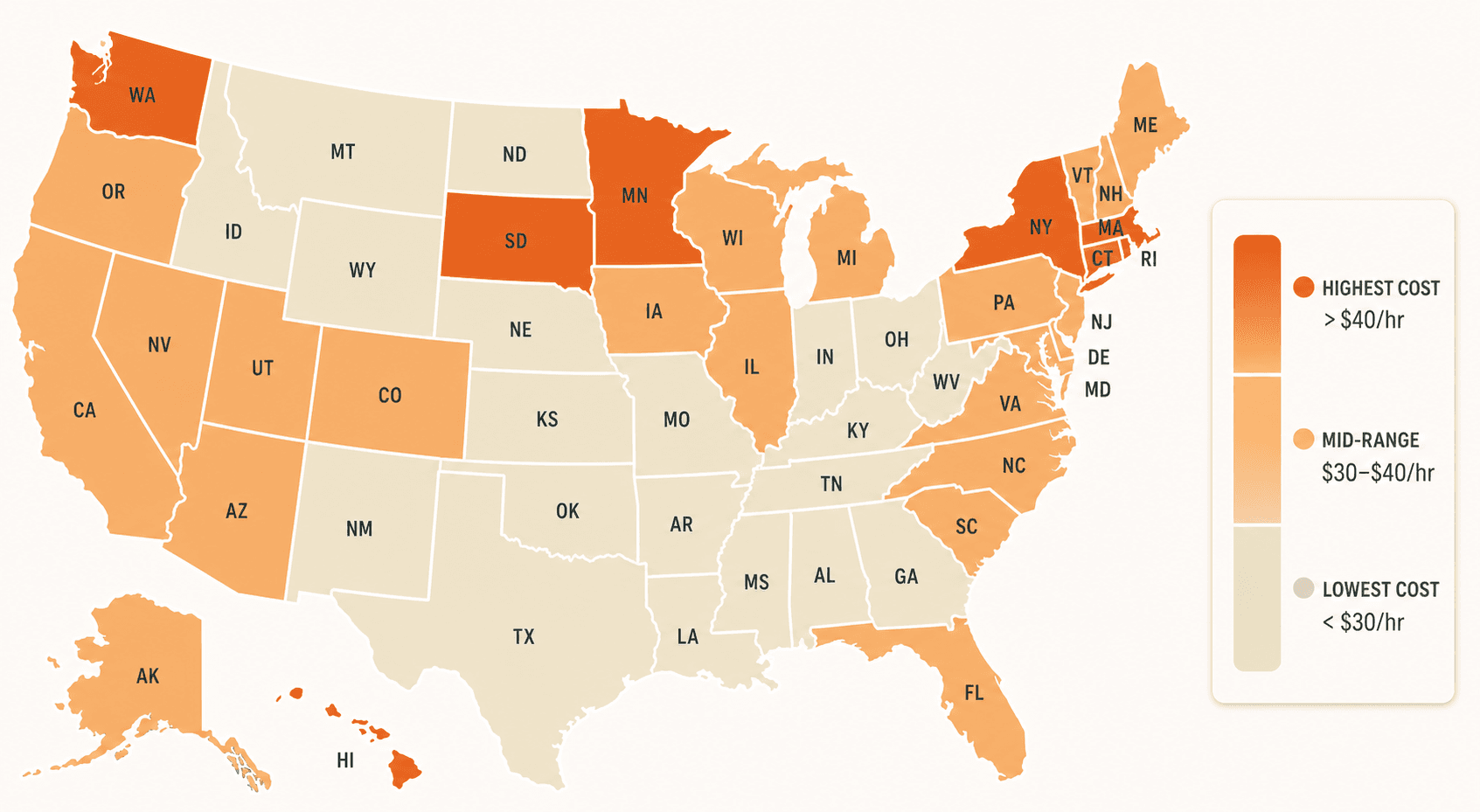
The table below compiles median hourly rates for all 50 states and the District of Columbia from A Place for Mom's 2026 report and SeniorLiving.org's 2026 data. Where the two sources differ by more than $1, both figures are shown. These are median rates for non-medical in-home care — homemaker services and home health aide combined — not skilled nursing care.
| State | Median Hourly Rate | State | Median Hourly Rate |
|---|---|---|---|
| Alabama | $27 | Montana | $33 |
| Alaska | $36 | Nebraska | $35 |
| Arizona | $33 | Nevada | $33 |
| Arkansas | $27 | New Hampshire | $35 |
| California | $35 | New Jersey | $35 |
| Colorado | $36 | New Mexico | $30 |
| Connecticut | $35 | New York | $35 |
| Delaware | $30 | North Carolina | $29 |
| District of Columbia | $35 | North Dakota | $36 |
| Florida | $30 | Ohio | $32 |
| Georgia | $29 | Oklahoma | $28 |
| Hawaii | $35 | Oregon | $37 |
| Idaho | $31 | Pennsylvania | $33 |
| Illinois | $35 | Rhode Island | $34 |
| Indiana | $32 | South Carolina | $28 |
| Iowa | $33 | South Dakota | $44 |
| Kansas | $32 | Tennessee | $29 |
| Kentucky | $28 | Texas | $28 |
| Louisiana | $23–$26 | Utah | $33 |
| Maine | $30 | Vermont | $34 |
| Maryland | $33 | Virginia | $30 |
| Massachusetts | $37 | Washington | $42 |
| Michigan | $32 | West Virginia | $28–$29 |
| Minnesota | $41–$42 | Wisconsin | $36 |
| Mississippi | $25 | Wyoming | $33 |
| Missouri | $30 |
The range is striking. Mississippi and Louisiana sit at $23 to $26 per hour, while South Dakota ($44), Washington ($42), and Minnesota ($41–$42) are nearly double. The difference is not simply a cost-of-living adjustment — it reflects local labor market conditions, state minimum wage laws, the availability of home care workers, and regional differences in how care is delivered.
Agency vs. Private Hire: The 20–30% Premium and What It Buys
The rates above reflect what you would pay a home care agency. Hiring a private caregiver directly — someone you find through a referral, a local ad, or an online platform — typically costs 20 to 30% less. That difference can mean $7 to $10 per hour off the agency rate, which adds up to hundreds of dollars per month.
But the agency premium buys specific protections that many families find essential:
- Background checks and credential verification: Agencies screen caregivers before sending them into your home.
- Payroll and tax handling: The agency is the employer of record, which means you do not have to manage payroll taxes, workers' compensation, or unemployment insurance.
- Backup coverage: If the regular caregiver calls in sick, the agency sends a replacement. With a private hire, you are the backup plan.
- Liability and bonding: Agency caregivers are covered by the agency's insurance, protecting you if something is damaged or an accident occurs.
For many families, the 20–30% premium is worth the peace of mind, especially when care needs are complex or the parent lives alone. For others, especially those with a trusted referral or a family member who can supervise, private hire makes financial sense.
Annual Projections: $31,000 to $80,000+ Depending on Schedule
Annualizing the monthly costs gives a clearer picture of the long-term financial commitment. Using the $34 per hour national median, here is what a year of care costs at different weekly schedules:
| Weekly Hours | Monthly Cost | Annual Cost |
|---|---|---|
| 7 hours | $1,031 | $12,372 |
| 15 hours | $2,208 | $26,496 |
| 30 hours | $4,416 | $52,992 |
| 44 hours | $6,478 | $77,736 |
| 44 hours (CareScout $35/hr) | $6,731 | $80,080 |
The annual range — from roughly $12,000 for a few hours of weekly companionship to over $80,000 for near-full-time care — explains why most families use a combination of paid care and family-provided care. Even at the 30-hour-per-week level, $53,000 per year is a significant expense that requires planning.
For families looking to reduce costs, our complete guide to affordable senior care covers assistance programs, money-saving strategies, and ways to stretch a care budget without sacrificing quality.
How In-Home Care Compares to Assisted Living and Nursing Homes
Families often assume that home care is cheaper than a facility. That is true at lower care hours, but the math flips as needs increase. Here is how the monthly costs compare using 2026 data:
| Care Setting | Monthly Cost (2026 Median) |
|---|---|
| In-home care (44 hrs/week) | $6,478 |
| Assisted living | $6,200 |
| Nursing home (semi-private room) | $9,581 |
| Nursing home (private room) | $10,798 |
At 44 hours per week, in-home care costs roughly the same as assisted living — about $6,200 to $6,500 per month. But home care becomes more expensive than a nursing home when care needs exceed 40 to 50 hours per week, because you are paying for labor on top of your parent's existing housing costs (mortgage or rent, utilities, groceries, home maintenance). Nursing home costs are all-inclusive: housing, meals, 24-hour supervision, and skilled nursing are bundled into the monthly rate.
Using This Data to Build Your Family's Care Budget
The numbers in this guide are a starting point, not a final answer. Here is a practical framework for turning them into a budget that reflects your family's actual situation:
- Start with your state's median hourly rate from the table above. If your state has a range (e.g., Louisiana $23–$26), use the higher end for a conservative estimate.
- Estimate the weekly hours your parent needs. Be honest about what family members can provide and what must be hired out. Most families underestimate the hours needed in the first month.
- Multiply: hourly rate × weekly hours × 4.33 (average weeks per month) to get a monthly estimate. Then multiply by 12 for an annual projection.
- Add 20–30% if you plan to use an agency. Subtract 20–30% if you plan to hire privately, but add the cost of your time for payroll, scheduling, and backup coverage.
- Factor in your parent's existing housing costs. Home care adds to those costs; facility care replaces them.
Once you have a realistic budget, the next question is how to pay for it. Our guide to payment options for elderly home care covers Medicare, Medicaid HCBS waivers, VA benefits, long-term care insurance, and other funding sources that can make in-home care affordable.
Read the Full Guide
FAQs provide a concise answer. For comprehensive coverage, see these related guides.
- Short-Term Care for Elderly: A Respite Guide for Caregivers Facing Burnout
This guide helps spousal and adult child caregivers recognize when burnout is approaching, understand the emotional barriers to seeking help, and find practical, affordable short-term care options to sustain their caregiving journey.
- A Compass for Caregiving: Your Guide to Help for Elderly and Disabled Adults
Feeling overwhelmed by the fragmented system of help for an aging or disabled loved one? This compass-style guide maps the four interconnected domains of assistance — in-home care, government benefits, financial aid, and caregiver support — so you can find every source of help available and start anywhere.
- Beyond 'Senior Citizen Home': A Family Guide to 6 Senior Living Options in 2026
Most families search for 'senior citizen home' without realizing the term masks six fundamentally different facility types. This guide helps adult children understand the landscape—from independent living to skilled nursing—so they can match a parent's actual needs to the right setting and avoid costly mismatches.
Comments
Join the discussion with an anonymous comment.