
Caregiver decision guide
Private Caregiver vs. Home Care Agency: A Decision Framework for Families Weighing Cost, Risk, and Control
This article helps adult children decide whether to hire a private caregiver directly or use a home care agency. It centers on the employer-responsibility trade-off, comparing hourly costs, hidden employer expenses, backup reliability, safety vetting, legal exposure, and caregiver continuity, and provides a structured decision matrix with diagnostic questions.

The Core Question: Can Your Family Absorb the Employer Role?
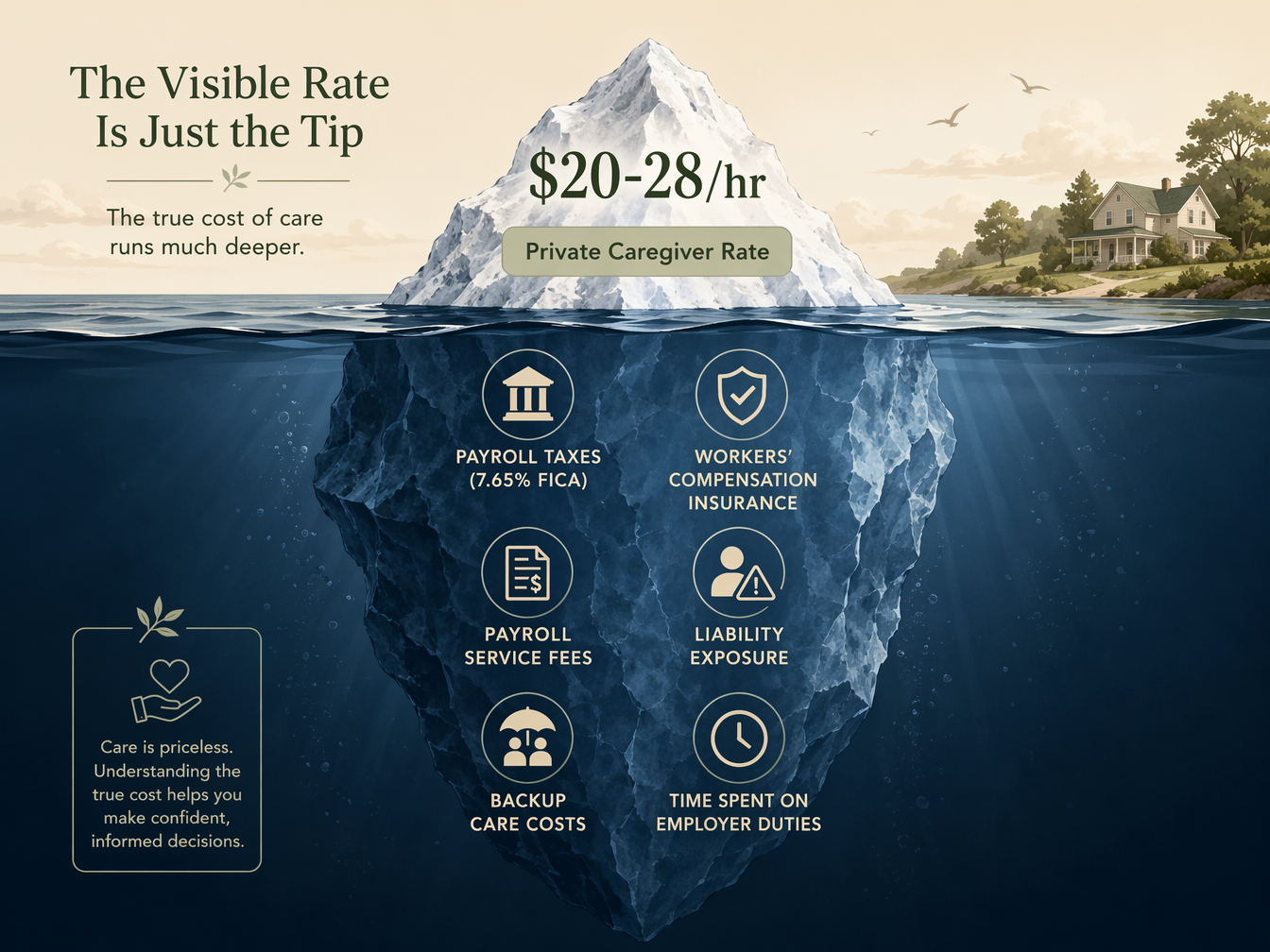
When a parent needs regular help at home, families quickly discover two paths: hire a private caregiver directly, or contract with a home care agency. The surface-level difference is cost — private caregivers typically charge $20–28 per hour while agencies average $33–40+ per hour. But the real question isn't about the hourly rate. It's about whether your family can take on the full set of employer responsibilities — payroll, taxes, backup coverage, liability, and ongoing management — in exchange for saving 20–30% and gaining more control over who walks through the door.
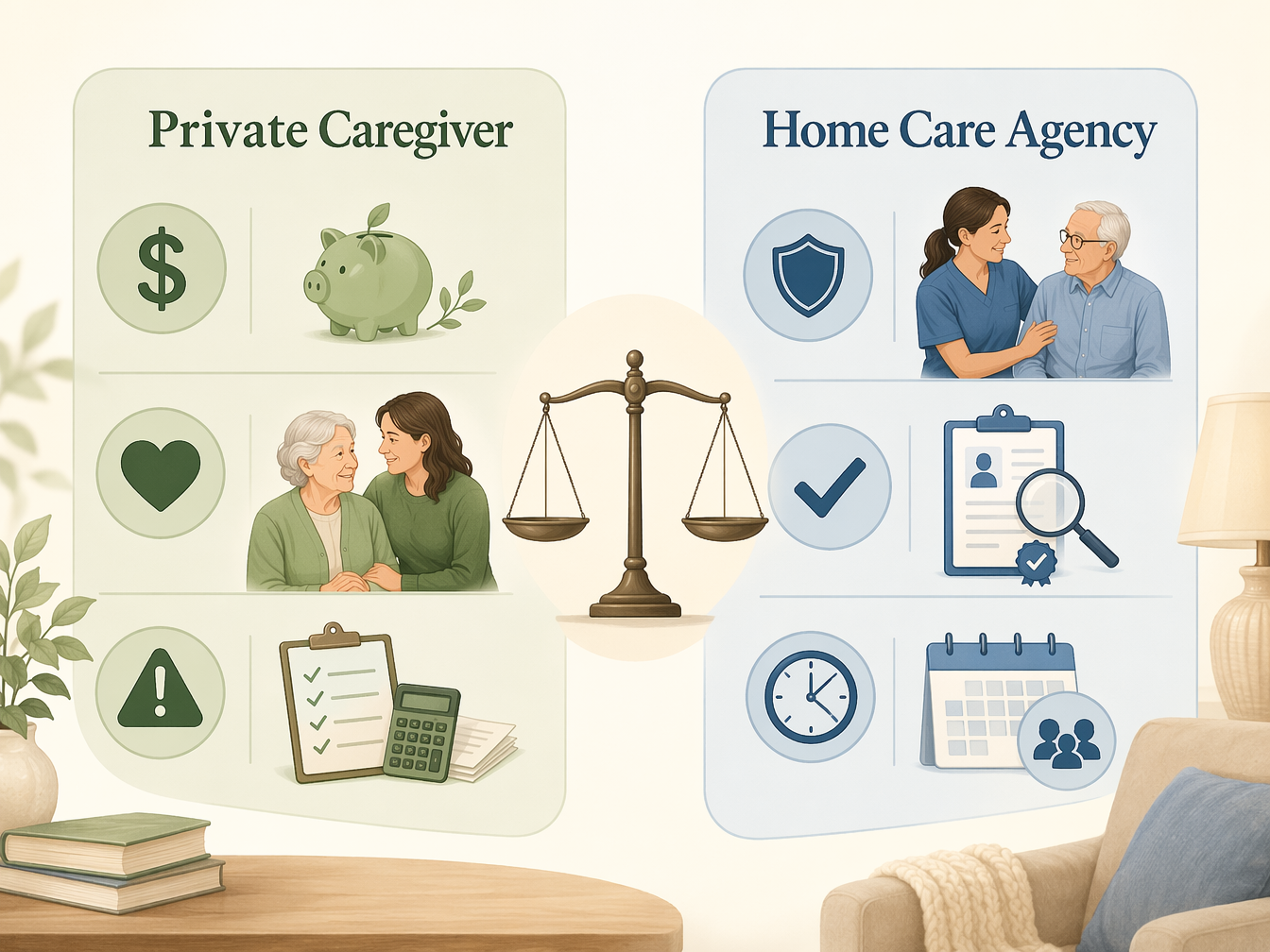
This article is a decision framework, not a neutral pro/con list. It centers on one criterion: the employer-responsibility trade-off. By the end, you'll have a clear sense of which model fits your family's situation — and a set of diagnostic questions to help you decide.
How the Two Models Work: Private Direct Hire vs. Home Care Agency
Before comparing costs and risks, it helps to understand exactly what each model includes — and what it leaves for the family to handle.
Private Direct Hire
You find, interview, hire, and pay a caregiver directly. You set the schedule, define the tasks, and manage the relationship. The caregiver works for you — you are their employer. This means you are responsible for payroll taxes, workers' compensation insurance, background checks, and finding backup coverage when the caregiver is unavailable. According to the IRS, if you pay a caregiver more than $3,000 in cash wages in 2026, they are legally a household employee — not an independent contractor — and you must withhold and pay Social Security and Medicare taxes.
Home Care Agency
You sign a contract with a company that employs the caregivers. The agency handles hiring, training, background checks, payroll, taxes, insurance, and scheduling. If your regular caregiver is sick, the agency sends a substitute. You pay a higher hourly rate — typically 30–50% more than a private caregiver, according to Clara Home Care — but you trade money for convenience, legal protection, and reliability.
- Private hire: You are the employer. You save money but take on all management and legal duties.
- Agency: The agency is the employer. You pay more but offload nearly all administrative and legal risk.
Cost Comparison: Hourly Rates and the Hidden Employer Costs of Private Hire
The headline numbers are straightforward. According to CareScout's 2025 Cost of Care Survey, the national median hourly rate for a non-medical caregiver is $35 per hour. The AARP June 2026 report found that home care costs rose 39% from 2021 to 2026, with a 7.9% increase in the single year from May 2025 to May 2026. Private caregivers, who don't carry an agency's overhead, typically charge $20–28 per hour nationally — a 20–30% savings, per Clara's analysis.
But the private hire rate is not the full cost. When you become a household employer, several additional expenses appear:
| Cost Component | Private Hire | Agency |
|---|---|---|
| Hourly rate (national median) | $20–28/hr | $33–40+/hr |
| Employer FICA (Social Security + Medicare) | 7.65% on all wages | Included in agency rate |
| Employee FICA (withheld from caregiver's pay) | 7.65% (you manage withholding) | Handled by agency |
| FUTA (federal unemployment) | 6% on first $7,000 (net ~0.6% after credit) | Included in agency rate |
| Workers' compensation insurance | Varies by state; ~$0.50–$2.00 per $100 of payroll | Included in agency rate |
| Payroll service fee (optional) | $30–$60/month | Not needed |
| Liability insurance rider | $100–$300/year on homeowner's policy | Covered by agency |
| Family management time (unpaid) | 5–10 hours/month for scheduling, payroll, issues | Minimal |
For a private caregiver earning $25/hour working 30 hours per week, the employer-side FICA alone adds roughly $2,980 per year. Add workers' comp, a payroll service, and a liability insurance rider, and the effective hourly cost rises to $28–$30 — still below the agency median, but closer than the headline numbers suggest.
For a deeper look at state-by-state rates and other hidden expenses, see our in-home senior care cost guide.
Reliability and Backup: What Happens When the Caregiver Can't Come?
This is often the deciding factor for families who do not live nearby. Agencies typically guarantee backup coverage: if your regular caregiver calls in sick, the agency sends a substitute. With private hire, there is no backup unless you arrange one. If the caregiver has a family emergency, a car problem, or takes a vacation, you — or another family member — must fill the gap.
The Family Caregiver Alliance explicitly lists this as a key disadvantage of private hire: "You must find alternate help if worker is sick." For long-distance caregivers — adult children who live in a different city or state — this can be a dealbreaker. If you have no local siblings, neighbors, or friends who can step in on short notice, the agency's backup guarantee may be worth the premium.
- Agency: Substitute caregiver provided, often within a few hours. No gap in care.
- Private hire: No backup. Family must find and vet a replacement, or provide care themselves.
- Long-distance caregivers: Agency backup is especially critical if no local family can fill in.
Safety and Vetting: Who Does the Background Check?
Agencies typically conduct criminal background checks, reference checks, credential verification, and sometimes drug testing before assigning a caregiver. They also provide training. When you hire privately, all of that vetting falls on you.
The Family Caregiver Alliance recommends a thorough process: ask for at least three references (two from former employers), check photo ID and driver's license, verify the Social Security number, and obtain signed waivers for criminal and credit background checks. Online background check services cost $10 to $100. In some states, like California, criminal records are restricted, but checks can still be conducted through state registries like TrustLine.
For a complete walkthrough of the screening process — including interview questions, reference checks, and background check resources — see our step-by-step guide to hiring a private sitter.
Relationship Continuity vs. Staff Rotation
One of the strongest arguments for private hire is relationship continuity. When you hire a specific person, that caregiver becomes a consistent presence in your parent's life. They learn the routines, preferences, and personality quirks. For someone with dementia or anxiety, this consistency can reduce agitation and improve cooperation with daily tasks.
Agencies vary widely on this point. Some assign a dedicated team of two or three caregivers who rotate, giving the family consistency while still providing backup coverage. Others send different workers based on availability, which means your parent may see a new face every shift. The Family Caregiver Alliance notes that agencies "may schedule multiple attendants" and have "more turnover" — a real concern for families who prioritize emotional connection.
If continuity is your top priority, ask agencies directly: "Will my parent see the same caregiver every shift, or could it be a different person each time?" Some agencies offer a "consistent staffing" model, but it may come at a premium.
Legal Exposure: Liability, Workers' Comp, and Insurance
This is the area where private hire carries the most hidden risk. Agencies carry liability insurance and workers' compensation coverage. If a caregiver is injured while helping your parent transfer from a bed to a wheelchair, the agency's workers' comp covers it. If the caregiver accidentally damages property or causes harm, the agency's liability insurance responds.
With private hire, you are personally exposed. If you do not carry workers' compensation insurance (required in most states once you have a household employee), you could be personally liable for medical bills and lost wages if the caregiver is injured on the job. Your homeowner's or renter's insurance may not cover a household employee unless you add a specific rider. The Alzheimer's San Diego guide explicitly advises families to check their home insurance policy for household employee coverage.
Decision Framework: Key Questions to Ask Your Family
The following table organizes the decision into five diagnostic questions. For each question, the answer points toward one model or the other. No single factor decides it — the pattern of answers across all five questions will clarify the right path for your family.
| Question | If Yes, Lean Toward... | If No, Lean Toward... |
|---|---|---|
| Can a family member dedicate 5–10 hours per month to payroll, scheduling, and management? | Private hire (you can handle the employer role) | Agency (you need the administrative overhead handled) |
| Are you comfortable being a legal employer — withholding taxes, filing Schedule H, carrying workers' comp? | Private hire (you accept the legal duties) | Agency (you prefer to avoid employer liability) |
| Does your parent need complex care (dementia, mobility transfers, medication management)? | Agency (trained staff, backup, liability coverage) | Private hire (simpler care needs, less risk) |
| Do you live locally and have a backup plan if the caregiver can't come? | Private hire (you can fill gaps) | Agency (you need guaranteed backup) |
| Is your budget flexible enough to absorb the 30–50% agency premium? | Agency (you can pay for convenience and protection) | Private hire (you need the cost savings) |
If you answered "yes" to three or more of the first three questions, your family is well-positioned to handle the employer responsibilities of private hire. If you answered "no" to most of them — especially the backup and legal exposure questions — an agency is likely the safer choice, even at a higher cost.
For families still weighing in-home care against other options, our comparison of adult day care, in-home care, and nursing homes provides a broader cost and decision framework.
A Third Path: Facilitator/Hybrid Models
In the last few years, a new category of service has emerged: facilitator or hybrid models that combine elements of both private hire and agency care. Companies like Clara act as a middle layer: they vet and background-check caregivers, handle payroll and tax filing, provide backup coordination, and offer ongoing support — but the caregiver is not a full agency employee, so the cost is closer to private hire rates. Clara reports that families save 20–30% compared to traditional agencies.
For budget-conscious families who want more protection than pure private hire but cannot afford the full agency premium, a hybrid model may be worth exploring — if it is available in your area.
Questions to bring to a clinician or OT
This is not medical, legal, or a family's final decision — only a framework. Bring these questions to a clinician, occupational therapist, or your local Area Agency on Aging.
Find Local HelpRelated reading
Noticed something outdated or inaccurate on this page? Flag a correction. We review every report against CDC, NIA, and AARP HomeFit guidance before updating a page.