
Glossary entry
The Medicare Homebound Rule: What It Actually Means (And Why Most Families Get It Wrong)
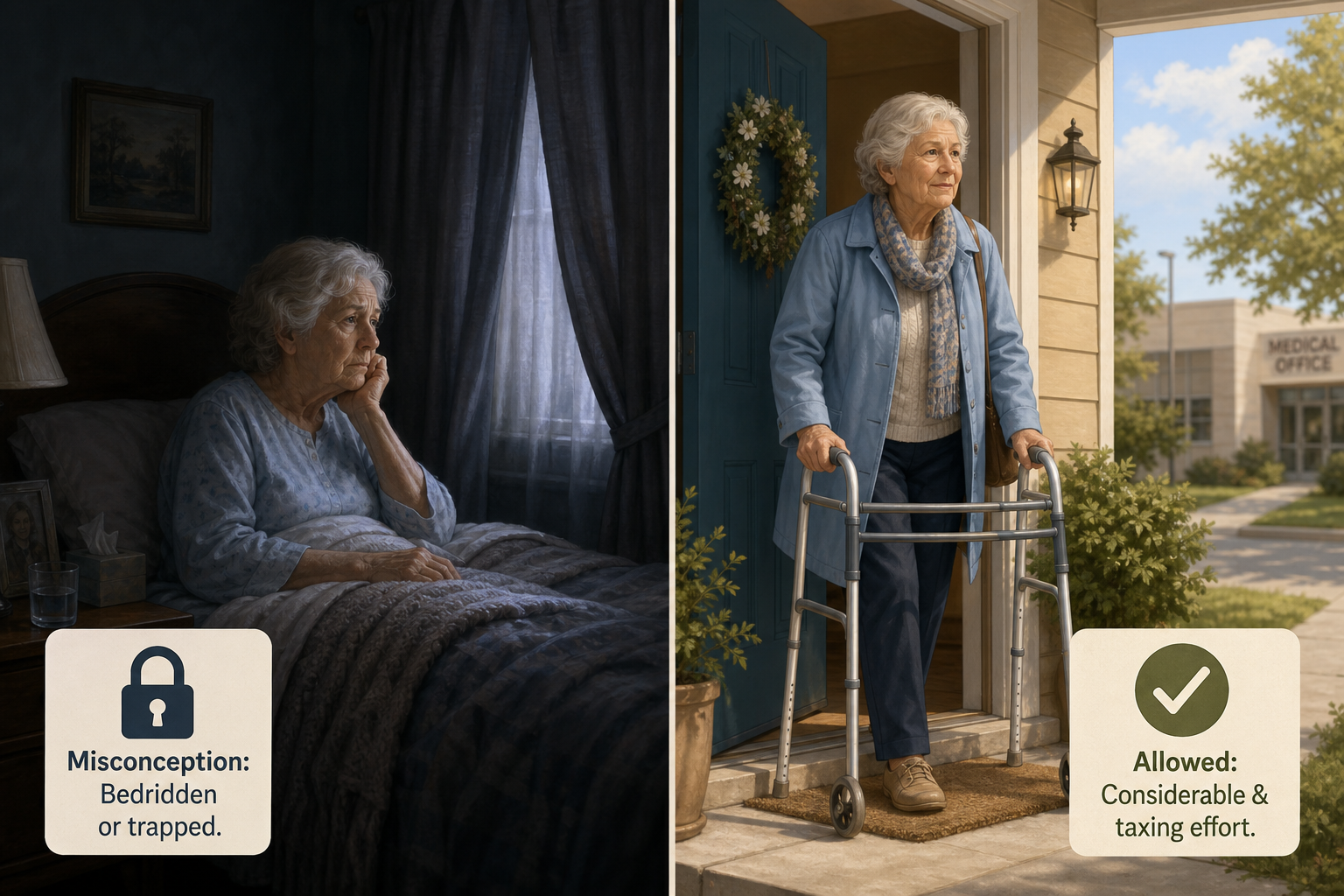
Introduction: The Most Misunderstood Medicare Requirement
Few Medicare rules cause as much confusion — and as many wrongful denials — as the homebound requirement. Families are told their elderly relative does not qualify for home health care because they are not "homebound enough." A parent who uses a walker to get to the mailbox? Denied. A spouse who attends adult day care twice a week? Denied. A grandparent who makes it to Sunday services with help from a family member? Also denied.
These denials are often based on a misunderstanding of what the homebound rule actually says. The Centers for Medicare & Medicaid Services (CMS) defines homebound in terms of effort and necessity — not total confinement. Understanding the real criteria is the single most important step a family can take to secure or appeal Medicare home health coverage.
Common Myths About the Homebound Requirement
The homebound rule is surrounded by myths that lead families to give up on coverage they may be entitled to. Here are the most common ones — and the reality behind each.
- Myth: Homebound means bedridden. Reality: CMS explicitly states that needing a cane, walker, wheelchair, crutches, or help from another person to leave home can satisfy the homebound requirement. Being bedridden is not required.
- Myth: Any outing at all disqualifies you. Reality: Medicare.gov confirms that patients may leave home for medical treatment or "short, infrequent absences for non-medical reasons, like attending religious services." Attendance at adult day care is also explicitly allowed.
- Myth: If you can walk to the mailbox, you are not homebound. Reality: The Center for Medicare Advocacy states that "occasional but infrequent 'walks around the block' and outings are allowable" and do not automatically disqualify a patient.
- Myth: Home health care is only for short-term recovery. Reality: Per the Jimmo v. Sebelius settlement, Medicare covers skilled home health care to maintain a condition or slow decline — not just to improve it. There is no legal limit to the duration of the benefit.
The Actual CMS Definition: 'Considerable and Taxing Effort'
The official CMS definition of homebound has two parts, and both must be met:
- You have a "normal inability to leave home" — meaning your condition makes it medically inadvisable or physically difficult to leave, and you typically do not leave.
- Leaving home requires a "considerable and taxing effort" — which may be shown by needing personal assistance, a wheelchair, walker, crutches, or other supportive device.
As Medicare.gov puts it: "Leaving your home isn't recommended because of your condition or you have trouble leaving your home without help (like using a cane, wheelchair, walker, or crutches; special transportation; or help from another person) because of an illness or injury." The key phrase is "considerable and taxing effort" — not "impossible."
This standard is broader than most people realize. An older adult who can walk to the car with a walker but needs help from a family member to get in and out, and who finds the trip exhausting, likely meets the homebound definition. The effort required to leave — not the frequency of leaving — is what matters.
The homebound standard is met if leaving home requires a considerable and taxing effort which may be shown by the patient needing personal assistance, or the help of a wheelchair or crutches, or other supportive device.
— Center for Medicare Advocacy
What Activities Are Allowed Without Losing Homebound Status
One of the most persistent myths is that any departure from home — for any reason — automatically revokes homebound status. CMS guidance is clear: certain absences are permitted and do not disqualify a patient. The table below summarizes what is allowed and what is not.
| Activity | Allowed? | Source / Notes |
|---|---|---|
| Medical appointments (doctor, PT, OT, speech therapy) | Yes | Explicitly allowed by Medicare.gov |
| Adult day care attendance | Yes | Explicitly allowed by Medicare.gov and Center for Medicare Advocacy |
| Religious services (infrequent) | Yes | Listed as a permitted non-medical absence by Medicare.gov |
| Short, infrequent walks (e.g., around the block) | Yes | Center for Medicare Advocacy confirms occasional walks are allowable |
| Infrequent trips for family events or essential errands | Yes | Permitted if short and infrequent; no automatic bar |
| Regular social outings (e.g., weekly lunch with friends) | May be questioned | Frequency and effort required determine eligibility; not automatically disqualifying but may require strong physician documentation |
| Overnight trips or extended vacations | Likely disqualifying | Would contradict the 'normal inability to leave home' standard |
Browse more in the Glossary.