
Glossary entry
Does Medicare Cover Short-Term Care for Elderly? Breaking Down What Is and Isn't Covered in 2026

The Core Confusion: Why Families Think Medicare Covers More Short-Term Care Than It Does
If you've just helped a parent through a hospital stay, you've probably heard the phrase "Medicare will cover it" from well-meaning friends, discharge planners, or even facility admissions staff. The reality is far more specific — and the gap between what families expect and what Medicare actually pays for is one of the most common sources of surprise medical bills in senior care.
The confusion is understandable. Medicare is not a single program with a single set of rules. It has multiple parts, each with its own coverage logic, and the word "short-term" means something different to a discharge planner than it does to a family trying to arrange care. Original Medicare (Parts A and B) covers short-term care only under three very specific conditions: a skilled nursing facility stay after a qualifying hospitalization, home health services for a homebound patient who needs skilled care, and hospice respite for patients receiving end-of-life benefits. Everything else — adult day care, custodial in-home help, assisted living respite stays, long-term nursing home care — falls outside Original Medicare's scope.
What IS Covered: Skilled Nursing Facility (SNF) Care
The most common Medicare-covered short-term care scenario is a stay in a skilled nursing facility for rehabilitation after a hospitalization. But the qualifying rules are strict, and missing even one can mean paying the full cost out of pocket.
The Qualifying Hospital Stay: The 3-Day Inpatient Rule
Medicare Part A covers SNF care only after a qualifying inpatient hospital stay of at least 3 consecutive days. This means the patient must be formally admitted as an inpatient — time spent under observation status or in the emergency room does not count toward the 3-day requirement. This distinction is one of the most common reasons families receive unexpected denials. If the hospital keeps a patient under observation for two days and then admits them for one day, the 3-day inpatient clock has not been met.
The patient must also enter the SNF within a short time — generally 30 days — of leaving the hospital. And the SNF stay must be for a condition that was treated during the hospital stay, or for a condition that arose while being treated in the hospital for that stay.
The 100-Day Benefit Period and 2026 Costs
Once the qualifying conditions are met, Medicare Part A covers up to 100 days of SNF care per benefit period. The cost structure changes at day 21, which is where many families get caught off guard.
| Days in SNF | Your Cost in 2026 | What Medicare Pays |
|---|---|---|
| Days 1–20 | $0 (after $1,736 Part A deductible) | Full cost of covered services |
| Days 21–100 | $217 per day coinsurance | Everything above $217 per day |
| Day 101 and beyond | All costs | $0 |
The $217 daily coinsurance for days 21–100 is confirmed by Medicare.gov for 2026. Over an 80-day stay (days 21–100), that adds up to $17,360 in coinsurance — a significant figure that families should plan for, not discover after the fact.
What IS Covered: Home Health Services
Medicare Part A and Part B both contribute to covering home health services, but the rules are just as specific as the SNF rules — and just as commonly misunderstood. Medicare covers home health services only when all of the following conditions are met.
- The patient must be homebound. Medicare defines homebound as having a condition that makes it difficult to leave home without help (such as using a walker, wheelchair, or needing another person's assistance), and leaving home requires a considerable and taxing effort.
- The patient must need part-time or intermittent skilled nursing care or physical therapy, occupational therapy, or speech-language pathology. Medicare does not cover home health for custodial care alone — help with bathing, dressing, or meal preparation is not enough to qualify.
- The care must be provided by a Medicare-certified home health agency. The agency must create a plan of care that a doctor has reviewed and signed.
- The patient must have a face-to-face meeting with a doctor (or certain other health care providers) within 90 days before or 30 days after the start of home health services.
When these conditions are met, Medicare covers skilled nursing care (wound care, IV therapy, injections, monitoring), physical therapy, occupational therapy, speech-language pathology, and medical social services. Medicare also covers home health aide services — but only as part of a skilled care plan, not as standalone personal care.
What Home Health Does NOT Cover
This is where the gap between expectation and reality is widest. According to Medicare.gov, Medicare does NOT pay for:
- 24-hour-a-day care at home
- Home meal delivery
- Homemaker services (shopping, cleaning) that are not part of the care plan
- Custodial or personal care when that is the only care needed — for example, if a patient only needs help bathing and dressing but does not need skilled nursing or therapy
Even when skilled care is present, there are limits: patients can receive up to 8 hours per day (combined skilled nursing and home health aide) for a maximum of 28 hours per week, or up to 35 hours per week for a short time if medically necessary.
What IS Covered: Hospice Respite Care
The third Medicare-covered short-term care scenario is hospice respite care — and it is the most narrowly defined of the three. This benefit is available only for patients who have elected the Medicare hospice benefit, meaning they have been diagnosed with a terminal illness and have chosen to focus on comfort care rather than curative treatment.
Under the Medicare Part A hospice benefit, the program covers up to 5 consecutive days of respite care in a Medicare-approved facility — typically a hospital or skilled nursing facility. The purpose is to give the primary caregiver a short break from the demands of end-of-life care. The patient is responsible for 5% of the Medicare-approved cost for the respite stay, which is a relatively small amount compared to the full cost of a facility stay.
It is important to understand that hospice respite is not a general short-term care benefit. It is a caregiver relief benefit embedded within the hospice program. If the patient is not enrolled in hospice — or if the respite stay exceeds 5 days — Medicare will not cover the cost.
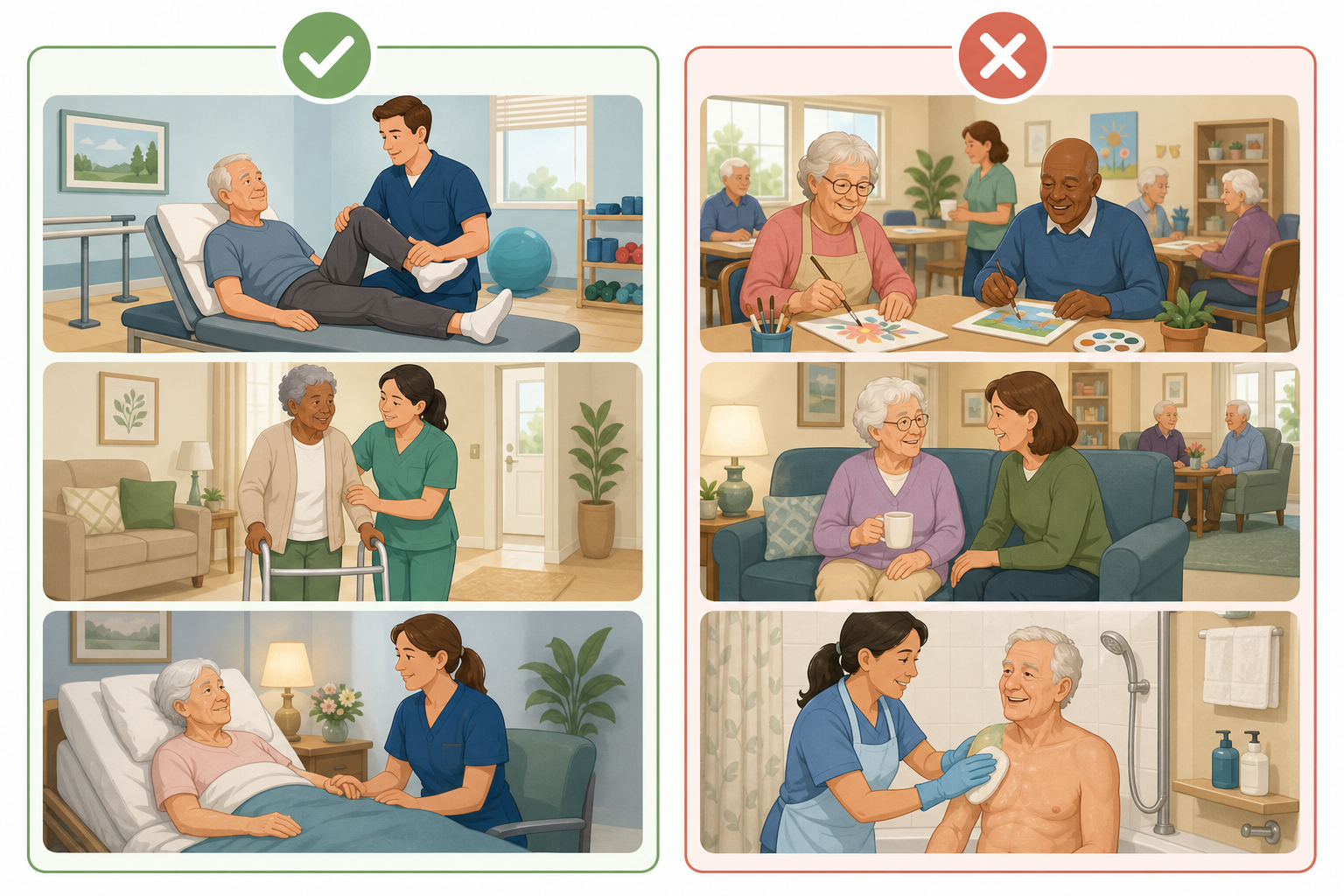
What Is NOT Covered by Original Medicare
This section is the most important part of this guide — because the services families most commonly assume Medicare will cover are precisely the ones it does not. Understanding these exclusions is the key to avoiding costly surprises.
| Service | Covered by Original Medicare? | Why Not Covered |
|---|---|---|
| Adult day care | No | Medicare considers adult day care a social and custodial service, not a skilled medical service. Medicare.gov explicitly states Medicare does not pay for adult day care. |
| Assisted living respite stays | No | Assisted living is considered custodial care (room and board with personal care support), not skilled nursing or rehab. Original Medicare does not cover assisted living costs. |
| Custodial in-home care (personal care only) | No | Help with bathing, dressing, toileting, and meal preparation is custodial care. Medicare covers home health only when skilled nursing or therapy is also needed. |
| Long-term nursing home care | No | Medicare covers up to 100 days of SNF care per benefit period for rehabilitation, not indefinite custodial nursing home care. Days 101+ are entirely out-of-pocket. |
| 24/7 home care | No | Medicare home health is limited to part-time or intermittent care — up to 8 hours per day, 28–35 hours per week. Around-the-clock care is not covered. |
The distinction between "skilled care" and "custodial care" is the single most important concept to understand. Medicare pays for skilled nursing, therapy, and medical social services. It does not pay for help with the activities of daily living — bathing, dressing, eating, toileting, transferring — when that help is the only thing needed. This is not a loophole or a technicality; it is a fundamental design feature of the Medicare program.
For a deeper look at how short-term care differs from long-term care — and how to decide which your parent needs — see our decision framework for short-term vs. long-term care.
Medicare Advantage (Part C) Variations: What Some Plans Offer
If your parent is enrolled in a Medicare Advantage (Part C) plan instead of Original Medicare, the coverage picture changes. Medicare Advantage plans are required to cover everything Original Medicare covers, but they can also offer supplemental benefits that Original Medicare does not. Some Part C plans have begun to include coverage for services like adult day care, in-home support services, meal delivery, and transportation.
However — and this is a critical caveat — these supplemental benefits vary enormously by plan, by state, and even by county. A Medicare Advantage plan in one region might cover 20 days of adult day care per year, while a plan in another region covers none. There is no standard benefit across all Part C plans.
- Check the plan's Summary of Benefits document. This is the official document that lists what the plan covers, including any supplemental benefits.
- Call the plan directly and ask specifically about adult day care, in-home support services, and respite care. Do not assume these are covered just because the plan is a Medicare Advantage plan.
- Review the plan's provider network. Even if a benefit is offered, it may only be available through specific providers or agencies that contract with the plan.
- Understand that Medigap (Medicare Supplement Insurance) policies do not cover assisted living, adult day care, or long-term care. Medigap helps pay for Original Medicare's cost-sharing (deductibles, coinsurance, copayments) but does not expand the scope of covered services.
Alternative Funding Sources When Medicare Doesn't Cover Short-Term Care
When Original Medicare and Medicare Advantage do not cover a needed short-term care service, families have several other funding options to explore. These are not always easy to navigate, but they can make the difference between affording care and going without.
| Funding Source | What It Covers for Short-Term Care | Key Details |
|---|---|---|
| Medicaid HCBS Waivers | Adult day care, in-home personal care, respite care | State-specific programs; eligibility varies by income and assets; waitlists are common in some states |
| VA Benefits | Up to 30 days of respite care in a VA facility for eligible veterans | Must be enrolled in VA health care; a VA physician must indicate the need for respite |
| Long-Term Care Insurance | Respite care, adult day care, in-home care (depending on policy) | Policies vary widely; some have elimination periods and daily benefit caps; check whether respite is a covered service |
| National Family Caregiver Support Program | Respite care, counseling, support services | Administered through local Area Agencies on Aging; funding is limited and may be based on caregiver need |
For families exploring adult day care specifically — which Original Medicare does not cover — it is worth noting that the national median daily rate is approximately $100 per day (based on the 2024 Genworth Cost of Care Survey), with monthly costs averaging around $2,123. Some Medicare Advantage plans may offer limited coverage, and Medicaid HCBS waivers are the most common public funding source for this service. For more on how adult day care can benefit both the person with dementia and the caregiver, see our guide to adult day care for dementia.
Decision Checklist: What to Ask Before Agreeing to Any Short-Term Care Arrangement
Use this checklist when evaluating any short-term care option after a hospitalization. Each question is designed to help you apply the Medicare coverage rules to your specific situation — before you sign any admission papers or agree to any payment plan.
- Was there a qualifying 3-day inpatient hospital stay? Check the hospital discharge paperwork. If the patient was under observation status, the 3-day clock has not started, and Medicare will not cover an SNF stay.
- Is the patient entering the SNF within 30 days of leaving the hospital? If more than 30 days have passed, Medicare may deny coverage even if the 3-day stay was met.
- Is the patient homebound and in need of skilled nursing or therapy? If the answer is yes, home health may be an option. If the answer is no — and the patient only needs custodial help — Medicare will not cover home health.
- Is the facility or agency Medicare-certified? Medicare only pays for services provided by Medicare-certified providers. Always verify certification before agreeing to care.
- Does the patient have a Medicare Advantage plan that offers supplemental benefits? Check the Summary of Benefits or call the plan directly. Do not assume coverage exists.
- Have I explored VA benefits (if the patient is a veteran) or Medicaid HCBS waivers (if the patient has limited income and assets)? These are the most common alternative funding sources for services Medicare does not cover.
- Does the patient have long-term care insurance? If so, check whether the policy covers respite care, adult day care, or in-home personal care. Policies vary widely, and some have waiting periods.
- Have I contacted the local Area Agency on Aging? They can help identify state-specific programs, the National Family Caregiver Support Program, and local respite resources.
Browse more in the Glossary.