
Glossary entry
How to Choose a Medicare Advantage Plan for a Parent
Last verified 2026-08-25
This is not financial or legal advice. Medicare/Medicaid and benefits rules vary by state and change over time — verify current rules with your state Medicaid office or Area Agency on Aging.

If you are trying to figure out how to choose a Medicare Advantage plan for seniors, the monthly premium is the most tempting place to start because it is visible, tidy, and easy to sort. It is also the wrong first filter for a parent living at home with fall risk.
In 2026, beneficiaries have access to an average of 39 Medicare Advantage plans per county, including 32 plans with drug coverage; 28% of beneficiaries live in counties with more than 50 Medicare Advantage plans available. Those numbers were last verified on Aug. 25, 2026, and they still do not tell you what your parent can actually use in a specific ZIP code, with a specific therapist, home health agency, hospital, and equipment supplier. [1]
The practical question is narrower: if your parent falls, fractures nothing but loses confidence, needs outpatient physical therapy, then needs a walker delivered and a few home health visits, which plans can carry that chain of care without turning every step into a scramble?
That is where the comparison should begin. Premium can decide between two otherwise workable plans. It should not be allowed to keep a plan on the list after the physical therapy clinic is out of network, the home health agency is unavailable, the durable medical equipment supplier is hard to access, or the plan is not continuing in the county.
Start by shrinking the county list to plans that still exist in 2026
Before comparing benefits, confirm that each plan is actually operating in your parent’s county for 2026. This sounds too basic to deserve its own step until a caregiver is holding an annual notice of change and discovering that last year’s plan is gone.
Plan stability matters more than usual for 2026. KFF reported that 13% of individual Medicare Advantage prescription drug plan enrollees — 2.6 million people — were in plans terminated at the end of 2025, with rural enrollees disproportionately affected. That figure was last verified on Aug. 25, 2026. [2]
So the first cut is administrative, not medical. In Medicare Plan Finder, use your parent’s ZIP code and county, then remove any plan that is not available for the 2026 coverage year. If your parent received a plan termination notice, do not assume the insurer’s similar-looking plan has the same network, copays, authorization rules, or pharmacy coverage. Treat it as a new plan.
If your parent lives in a rural county, this verification deserves extra care. A plan can look familiar in advertising and still have exited the county, narrowed its network, or changed the services that matter after a fall.
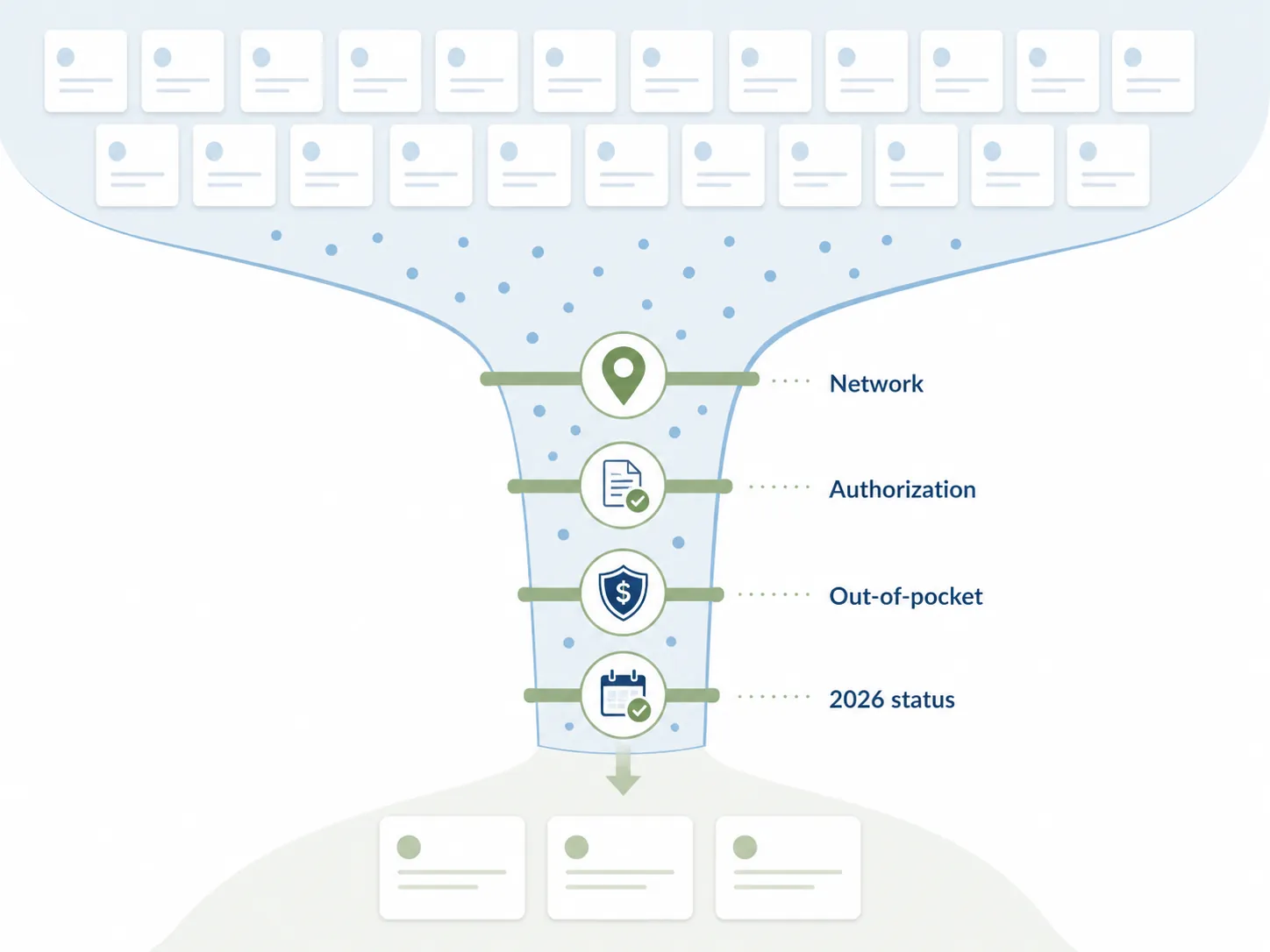
Use a fall-recovery checklist, not a benefits brochure
A fall may trigger several separate Medicare Advantage decisions: the emergency department or urgent visit, the primary care follow-up, outpatient physical therapy, a possible skilled nursing facility stay, home health, and durable medical equipment such as a walker, wheelchair, commode, or hospital bed. The plan does not have to fail everywhere to fail your parent. One blocked service can delay the whole recovery path.
| Checkpoint | What to confirm before the plan stays on the shortlist |
|---|---|
| 2026 county availability | The plan is offered in your parent’s county for the 2026 coverage year and is not replacing a terminated plan you have not reviewed. |
| Physical therapy and rehabilitation network | Your parent’s preferred outpatient PT clinic, rehabilitation facility, orthopedic group, primary care clinician, and relevant hospital are in network for this exact plan. |
| Home health access | At least one acceptable in-network home health agency serves your parent’s address, and the plan’s authorization rules are clear. |
| Durable medical equipment | The plan has usable in-network suppliers for walkers, wheelchairs, hospital beds, and other equipment your parent may realistically need. |
| Prior authorization | The evidence of coverage shows which fall-related services need approval, who requests it, how long review may take, and what happens if care is denied. |
| Out-of-pocket exposure | The in-network maximum and, for PPOs, the combined in- and out-of-network maximum are tolerable for your parent’s finances. |
| Supplemental fall-related benefits | Bathroom safety devices, in-home support, transportation, or meal benefits are confirmed in the plan documents, not assumed from advertising. |
This checklist intentionally puts drug coverage, dental allowances, gym memberships, and premium comparisons later. They may matter a great deal. They just do not answer the first caregiver question after a fall: who can see my parent, what needs approval, and how much could this cost before the year ends?
Check physical therapy and rehab like you expect to use them
Physical therapy is the first place I would spend real comparison time. For many older adults, the difference between a manageable fall and a permanent drop in independence is not only the first medical visit. It is whether therapy starts soon, happens at a place the parent can actually reach, and continues long enough to rebuild strength, balance, and confidence.
Original Medicare covers medically necessary outpatient physical therapy with no annual visit limit, although cost sharing still applies. Medicare Advantage plans must cover Medicare-covered services, but they can manage access through network rules, prior authorization, and utilization review. That difference becomes concrete when a parent is discharged with a therapy referral and the family has to find an appointment. [3][4]
For each candidate plan, verify the exact outpatient physical therapy clinic by name, address, and plan. Do not stop at the health system logo. A hospital may be in network while one outpatient rehab location, one specialty group, or one affiliated therapist is not. If your parent already has a preferred clinic, call the clinic’s billing office and ask whether it participates in that exact 2026 Medicare Advantage plan, not just whether it “takes Medicare.”
Then check rehabilitation coverage beyond outpatient PT. If your parent has osteoporosis, Parkinson’s disease, neuropathy, a history of hip fracture, stroke-related weakness, or repeated falls, look at the plan’s network for skilled nursing facilities, inpatient rehab relationships, and orthopedic or neurology follow-up. You are not predicting that your parent will need all of those services. You are refusing to choose a plan that only looks good when nothing complicated happens.
- Search Medicare Plan Finder for the plan and provider network, if the tool is available for the 2026 plan year in your area.
- Call the therapy clinic or rehabilitation provider directly and ask about the exact plan name, not just the insurer name.
- Call the plan and ask whether outpatient PT requires prior authorization, a referral, a visit limit, or reauthorization after a set number of visits.
- Save screenshots, representative names, dates, and reference numbers when possible.
AARP reported that the 2026 Medicare Plan Finder shows Medicare Advantage provider networks for the first time, and also described a 2026 special enrollment period for people misled about whether their doctors were in network. Because both are time-sensitive, confirm the current Plan Finder display and special-enrollment rules at the time you enroll or challenge a network error. [5]
KFF’s provider-network guidance still points to the same practical safeguard: use the plan’s directory, contact the plan, and contact the provider, because directories can lag reality. For a caregiver, this is not busywork. It is how you avoid learning about a network problem from a receptionist after your parent has already been told to start therapy. [6]
Home health and equipment are where vague coverage promises get tested

After a fall, “home” can become a care setting overnight. A parent may need a nurse to check wounds or medications, a therapist to assess safe transfers, an aide for a limited service ordered under home health, or equipment that changes whether the bathroom, bedroom, or hallway is usable.
Do not compare home health by reading the benefit line alone. Confirm that in-network agencies serve the actual address. Ask whether the plan requires prior authorization, whether the physician or agency submits it, and whether the plan uses a preferred agency list. If your parent lives outside a metro area, ask the agency directly whether it accepts new patients in that ZIP code under the plan.
Durable medical equipment needs the same treatment. A plan may cover walkers, wheelchairs, hospital beds, oxygen equipment, or commodes when medically necessary, but the supplier network and authorization process decide how usable that coverage feels. If a parent is being discharged and cannot safely transfer, waiting on the wrong supplier is not a minor inconvenience.
- Ask the plan for in-network durable medical equipment suppliers serving your parent’s address.
- Ask whether common post-fall items require prior authorization or a preferred supplier.
- Ask the supplier whether it accepts the exact plan and whether delivery is available to the home.
- Check whether the plan distinguishes rental equipment from purchased equipment.
For the home-safety side of the work — grab bars, clutter, lighting, footwear, stairs, and bathroom hazards — use a separate safety checklist rather than expecting the insurance comparison to do that job. The CDC STEADI home fall-prevention checklist and this caregiver fall-prevention handout are better places to organize the house itself.
Prior authorization deserves its own phone call
Prior authorization is not a footnote in Medicare Advantage. In 2026, 99% of Medicare Advantage enrollees are in plans that require prior authorization for at least some services. KFF also found that 90% of enrollees are in plans requiring prior authorization for home health and 95% are in plans requiring it for skilled nursing facility stays. These figures were last verified on Aug. 25, 2026. [4]
That does not mean every authorization request will be denied, or that every plan handles requests the same way. It does mean a caregiver should know the route before the route is needed. If the plan requires approval for home health, skilled nursing, advanced imaging, certain therapies, or durable medical equipment, someone has to submit the request, attach documentation, wait for review, and respond if the plan asks for more information.
When calling the plan, ask about a realistic fall scenario rather than a broad benefit category. For example: “If my mother falls, is discharged home, and the doctor orders home health physical therapy plus a walker, which parts require prior authorization, and who submits each request?” Keep the example general unless your parent is already in care; you are testing the process, not asking the representative to approve a future claim.
| Ask this | Why it matters |
|---|---|
| Does outpatient physical therapy require prior authorization or reauthorization? | A delay here can slow the start or continuation of balance and strength work. |
| Does home health require prior authorization? | The plan’s answer affects discharge planning and whether an agency can begin promptly. |
| Which durable medical equipment needs approval? | Walkers and other equipment may be time-sensitive for safe movement at home. |
| How are urgent or post-discharge requests handled? | Routine timelines may not fit a parent being discharged after a fall. |
| What is the appeal process after a denial? | A caregiver may need to challenge a decision quickly and with documentation. |
This is also where the comparison with Original Medicare can clarify what you are giving up or gaining. If you are comparing Medicare Advantage against staying with Original Medicare and possibly adding other coverage, use a baseline like what Medicare covers for fall-prevention services. The goal is not to make every parent choose the same route. It is to stop treating “covered” as the same thing as “easy to access.”
Compare the out-of-pocket cap as a real family number
A zero-dollar premium can still come with thousands of dollars of possible medical spending. For 2026, the maximum allowed Medicare Advantage out-of-pocket limit is $9,250 for in-network services and $13,900 for combined in- and out-of-network services. KFF reported enrollment-weighted average limits of $5,421 in network and $9,825 combined, with HMO averages at $4,636 and PPO averages at $6,592 for in-network care. These figures were last verified on Aug. 25, 2026. [4]
Those numbers should teach comparison, not decide the answer by plan type. An HMO may have a lower average in-network cap but a tighter network. A PPO may offer some out-of-network flexibility but expose your parent to a higher combined maximum. The right question is whether your parent’s likely doctors, therapy clinic, hospital, home health agency, and equipment suppliers fit the plan’s network well enough that the in-network number is the one that matters.
The National Council on Aging’s Medicare Advantage checklist includes maximum out-of-pocket costs among the plan details to review, and that belongs near the top for a fall-risk comparison. A parent who lives on fixed income needs to know the worst-case medical exposure under the plan, not just the monthly premium. [7]
For each plan still on the list, write down four separate numbers: monthly premium, primary care copay, specialist or therapy copay, and maximum out-of-pocket limit. If the plan is a PPO, add the combined in- and out-of-network maximum. Then look at them through a recovery year, not a healthy month. Multiple therapy visits, specialist follow-ups, imaging, equipment, and home health cost sharing can change the comparison quickly.
| Cost line | How to read it for a parent with fall risk |
|---|---|
| Premium | Useful only after the plan passes the service-fit checks. |
| Primary care copay | Matters for post-fall follow-up and chronic-condition management. |
| Specialist copay | Relevant for orthopedics, neurology, cardiology, or other fall-related evaluation. |
| Therapy copay or coinsurance | Can add up if balance and strengthening visits continue for weeks. |
| In-network out-of-pocket maximum | The key ceiling if all important providers are truly in network. |
| Combined out-of-network maximum | Especially important for PPOs and for parents who travel or split time between homes. |
Treat supplemental fall benefits as a bonus until confirmed
Supplemental benefits are where Medicare Advantage marketing often sounds most comforting: bathroom safety devices, transportation, over-the-counter allowances, meals after a hospital stay, or in-home support. Some of these can help a parent age at home. None should be assumed.
KFF found that only 21% of individual-plan enrollees were in Medicare Advantage plans offering bathroom safety device coverage in 2026, down from 32% in 2025. It also found that in-home support services were available to 10% of individual-plan enrollees, compared with 38% of special needs plan enrollees. These figures were last verified on Aug. 25, 2026. [4]
That is a useful reality check. If a plan says it supports fall prevention, read the evidence of coverage for the exact benefit. Look for dollar limits, approved vendors, medical-necessity rules, whether installation is included, whether the benefit is annual or one-time, and whether the item has to be ordered through the plan.
For planning before a fall, pair the insurance review with your parent’s preventive visits. A fall-risk discussion during the free Medicare wellness visit can help identify balance, medication, vision, footwear, and home-safety issues before coverage has to be tested in a hurry.
Where to get help without handing over the decision
A broker may help gather plan options, but a broker is not the same as a product-neutral counselor. Ask how the person is compensated, which insurers they represent, and whether they are showing every plan available in the county. If the answer is vague, use them only as one input.
For product-neutral help, contact 1-800-MEDICARE or your State Health Insurance Assistance Program, usually called SHIP. Bring the shortlist, your parent’s doctors, medication list, preferred therapy clinic, hospital, home health concerns, and equipment questions. The better your questions, the less likely the conversation will drift back to premium and dental extras.
This article is general coverage-planning information, not medical, legal, or financial advice. Medicare Advantage rules, county availability, networks, costs, and special-enrollment protections can change, so confirm the 2026 details in Medicare Plan Finder, the plan’s evidence of coverage, and direct calls with the plan and providers before enrollment.
The defensible shortlist
By the end of the review, a good shortlist may be small. That is the point. Keep the plans that are confirmed for your parent’s county in 2026, include the key doctors and therapy providers, have usable home health and durable medical equipment access, explain prior authorization clearly, and set an out-of-pocket limit your parent could survive financially.
Then compare premiums.
If you need a broader fall-risk primer while doing the coverage work, use the fall-prevention FAQ for seniors and caregivers separately. The plan decision should stay focused on the services a fall can trigger and the people who will have to arrange them.
References
- Medicare Advantage 2026 Spotlight: A First Look at Plan Offerings, KFF.
- Most Medicare Beneficiaries Affected by Plan Terminations in 2025 Have Robust Medicare Advantage Options in 2026, KFF, Mar. 2026.
- Physical therapy services, Medicare.gov.
- Medicare Advantage in 2026: Premiums, Out-of-Pocket Limits, Supplemental Benefits, and Prior Authorization, KFF, June 2026.
- 8 Changes Shaping Your Medicare Coverage in 2026, AARP, Jan. 2026.
- How can I find out if my doctor is in a Medicare Advantage plan network?, KFF.
- A 7-Point Checklist for Choosing a Medicare Advantage Plan, National Council on Aging.
Browse more in the Glossary.