
Product term
What the iPhone 18 Pro Max Release Date Means for Seniors
Last verified 2026-08-01
Last verified: Aug. 1, 2026. The iPhone 18 Pro Max is expected around mid-September 2026, but Apple has not confirmed the iPhone 18 lineup, release date, price, or final safety features.
For a caregiver trying to decide whether to replace a parent’s phone now or wait, that distinction matters. Current launch chatter points in the same general direction, but not to one official day: some trackers estimate a Sept. 8–9 announcement window, Forbes’ Ewan Spence reported a Sept. 12 Pro launch, and Forbes’ David Phelan pointed to Sept. 18 as the likely public release date based on Apple’s event pattern.[1][2] Those are planning signals, not a promise from Apple.
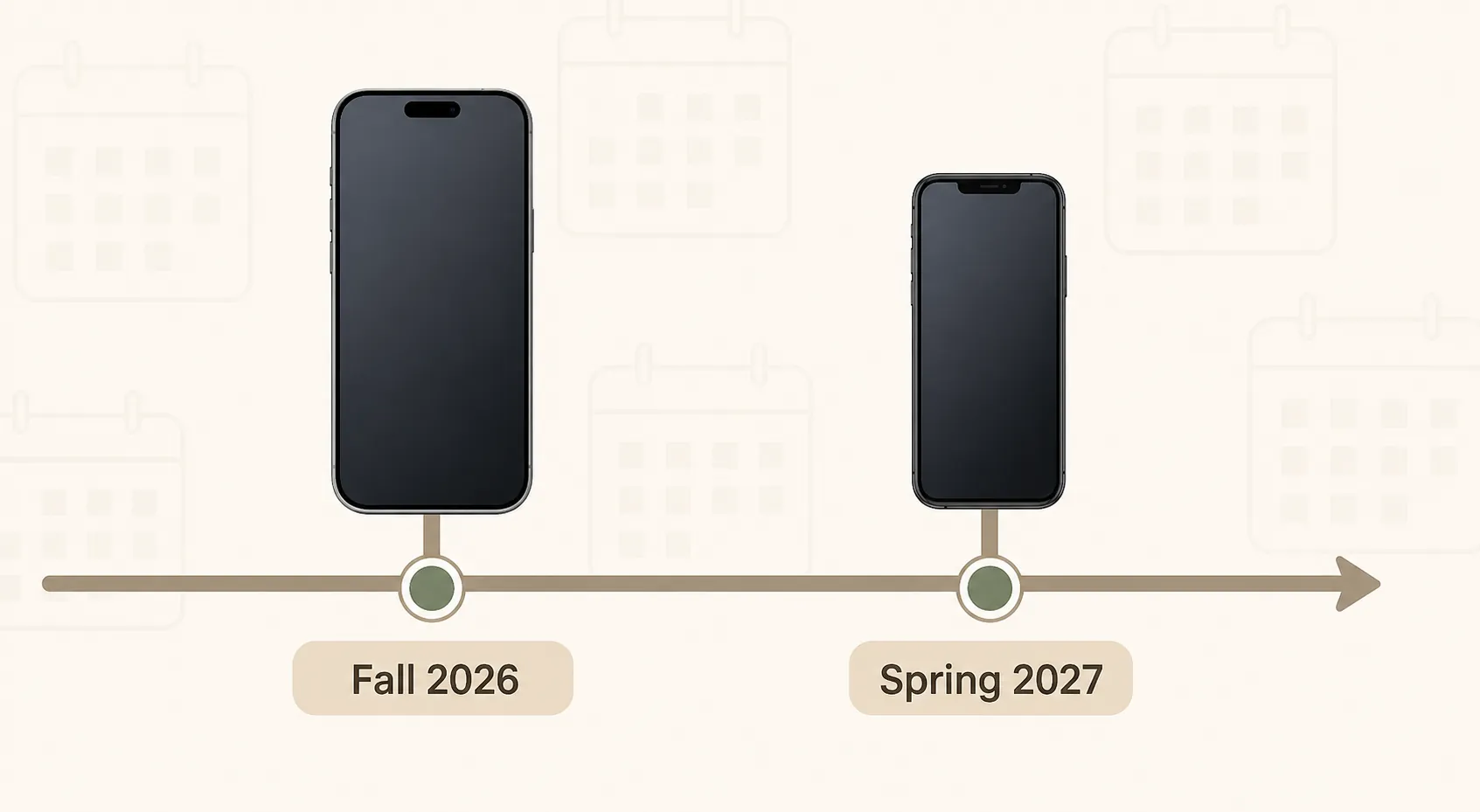
There is another wrinkle for families who do not want the biggest, most expensive model. Bloomberg reporting summarized by CNET and MacRumors both describe a split iPhone 18 rollout: iPhone 18 Pro, iPhone 18 Pro Max, and a foldable model are expected in fall 2026, while the standard iPhone 18, iPhone 18e, and next Air model are reported to follow in spring 2027.[3][4] If that holds, “wait for the iPhone 18” may really mean “wait for the Pro Max or wait much longer for the standard phone.”
The Release-Date Question Is Really a Caregiving Timing Question
The practical answer is simple enough: the iPhone 18 Pro Max release date is expected in September 2026, most likely around the middle of the month, but it is not confirmed. The harder question is whether an older adult should arrange a phone replacement around that expectation.
A caregiver’s calendar does not always line up with Apple’s. A battery may already be fading. A carrier may be offering a trade-in deadline. A sibling may be pushing for “the newest one” without being the person who will set it up, test emergency contacts, and explain the bill afterward. Rumored dates are useful for avoiding a poorly timed purchase, but they are not stable enough to be the whole plan.
| Situation on Aug. 1, 2026 | What the rumored timing means |
|---|---|
| The older adult has an iPhone 14 or later in good condition | There is no clear safety reason to rush toward the iPhone 18 Pro Max before Apple confirms what is new. |
| The current phone is unreliable, unsupported, damaged, or has poor battery life | Waiting for September may be reasonable only if the phone can safely last; otherwise the safer move may be replacing it sooner. |
| The family wants a lower-cost non-Pro iPhone 18 | The reported split launch matters because the standard iPhone 18 may not arrive until spring 2027.[3][4] |
| A carrier trade-in window expires before Apple’s event | Compare the guaranteed offer against the risk of higher Pro pricing and unconfirmed launch details. |
| The purchase is mainly about fall detection | Do not buy an iPhone 18 Pro Max for that reason alone; Fall Detection is an Apple Watch feature, not an iPhone feature. |
For a more detailed scenario-by-scenario comparison, use the buy-versus-wait guide for seniors considering the iPhone 18 Pro. The important thing here is not to treat September as a magic safety deadline.
The Safety Baseline Already Starts at iPhone 14
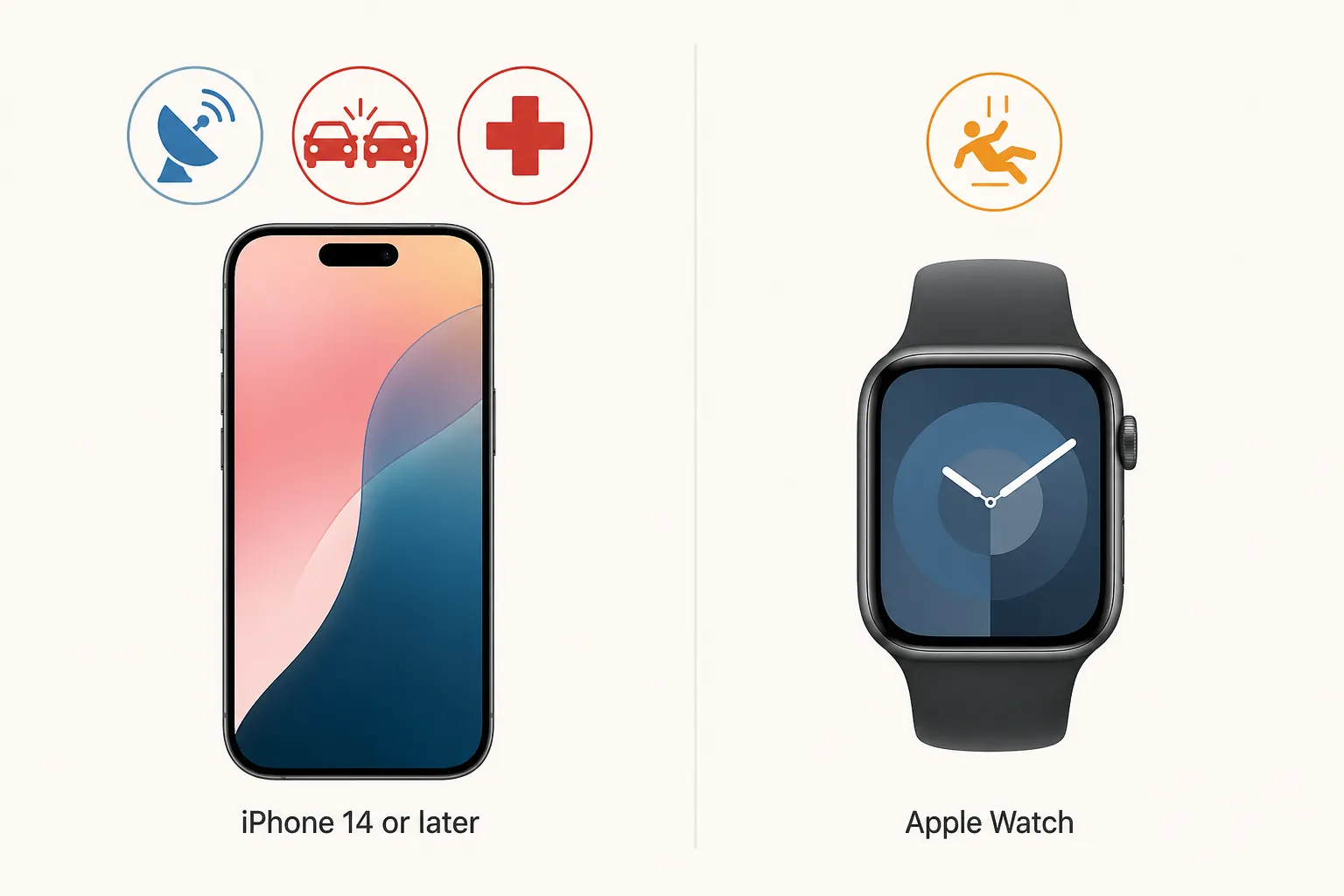
The strongest reason not to panic-wait for the iPhone 18 Pro Max is that several important emergency features already exist on iPhone 14 or later. Emergency SOS via satellite works on all iPhone 14 and later models, letting a user contact emergency services when cellular and Wi-Fi coverage are not available.[6] That is a real safety baseline for someone who drives rural roads, walks outside coverage, or may be stranded where a normal call cannot go through.
Crash Detection and Medical ID also belong in the practical conversation. Crash Detection is designed to help after a severe car crash, while Medical ID can make emergency details available from the Lock Screen if it has been set up. These are not reasons to buy the most expensive rumored 2026 phone if the older adult already has a working iPhone 14, 15, 16, or 17. They are reasons to check whether those features are present, enabled where appropriate, and understood by the person carrying the phone.
SeniorLiving.org’s iPhone guidance also notes that iPhone 15-series satellite features were free for two years, which is a reminder to check the current terms attached to any satellite feature rather than assuming every emergency service is permanently free in the same way.[7] Apple’s official support page is the better place to verify current availability before a purchase.[6]
If you need the fuller setup checklist, see the iPhone safety-features explainer for seniors. The release-date decision is much cleaner once the family separates features the person already has from features that only appear in rumors.
Fall Detection Is the Feature People Most Often Put on the Wrong Device
A new iPhone by itself does not add Apple Watch Fall Detection. Apple’s Fall Detection support applies to Apple Watch SE, Apple Watch Series 4 or later, and Apple Watch Ultra models.[8] NCOA’s review of Apple Watch as a medical alert option describes the same device boundary: the watch, not the phone, is what detects a hard fall and can start the emergency sequence.[9]
The distinction is not technical hair-splitting. If a parent lives alone and the family’s main fear is a fall in the kitchen or bathroom, the iPhone 18 Pro Max release date does not solve that problem. The relevant purchase may be an Apple Watch, a medical alert system, or a broader home-monitoring setup, depending on the person’s habits and tolerance for wearing a device.
Apple says Fall Detection can be enabled in the Watch app and is automatically turned on for users 55 and older when their age is entered in the Health app or Medical ID.[8] If the watch detects a hard fall, the user can dismiss the alert, contact emergency services, or wait; if the watch senses the user has been immobile for about a minute, it begins a 30-second countdown before calling emergency services.[8] NCOA summarizes the same basic emergency-call behavior while also treating Apple Watch as one option among medical alert tools, not as a universal substitute for every older adult.[9]
That is why the family conversation should name the risk precisely. Car crash, no cell service, emergency medical details, and fall detection are related caregiving concerns, but they are not handled by the same device in the same way.
The Price Rumors Are Conflicting, and That Is the Point
Pricing is still rumor-level, and the signals are not gentle. Mashable’s roundup cites a Wall Street Journal estimate of $1,299 for the iPhone 18 Pro, IDC projections of $1,299 for the Pro and $1,399 for the Pro Max, analyst Jeff Pu’s warning that prices could rise by up to $300, and Tim Cook’s comment that increases are “unavoidable” amid the RAM shortage.[5]
Those figures should not be treated as Apple’s price list. They are useful because they show the risk on the caregiver’s side of the purchase: waiting may mean a higher bill, not just a newer phone. A family that can afford a Pro Max comfortably may wait for confirmation. A family stretching to buy one for safety reasons should first ask whether a less expensive iPhone 14-or-later model, paired with the right settings or a watch, solves the actual problem.
| Pricing signal reported before launch | How to use it |
|---|---|
| WSJ estimate: iPhone 18 Pro at $1,299 | A signal that the Pro tier may be expensive, not confirmation of Apple pricing.[5] |
| IDC projection: $1,299 Pro and $1,399 Pro Max | A planning range for families budgeting around the larger model.[5] |
| Jeff Pu: up to $300 more | A warning to compare trade-in offers before assuming waiting saves money.[5] |
| Tim Cook: increases are “unavoidable” amid RAM shortage | Context for why rumors point upward, but still not a final iPhone 18 Pro Max price.[5] |
Rumored Battery and Satellite Changes Could Matter, If They Ship
Some rumored iPhone 18 Pro Max changes are worth watching precisely because they could affect older adult use. MacRumors lists a rumored 5,567 mAh battery for the iPhone 18 Pro Max, compared with 5,088 mAh on the iPhone 17 Pro Max.[10] A larger battery does not make a phone a medical device, but it can matter for someone who forgets to charge, spends long days away from home, or depends on the phone for maps, rides, medication reminders, and emergency contact.
The other rumor worth separating from the usual launch noise is satellite usability. 9to5Mac reports that the iPhone 18 Pro could use Apple’s C2 modem to make satellite connectivity work more automatically, without requiring the user to point the phone at the sky in the same fussy way.[11] If confirmed, that could be meaningful for an older adult under stress, especially because emergency instructions are hardest to follow when the emergency is already happening.
But both points stay in the promising, unconfirmed bucket until Apple says what ships. For families comparing emergency connectivity options, the broader satellite and direct-to-phone guide for seniors is the better place to think through coverage, ease of use, and what happens when cellular service fails.
What to Ignore Until Apple Confirms It
Most launch-page details do not change the senior-safety decision. A new finish, a thinner edge, a camera change, or a faster chip may be welcome, but they do not automatically improve what happens when an older adult is alone, confused, outside coverage, or unable to call. The questions that deserve priority are plainer:
- Can the older adult reliably keep the current phone charged and with them?
- Does the current phone support Emergency SOS via satellite, Crash Detection, and Medical ID?
- Are emergency contacts, Medical ID, location sharing, and passcode access set up correctly?
- Is fall detection actually needed, and if so, is the person willing to wear an Apple Watch or another fall-detection device?
- Will waiting for a Pro Max strain the budget compared with buying a confirmed, available model now?
If the family is also comparing phones, watches, sensors, and alert systems, the caregiver’s guide to aging-in-place technology categories can keep the conversation from turning every problem into a phone upgrade.
So, Should Seniors Wait for the iPhone 18 Pro Max?
If the older adult already has an iPhone 14 or later in good condition, the safety case for upgrading to the iPhone 18 Pro Max is weak as of Aug. 1, 2026. The emergency features that matter most in everyday caregiving conversations already start with iPhone 14 or later, and Fall Detection belongs to Apple Watch.
If the current phone is failing, no longer supported, physically damaged, hard to hear, hard to charge, or cannot hold a battery through the day, the decision changes. Then the family is not choosing between “safe” and “unsafe” based on an unannounced Pro Max. It is choosing between a confirmed phone available now and a rumored phone that may arrive in September at a higher price.
Before buying, check Apple’s official site for the final iPhone 18 Pro Max release date, supported features, and price. Plan around phone condition, cost, trade-in timing, and confirmed emergency tools—not rumor-level safety hype.
References
- iPhone 18 Release Date: Spring Delay, iPhone 18 Pro Sales, Siri AI - Forbes, Jul. 28, 2026, link
- iPhone 18 Pro Release Date: Apple’s 15-Year Event Timeline Points To One September Date - Forbes, Jul. 22, 2026, link
- iPhone 18: Everything We Know About Apple's Biggest Updates - CNET, link
- iPhone 18 - MacRumors, link
- Apple iPhone 18 latest rumors, release date, leaks July 2026 - Mashable, link
- Use Emergency SOS via satellite on your iPhone - Apple Support, link
- Best iPhones for Seniors - SeniorLiving.org, link
- Use Fall Detection with Apple Watch - Apple Support, link
- Apple Watch as Medical Alert System: What to Know - National Council on Aging, link
- iPhone 18 Pro - MacRumors, link
- iPhone 18 Pro could make life-saving niche feature into everyday asset - 9to5Mac, May 21, 2026, link
Browse more in the Glossary.