
Caregiver decision guide
How satellite direct-to-phone keeps seniors safe in emergencies
This article explains how T-Mobile T-Satellite (Starlink) allows seniors to text 911 and family from their current smartphone even in areas with no cell service, including compatible phones, pricing, and key limitations such as the need for outdoor sky access. It helps caregivers decide if this technology is right for their parent's safety.
The scariest part of a rural emergency is not always the fall, the flat tire, or the storm damage. It is the silence afterward: no bars, no landline nearby, no neighbor within shouting distance, and a phone that looks useful until it cannot reach a tower.
Satellite direct-to-phone service is meant to close that gap without asking an older adult to carry a separate satellite device. With T-Mobile’s T-Satellite service, powered by Starlink, a compatible everyday smartphone can send texts over satellite when cellular service is unavailable. The most important safety detail is simple: compatible phones can text 911 by satellite for free, without a T-Mobile account, T-Mobile plan, or paid satellite subscription.[1]
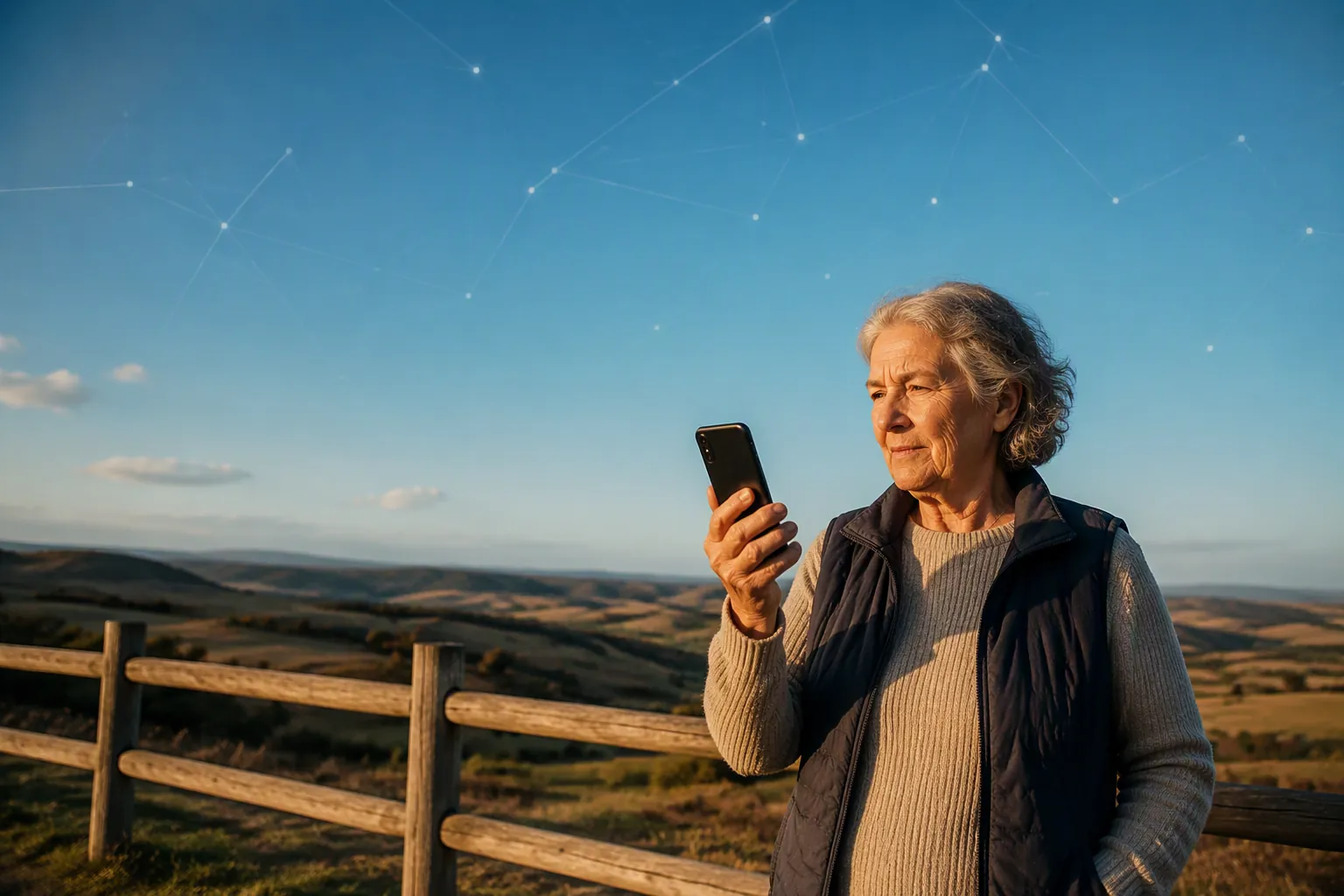
That matters because the coverage problem is not rare at the edges of American life. T-Mobile and Starlink have described roughly 500,000 square miles of U.S. territory as having zero cell coverage, and older adults are more likely than many families realize to live near those gaps.[2] The National Council on Aging reports that 1 in 5 adults age 65 and older live in rural communities.[3]
For a caregiver, the question is not whether satellite networks are impressive. The question is whether this gives a parent one more workable way to reach help from the pasture, a county road, a trailhead, a fishing spot, or the long driveway where cell service drops.
What satellite direct-to-phone can do in an emergency
In the right conditions, satellite direct-to-phone service lets a senior use the phone already in their pocket to send a text when there is no usable cell tower. They do not need a classic satellite phone. They do not need to unfold an antenna. T-Mobile says the service uses standard LTE protocols, so the phone connects to satellites in a way that is designed to feel closer to ordinary texting than to operating specialty emergency equipment.[4]
The cleanest use case is also the most important one: text 911 from outside cellular coverage. If an older adult is outside, has a compatible phone, and can get a view of the sky, T-Satellite can provide a path to emergency services even when the regular network is unavailable.[1]
That is a different kind of safety net from a medical alert pendant. A pendant is usually meant to make help simple from inside daily life: press a button, detect a fall, call a monitoring center. Satellite texting is narrower. It is for the dead-zone moment when the person is away from usable coverage and the phone would otherwise have no route out.
| Emergency situation | What satellite direct-to-phone may help with | What still matters |
|---|---|---|
| Parent is on a rural road with no bars | Send a 911 text or message family from a compatible phone | They need to be able to text and wait for a reply |
| Parent is outside after a storm and towers are unreachable | Use satellite texting when cellular service is unavailable | Open sky matters; trees, buildings, and terrain can interfere |
| Parent falls inside the house | Usually not the right tool | Indoor fall detection, a landline backup, or a medical alert system matters more |
| Parent becomes confused or unconscious | Only helps if they can use the phone or someone else can | No automatic fall detection is built into satellite texting alone |
Expectations need to stay honest. Satellite direct-to-phone service helps most when the person can still take an action: unlock the phone, type or select a message, and stay in a place where the phone can see the sky. It is not a silent guardian for every emergency.
Start with the phone, not the satellite map
The first practical question is whether your parent’s current phone is compatible. SatelliteInternet.com’s 2026 compatibility guide describes support across many recent models, including iPhone 13 and newer, Samsung Galaxy S21 and newer, Google Pixel 7 and newer, and other Motorola and Android models.[5] The exact list can change, so this is worth checking against the carrier’s current support page before you count on it for safety.
For many families, this is the best part of the new service: it may not require adding another object to an older adult’s routine. No second device on the kitchen counter. No separate charging cable. No “take this when you go outside” reminder that works until the one day it is forgotten.
If the phone is too old, the decision becomes more ordinary: is it time to upgrade anyway? A newer iPhone or Android phone may bring better battery life, clearer emergency features, and satellite compatibility in one purchase. If you are specifically shopping Apple for a parent, CareWise Guide’s budget iPhone guide for seniors is a useful next stop before buying more phone than they need.
Free 911 texting is not the same as full satellite messaging
There are two different promises here, and mixing them up can lead to bad planning.
- Emergency access: compatible phones can text 911 by satellite for free when cellular service is unavailable.[1]
- Everyday satellite use: broader texting and supported apps require either a paid add-on or an eligible premium plan.[1][6]
T-Mobile lists a $10 per month add-on for broader T-Satellite use, with inclusion on certain premium plans; its support materials also identify supported app use such as WhatsApp, Google Maps, AllTrails, and AccuWeather.[1][6] That paid layer may matter if your parent spends time outside coverage and you want them to message family before something becomes an emergency.
The free 911 piece is the baseline safety fact. The paid piece is a family communication decision. A parent who drives through a dead zone twice a week may benefit from being able to text “I’m delayed” or “road blocked” before anyone panics. A parent who almost never leaves home may not need the monthly add-on, even though free emergency texting is still worth knowing about.
Message delay is normal, and it matters
Satellite texting should not be treated like instant voice contact. RootMetrics, part of Ookla, drive-tested direct-to-device satellite messaging and reported a 60% text success rate from a moving car, with an average send-and-receive round trip of 1 minute 17 seconds.[7]
That result is useful, not magical. A text that gets through after a delay can change the outcome of a rural emergency. It can tell 911 where to send help. It can tell an adult child that the parent is stranded but conscious. It can turn a blind search along back roads into a specific response.
But a delayed text is not the same as talking with a dispatcher in real time. If your parent has chest pain, trouble breathing, a head injury, or confusion, every minute of friction matters. T-Satellite is still text-first for emergency use; voice calling has been described as being in beta, while broader data connectivity is expected in the 2026–2027 window.[8]
The practical setup should reflect that. Teach the shortest useful message: “Need 911. Fell outside. 123 County Road 8 near red barn.” If your parent can use location sharing or emergency contacts on the phone, set those up before there is a crisis. Satellite service may create the path, but the message still has to carry enough information to help.
The clear-sky rule is the boundary caregivers cannot skip
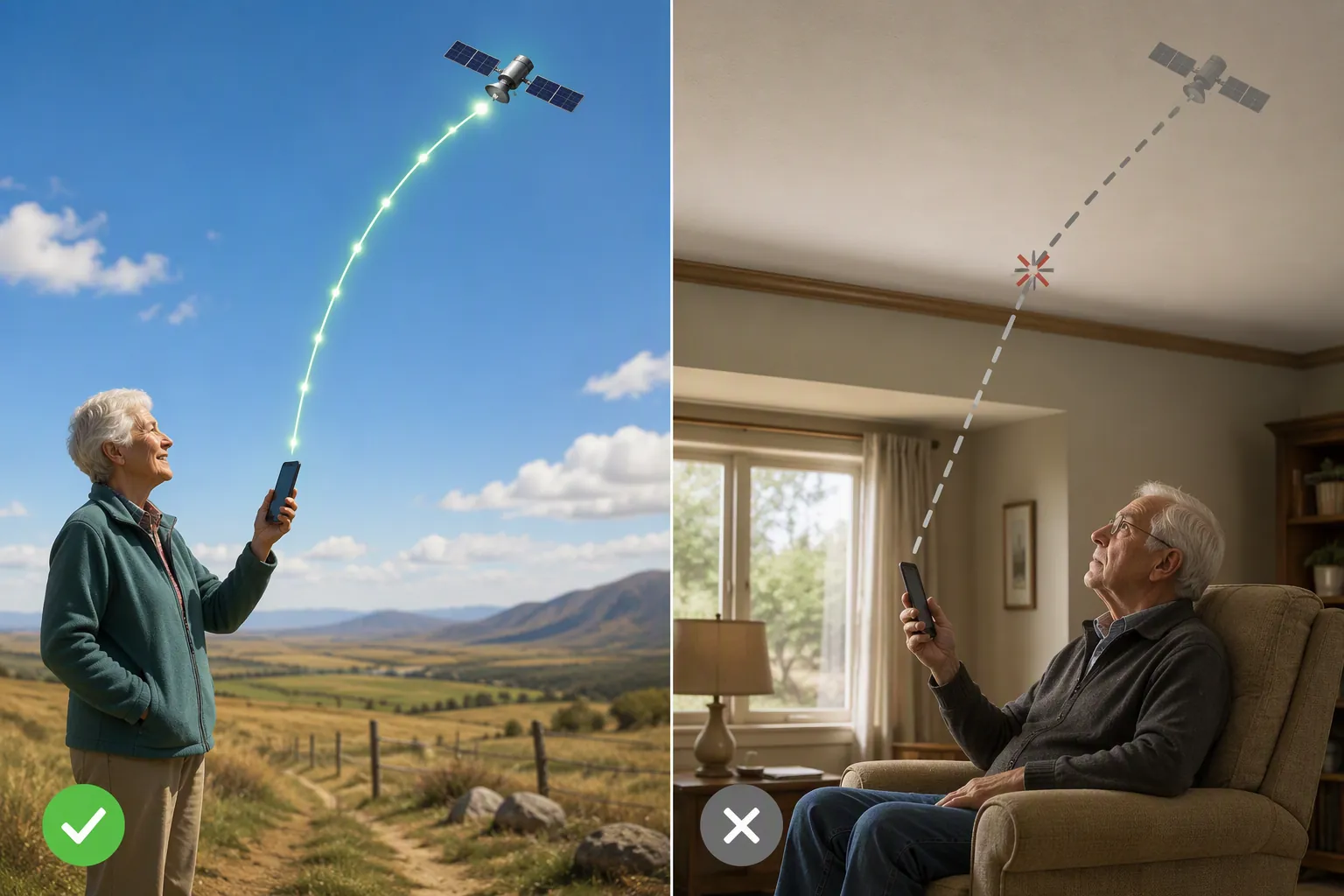
The hardest limitation is also the easiest to forget in a product headline: satellite direct-to-phone needs access to the sky. It is not designed to be a dependable indoor safety system. It may also struggle under dense tree canopy, around obstructing buildings, or in terrain where the phone cannot maintain a satellite connection.
That matters because many serious senior emergencies happen indoors. A fall between the bed and bathroom, a collapse in the kitchen, or a dizzy spell in the hallway is not the scenario this service solves best. If the phone is on the counter, if the person cannot reach it, or if the ceiling blocks the satellite signal, the free 911 feature does not fill the gap.
This is where satellite texting and fall detection should be treated as complementary, not competing. Fall detection watches and medical alert systems are built around a different problem: the person may not be able to initiate the call. NCOA notes that Apple Watch can provide medical-alert-like features, including fall detection and emergency calling, but it also has limits caregivers need to understand.[9] CareWise Guide’s fall detection watch evaluation guide can help sort out those trade-offs.
A caregiver setup checklist that keeps the promise realistic
The right way to evaluate satellite direct-to-phone is not to ask whether it sounds advanced. Ask where your parent actually becomes unreachable.
- Map the dead zones. Write down the roads, fields, barns, trailheads, lake areas, or neighboring properties where their phone regularly shows no service.
- Check the phone model. Confirm that the exact device is on the current compatibility list before relying on satellite texting.
- Separate 911 from family messaging. Free emergency texting may be enough; paid satellite messaging is a different decision.
- Practice the outdoor habit. The parent should know to move toward open sky if they can do so safely.
- Prepare short emergency wording. A simple message with the emergency, location, and visible landmark is better than a long explanation typed under stress.
- Keep indoor protection separate. Use fall detection, medical alert equipment, home safety planning, or check-ins for the places satellite texting does not cover.
A family does not need to turn this into a surveillance system. In many cases, the most respectful setup is also the simplest: make sure the phone works, make sure emergency contacts are current, make sure the parent understands when satellite texting appears, and make sure nobody cancels the indoor safety tools that still do a different job.
Do not confuse T-Satellite with iPhone SOS messages
The wording on phones can be confusing. “SOS Only” on an iPhone usually means the phone cannot connect to the normal carrier network but may still be able to place emergency calls through another available cellular network. That is not the same thing as satellite direct-to-phone service.
Apple also has its own Emergency SOS via satellite feature on newer iPhones, and that can be useful. But it is a separate system from T-Mobile’s T-Satellite service. If your parent’s iPhone is stuck showing SOS or you are trying to understand whether the phone is broken, start with CareWise Guide’s plain-language article on fixing iPhone SOS mode for seniors.
Where it fits in a senior safety plan
Satellite direct-to-phone service earns its place when an older adult spends real time beyond cell coverage. That might be a rural homeowner who checks fences, a widow who drives a wooded county route, a retiree who fishes alone, or a parent whose driveway and road both lose service after storms.
It is less compelling as the main answer for someone whose biggest risks are inside the home. For that person, grab bars, lighting, medication review, fall detection, a medical alert plan, and regular check-ins may matter more than satellite messaging. The satellite feature still helps when they leave coverage, but it should not become a reason to ignore the bathroom, stairs, bedroom, or kitchen.
The best judgment is narrow and useful: satellite direct-to-phone is a strong outdoor and rural backup for seniors who may be unreachable, especially because free 911 texting removes the paid-plan barrier for compatible phones. It belongs beside indoor fall detection, home safety planning, and caregiver check-ins—not in place of them.
References
- T-Satellite with Starlink | T-Mobile
- Starlink Satellite Phone Calls: Direct-to-Cell Guide | US Mobile, 2026
- How Technology Is Helping Older Adults Thrive in Rural America | National Council on Aging
- How Satellite Phone Service Works | T-Mobile
- T-Mobile Starlink Compatible Phones | SatelliteInternet.com
- T-Satellite Support | T-Mobile
- Measuring the Direct-to-Device (D2D) Marketplace in 2026 | Ookla, 2026
- Starlink Direct to Cell: Coverage, Pricing, and Availability | SatelliteInternet.com, 2026
- Apple Watch as Medical Alert System: What to Know | National Council on Aging
Questions to bring to a clinician or OT
This is not medical, legal, or a family's final decision — only a framework. Bring these questions to a clinician, occupational therapist, or your local Area Agency on Aging.
Find Local HelpRelated reading
Noticed something outdated or inaccurate on this page? Flag a correction. We review every report against CDC, NIA, and AARP HomeFit guidance before updating a page.