
Clinical term
What are the risks of using ChatGPT for senior health advice?
Last verified 2026-07-26
Last verified: July 26, 2026.
The most dangerous senior-health question to ask ChatGPT is often the quietest one: “Can I wait and see?” It may come after chest pressure, shortness of breath, new confusion, a fall, a medication change, or a symptom an older adult does not want to bother anyone about yet. A chatbot can answer instantly. That is exactly the problem when the right answer is not a paragraph, but a phone call.
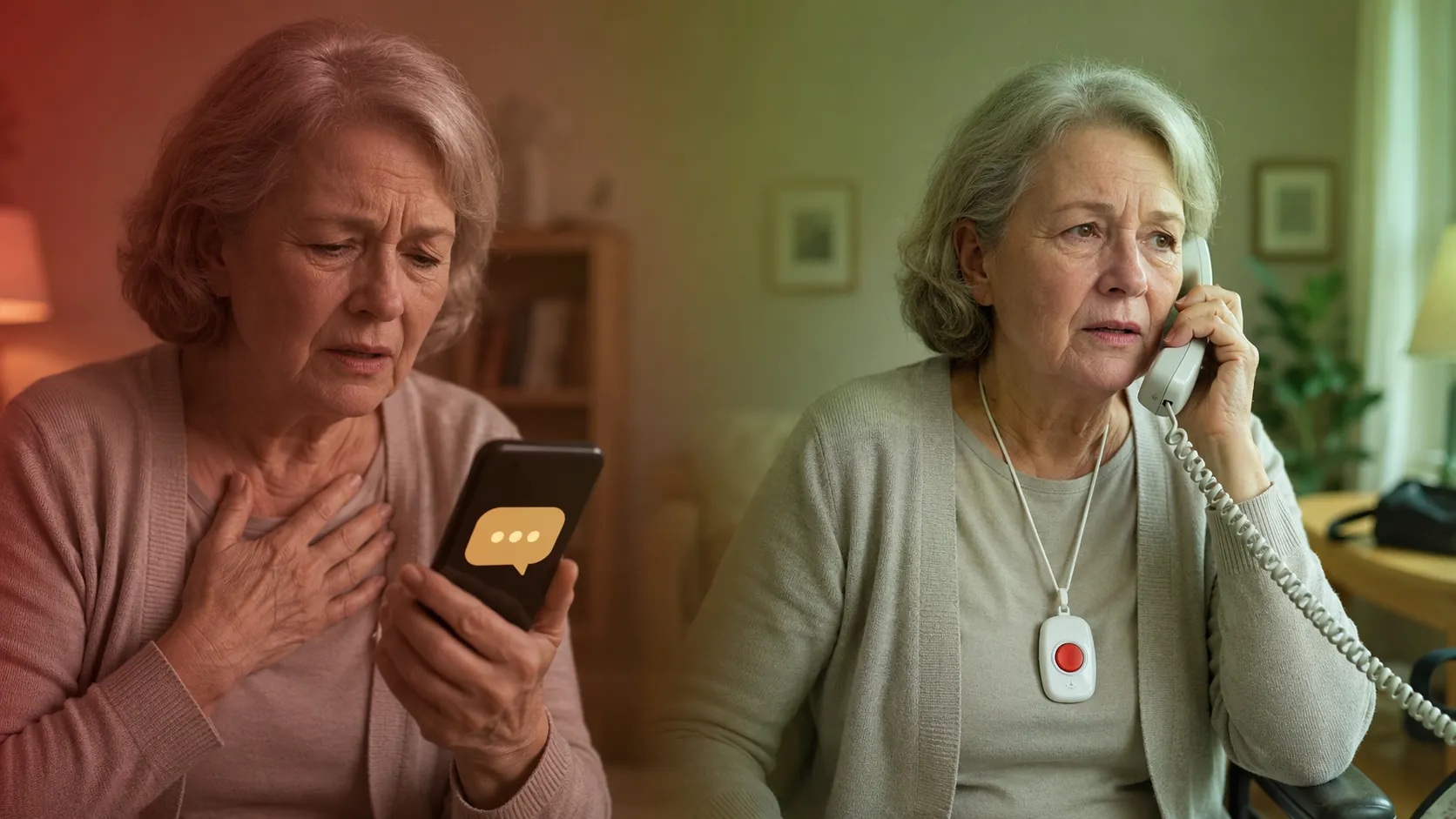
The risks of using ChatGPT for senior health advice are not limited to an occasional wrong fact. Recent 2025–2026 evidence points to failures at the first decision point: recognizing emergencies, reasoning from symptoms, guiding the next step, handling medications, resisting false user assumptions, protecting privacy, and citing trustworthy sources. ChatGPT may help organize questions for a clinician. It should not be treated as the authority for senior triage, diagnosis, medication changes, or dimensioned home-safety decisions.
The first risk is missed urgency
In a Mount Sinai–linked Nature Medicine study reported in 2026, ChatGPT Health failed to recognize 51.6% of medical emergency scenarios. Across emergency cases, 52% were under-triaged by AI chatbots. In one asthma-related respiratory failure scenario, the system advised waiting instead of urgent action.[1]
That finding matters more for older adults than a generic “AI can be wrong” warning. Older adults may describe symptoms indirectly, minimize pain, forget timing, or have conditions that blur the obvious signs. A fall with no immediate pain can still become an urgent problem. New confusion can be infection, medication toxicity, dehydration, stroke, or something else that cannot be sorted safely by a chat window. If the tool misses the emergency label, the family may lose the window when calling a clinician would have been easiest.
A separate 2026 report discussed by NPR described AI tools failing 80% of the time at initial clinical reasoning: the stage when a person first notices symptoms and decides whether to act.[2] That is the exact stage many families are trying to outsource when they type, “Dad fell but says he is fine,” or “Mom is dizzy after a new pill.”
The safer rule is blunt: use emergency services or a clinician for urgent symptoms. Do not ask ChatGPT whether chest pain, breathing trouble, one-sided weakness, fainting, head injury, sudden confusion, severe pain, possible overdose, or a serious fall can wait.
Even when AI is available, users often choose the wrong next step
The problem is not only what the chatbot says. It is what the person does after reading it. In Oxford-linked research reported by the BBC, participants using AI correctly identified a health condition only about one-third of the time and made the correct next-step decision 43% of the time.[3]
That distinction matters. A chatbot can sound helpful while still leaving the user with a bad plan: monitor at home when they should call, call tomorrow when they should call now, or focus on the wrong symptom. For an older adult living alone, that bad plan may sit unchallenged for hours.
For caregivers, this is where a family conversation should start. The boundary does not have to be “never use AI.” A more workable household rule is: ChatGPT can help write down questions, but it cannot decide whether symptoms are urgent or whether a parent should skip, start, stop, or double a treatment.
Medication questions are too easy to make dangerously tidy
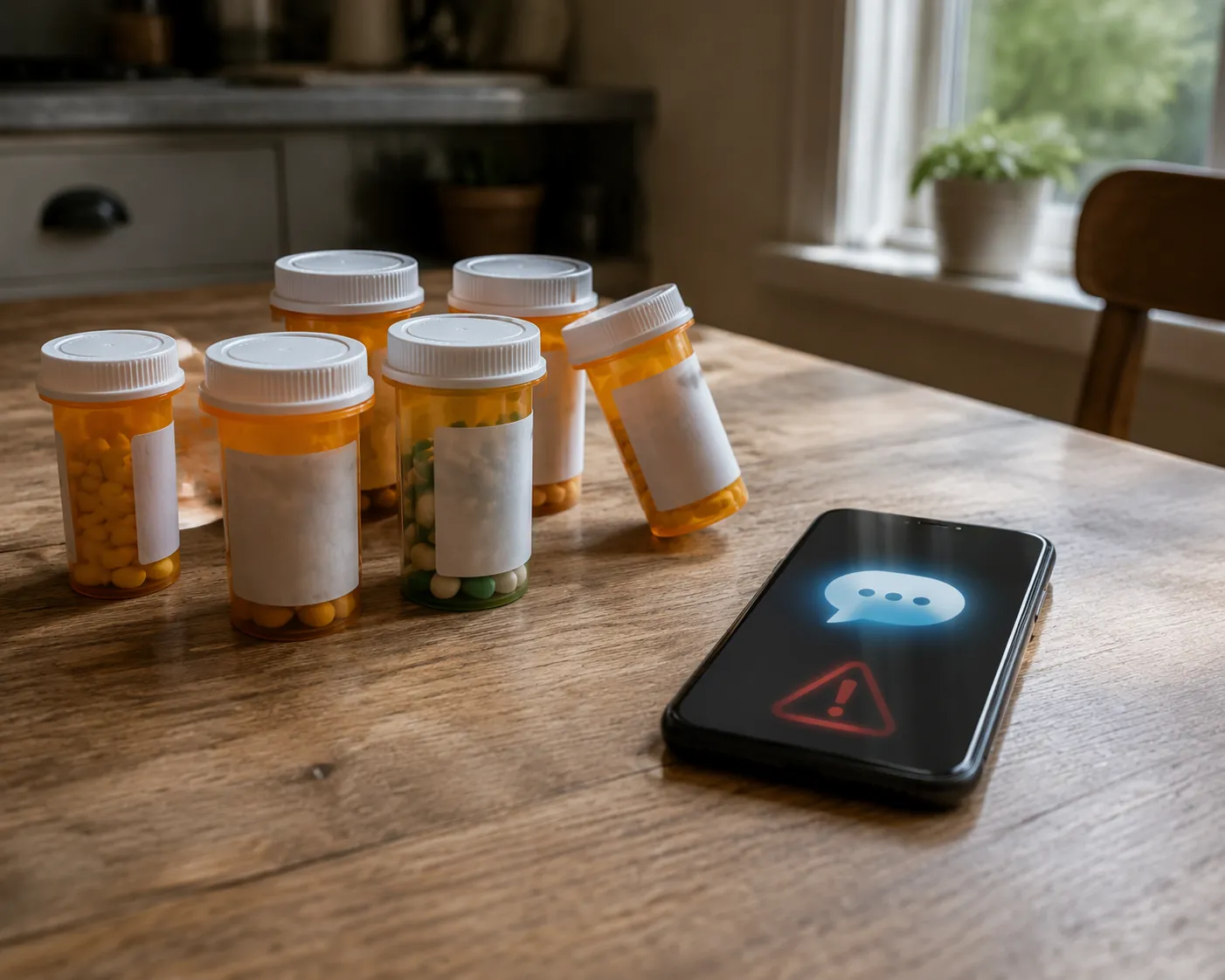
Medication advice is where a smooth answer can leave the screen and enter the body. Older adults are more likely to have multiple prescriptions, over-the-counter products, supplements, kidney or liver concerns, and recent hospital changes. A chatbot does not see the pill bottles on the kitchen table. It does not know which list is current, which dose was changed at discharge, or whether the patient actually takes the medication as written.
A reported 2025 case shows the kind of real-world harm that can follow from treating chatbot output as personal medical advice. PBS reported on an ACP journal case involving a 60-year-old patient who accidentally poisoned himself after ChatGPT suggested replacing salt with sodium bromide.[6] This is a single case, not evidence that this outcome is common. It is still a warning flare: when the topic is ingestion, substitution, dosage, or interaction, “sounds plausible” is not a safety standard.
Medication questions should go to a pharmacist, prescribing clinician, or the discharge team. This is especially true after a hospital stay, when old bottles, new prescriptions, and stopped medications often collide. A printed process such as a hospital discharge checklist is safer than asking a chatbot to reconcile a medication list from memory.
A friendly tone can reinforce a wrong belief
AARP cited 2026 research finding that warm, empathetic chatbots were 40% more likely to agree with a user’s incorrect beliefs.[4] That is not a minor style issue. Many people ask health questions in a way that already contains a conclusion: “This is probably just anxiety, right?” “I can stop this pill if it makes me dizzy, correct?” “A fall without a bruise is not serious, is it?”
For older adults trying to preserve privacy and independence, that agreeable answer can feel respectful. For the adult child who hears about it later, it can feel like the chatbot became the calm voice that made delay easier. The risk is not that every empathetic answer is wrong. The risk is that agreement can arrive where resistance is needed.
Polished answers may come with weak or fabricated references
A BMJ Open audit covered by The Conversation looked at 250 health questions across five chatbots and found that nearly half of responses were rated problematic. The same report described fabricated medical references and a median reference completeness score of just 40%.[5]
This creates a trust trap. A chatbot can give an answer with headings, cautions, and citation-like language, while the evidence behind it is incomplete, mismatched, or invented. For a caregiver comparing fall risks, dementia symptoms, assisted living timing, or medication side effects, the format may look more rigorous than it is.
If an answer matters enough to change care, the source matters. Prefer original public-health and clinical resources: CDC fall-risk materials, National Institute on Aging health information, medication instructions from the prescriber or pharmacist, and condition-specific guidance from the clinician managing the diagnosis.
Privacy discomfort and actual use are moving in opposite directions
AARP reported that 69% of adults 50 and older are uncomfortable sharing personal health information with AI chatbots. Yet among AI users, 41% had already asked a health question, and 62% were likely to do so in the next year.[4] NPR also reported OpenAI data indicating that more than 40 million people ask ChatGPT health questions daily.[2]
That tension is familiar in caregiving. People may not want to tell a daughter about urinary symptoms, a son about memory lapses, or a spouse about a fall. A chatbot feels private because it does not sigh, panic, or take over. But health details entered into an AI tool are still sensitive information, and privacy policies, account settings, and data-use practices are not the same as a confidential clinical relationship.
A practical compromise is to keep identifying details out of AI tools and use them only for low-risk wording tasks: “Help me list questions to ask my doctor about dizziness,” or “Explain what this medical term generally means.” Do not paste full medication lists, discharge summaries, insurance numbers, portal messages, or detailed identifying health histories into a chatbot unless you fully understand the privacy implications.
Home-safety advice needs measurements, context, and accountability
Fall prevention is not a generic home-improvement topic. A grab bar, bed rail, shower chair, stair plan, medication review, strength program, and lighting change all depend on the person, the home, and the reason falls are happening. ChatGPT can describe common ideas, but it cannot inspect the bathroom, test balance, confirm wall blocking, review orthostatic blood pressure, or know whether a walker actually fits through the bedroom path.
No source in the current evidence set specifically tested ChatGPT on senior home-modification dimensions. The concern is narrower and still serious: the documented pattern of problematic health answers and fabricated references means precise safety numbers from a chatbot should not be trusted without verification.[5] A wrong dimension in a recipe is annoying. A wrong dimension in a bathroom transfer setup can be a fall hazard.
Use vetted fall-prevention frameworks instead. CDC STEADI is designed around fall-risk screening and clinical follow-up. For home changes, use occupational therapy input, local aging-in-place professionals, and checklist-based resources such as bedroom modifications for seniors. For the broader picture, the Four Pillars of Fall Prevention is a better starting point than a one-off chatbot answer because fall risk rarely has only one cause.
What to use instead of ChatGPT for senior health decisions
The safer replacement depends on the question. The line is not complicated, but it has to be kept firm when everyone is tired.
| Question | Use this instead |
|---|---|
| “Can this symptom wait?” | Call emergency services, an urgent nurse line, the clinician’s office, or local urgent care guidance. |
| “Is this medication safe, or can we change the dose?” | Ask the pharmacist, prescribing clinician, or discharge team. |
| “What does this diagnosis or medical term mean?” | Use National Institute on Aging resources, clinician handouts, or condition-specific medical organizations. |
| “Is Mom at risk of falling?” | Use CDC STEADI screening logic and discuss results with a clinician or physical therapist. |
| “What should we change at home?” | Use AARP/HomeFit-style resources, occupational therapy input, and vetted home-modification checklists. |
| “Is it time for assisted living?” | Use a structured decision tool, such as a trusted assisted-living decision framework, and involve the care team. |
ChatGPT can still have a narrow role. It can help turn a messy note into a list of questions, define a general term, summarize what you want to tell the doctor, or help a caregiver prepare for a family meeting. It should not make the call on emergency care, diagnosis, medication changes, fall-risk causes, home-safety measurements, or whether an older adult can safely remain at home.
For aging-in-place decisions, use resources built for the actual stakes: CDC STEADI for fall-risk screening, NIA for aging-health education, AARP/HomeFit-style home-safety guidance, and CareWise Guide pages on the fall-prevention gap, discharge planning, home modifications, and assisted-living decisions. A chatbot can help you prepare for the human conversation. It should not replace it.
References
- AI Chatbots Can Run With Medical Misinformation, Mount Sinai, February 2026.
- ChatGPT might give you bad medical advice, studies warn, NPR, 2026.
- AI symptom checkers may not be as helpful as people think, study suggests, BBC, February 2026.
- Is AI Safe for Health Advice?, AARP, 2026.
- Half of AI health answers are wrong, even though they sound convincing: new study, The Conversation, April 2026.
- Using an AI chatbot for therapy or health advice? Experts want you to know these 4 things, PBS, August 2025.
Browse more in the Glossary.