
Clinical term
How Much Protein Seniors Need to Prevent Falls
Last verified 2026-08-05
A fall-prevention plan usually starts where the eye can see trouble: a throw rug, a dark hallway, a loose handrail, shoes that slide, a medication that causes dizziness. Those checks matter. But they can miss the moment just before the fall: an older adult pushing hard with both arms to get out of a chair, slowing down on stairs, losing balance while turning, or failing to recover from a small stumble.
That is where protein belongs in the conversation. Not because a chicken breast or yogurt cup “prevents falls” by itself, but because protein is one of the basic inputs the body uses to preserve muscle. Less muscle can mean weaker transfers, poorer grip, slower walking, and less reserve when something goes wrong.
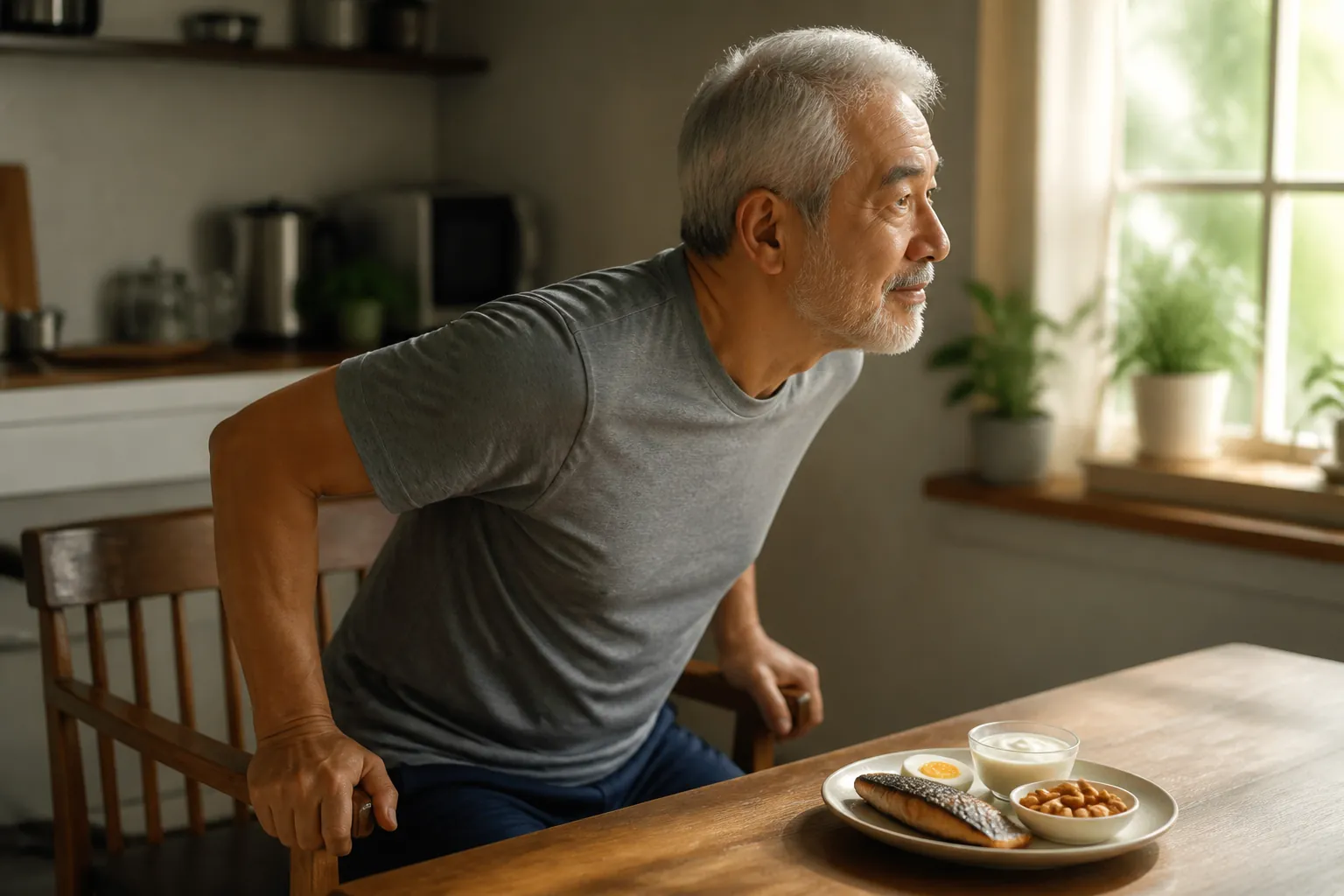
So the useful question is not “Can protein prevent every fall?” It is narrower and more practical: when an older adult has fallen, screened at risk, lost weight, or seems weaker, does protein matter enough to review as part of the fall-prevention plan? The evidence supports that review, with one important caution: protein is a contributor, not a standalone fix.
The missing link: muscle strength is part of staying upright
Muscle is not just for exercise. It is what lets someone rise from a toilet, step over a threshold, carry a grocery bag while turning, and catch themselves when a foot catches on the floor. A fall often happens in that small gap between a hazard and the body’s ability to recover from it.
Protein is not the only determinant of muscle, but it is the nutrient most directly tied to preserving it. In the Health ABC cohort, older adults in the highest protein-intake quintile lost roughly 40% less lean mass over 3 years than those in the lowest quintile, as reported in later reviews of the study findings.[1]
That finding does not prove that higher protein intake by itself prevents falls. It does explain why nutrition belongs beside the more familiar fall-risk checks. If an older adult is losing lean mass, the consequences show up in ordinary movements long before anyone uses a term like sarcopenia.
A NHANES analysis of adults age 70 and older found that not meeting protein recommendations was associated with more functional limitations, including difficulty stooping or crouching, walking 10 steps, and walking a quarter mile. It was also associated with lower grip strength.[2] Those are the abilities caregivers notice: the parent who stops bending for dropped items, grips furniture while walking, or avoids the mailbox because the walk feels too hard.
What the evidence says: lean mass, function, and falls are not the same outcome
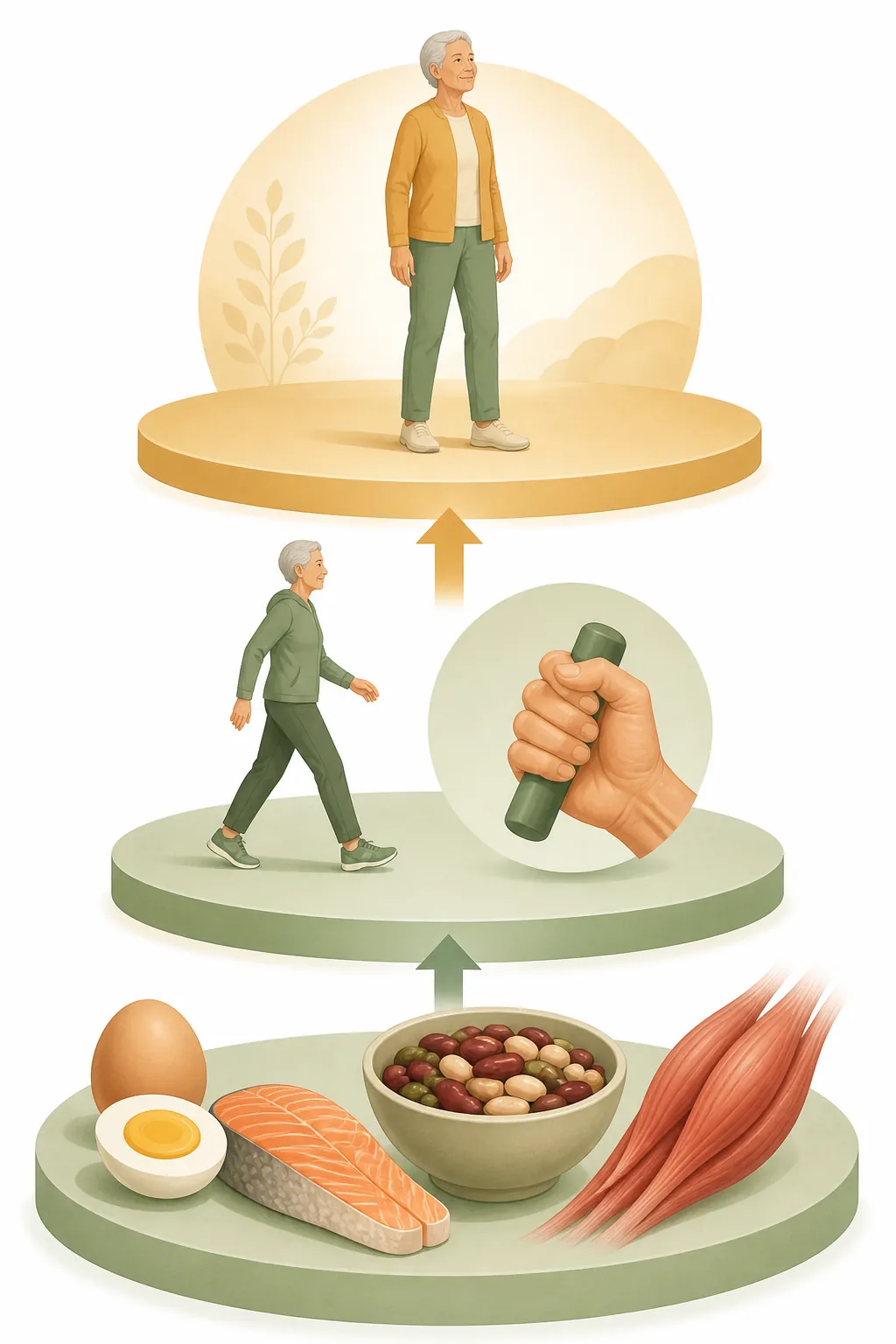
It is tempting to compress the evidence into one simple claim: more protein means fewer falls. The research is more useful when it is kept in three layers.
| Evidence layer | What it can tell a family | What it cannot prove by itself |
|---|---|---|
| Protein and lean mass | Whether protein intake is connected with preserving the tissue that supports strength and movement | That a specific meal pattern will prevent a specific fall |
| Protein and function | Whether low protein intake is linked with everyday abilities such as grip, walking, bending, and transfers | That protein alone caused the functional difference |
| Protein and actual falls | Whether people with higher or lower protein intake had different fall outcomes in follow-up studies | That protein works independently of exercise, illness, medications, weight loss, or overall frailty |
The first layer is the most biologically straightforward: protein intake is linked with lean mass preservation. The second layer is closer to daily life: protein adequacy is associated with grip strength and physical function. The third layer—actual falls—is the one families care about most, and it is also the messiest.
Framingham found a protective association, especially after weight loss
In the Framingham Study analysis of 807 men and women ages 67 to 93, higher protein intake was associated with lower odds of subsequent falling. The overall association was borderline, with an odds ratio of 0.80. The finding became stronger among participants who had lost at least 5% of body weight, where higher protein intake was significantly protective.[3]
That weight-loss detail matters. An older adult who is losing weight may also be losing muscle, appetite, stamina, and reserve. In that situation, reviewing protein intake is not a cosmetic nutrition project. It is part of understanding why standing, walking, and recovering from a stumble may be getting harder.
The Study of Osteoporotic Fractures did not find an independent protein–falls link
A secondary analysis from the Study of Osteoporotic Fractures reached a more cautious result. After adjustment for fall-related covariates, the researchers did not find a direct independent association between protein intake and falls.[4]
That null finding should not be treated as a footnote. It is the reason the practical advice has to stay proportional. The evidence supports protein as part of a fall-risk plan because of its connection to muscle and function, and because at least one cohort found a falls association. It does not support selling protein intake as a guaranteed fall-prevention intervention on its own.
How much protein do adults 65+ generally need?
For many older adults, “eat more protein” is too vague to be useful. A caregiver looking at a half-finished lunch tray needs a rough target, even if the final number should be individualized.
Several expert groups have argued that healthy older adults generally need more than the adult RDA floor. The PROT-AGE Study Group recommended an average daily intake of 1.0 to 1.2 grams of protein per kilogram of body weight for healthy adults over 65.[5] ESPEN expert guidance has also used the 1.0 to 1.2 g/kg/day range for healthy older people.[6]
By comparison, the adult RDA is 0.8 grams per kilogram per day—a floor that is often cited for general adult adequacy, not a fall-prevention target.[1][7] For a 150-pound adult, which is about 68 kilograms, that difference is practical: the RDA floor is about 54 grams per day, while the 1.0 to 1.2 g/kg/day range is about 68 to 82 grams per day.
| Body weight | 0.8 g/kg/day RDA floor | 1.0–1.2 g/kg/day older-adult consensus range |
|---|---|---|
| 120 lb, about 54 kg | About 43 g/day | About 54–65 g/day |
| 150 lb, about 68 kg | About 54 g/day | About 68–82 g/day |
| 180 lb, about 82 kg | About 66 g/day | About 82–98 g/day |
Those numbers are starting points, not prescriptions. Kidney disease, advanced liver disease, cancer treatment, diabetes management, wounds, severe frailty, appetite loss, swallowing problems, and recent hospitalization can all change what is safe or realistic. When any of those are present, the right next step is a clinician or registered dietitian review rather than a family guessing at a higher target.
When protein deserves a closer look in a fall-prevention plan
Protein review is most urgent when the fall story includes weakness, weight loss, poor appetite, or a change in function. The red flag is not only “my parent fell.” It is also “my parent is eating less, standing up more slowly, losing weight, or avoiding movements that used to be routine.”
- A fall or near-fall followed by visible weakness or fear of walking
- Unintentional weight loss, especially if clothing is looser or meals are being skipped
- Trouble rising from a chair without using both arms
- Lower grip strength, such as difficulty opening jars, carrying bags, or holding a walker securely
- New difficulty with stairs, curbs, bathing, toileting, or walking outside
- A mostly tea-and-toast, cereal-only, or snack-based eating pattern
This is also where sarcopenia belongs in the discussion. Sarcopenia means loss of muscle mass and function, but prevalence estimates vary because studies use different definitions. A 2023 meta-analysis summarized by Harvard Health described sarcopenia as affecting roughly 10% to 16% of older adults, with some estimates near 50% among people over 80.[8] The exact label matters less at the kitchen table than the pattern: shrinking muscle reserve plus harder daily movement.
Protein works best when it is paired with strength work
Protein gives the body material to maintain and repair muscle. Strength and balance work give the body a reason to use that material. A fall-prevention plan that improves protein intake but leaves an older adult sitting most of the day is incomplete; so is an exercise plan that ignores poor intake, weight loss, or skipped meals.
For a caregiver, the practical move is often simple: bring the food question into the same appointment where falls are already being discussed. Instead of asking only about rugs, shoes, and blood pressure, add: “Has weight changed?” “How much protein is usually eaten at breakfast and lunch?” “Is there trouble chewing or swallowing?” “Would a dietitian referral make sense?”
That conversation fits naturally with a STEADI-style approach: screen for fall risk, assess the modifiable factors, and intervene on more than one cause. If you are building the larger plan, start with the Fall Prevention FAQ, then use the Caregiver’s Action Guide to turn the discussion into tasks.
Where protein sits beside the other fall-risk factors
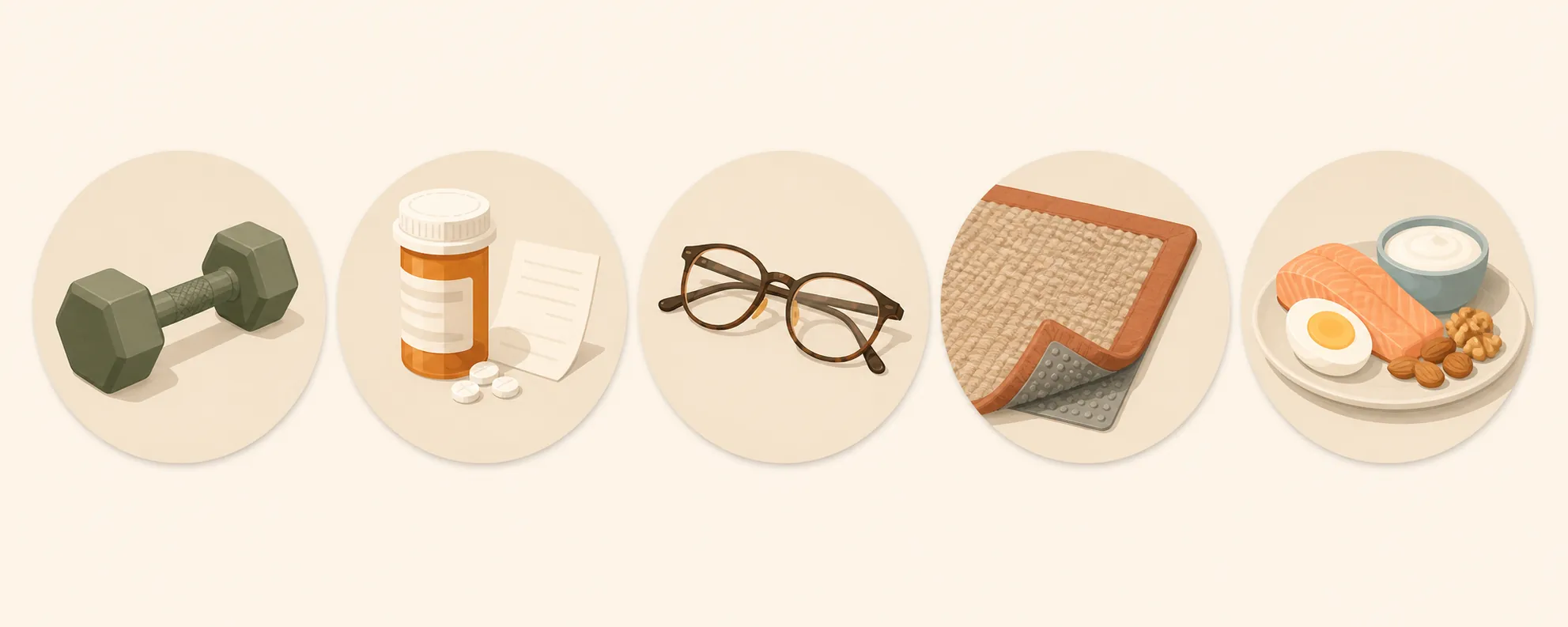
Protein should not crowd out the proven basics. Medication review still matters when dizziness, sedation, low blood pressure, or drug interactions are in the picture. Vision checks still matter. Home hazards still matter. Strength and balance training still matter. The point is to stop treating nutrition as a separate wellness topic when weakness is part of the fall story.
| Fall-prevention area | What to check | Who may need to be involved |
|---|---|---|
| Strength and balance | Chair rise, gait, stair confidence, exercise tolerance | Primary care clinician, physical therapist, trained exercise program |
| Medication risk | Sedating drugs, dizziness, blood pressure changes, recent medication changes | Prescriber, pharmacist |
| Vision and feet | Blurred vision, outdated glasses, foot pain, unsafe footwear | Eye clinician, podiatrist, primary care clinician |
| Home hazards | Lighting, rugs, cords, bathroom surfaces, stairs, grab bars | Caregiver, occupational therapist, home-safety program |
| Protein and eating pattern | Skipped meals, low-protein breakfasts, weight loss, chewing or swallowing trouble | Primary care clinician, registered dietitian, dentist or speech-language pathologist when relevant |
The same logic applies to other modifiable risks. A medication problem, such as a potency issue or dosing mismatch, can sit quietly in the background until a fall forces everyone to look harder. Nutrition can do the same. For an example of another risk factor that belongs in the fall-prevention review, see this discussion of subpotent levothyroxine and falls in seniors.
A cautious reading of the research
The strongest practical case for protein is the chain from intake to lean mass to function. The direct fall-outcome evidence is supportive but mixed: Framingham found lower fall odds with higher protein intake, especially among people who had lost at least 5% of body weight, while the Study of Osteoporotic Fractures found no independent association after adjustment.[3][4]
The NHANES findings are also association findings, not proof of causation. The analysis used single 24-hour dietary recalls, which can miss usual intake, especially if the day recalled was unusual.[2] That does not make the results useless; it means they should be used as a signal to assess, not as proof that one protein target will change one person’s fall risk.
Funding and disclosure details are also worth reading in this area. The NHANES protein-function paper reported support that included Abbott Nutrition, and some protein-focused reviews include authors with industry relationships.[1][2] That does not automatically invalidate the findings, but it is a reason to prefer modest conclusions over nutrition marketing language.
What to do after a fall, screen, or noticeable weakness
If an older adult has fallen, screened at risk, lost weight, seems weaker, or is eating poorly, protein intake is worth reviewing this week. The review does not need to become a medical project at the dinner table. It should answer a few concrete questions: is the person eating protein more than once a day, are meals being finished, has weight changed, and is there a medical reason to individualize the target?
Then place the answer back into the full plan: strength and balance work, medication review, vision and footwear checks, safer home setup, and follow-up after any new fall or near-fall. The site’s three-layer fall-prevention system guide can help organize those pieces without treating any single fix as enough.
This article is for education and planning support, not individual medical advice. Older adults with kidney disease, complex medical conditions, swallowing problems, unintended weight loss, or recent hospitalization should review protein goals with their clinician or a registered dietitian. Clinical review: Lauren M. Chen, MS, RD, CNSC.
References
- The Role of Dietary Protein Intake in the Prevention of Sarcopenia of Aging, Nutrients, 2016.
- Low Dietary Protein Intakes and Associated Dietary Patterns and Functional Limitations in an Aging Population: A NHANES analysis, 2019.
- Dietary protein intake and subsequent falls in older men and women: the Framingham Study, PubMed, 2011.
- Protein and Vitamin D Intake and Risk of Falls: A Secondary Analysis of Postmenopausal Women from the Study of Osteoporotic Fractures, 2015.
- Evidence-based recommendations for optimal dietary protein intake in older people: a position paper from the PROT-AGE Study Group, PubMed, 2013.
- Protein intake and exercise for optimal muscle function with aging: recommendations from the ESPEN Expert Group, ESPEN, 2014.
- Are you getting too much protein?, Mayo Clinic Health System.
- Muscle loss and protein needs in older adults, Harvard Health.
Browse more in the Glossary.