
Fall Prevention at Home: How to Build a Complete Aging-in-Place Safety System Using CDC STEADI, Home Modifications, and Community Services
This guide helps adult children whose parent has fallen at home build a coordinated, three-layer fall prevention system. It covers the CDC STEADI medical assessment, prioritized home modifications with cost ranges, and community-based monitoring and services — all organized into an actionable plan for family caregivers.
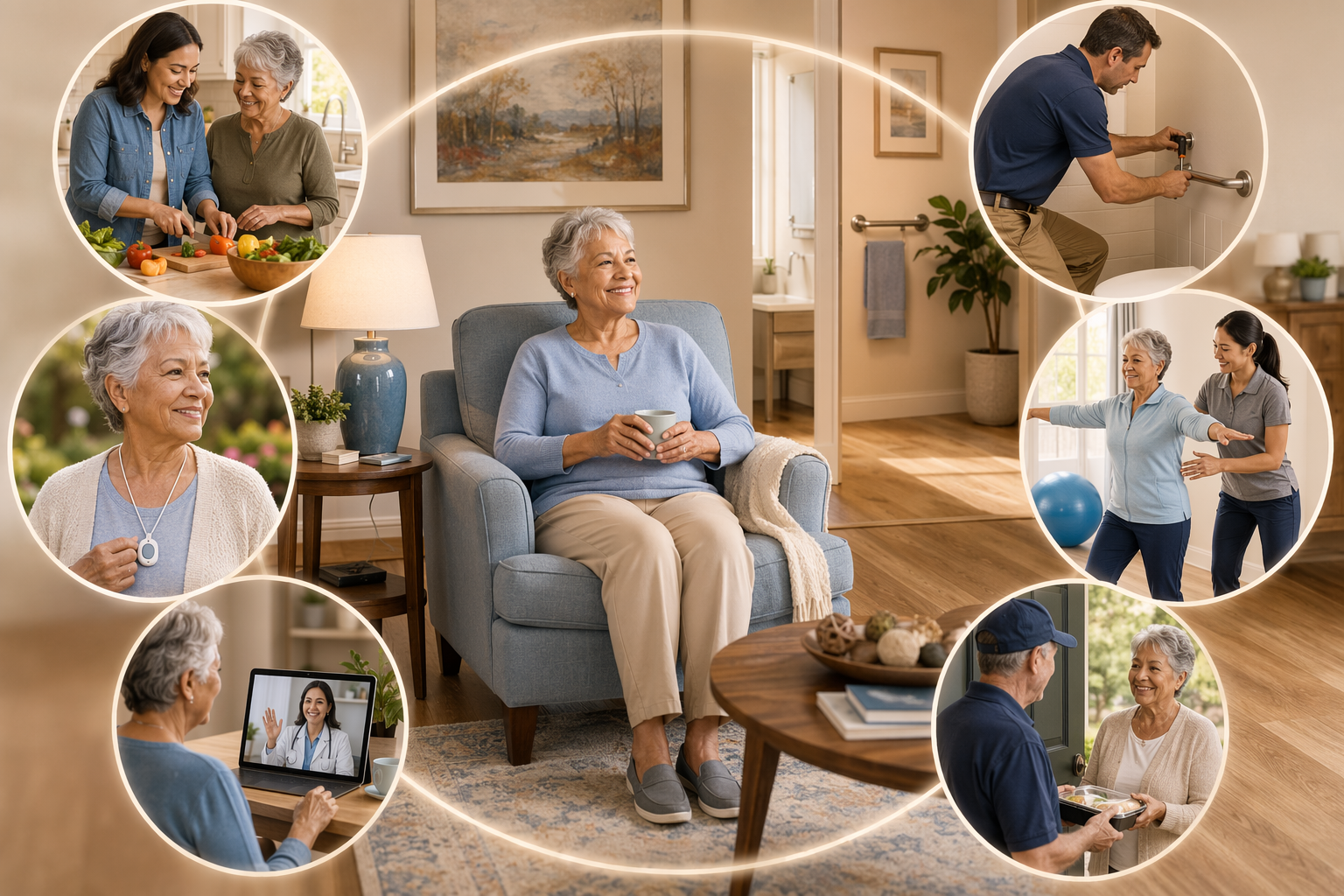
Why Falls Are the #1 Threat to Aging in Place — and Why a Checklist Isn't Enough
Every year, 14 million older adults — 1 in 4 people aged 65 and older — report falling. In 2021 alone, falls caused more than 38,000 deaths among older adults and sent nearly 3 million to emergency departments. The financial toll is staggering: the total healthcare cost of non-fatal falls reached $80 billion per year based on 2020 data, with Medicare covering 67% of that burden. And the trend is worsening. The age-adjusted fall death rate climbed 21% from 64.7 per 100,000 older adults in 2018 to 78.4 per 100,000 in 2024, according to CDC WONDER data released in February 2026.
These numbers are not abstract statistics. For the adult child whose parent just fell, they represent a clear signal: the current approach to safety at home is not working. The instinct is to grab a checklist, remove a few throw rugs, and hope that's enough. But the evidence shows that effective fall prevention requires a coordinated system — not a single checklist, not a single grab bar, and not a single doctor's visit.
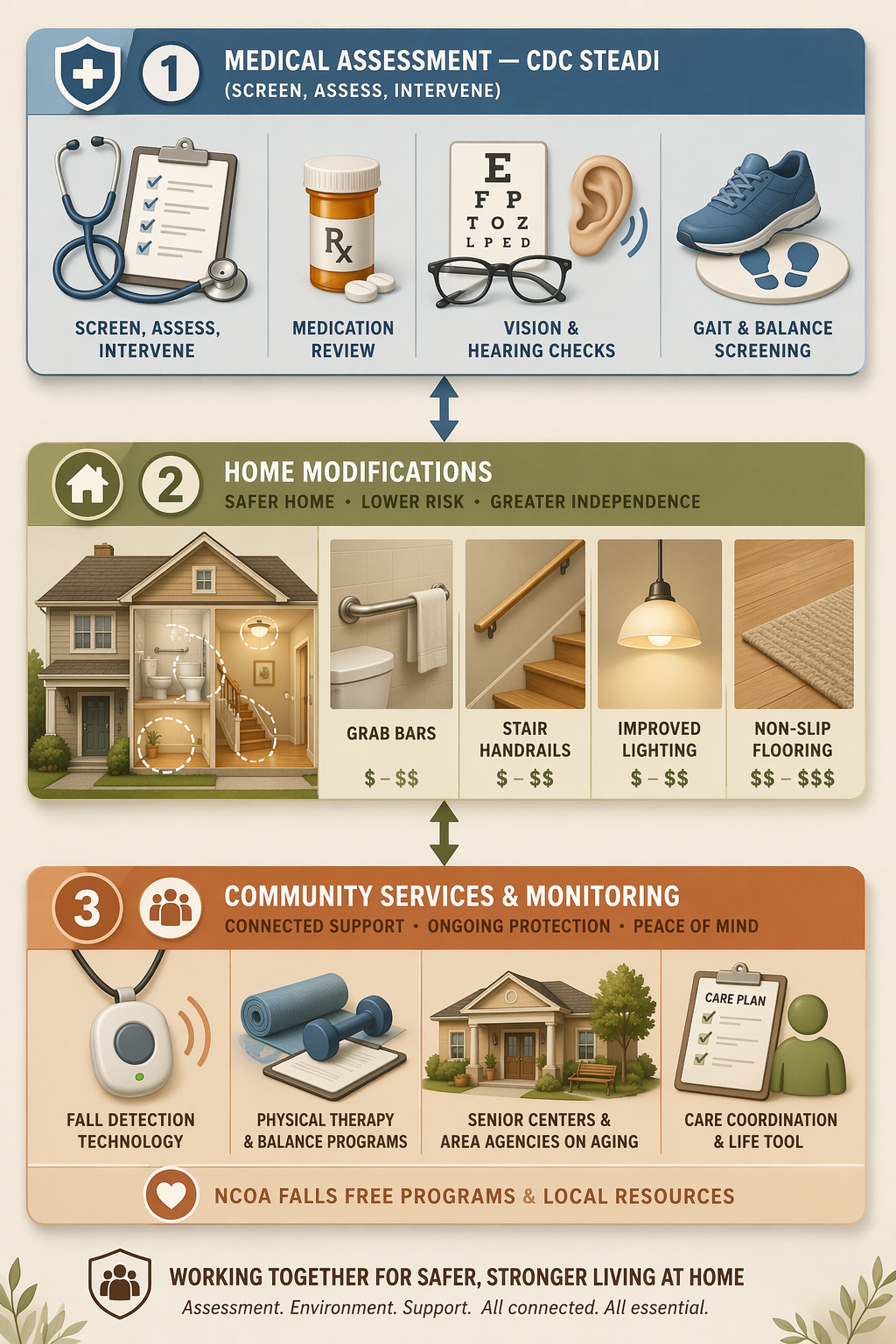
This guide presents a three-layer fall prevention system built on the CDC's STEADI framework. Layer 1 addresses the medical and physiological risk factors that make a person prone to falling. Layer 2 tackles the home environment, prioritizing modifications by both fall risk reduction and cost. Layer 3 deploys community-based services and monitoring technology as a safety net. Each layer depends on the others. A medical assessment without home modifications leaves environmental hazards in place. Home modifications without medical management miss the underlying causes. Monitoring technology without either layer is just a reaction after the fall has already happened.
Layer 1: Start with a Clinical Assessment Using the CDC STEADI Model
Before you change a single lightbulb or install a single grab bar, your parent needs a clinical fall risk assessment. The CDC's STEADI initiative — Stopping Elderly Accidents, Deaths & Injuries — provides the evidence-based framework for this first layer. STEADI organizes fall prevention into three steps: Screen, Assess, and Intervene.
What a STEADI-Based Assessment Includes
A thorough clinical assessment goes far beyond asking "Have you fallen recently?" It systematically evaluates the multiple risk factors that converge to cause a fall. Here is what a primary care provider or geriatrician should cover:
- Medication review: Sedatives, antihypertensives, anticholinergics, and certain diabetes medications are strongly associated with fall risk. A pharmacist or physician should review every prescription and over-the-counter drug for interactions and side effects that affect balance or blood pressure.
- Vision and hearing screening: People with hearing loss are nearly three times as likely to fall, but wearing a hearing aid reduces that risk by 50%. Vision changes affect depth perception and obstacle detection.
- Gait and balance testing: Simple clinical tests like the Timed Up and Go (TUG) or the 30-Second Chair Stand can identify mobility deficits that predict falls.
- Vitamin D assessment: Low vitamin D levels are linked to muscle weakness and impaired balance. Supplementation, when indicated, can reduce fall risk.
- Referral to evidence-based exercise: Programs like Otago (a home-based strength and balance program) and Tai Chi have demonstrated effectiveness in reducing fall rates. The assessment should identify which program matches your parent's current mobility level.
This layer must come first because it identifies the root causes. A person who falls because of medication-induced dizziness will keep falling no matter how many grab bars you install. The clinical assessment tells you what you are actually solving for.
Layer 2: Prioritize Home Modifications by Fall Risk and Cost
Once you understand your parent's specific risk factors, the second layer addresses the physical environment where most falls happen: the home. Research shows that home modification programs can reduce in-home falls by nearly 40%, and the most frequently implemented effective strategies — used by 90% of programs — are non-slip flooring, stair handrails, and improved lighting.
Yet the gap between what is needed and what has been done is enormous. According to survey data, only 10% of U.S. homes are "aging ready" to accommodate older adults, and only 18% of adults aged 50 and older have made any home modifications. Nearly 80% of older adults say they need bathroom modifications such as grab bars and walk-in showers, but most have not acted on that need.
The following table ranks common home modifications by their fall risk reduction impact and typical cost range. Start at the top and work down.
| Modification | Fall Risk Reduction | Typical Cost Range | Best For |
|---|---|---|---|
| Grab bars (bathroom, toilet, shower) | High | $50 – $200 per bar (installed) | Bathroom transfers, shower entry/exit |
| Stair handrails on both sides | High | $100 – $400 per rail (installed) | Stair navigation, balance support |
| Improved lighting + motion-activated night lights | High | $20 – $100 per fixture | Nighttime bathroom trips, dark hallways |
| Non-slip flooring and mats (bathroom, kitchen) | High | $30 – $200 per room | Wet areas, high-traffic zones |
| Removal of throw rugs and clutter | High | $0 (free) | All rooms, especially walkways |
| Walk-in tub or curb-less shower | Moderate | $2,500 – $10,000 | Bathing safety, transfer difficulty |
| Stair lift | Moderate | $3,000 – $10,000 | Multi-level homes, limited mobility |
| Ramp installation (entryway) | Moderate | $1,110 average (NCOA) | Wheelchair or walker access |
| Doorway widening | Low to Moderate | $500 – $3,000 per door | Wheelchair accessibility |
For the highest-impact changes — grab bars, handrails, lighting, and non-slip surfaces — you do not need a contractor. Many can be installed by a handy family member or a handyman service in an afternoon. For structural modifications like stair lifts, walk-in tubs, and ramps, you will need a professional assessment.
Who should perform that assessment? An occupational therapist (OT) or physical therapist (PT) can conduct a home safety evaluation and recommend specific modifications tailored to your parent's functional abilities. A CAPS-certified contractor (Certified Aging-in-Place Specialist) can then execute the structural work. The OT identifies what needs to change; the CAPS contractor knows how to build it.
Layer 3: Deploy Community-Based Services and Monitoring Technology
The first two layers reduce the likelihood of a fall. The third layer ensures that when a fall does happen — because no system is perfect — help arrives quickly and the consequences are minimized. This layer combines monitoring technology with community-based services that provide ongoing support, assessment, and programming.
Monitoring Technology as a Safety Net
Technology options have expanded well beyond the classic "I've fallen and I can't get up" pendant. The key categories include:
- Personal Emergency Response Systems (PERS) with automatic fall detection: These devices detect a fall even if the user cannot press the button. Response times and detection accuracy vary significantly by device category — evaluate these dimensions rather than brand names.
- Passive home sensors: Motion sensors, door sensors, and stove monitors track activity patterns and alert caregivers if something is wrong — for example, no motion detected by mid-morning, or the stove being left on.
- GPS trackers: For seniors who wander, GPS-enabled devices provide location tracking and geofencing alerts. These are particularly relevant for individuals with dementia.
- Wearable health monitors: Devices that track heart rate, activity levels, and sleep patterns can flag changes that precede a fall, such as a urinary tract infection causing confusion or a drop in blood pressure.
It is critical to understand what monitoring technology cannot do. It cannot prevent the first fall. It cannot replace the medical assessment in Layer 1 or the home modifications in Layer 2. It is a safety net — an essential one, but only one part of the system.
Community-Based Services That Support All Three Layers
Your local Area Agency on Aging (AAA) is the single most important resource for connecting all three layers. AAAs provide or coordinate:
- Home safety assessments by an occupational therapist or nurse
- Fall prevention classes and evidence-based programs (including Tai Chi and Otago)
- Home modification programs and funding assistance
- Referrals to NCOA Falls Free programs and the Falls Free CheckUp screening tool
- Care coordination and case management for complex situations
The National Council on Aging (NCOA) Falls Free initiative provides a national network of evidence-based fall prevention programs. The LIFE Tool (Lifestyle Interventions and Independence for Elders) is another resource that helps create a personalized fall prevention plan combining exercise, home safety, and medical management.
To find your local AAA, visit the Eldercare Locator (eldercare.acl.gov) or call 1-800-677-1116. This single call can unlock access to all three layers of the system.
How to Find and Fund the Three-Layer System
Cost is the most common barrier families face when building a fall prevention system. The good news is that funding sources exist for each layer, though they are often fragmented across different programs. The following table summarizes the major funding options and what they cover.
| Funding Source | Covers Layer 1 (Medical) | Covers Layer 2 (Home Mods) | Covers Layer 3 (Monitoring/Services) | Key Limitation |
|---|---|---|---|---|
| Medicare (Original Parts A & B) | Yes — Annual Wellness Visit, fall risk assessment, PT/OT | No — does not cover grab bars, ramps, or structural changes | No — does not cover PERS or medical alert systems | Short-term home health only; no custodial care |
| Medicare Advantage (Part C) | Yes — same as Original Medicare | Some plans may cover limited home modifications | Some plans may cover PERS or adult day services | Coverage varies by plan and state; verify directly |
| Medicaid HCBS Waivers | Yes — personal care, nursing, therapy | Yes — may cover grab bars, ramps, bathroom modifications | Yes — may cover personal care, adult day, case management | State-specific; asset and income limits apply |
| VA Benefits (SAH, SHA, HISA grants) | Yes — VA healthcare covers assessments and PT | Yes — SAH/SHA grants for structural modifications; HISA for home improvements | Yes — Aid & Attendance for in-home care | Eligibility requires service-connected disability or specific criteria |
| Nonprofit Programs (Habitat for Humanity, Rebuilding Together, local AAAs) | No | Yes — may provide free or low-cost modifications | Yes — some offer fall prevention classes and safety checks | Limited availability; often income-qualified |
| Out-of-Pocket / Private Pay | Yes — if not covered by insurance | Yes — most common payment method for modifications | Yes — most PERS and monitoring devices are private pay | No reimbursement; cost varies widely |
The key takeaway: do not assume a single program will cover everything. A typical family might use Medicare for the initial medical assessment, a VA grant for a bathroom modification, an AAA program for a home safety check and fall prevention classes, and private pay for a medical alert system. Each funding source fills a specific gap.
Creating a Personalized Fall Prevention Care Plan
A care plan is what transforms the three-layer system from a concept into an actionable roadmap for your family. Here is a simple framework to build one:
- Schedule a STEADI-based medical assessment within 2 weeks. Call your parent's primary care provider and request a fall risk evaluation. Bring a list of all medications, including over-the-counter drugs and supplements.
- Conduct a room-by-room home hazard audit using a printable checklist. Walk through every room with a critical eye. Look for loose rugs, poor lighting, clutter in walkways, lack of handrails, and slippery surfaces. The NIA provides a Home Safety Checklist PDF for this purpose.
- Prioritize the top 3 modifications by cost and risk. Start with the highest-impact, lowest-cost changes from the table in Layer 2. Install grab bars in the bathroom, add handrails to stairs, and improve lighting before considering a stair lift or bathroom remodel.
- Contact your local Area Agency on Aging. Request a home safety assessment, ask about fall prevention classes, and inquire about any home modification programs or funding they offer.
- Evaluate monitoring technology based on your parent's specific needs. Consider mobility level, cognitive status, living situation (alone or with others), and willingness to wear a device. A PERS with automatic fall detection is appropriate for most seniors living alone. Passive sensors may be better for someone who refuses to wear a pendant.
Review this plan quarterly and update it after any significant change in health, medication, mobility, or living situation. A fall prevention system is not a one-time project — it is an ongoing process that evolves as your parent's needs change.
Family Caregiver Checklist: Your Next Steps After a Parent's Fall
Use this checklist as your immediate action guide. Print it, save it, or share it with other family members involved in care.
Immediate Actions (Within 48 Hours)
- Ensure your parent has been seen by a healthcare provider after the fall, even if they say they are fine.
- Remove immediate tripping hazards from the area where the fall occurred: loose cords, small rugs, clutter, pets underfoot.
- Place a night light in the bathroom and bedroom if one is not already there.
- Write down the details of the fall: time, location, activity, any symptoms before the fall (dizziness, weakness, confusion). This information is critical for the medical assessment.
Short-Term Actions (Within 2 Weeks)
- Schedule a STEADI-based fall risk assessment with your parent's primary care provider or a geriatrician.
- Install grab bars in the bathroom — at least one near the toilet and one inside the shower or tub.
- Contact your local Area Agency on Aging (1-800-677-1116) to request a home safety assessment and ask about fall prevention programs.
- Review all medications with a pharmacist or physician for fall risk.
- Begin the conversation about home modifications with your parent. This is often the hardest step.
Ongoing Actions (Monthly and Quarterly)
- Review medications quarterly with a healthcare provider — new prescriptions can introduce fall risk.
- Re-assess home safety after any change in health, mobility, or vision.
- Test monitoring equipment monthly (battery life, fall detection function, response time).
- Encourage continued participation in balance and strength exercises (Otago, Tai Chi, or a local program through the AAA).
- Update the fall prevention care plan quarterly and after any hospitalization or change in medication.
Related reading
Noticed something outdated or inaccurate on this page? Flag a correction. We review every report against CDC, NIA, and AARP HomeFit guidance before updating a page.
Part of the Fall Prevention section.