
Caregiver decision guide
Can a Robot Vacuum Cut Fall Risk for Seniors Aging in Place?
A robot vacuum can cut the fall risk of floor cleaning for seniors aging in place — but only when the person and home are the right match. Caregivers get clear criteria for who genuinely benefits, who should skip it, and what to prep before the first run so the robot doesn't become a trip hazard.
Vacuuming is not just “cleaning.” It is pushing a machine, turning it around furniture, bending to plug and unplug a cord, carrying it between rooms, and sometimes working near stairs, thresholds, rug edges, or clutter. For an older adult aging in place, those small movements can become the risky part of the chore.
So the short answer is yes: a robot vacuum can reduce fall exposure from floor cleaning. The longer answer matters more. It helps only when vacuuming is genuinely straining the person’s mobility, grip strength, stamina, or balance; when the home is cleared of cords and loose rugs before the first run; and when the robot is set up so it does not strand itself in a walking path or drag a cord into the hallway.
If you are searching for robot cleaning services for seniors aging in place, the practical decision today is usually not whether a robot can replace housecleaning. It cannot. The useful question is narrower: can a small floor robot safely remove one physically demanding task from the week?
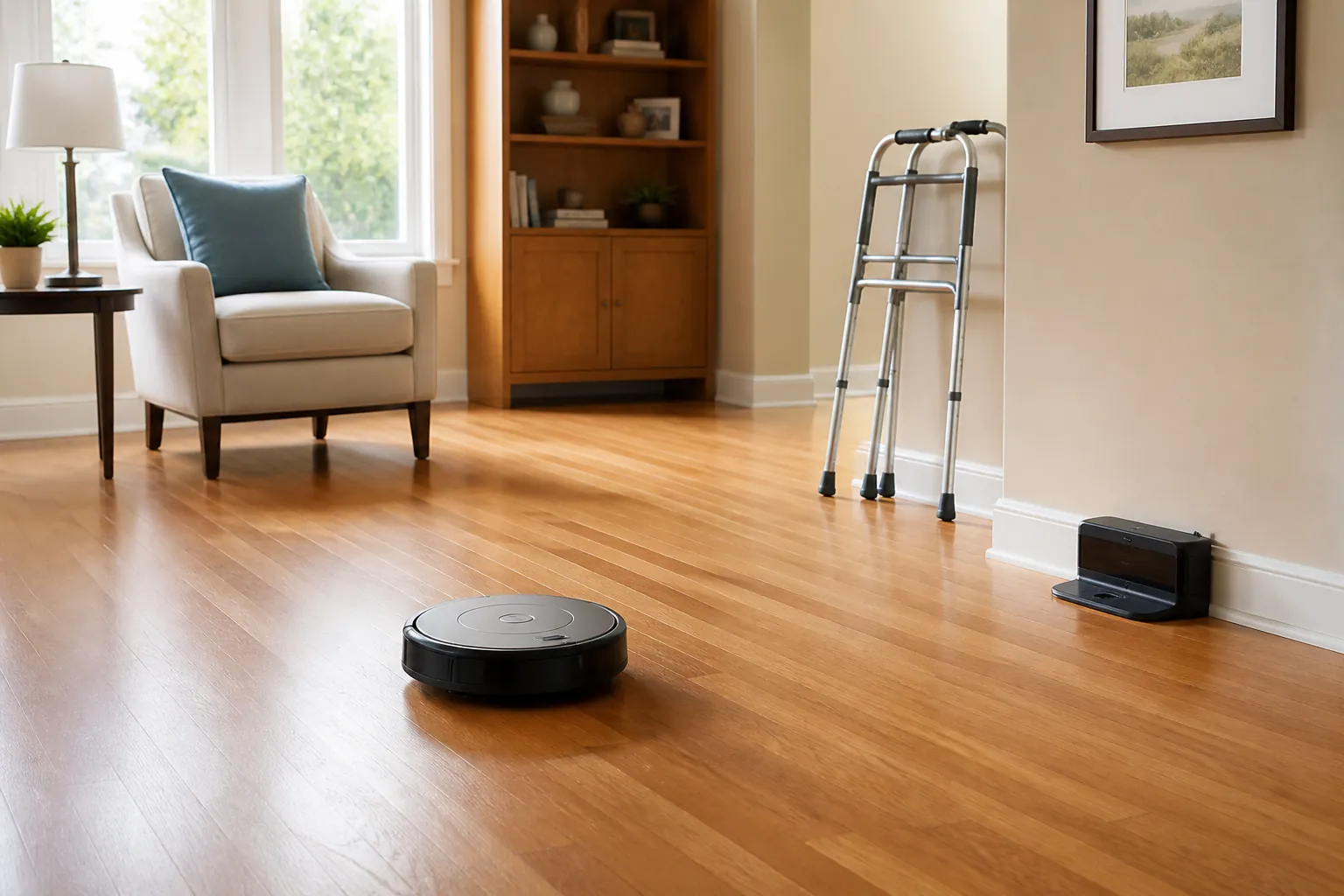
Why floor cleaning belongs in a fall-risk conversation
Falls are not a fringe concern in later life. The CDC reports that more than 1 in 4 older adults falls each year, and it lists throw rugs and clutter among home hazards that can contribute to falls [1]. That does not mean every rug or every chore is dangerous. It does mean floor care deserves the same practical scrutiny as grab bars, lighting, footwear, and stair railings.
Cleaning can combine several risk factors at once. LTC News notes that tasks such as vacuuming stairs or mopping can increase fall risk if balance is lost, especially when fatigue, reduced grip strength, arthritis, or impaired vision are also present [2]. A traditional upright vacuum adds its own small hazards: a cord across the route, a heavy machine that must be pulled backward, and a bin or bag that may require bending, twisting, or carrying.
That is why the robot vacuum is worth considering. It is not interesting because it is clever. It is interesting because, in the right home, it can remove pushing, cord handling, and some bending from a recurring chore. For the broader fall-risk picture, readers can also review the Fall Prevention FAQ for Seniors and Caregivers.
The best fit: a real cleaning strain, plus a simple support system
A robot vacuum makes the most sense for an older adult who is still living with enough routine and judgment to use the home safely, but for whom ordinary vacuuming has become a strain. AARP’s 2025 overview quotes Sara J. Czaja of Weill Cornell on robotic aids such as Roomba helping off-load physically demanding vacuuming for older adults [3]. The key word is off-load. The robot should remove a burdensome movement, not create a new job that requires crouching on the floor twice a week.
A good-fit household usually has most of these traits:
- Vacuuming causes fatigue, pain, low stamina, balance worry, or grip problems.
- The main cleaning area is one level, with enough open floor for the robot to navigate.
- The person can keep common walking paths reasonably clear, or a helper can reset the floor regularly.
- A family member, neighbor, aide, or cleaner can handle the initial app setup, mapping, no-go zones, and occasional troubleshooting.
- The older adult is willing to let the robot run on a predictable schedule and can leave it alone while it cleans.
- Someone can replace bags, filters, brushes, or mop pads before maintenance becomes a floor-level rescue mission.
That last point is not minor. The person who benefits most from not bending to vacuum may also be the person who should not be flipping a robot over to cut hair from a brush roll. The purchase decision should include the helper, not because the older adult is incapable, but because safe independence often depends on taking the right tasks off the wrong person’s plate.
| Person and home factor | What it suggests |
|---|---|
| Vacuuming is tiring, painful, or balance-challenging | A robot may remove a meaningful physical demand. |
| Floors are usually clear, with limited loose rugs and cords | The robot has a better chance of helping without becoming a trip hazard. |
| The home has one main cleaning level | The robot can cover the area where it is actually useful. |
| A helper can configure the app and check maintenance | Daily use can stay simple for the older adult. |
| The person strongly dislikes devices or will not leave the robot alone | The robot may add stress and rescue calls instead of reducing strain. |
When a robot vacuum is the wrong fix
Some homes should skip the robot vacuum, at least for now. This is not a judgment about wanting help. Wanting less cleaning strain is reasonable. The question is whether this particular tool makes the walking environment safer.
A robot vacuum is a poor fit when the main problem is stairs. Consumer robot vacuums do not clean stair treads, carry themselves between levels, or remove the need for someone to handle the riskiest part of stair cleaning. If the chore that worries you is vacuuming a staircase, the safer answer is usually human help, a lighter cordless tool used by someone steady enough to manage it, or changing how often that area is cleaned.
It is also a poor fit for heavy clutter. A floor robot needs a floor. If mail piles, laundry, shoes, charging cords, pet toys, oxygen tubing, or small household objects routinely sit in walking paths, the robot will either avoid the mess, push it, get stuck in it, or make someone bend down to intervene. In that home, clutter reduction comes before automation.
Be especially cautious when dementia or other judgment changes affect safe use of the home. A person who may pick up the robot while it is running, step around it unpredictably, unplug the dock, ignore error sounds, or become distressed by an automated device is not being helped by another moving object on the floor. In that situation, talk with the care team or an occupational therapist about the safer way to handle cleaning support.
Strong tech aversion matters, too. The daily experience can be simple after setup, but the household still needs someone who can understand alerts, rescue the robot safely, and decide when it should not run. If every error becomes an urgent phone call or every run creates anxiety, the device has shifted work from the vacuum cord to the caregiver.
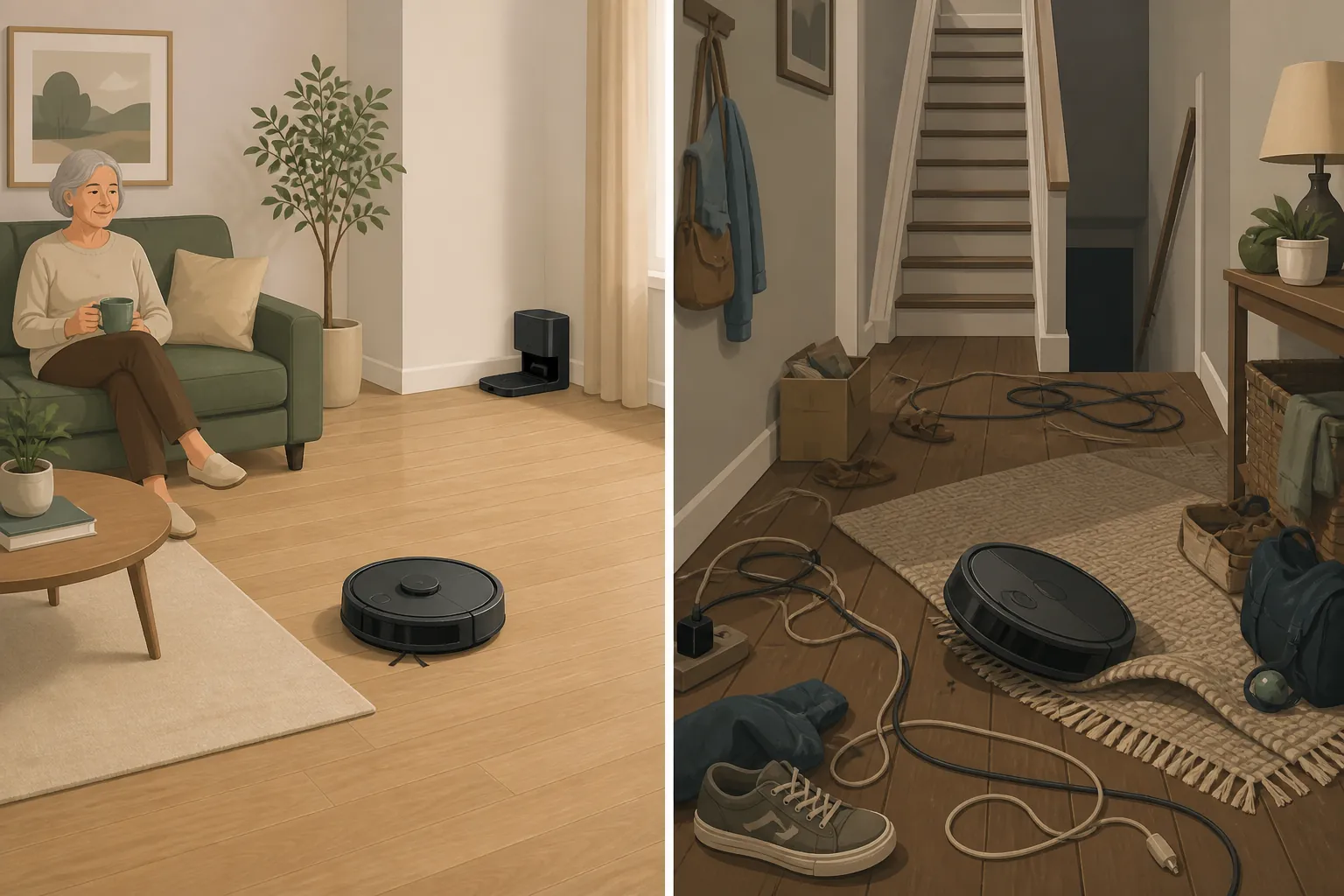
Features that matter because they reduce bending, rescuing, and confusion
This should not be a feature hunt. The safest robot vacuum for an older adult is not automatically the one with the longest spec sheet. It is the one that creates the fewest reasons for a person with balance, grip, vision, or stamina limits to bend down, tug, untangle, or troubleshoot.
AARP’s 2025 article gives a broad price range of about $180 to more than $1,400 for robot vacuums [3]. That range is too wide to treat price as a safety proxy. A cheaper model may be fine in a small, open apartment with a helper nearby. A more expensive model may still be a bad purchase if it gets stranded at a threshold or requires app attention the household cannot provide.
| Priority | Feature to look for | Why it matters for aging in place |
|---|---|---|
| 1 | Self-emptying base | Reduces how often someone has to bend down and empty a small onboard bin. |
| 2 | Reliable docking and obstacle handling | A robot that returns home cleanly is less likely to sit in a hallway or beside a chair. |
| 3 | No-go zones and room mapping | Lets a helper block off stair openings, cord-heavy areas, rug fringe, and problem thresholds. |
| 4 | App-light daily use after setup | The helper can configure the system, while the older adult uses a button, voice routine, or simple schedule. |
| 5 | Anti-tangle brush design | Reduces the need to flip the robot over and cut hair or fibers from the roller. |
| 6 | Reachable consumables | Bags, filters, brushes, tanks, and mop pads should be reachable without kneeling or moving furniture. |
Self-emptying deserves its place at the top because it addresses a specific movement: bending to empty a small dustbin. Reviewed’s 2021 aging-in-place robot vacuum coverage described self-emptying bags as lasting roughly 30 to 60 days, while also noting this as a way to reduce a major maintenance burden [4]. Ecovacs, a manufacturer, similarly describes self-emptying maintenance as roughly once every 1 to 2 months, which is useful as a vendor claim but should not be treated as independent testing [5].
The next safety issue is not suction. It is whether the robot can get home. A robot that dies in the middle of a hallway has become floor clutter. A robot that repeatedly catches on a threshold trains the household to walk around it. Reliable docking, sensible mapping, and well-placed no-go zones matter because they reduce rescue missions.
The app question needs a realistic answer. ui44’s 2026 feature guidance for seniors notes that almost every premium model still requires a smartphone during setup, so the better goal is app-light daily use after a helper has configured the robot [6]. That means plain room names, a predictable schedule, and controls the older adult can actually use without searching through menus.
Mopping features deserve caution. A robot mop may be helpful in some homes, but it also introduces water tanks, mop pads, wet floor timing, and more maintenance. For someone with balance concerns, a freshly damp floor can be a worse trade than a little dust. If mopping is included, schedule it when the person will not walk through the area until the floor is dry.
Prep the home before the robot earns unsupervised runs
The first safety step is not downloading the app. It is walking the route the robot will clean and removing the things that make both people and robots stumble. AARP advises robot vacuum users to put away thin cords and remove throw rugs [3]. That lines up with the CDC’s broader warning that throw rugs and clutter are home fall hazards [1].
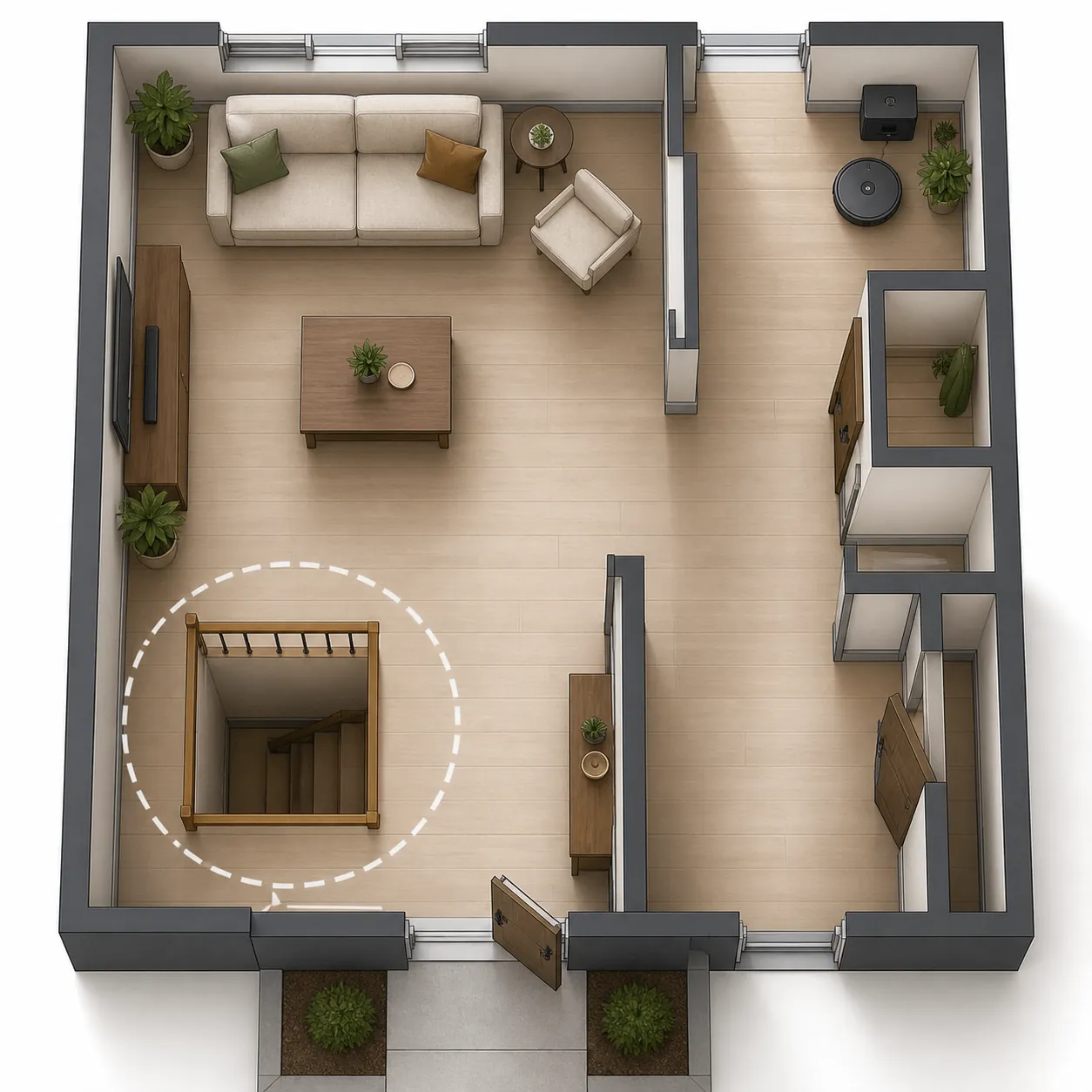
Treat the first setup as a caregiver safety visit, not a gadget afternoon. The same room-by-room thinking used in broader home-safety resources, including AARP’s HomeFit Guide, belongs here: clear the route, check transitions, reduce hazards, and make the safe path obvious [7]. For a wider caregiver framework, use the Fall Prevention Handout for Seniors: A Caregiver’s Action Guide alongside this robot-specific checklist.
Before the first run
- Remove thin cords from the floor, including phone chargers, lamp cords, extension cords, and power strips that the robot could pull into a path.
- Remove throw rugs, especially lightweight rugs, rugs with curled edges, and rugs with fringe.
- Check thresholds. If the robot climbs halfway and gets stuck, block that threshold instead of letting it become a recurring obstacle.
- Block stair openings with a no-go zone or physical barrier during mapping. Do not rely on hope near an open drop.
- Pick a dock location outside the main walking route from bed to bathroom, chair to kitchen, or door to sofa.
- Leave enough clear space around the dock so the robot can return without parking crooked in a walkway.
- Make sure bags, filters, water tanks, and brushes can be reached without kneeling, stretching behind furniture, or moving the dock.
During setup, use plain room names. “Kitchen,” “Hall,” and “Living room” are better than cute labels no one remembers. ui44 recommends practical setup choices such as reachable dock placement, plain room names, no-go zones around cords and rug fringe, scheduled runs when the person is seated, and a one-page rescue card [6]. Those details sound small until the first time the robot stops under a chair and the older adult tries to solve the problem alone.
The first week should be supervised
Run the robot while someone is present for the first few cleaning cycles. Watch where it hesitates, what it bumps, what it drags, and where it docks. If it catches a rug edge once, assume it will do it again. If it nudges a cord once, move the cord permanently. If it stops in a walking path, adjust the map or schedule before calling the setup finished.
A simple rescue card should live near the charging dock or on the refrigerator. It does not need to explain the whole device. It should say what to do if the robot stops, whom to call, how to pause it, and when to leave it alone. For some households, the safest instruction is: “Do not bend down to fix this. Press stop and call me.”
| If this happens | Do this |
|---|---|
| Robot stops in a hallway | Pause it, move it only if safe, and adjust the schedule or map so it does not repeat. |
| Robot drags a cord | Remove that cord from the floor before the next run; do not depend on the robot to avoid it. |
| Robot catches on a rug or fringe | Remove the rug or create a no-go zone around it. |
| Robot cannot dock reliably | Move the dock out of traffic but give it a clearer approach. |
| The older adult has to bend to rescue it often | Stop using it until the setup is changed; frequent rescue defeats the safety purpose. |
What a robot vacuum does not replace
The phrase “robot cleaning services” can suggest a much larger promise than a consumer robot vacuum can deliver. This article is about the practical floor robots available for home use, not pilot-stage humanoid cleaning services or full housekeeping replacement. For fall-risk planning, the distinction matters.
A robot vacuum does not clean stairs. It does not scrub bathrooms, remove deep grime, move clutter, wash baseboards, or decide that a room is unsafe today. It cannot notice that a rug edge has curled again or that a new cord now crosses the path to the bathroom. It may reduce how often someone needs to push a vacuum, but it does not remove the need for human eyes in the home.
This is general safety education, not medical advice. If falls, dizziness, neuropathy, vision changes, medication side effects, dementia symptoms, or repeated near-falls are already part of the picture, the cleaning plan should be discussed with the person’s clinician, physical therapist, occupational therapist, or home-safety professional.
A robot vacuum earns its place when it removes a risky chore without adding a new obstacle. For the right person in a prepared home, that can be a useful narrow fix. For stairs, bathrooms, heavy clutter, deep cleaning, or a person who cannot safely manage even a simplified setup, human help is still the safer answer.
References
- Facts About Falls, CDC.
- Older Adults Can Clean Homes Safely Without Strain, LTC News.
- Should a Robot Vacuum Be Your Next Appliance?, AARP.
- These are the best robot vacuums for people who are aging in place, Reviewed.
- Self-Emptying Robot Vacuum: A Perfect Gift for Elderly Loved Ones, Ecovacs.
- Robot Vacuum for Seniors & Elderly: Features That Matter, ui44.
- AARP HomeFit Guide, AARP.
Questions to bring to a clinician or OT
This is not medical, legal, or a family's final decision — only a framework. Bring these questions to a clinician, occupational therapist, or your local Area Agency on Aging.
Find Local HelpRelated reading
Noticed something outdated or inaccurate on this page? Flag a correction. We review every report against CDC, NIA, and AARP HomeFit guidance before updating a page.