
STEADI: Intervene
Can a Towel Bar Be Used as a Grab Bar?
A towel bar cannot safely serve as a grab bar — its mounting hardware has no load rating and can pull out of drywall under body weight. This guide explains why the risk is real and gives the exact specifications (250-lb minimum capacity, stud or blocking mounting, 1.5-inch wall clearance) for choosing a real grab bar or an ADA-compliant towel-bar combination.
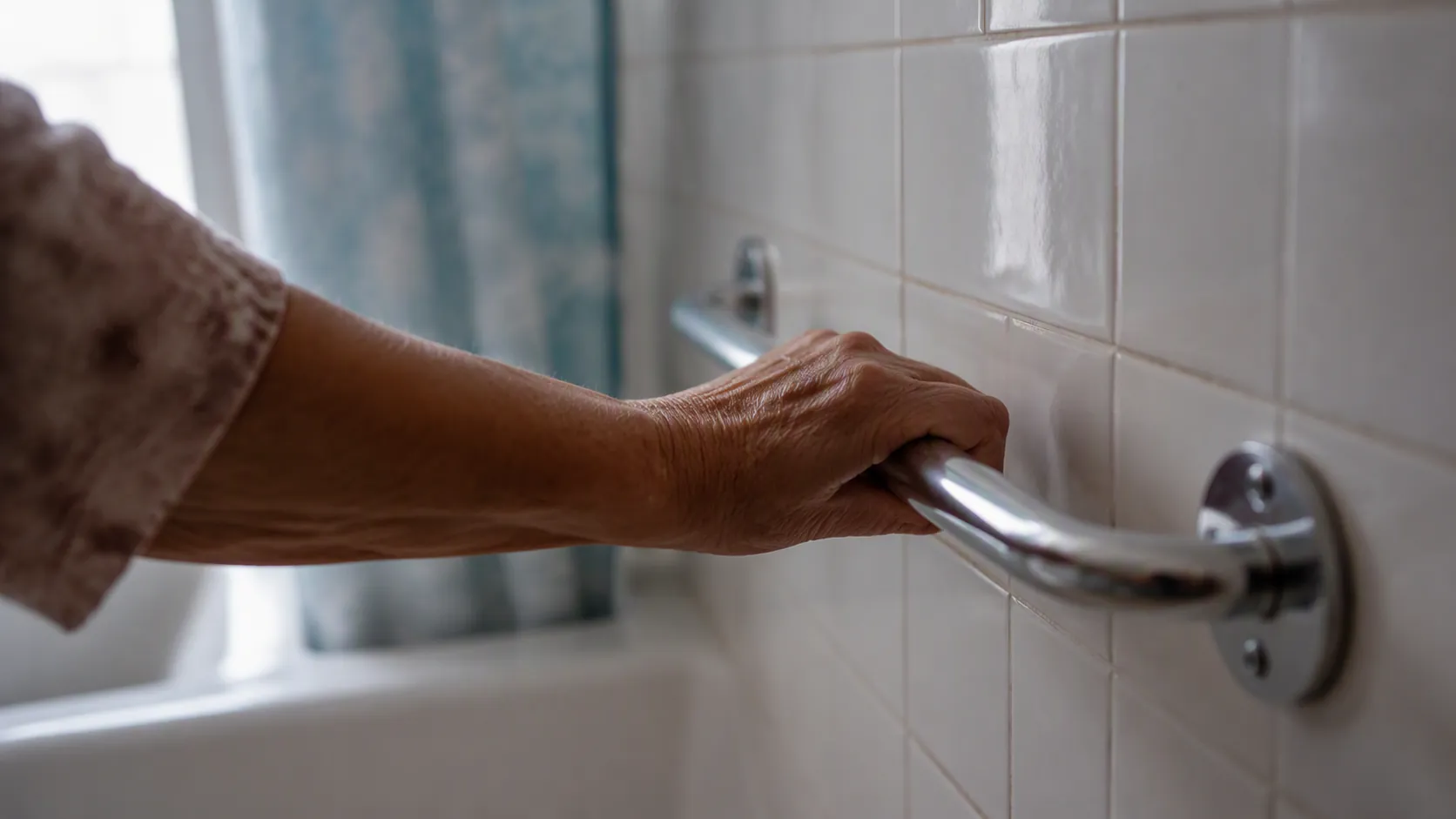
No. A towel bar should not be used as a grab bar for an older adult. A towel bar is built to hold a towel, not a person’s body weight during a slip, transfer, or tired reach out of the shower. The weak point is usually not the shiny metal bar you can see; it is the unrated bracket, screw, anchor, and wall connection behind it.
That distinction matters because the hand does not reach for support gently in a bad moment. It grabs fast, often sideways, often with wet skin and one foot already moving. A towel bar that “feels solid” during a quick tug has not proved that it can take that kind of load.
What usually fails is the wall connection
A towel bar can look sturdy because the exposed tube is metal. That is the wrong part to trust. Most towel bars are held by small end brackets fastened to the wall with light-duty screws or drywall anchors. Those parts may be adequate for towels, but they are not published as body-weight support hardware. Grab-bar guidance and product testing discussions repeatedly come back to the same issue: the mounting system has to carry the load, not merely the bar itself.[1][2]
Drywall anchors are especially poor evidence of safety. Drywall is a surface material, not structural backing. If a person pulls downward and outward while stepping over a tub edge, the bracket can pry against the wall, the anchor can loosen, and the whole assembly can tear out before the bar itself ever bends. That is why a towel bar may survive years of towels and still fail the first time someone uses it like a rail.
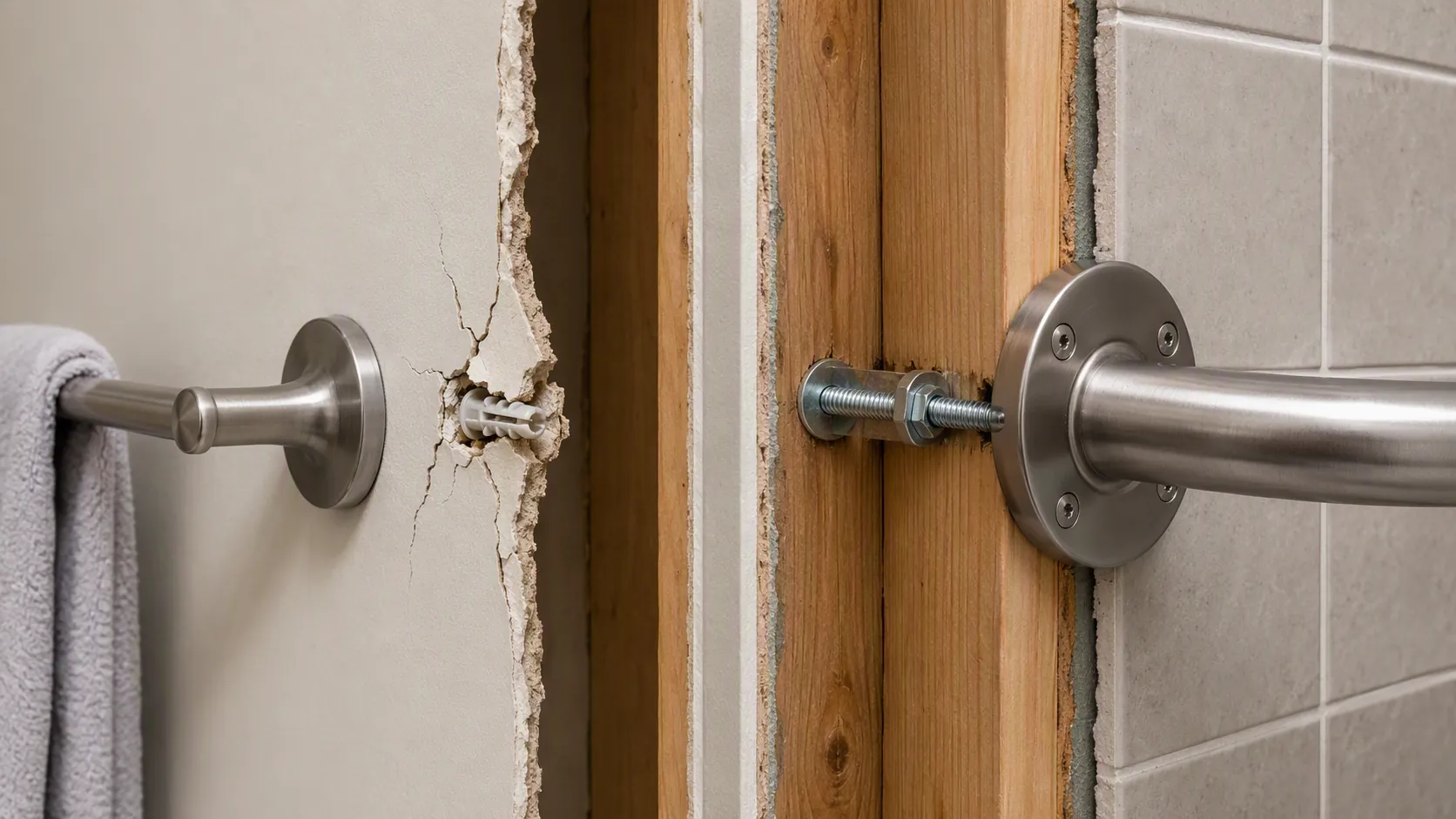
This is also why “it has been fine so far” is not a useful safety test. The event you are worried about is not normal towel use. It is a sudden load at an awkward angle, exactly when the person has the least margin to recover if the bar pulls loose.
Falls are already a serious risk for older adults: CDC identifies falls as the leading cause of injury for adults 65 and older, and says more than 1 in 4 older adults reports falling each year.[3] CDC also reports that about 37% of falls among older adults result in an injury that requires medical treatment or restricts activity for at least one day.[4] Those numbers do not prove that towel bars cause a specific share of falls, and there is no national towel-bar injury count in the materials here. The point is narrower and more practical: if a towel bar is being used for balance, it is occupying the place where a real support should be.
Home-safety organizations name unsecured towel racks as a bathroom hazard when they are gripped for support.[5] That is enough reason to fix the grab point, without dressing the warning up as a statistic it is not.
What to install instead
Replace the towel-bar grab point with a real grab bar: a bar with a published load rating, installed into structural backing. The common baseline to look for is the ADA 250-lb applied-force requirement, and many residential grab bars are marketed with 500-lb ratings when installed correctly.[1] The rating is not decoration on the package. It is the difference between hardware meant to hold a towel and hardware meant to help hold a person.
| What to check | What you want to see |
|---|---|
| Load rating | At least 250 lb of applied force; many residential models publish 500-lb ratings when properly installed.[1] |
| Wall attachment | Fastened into studs, blocking, or another approved structural backing — not merely drywall anchors. |
| Grip size | A diameter in the 1.25- to 1.5-inch range is commonly cited for usable grab-bar grip.[6] |
| Wall clearance | About 1.5 inches of clearance between the bar and wall gives fingers room to wrap without trapping the hand.[6] |
| Typical height | For many bathroom layouts, 33 to 36 inches above the finished floor is a common ADA-style reference range, but placement still has to fit the fixture and the person using it.[6] |
The mounting line deserves the most attention. A 500-lb label does not magically strengthen drywall. Load ratings assume the bar is installed according to the manufacturer’s instructions, usually into studs, blocking, or a rated anchoring system for the wall type. If the installer misses the stud, uses the wrong fastener, or relies on ordinary hollow-wall anchors, the product rating is not the system rating.
Placement matters, too, but do not let placement debates delay the obvious correction. Put the strongest support where the hand is already reaching: near the tub edge, shower entry, toilet transfer point, or wherever the towel bar has quietly become the substitute rail. A perfectly chosen bar on the wrong wall does not help the person who is already off balance.
If you still need a towel bar there
There is one legitimate way to keep the towel function: use a product that is explicitly sold and rated as a combination towel bar and grab bar. It should publish its load capacity and installation requirements. For example, HealthCraft’s PLUS Series Towel Bar is described by the manufacturer as ADA compliant and rated to 500 lb when properly installed.[7] That makes it a useful example of the category, not a reason to buy by brand name alone.
The label has to do real work here. “Designer,” “assist,” “safety style,” or “looks like a grab bar” is not enough. If the product page or box does not clearly state a body-weight load rating and proper mounting method, treat it as a towel bar.
Suction-cup bars are not the fix
A suction-cup bar may look like an easy answer because it avoids drilling tile. It is not a substitute for a mounted grab bar. Wirecutter reported suction bars releasing under roughly 70 to 92 lb in testing, which is far below the loads a person may place on a support during a slip.[2] At most, a suction bar may serve as a light balance reminder on a compatible surface if the manufacturer allows that use. It should not be the thing someone depends on to stop a fall.
DIY is only reasonable when you can prove the backing
This is where many well-meant fixes go soft. A grab bar is not safe because someone bought the right product. It is safe when the product, fasteners, wall structure, and placement work together.
A careful DIY installation can make sense if you can positively locate the studs or blocking, use the manufacturer’s specified fasteners, drill cleanly through the wall finish, and confirm that the bar is seated tight without cracked tile, loose brackets, or missed structure. That is a higher standard than “I found something that felt solid.”
Bring in a qualified installer, contractor, occupational-therapy-informed home safety professional, or CAPS-informed remodeler when the stud location is uncertain, the wall is tiled, the shower wall is fiberglass, the toilet wall lacks backing, or the person’s transfer pattern is complicated. If the wall needs blocking added behind it, that is not a failure of planning; it is the correct way to make the support real.
What to do with the towel bar today
- If someone is grabbing the towel bar for balance, stop treating it as support. Move the towel if that helps break the habit.
- Choose a true grab bar or a rated towel-bar/grab-bar combination with a published load capacity.
- Install it into studs, blocking, or another approved structural backing according to the manufacturer’s instructions.
- Do not substitute an ordinary decorative towel bar, adhesive accessory, or suction-cup bar for body-weight support.
- Get professional help when you cannot verify the wall structure or the safe placement.
Once that immediate grab point is fixed, it may be worth looking for the next hidden hazards. A towel bar doing grab-bar work is one of the issues covered in 10 bathroom design mistakes that increase fall risk. If this is part of a broader plan, use a bathroom modifications guide for aging in place rather than turning one bar into the whole project.
If the towel-bar habit appeared after a fall, start with an aging-in-place bathroom priority guide so the most urgent transfer points come first. For budgeting, check the Medicare coverage gaps for prevention items; grab bars and preventive home modifications often surprise families because they feel medical but are not always treated that way by coverage rules. Only if the decision has expanded beyond grab bars should you move on to larger fixture choices such as a walk-in tub versus curbless shower.
The towel bar is not unsafe because it looks like the wrong product. It is unsafe because it is not engineered, rated, or mounted for the job someone is asking it to do.
References
- How Much Weight Can a Grab Bar Hold? Understanding Safety Standards and Factors, YDValves.
- The Best Grab Bars, Wirecutter.
- Older Adult Falls Data, CDC.
- Facts About Older Adult Falls, CDC.
- Bathroom Safety: Grab Bars, Right at Home.
- Shower Grab Bars 101: A Professional's Guide to Safety Rails, The McClurg Team.
- PLUS Series Towel Bar, HealthCraft.
Related reading
Noticed something outdated or inaccurate on this page? Flag a correction. We review every report against CDC, NIA, and AARP HomeFit guidance before updating a page.
Part of the Fall Prevention section.