
Clinical term
A Fall-First Stroke Recovery Checklist for Elderly Parents
Last verified 2026-08-03
If your elderly parent is coming home after a stroke, the first recovery checklist is a fall-prevention checklist. The American Stroke Association says up to 70% of stroke survivors fall in the first six months after discharge; that figure should not be treated as a personal prediction for every family, but it is a strong enough warning to decide what gets handled first: the bathroom, walking paths, transfers, lighting, bedroom setup, and the mobility aid your parent was told to use. [1]
For an older parent, this is not a generic “be careful” concern. The CDC reports that stroke reduces mobility in more than half of stroke survivors age 65 and older. [2] That is why the practical question is not only whether your parent is motivated to recover. It is whether they can get from bed to toilet, chair to walker, shower to towel, and hallway to kitchen without a preventable fall.
This article is educational, not a substitute for medical care or discharge instructions. Use it beside the written plan from the hospital or rehab team, especially the occupational therapist’s or physical therapist’s recommendations. If the discharge papers say something different from a general checklist, the discharge team’s instructions come first.
The first six months: what to do before the rest of recovery planning
A stroke recovery checklist for elderly parents can include medications, follow-up visits, nutrition, speech therapy, transportation, paperwork, and emotional adjustment. Those matter. But in the first home setup, they do not replace the basic safety pass. A missed cord or slippery bathroom floor can undo a week of careful scheduling.
| Timing | Fall-first task |
|---|---|
| Before discharge, if possible | Ask the OT, PT, discharge planner, social worker, or case manager what home changes your parent specifically needs. |
| Before the first night home | Clear the route from bed to bathroom, add lighting, remove throw rugs, and make sure the prescribed walker, cane, or rollator fits through the path. |
| Before the first shower | Install or arrange bathroom supports such as grab bars, a shower chair or bath bench, a hand-held shower head, and a safer toilet setup. |
| Every day | Use the prescribed mobility aid every time, including short transfers and nighttime bathroom trips. |
| After any fall | Use the discharge instructions and the American Stroke Association caregiver guidance to decide whether the fall needs emergency care or a clinician/PT call. |
Walk the actual routes your parent will use
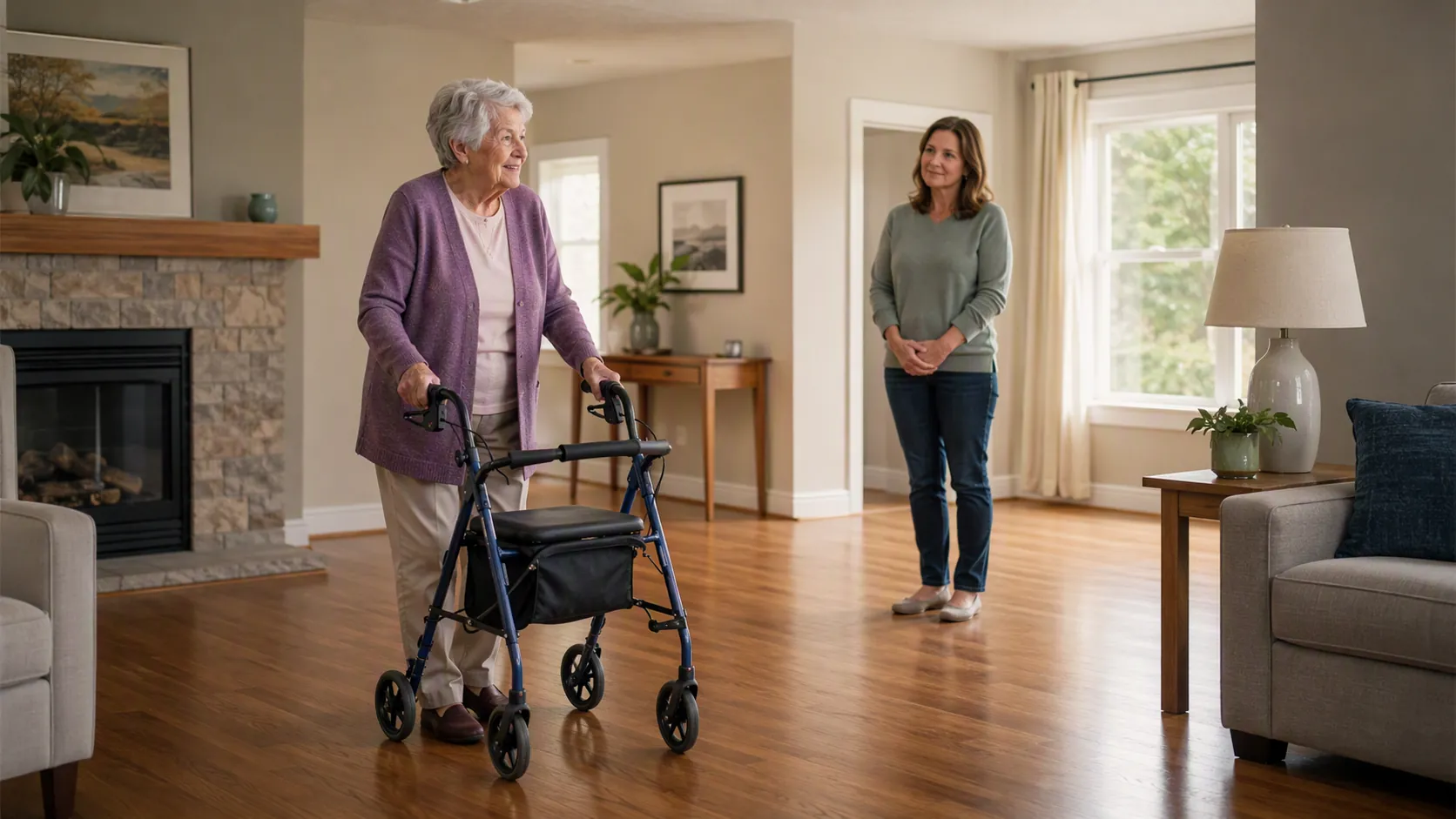
Do not inspect the house as if you are staging it. Inspect it as if it is 2 a.m., your parent is half-awake, one side is weaker than the other, and the walker catches on the edge of a rug. Start with the routes that will happen even on a bad day: bed to toilet, chair to bathroom, bathroom to bedroom, bedroom to kitchen, and entry door to the main sitting area.
The American Stroke Association’s home-modification guidance includes removing throw rugs, lighting halls and stairways, taping electrical cords, and considering a ground-floor bedroom. [3] Those items sound ordinary until the first time a walker wheel clips a rug or a parent tries to cross a dark hallway without turning on a light.
- Remove throw rugs from walking paths, especially near the bed, bathroom, kitchen, and favorite chair.
- Tape down or reroute electrical cords so a walker, cane, foot, or wheelchair caster cannot catch them.
- Add lighting to halls, stairways, and the bed-to-bathroom route.
- Check whether the prescribed mobility aid fits through doorways and around furniture without tight turns.
- Consider a ground-floor bedroom if stairs are part of the daily route and the discharge team has not cleared them as safe.
For a fuller whole-home pass, use a general room-by-room fall prevention checklist after you have handled the stroke-specific routes. If nighttime toileting is the weak point, the bedroom safety checklist is the better next stop because it keeps attention on the bed, lighting, floor clearance, and bathroom path.
Bathroom safety deserves the first money and the least optimism
The bathroom is where pride, water, urgency, and hard surfaces meet. It is also where small setup choices make an immediate difference. The American Stroke Association lists bathroom grab bars, a bath bench or shower chair, a hand-held shower head, and an elevated toilet seat among home modifications after stroke. [3] The VA Veterans Health Library also includes a rubber-backed mat and a commode chair in its home-preparation guidance after stroke. [4]
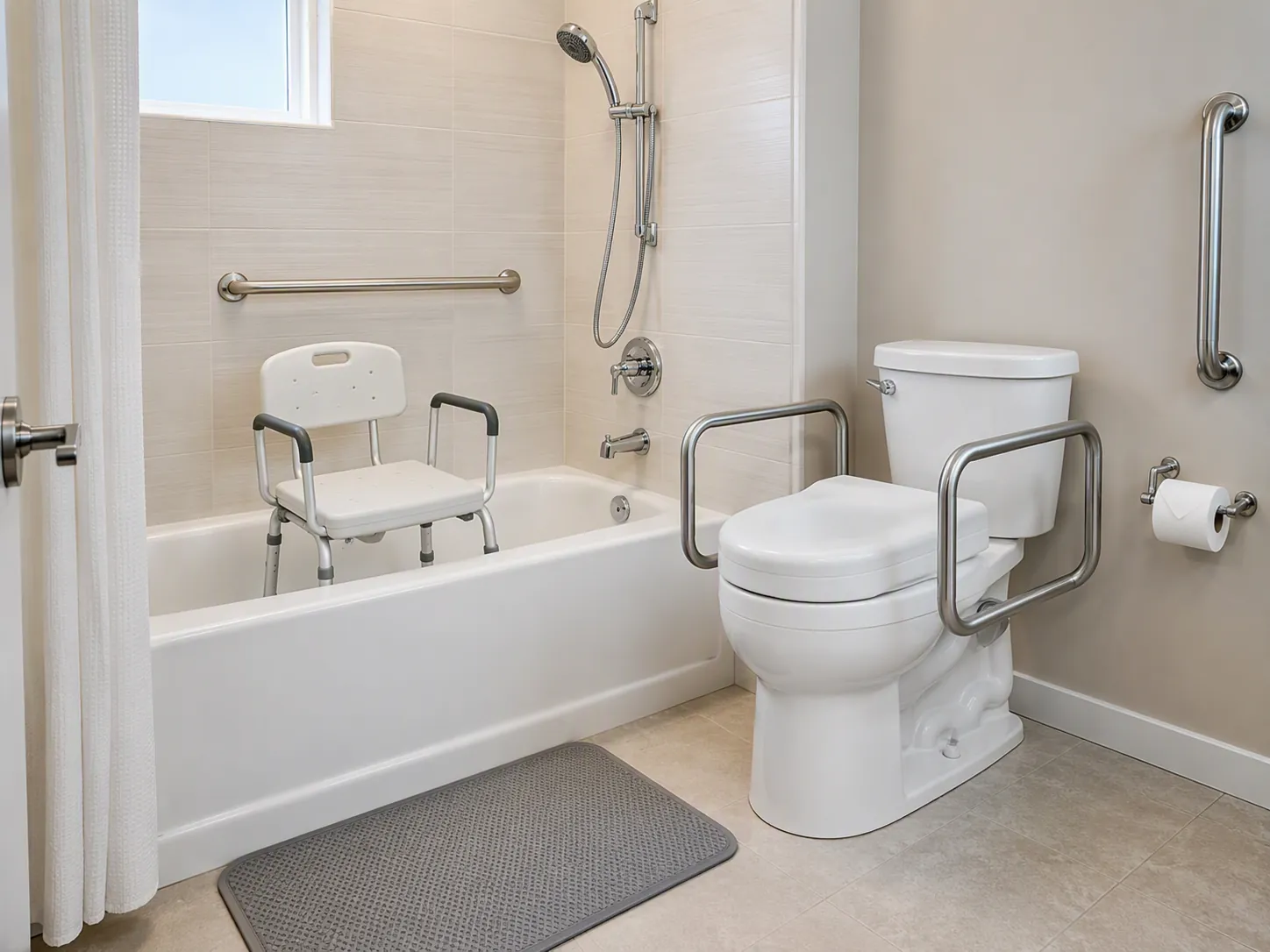
- Install grab bars beside the toilet and in the shower or tub area; do not rely on towel bars as supports.
- Use a shower chair or bath bench if standing balance, endurance, or one-sided weakness makes bathing risky.
- Add a hand-held shower head so your parent does not have to twist, reach, and turn repeatedly while wet.
- Ask whether an elevated toilet seat, toilet safety frame, or commode chair is appropriate for transfers.
- Use a rubber-backed bath mat where a mat is needed, and remove any mat that slides, curls, or bunches.
- Put towels, clothing, continence supplies, and soap within easy reach before the first shower.
The test is not whether the bathroom looks safer. The test is whether your parent can approach, turn, sit, stand, wash, dry, dress, and leave without grabbing unstable surfaces or abandoning the prescribed aid at the doorway.
The mobility-aid rule: every transfer, every time
If the physical therapist prescribed a walker, cane, rollator, brace, or other device, build the home routine around using it every time unless the clinician changes the plan. The most dangerous moment is often not a long walk. It is the short, familiar transfer: bed to toilet, recliner to kitchen, bathroom door to sink. “Just this once” is exactly how a cleared walking path stops mattering.
This is harder than it sounds. The American Stroke Association says 30% to 80% of stroke survivors report fear of falling. [1] Fear may make a parent move less, rush to get a task over with, or reject the walker because it makes the stroke feel visible. Treat that as a safety problem to solve, not as a character flaw.
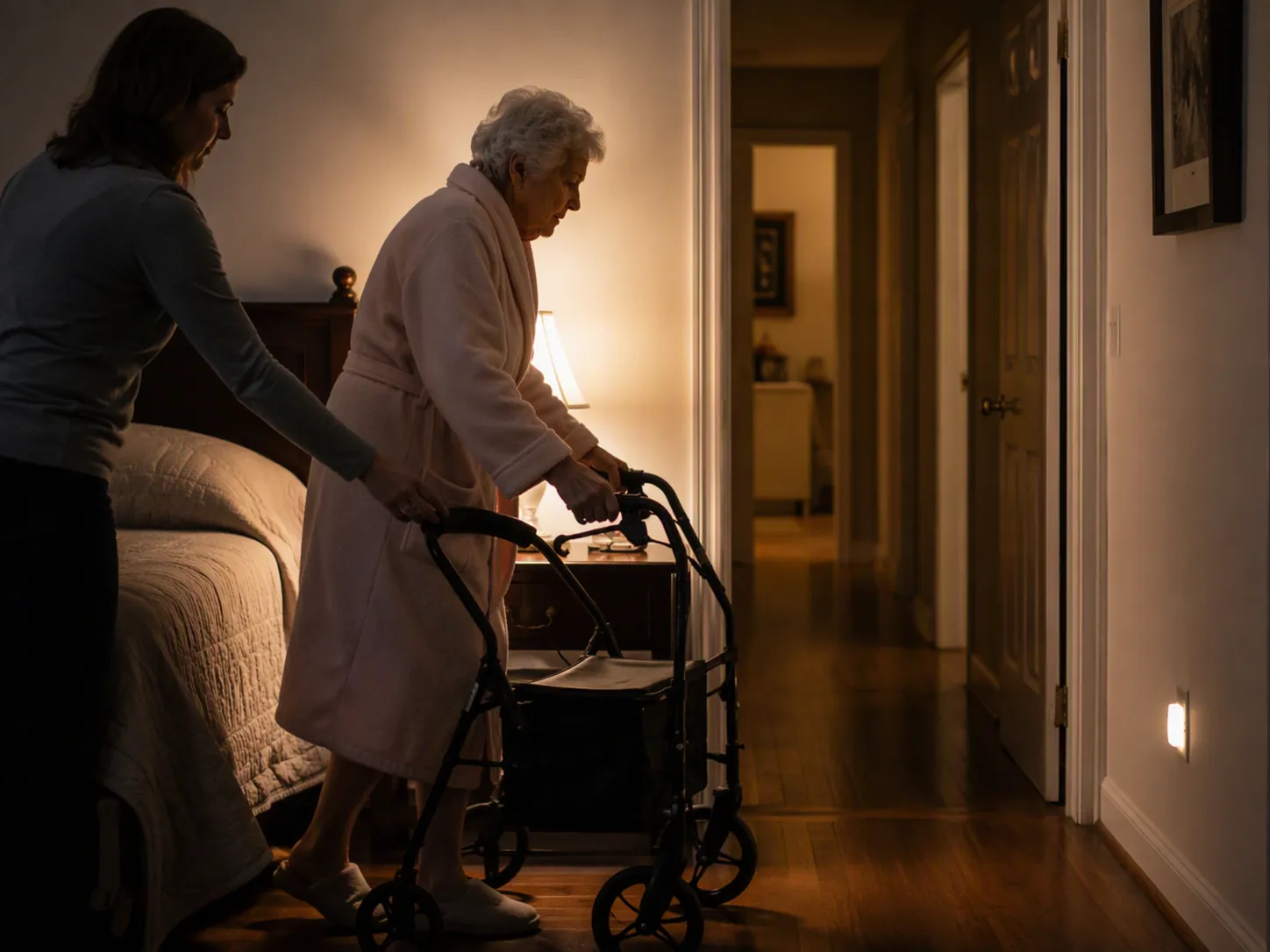
- Park the mobility aid where the next transfer starts, not across the room.
- Keep the route wide enough for the device your parent was actually given.
- Practice the bed-to-bathroom route during the day before relying on it at night.
- If your parent refuses the device, ask the PT to watch the transfer and correct fit, technique, or the device choice before you turn it into a family argument.
- If the device is used inconsistently, assume the setup is not finished.
For the persuasion side of this problem, use the guide on why a parent resists fall prevention after the hospital. The practical goal is not to win a debate about independence. It is to make the safe behavior easier to repeat than the unsafe one.
Know which falls trigger urgent action
Write the fall plan down before a fall happens. After a frightening event, families lose time deciding whether something “counts.” The American Stroke Association gives caregiver guidance that a serious fall with severe pain, bruising, or bleeding warrants an emergency room visit, and that two or more minor falls within six months warrant a physician or physical therapist visit. [1] These are ASA caregiver guidelines, not a replacement for your parent’s discharge instructions or a legal standard of care.
| What happened | Action to take |
|---|---|
| Fall with severe pain, bruising, or bleeding | Treat it as a serious fall and seek emergency room care, following ASA caregiver guidance and any discharge instructions. |
| Two or more minor falls within six months | Schedule a physician or physical therapist visit, following ASA caregiver guidance. |
| Any fall that makes you unsure what to do | Use the discharge paperwork, call the clinician listed there, or seek urgent medical guidance rather than guessing. |
| A near-miss during the same transfer more than once | Ask the PT, OT, or discharge team to reassess the transfer, device use, and home setup before it becomes a fall. |
A fall also changes the checklist. Do not only clean up and move on. Look at where it happened, what the person was trying to do, whether the prescribed aid was used, whether lighting was adequate, and whether the path had changed. If the fall raises the question of services, therapy, or added support, the guide to activating senior health services after a fall can help you organize the next calls.
Bring in OT, PT, or the discharge team before you improvise
A safe home after stroke is not built from a shopping list alone. AARP advises that an occupational or physical therapist should give individualized home-preparation advice so families can avoid unnecessary or expensive modifications. [5] That is the difference between buying equipment because it looks useful and changing the home around your parent’s actual weakness, balance, endurance, vision, cognition, bathroom layout, and transfer technique.
If you did not receive clear home instructions before discharge, ask for them. The American Stroke Association notes that a home safety evaluation can be arranged through a social worker or case manager. [3] You can also ask the physician, discharge planner, OT, or PT who should reassess the home if your parent has a fall, refuses the mobility aid, cannot manage the bathroom, or is unsafe alone during transfers.
- Ask the OT or PT to identify the highest-risk transfers: bed, toilet, shower, chair, car, and stairs.
- Ask which mobility aid is required indoors, outdoors, at night, and during bathroom use.
- Ask whether your parent is safe alone for toileting, bathing, stairs, and meal preparation.
- Ask who to call after a fall, a near-fall, or a sudden change in walking or transfer ability.
- Ask before making costly renovations that were not recommended by the rehab or discharge team.
If you are unsure whether the next layer is therapy, home health, nonmedical help, or a broader home-modification plan, compare the options in home health versus home care and the roadmap on fall prevention services for aging in place. Keep coverage questions with the discharge planner, social worker, case manager, or insurer; do not assume a service is covered just because it sounds medically reasonable.
The defensible first checklist is plain: make the bathroom and walking paths safer, set up the bedroom and night route, require the prescribed mobility aid every time, know the fall triggers that require action, and get individualized OT, PT, or discharge-team advice before deciding the house is ready.
References
- 15 Things Caregivers Should Know After a Loved One Has Had a Stroke — American Stroke Association
- Stroke Facts — CDC
- Home Modifications — American Stroke Association
- Preparing Your Home After Stroke — VA Veterans Health Library
- What Caregivers Should Know After a Loved One's Stroke — AARP
Browse more in the Glossary.