
Glossary entry
Estimate your 2027 Social Security check increase now
Last verified 2026-08-25
This is not financial or legal advice. Medicare/Medicaid and benefits rules vary by state and change over time — verify current rules with your state Medicaid office or Area Agency on Aging.
Last verified: Aug. 25, 2026. The official 2027 Social Security COLA is not available yet; it is scheduled to be announced on Oct. 14, 2026.[1] For planning today, the useful shortcut is simple: multiply your current monthly Social Security benefit by about 3.5% to 3.6%. That gives you a reasonable estimate of your January 2027 increase, not a guaranteed payment amount.

Here is the calculation before the averages and headlines get in the way:
Estimated monthly increase = current monthly benefit × 0.035 to 0.036
Estimated January 2027 monthly benefit = current monthly benefit + estimated monthly increase
That 3.5% to 3.6% range comes from the current forecast cluster: AARP has projected a 3.5% COLA, while Kiplinger reports The Senior Citizens League’s 3.6% estimate and economist David Payne’s 3.3% to 3.5% range.[2][3] The Senior Citizens League’s COLA Watch remains one of the live projection sources to check as the inflation data window closes.[4]
| Your current monthly benefit | Estimated increase at 3.5% | Estimated increase at 3.6% | Planning range for January 2027 |
|---|---|---|---|
| $1,200 | $42.00 | $43.20 | $1,242.00 to $1,243.20 |
| $1,500 | $52.50 | $54.00 | $1,552.50 to $1,554.00 |
| $2,000 | $70.00 | $72.00 | $2,070.00 to $2,072.00 |
| $2,500 | $87.50 | $90.00 | $2,587.50 to $2,590.00 |
| $3,000 | $105.00 | $108.00 | $3,105.00 to $3,108.00 |
If your current monthly benefit is $2,000, the estimate is not “the average raise.” It is your own rough increase: about $70 to $72 per month before any separate effect from Medicare premiums, tax withholding, or other deductions.
This article is general benefits education, not financial, tax, or legal advice. For household planning, use the estimate as a placeholder and confirm your official amount through the Social Security Administration once individual notices are available.
Use your own benefit amount, not a headline average
The number to start with is your current monthly Social Security benefit. If you are helping a parent, do not begin with a news article’s national average. Begin with the amount on the person’s current benefit record, recent Social Security notice, my Social Security account, or bank deposit history.
For the COLA math, the cleanest number is the monthly Social Security benefit before optional federal tax withholding and Medicare premium deductions. For grocery-and-rent budgeting, the bank deposit matters too, but that deposit can move differently if Medicare Part B premiums or withholding change. If that is the issue in your household, the better companion reading is the explanation of how Medicare Part B can reduce the deposited COLA raise and the guide to Social Security COLA and taxes.
A quick example: if the current benefit is $1,635, a 3.5% estimate gives $57.23 more per month; a 3.6% estimate gives $58.86. That puts the planning range around $1,692.23 to $1,693.86 before deductions. The exact official amount may be rounded or adjusted in the SSA notice, so do not build a January budget down to the last cent from a forecast.
Why the “average raise” looks different depending on the article
AARP’s current estimate is easy to understand if you keep its baseline attached: it says a 3.5% COLA would add about $73 a month for the average retired-worker benefit of roughly $2,086. AARP also lists approximate average monthly benefits of $1,933 for a surviving spouse and $1,635 for a disabled worker receiving SSDI.[2]
Kiplinger’s example is close but not identical. It uses The Senior Citizens League’s 3.6% projection and a June 2026 Social Security snapshot of $2,084.40, producing a $75.03 increase and a projected benefit of $2,159.43.[3]
| Source example | Forecast used | Benefit baseline stated | Estimated monthly increase |
|---|---|---|---|
| AARP | 3.5% | About $2,086 average retired-worker benefit | About $73 |
| Kiplinger / TSCL example | 3.6% | $2,084.40 June 2026 SSA snapshot | $75.03 |
That is why the wrong move is to grab “$73” from one source, “3.6%” from another, and call it a universal answer. They are separate estimates built on separate baselines. The right move is still faster: take your own benefit and multiply it by the current planning range.
Other national averages add more noise. CBS has discussed the 2027 estimate using a January benefit figure of $2,071 and framed the forecast as potentially the largest increase since the 8.7% COLA for 2023.[7] CNBC cites a different average of $2,026 in its coverage.[1] Those may be useful for news context. They do not tell you what to write into your own January budget.
A short checklist for estimating and then replacing the estimate
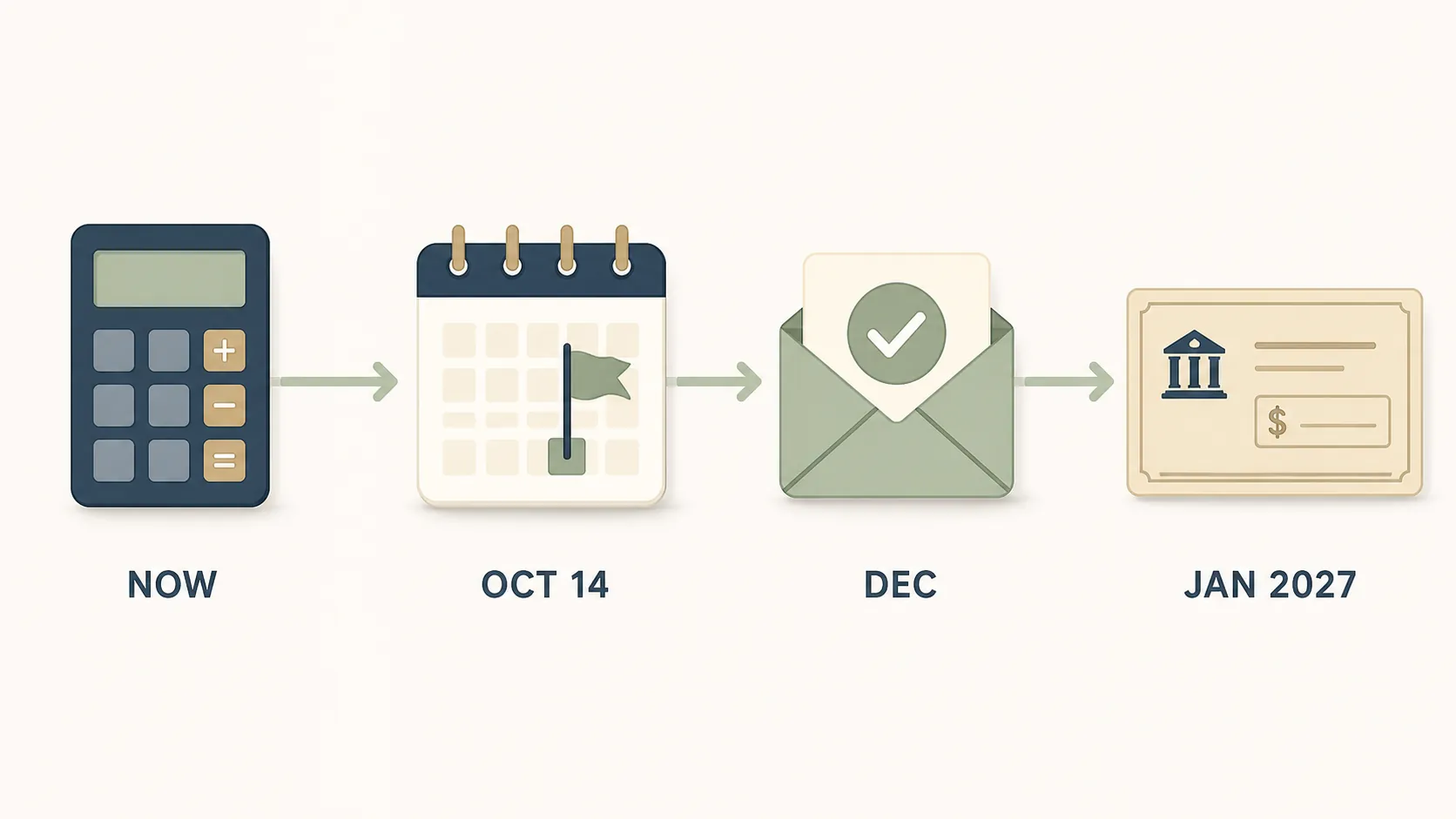
- Find the current monthly benefit amount. Use the gross monthly Social Security benefit if you can find it; use the bank deposit only as a cash-flow approximation.
- Multiply by 0.035 and 0.036. That gives a low and high planning estimate using the current forecast cluster.
- Add the estimated increase back to the current benefit. This gives the estimated January 2027 benefit before any separate deductions.
- On Oct. 14, 2026, replace the forecast percentage with the official COLA percentage once SSA announces it.[1]
- In November and December, look for the individual SSA notice or online account update rather than relying on a national average.
- In January 2027, compare the actual deposit with the official benefit amount and check whether Medicare premiums, tax withholding, or other deductions explain any difference.
SSA says COLA notices are available online in the my Social Security Message Center in November, and that beneficiaries can view the new benefit amount in December.[5] That individual notice is the number to use when the question changes from “What should I plan for?” to “What will actually be paid?”
SSA’s official tables also remind you why press rounding is not the final word. For the 2026 COLA effect table, SSA showed an average retired-worker benefit moving from $2,015 to $2,072.[6] If another article rounds an average differently, SSA’s own notice and tables win for benefit administration.
If you want to compare the coming notice with last year’s format, see the site’s explainer on what changed for retirees under the 2026 Social Security COLA.
When the 2027 increase should show up in payments

The 2027 COLA is expected to affect January 2027 Social Security payments. CNBC’s payment-date summary lists Jan. 3, 2027, for people who filed before May 1998, then Jan. 13, Jan. 20, and Jan. 27 for the birth-date-based Wednesday payment groups.[1]
| If this is how the person is usually paid | Expected date for the first 2027 COLA Social Security payment |
|---|---|
| Filed for Social Security before May 1998 | Jan. 3, 2027 |
| Birth date on the 1st through 10th | Jan. 13, 2027 |
| Birth date on the 11th through 20th | Jan. 20, 2027 |
| Birth date on the 21st through 31st | Jan. 27, 2027 |
| SSI payment for January 2027 | Dec. 31, 2026 |
SSI is the calendar wrinkle. Because of the payment schedule, the January 2027 SSI payment is listed for Dec. 31, 2026.[1] If a household receives both Social Security and SSI, do not assume both increases arrive on the same bank date.
Also keep the payment date separate from the announcement date. Oct. 14 tells you the official COLA percentage. The SSA notice tells you the individual benefit amount. The January deposit shows the cash that actually hit the account.
What can make the deposited increase smaller than the COLA math
The percentage applies to the Social Security benefit calculation. The bank deposit is what remains after other items are handled. Medicare premiums, voluntary tax withholding, and benefit-specific deductions can make the deposit increase look smaller than the headline COLA.
That does not mean the COLA disappeared. It means you are looking at a net deposit instead of the benefit amount. When January arrives, compare the SSA notice with the bank deposit. If the benefit rose but the deposit rose by less, the answer is usually in the deduction lines, not in the COLA percentage.
For a household already near the edge, those deductions are not a small detail. If a Medicare premium increase absorbs much of the raise, it may be worth checking whether a Medicare Savings Program could help with premiums.
How much confidence to put in the estimate
As of Aug. 25, 2026, the forecasts are clustered closely enough to be useful for a budget draft. AARP’s 3.5%, TSCL’s 3.6%, Mary Johnson’s 3.7%, and Kiplinger economist David Payne’s 3.3% to 3.5% range all point to a mid-3% COLA rather than a tiny adjustment or another 2023-style jump.[2][3][4]
Still, none of those figures is the official COLA. The estimate should be good enough for deciding whether January rent, prescriptions, groceries, or a family transfer need a placeholder adjustment. It is not good enough to treat as an SSA promise.
For inflation mechanics, buying-power arguments, and whether the formula itself could change, use the separate explainers on the 2027 COLA’s impact, Social Security COLA and senior inflation, and whether the 2027 COLA can be cut. For this calculation, the immediate task is narrower: estimate now, replace the estimate after Oct. 14, and confirm the individual amount when SSA posts it.
References
- How Much Will the Social Security 2027 COLA Be? — CNBC Select.
- Social Security COLA 2027: An Early Look at How Much Payments Could Increase — AARP. Updated Aug. 12, 2026.
- 2027 Social Security COLA Forecast — Kiplinger.
- COLA Watch — The Senior Citizens League.
- Cost-of-Living Adjustment (COLA) Information — Social Security Administration.
- Cost-of-Living Adjustment (COLA) Effect on Social Security Benefits — Social Security Administration.
- Social Security 2027 COLA estimate is shrinking as inflation cools — CBS News.
Browse more in the Glossary.