
Clinical term
Should Older Adults Take Statins? What to Consider
Last verified 2026-08-25
Last verified: August 25, 2026. This article is educational and is not medical advice. Statins should not be started, stopped, or changed without the prescribing clinician’s guidance, especially for someone with heart disease, prior stroke, diabetes, kidney disease, frailty, or multiple medications. Medical review before publication: because this is a medication decision topic, it should be checked by the site’s named geriatric RN, OT, or CAPS reviewer.
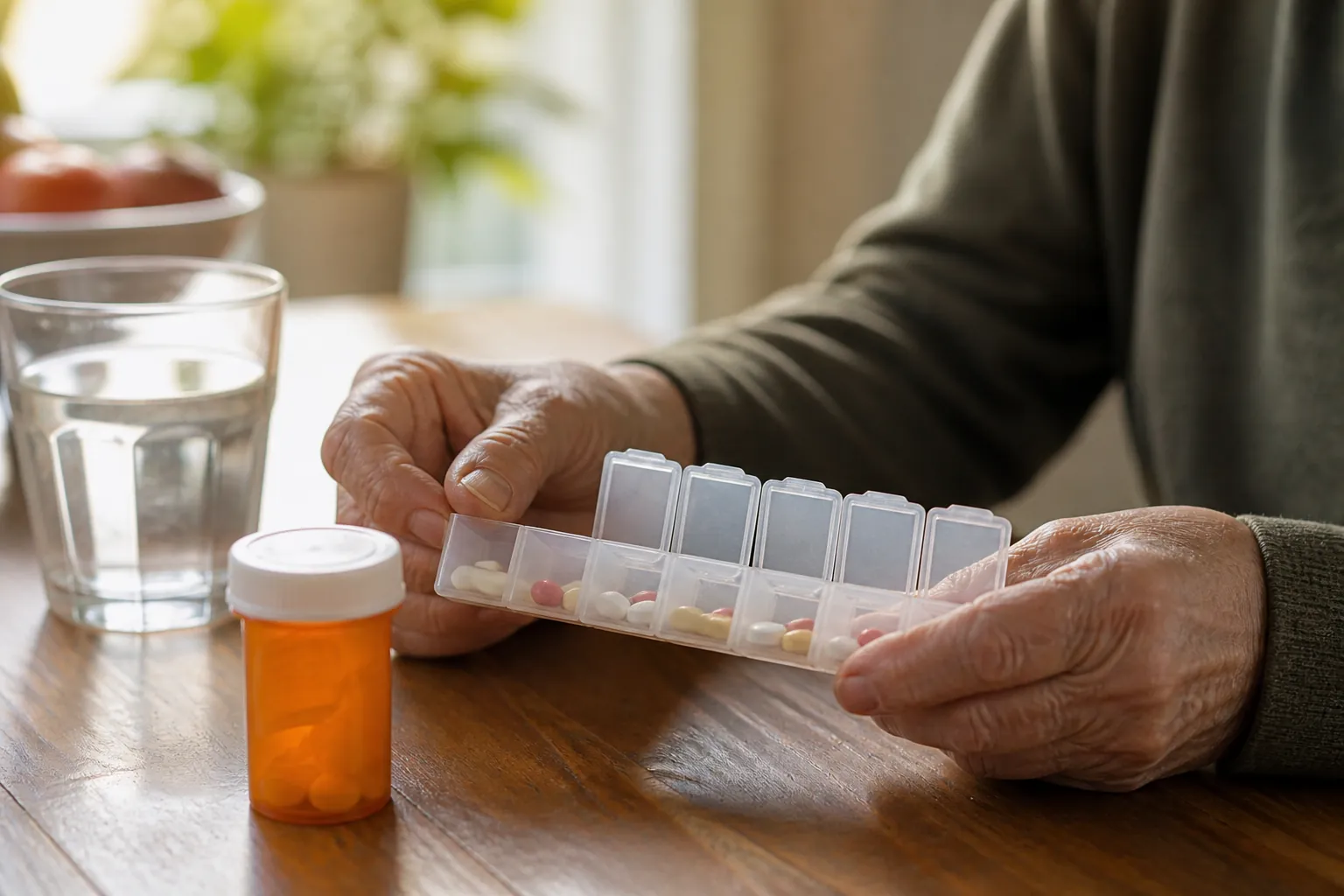
The statin question often starts with one ordinary bottle on the kitchen table: atorvastatin, rosuvastatin, simvastatin, pravastatin. A clinician recommends it after a cholesterol test, or an older parent says the pill makes their legs ache, or a family wonders whether a medicine started years ago still matters now that walking, balance, appetite, and appointments have become harder.
For older adults trying to apply cholesterol management guidelines, the useful question is not simply “Is the LDL high?” It is “What is this statin trying to prevent?” Current guidance for adults over 75 leaves room for clinician-patient decision-making; the 2026 dyslipidemia guideline summary says pharmacotherapy can be considered together with lifestyle interventions in this age group rather than treating age alone as an automatic yes or no.[1] If you want the broader rule changes, LDL thresholds, Lp(a), and calculator context, see our explainers on what the 2026 cholesterol guidelines mean for seniors and what the new statin guidelines mean for people over 70. This article stays with the decision at hand: start, continue, adjust, or deprescribe.
The first split: prior cardiovascular disease or no prior cardiovascular disease
Before arguing about side effects, age, or a cholesterol number, sort the situation into one of two buckets. The evidence looks different depending on whether the person already has vascular disease.
| Situation | What the statin is for | How the conversation usually starts |
|---|---|---|
| Prior heart attack, stroke, transient ischemic attack, stent, bypass surgery, symptomatic peripheral artery disease, or other established atherosclerotic cardiovascular disease | Secondary prevention: lowering the chance of another cardiovascular event | “What is the safest and most tolerable way to keep protecting them?” |
| No known cardiovascular disease; statin is being considered because of LDL, diabetes, blood pressure, smoking history, kidney disease, or estimated risk | Primary prevention: trying to prevent a first cardiovascular event | “Is the likely benefit big enough, soon enough, and meaningful enough for this person?” |
| Advanced illness, major frailty, limited life expectancy, or goals of care focused mainly on comfort | The original prevention goal may no longer fit the person’s current health status | “Does continuing this pill still serve the care plan?” |

That split matters because “over 75” is not one medical category. A 77-year-old who had a heart attack last year and walks daily is not making the same decision as an 88-year-old with no prior cardiovascular event, recurrent falls, and a pill organizer already full before breakfast.
When cardiovascular disease already exists, the case for a statin is usually stronger
For older adults with established vascular disease, the evidence is more reassuring. A Cholesterol Treatment Trialists’ meta-analysis summarized in a review of statin therapy in older adults found that among people older than 75 with vascular disease, each 1 mmol/L reduction in LDL cholesterol was associated with about a 26% proportional reduction in major vascular events, reported as a risk ratio of 0.74.[2]
That does not mean every person over 75 with prior heart disease must stay on the highest dose forever. It does mean the conversation starts from a different place. If the statin is being used after a heart attack, stroke, stent, bypass, or symptomatic artery disease, stopping it is not just “cutting back on cholesterol medicine.” It may remove a treatment meant to reduce the chance of another event.
In secondary prevention, the practical question is often not “statin or no statin?” but “which statin, what dose, and what monitoring plan can this person actually live with?” A lower dose, a different statin, or a revised medication schedule may solve a real problem without throwing away the benefit that matters most.
For a first-event prevention statin after 75, the evidence is less settled
Primary prevention is the harder kitchen-table argument. The person has not had a heart attack or stroke. The statin is being considered because a risk estimate, LDL level, diabetes history, or other risk factor suggests higher future cardiovascular risk. At age 76 and older, the U.S. Preventive Services Task Force concluded that evidence is insufficient to assess the balance of benefits and harms of initiating a statin for primary prevention.[3]
The same uncertainty appears in the trial evidence. In the CTT analysis, the relative-risk reduction for adults over 75 without known vascular disease was reported around 0.92 and was not statistically significant.[2] That is not proof that primary-prevention statins are useless after 75. It is a narrower statement: randomized-trial evidence has not firmly settled the size of benefit for starting a statin at that age when there is no established cardiovascular disease.
The USPSTF also noted that an estimated 10.7 million Americans age 75 and older were taking statins, which is one reason the “insufficient evidence” finding matters in real homes, not just journal clubs.[3] Millions of older adults are already living with the decision even when the trial evidence for starting after 75 is incomplete.
Observational studies add useful signals, but they should not be mistaken for randomized proof. A French nationwide cohort of adults ages 75 to 79 without prior cardiovascular disease found that stopping statins was linked with roughly 25% to 33% higher risk of cardiovascular hospitalization, as summarized by Harvard Health and the European Society of Cardiology.[4][5] Because this was observational, it cannot prove that stopping the statin caused the extra hospitalizations. People who stop a drug may differ from people who continue it in ways that are hard to fully adjust for.
Another observational signal comes from a Veterans Affairs cohort of more than 320,000 veterans age 75 and older; AARP summarized the findings as about 25% lower all-cause mortality and about 20% lower cardiovascular mortality among statin users.[6] That kind of result is worth discussing with a clinician, especially for a robust older adult with several cardiovascular risk factors. It still does not erase the central uncertainty: for primary prevention after 75, the decision depends heavily on health status, life expectancy, competing risks, and what the person values.
How long is the person likely to benefit?
A prevention medicine has to match the person’s time horizon. A statin does not lower a fall risk tomorrow, ease arthritis this week, or simplify the pillbox tonight. Its purpose is to lower the chance of cardiovascular events over time. For a healthy 76-year-old who is active, independent, and likely to live many more years, that long view may make sense. For someone with advanced illness and a care plan centered on comfort, the same pill may no longer be earning its place.
The boundary is clearest in advanced life-limiting illness. A randomized trial in patients with life expectancy under one year found no difference in 60-day mortality when statins were discontinued and reported better quality of life among those who stopped; the European Society of Cardiology summary and National Lipid Association/American Geriatrics Society consensus materials discuss deprescribing as reasonable in this setting.[4][7]
That evidence should not be stretched beyond its population. It does not say that a stable 78-year-old should stop a statin just because of age. It does say that when life expectancy is limited, pill burden is high, and the goal of care has changed, deprescribing a statin can be a medically legitimate conversation rather than a family “giving up.”
Frailty, falls, and the crowded pill organizer
Older adults rarely weigh a statin in isolation. The real comparison may be between one more preventive medication and an already crowded morning routine: blood pressure pills, diabetes medicines, anticoagulants, pain medicines, sleep aids, supplements, and the occasional antibiotic or steroid that disrupts everything.
Frailty changes the stakes. If a person is losing weight, walking less, getting dizzy, forgetting doses, or falling, the clinician needs to know. Those facts do not automatically make a statin wrong, but they affect the dose, the monitoring plan, and whether a prevention goal still fits the person’s day-to-day life.
Falls deserve careful wording. AAFP has reported an association between statin use and falls or fractures among statin users over 80 in one analysis.[8] That is a signal to raise, not proof that statins cause falls. A person who is falling may also have other conditions, medications, weakness, or balance problems that explain the risk. Still, if a new ache, weakness, dizziness concern, or medication change appears around the same time as a statin adjustment, it belongs in the clinician conversation.
For families already focused on aging-at-home safety, this is the bridge between cholesterol and the hallway rug. A statin decision is not a substitute for a home fall-risk review, and a fall-risk concern is not an automatic reason to abandon cardiovascular prevention. It is one more reason the medication list and the home-safety plan should be looked at together. For more on medication-related balance concerns, see our explainer on fall risk in seniors.
Side effects: real symptoms, careful attribution
Muscle symptoms are the side effect families talk about most. Two things can be true at once: many people taking statins report aches, and randomized trial data suggest the portion directly attributable to the statin is much smaller than raw reports make it sound.
Harvard Health has described muscle aches as reported by about 20% of people taking statins.[5] Mayo Clinic, discussing placebo-controlled evidence and the nocebo effect, describes the true statin-attributable muscle-pain risk as about 5% or less compared with placebo.[9] Those statements are not the same measurement. One reflects what people experience and report while on a statin; the other asks how much more often symptoms occur because of the statin rather than expectation, aging, arthritis, exercise, or other causes.
The practical response is not to dismiss the older adult’s legs as “just aging,” and not to assume every ache proves the statin is harmful. Write down when symptoms began, which muscles hurt, whether weakness is present, whether the dose recently changed, and whether any new drug was added. Then ask whether a dose reduction, a different statin, a temporary supervised pause, or lab testing is appropriate. Our separate guide on how to relieve statin muscle pain goes deeper into that troubleshooting conversation.
Severe muscle injury, including rhabdomyolysis, is extremely rare, but it is urgent when suspected.[9] New severe muscle pain, dark urine, profound weakness, fever, or symptoms after a drug interaction should be reported promptly according to the clinician’s instructions.
Diabetes risk is another decision input, especially with higher-intensity therapy in people already at risk. In JUPITER, new-onset diabetes occurred in 3.0% of participants taking rosuvastatin versus 2.4% taking placebo, as summarized by the USPSTF.[3] For someone with prior heart disease, that risk may be outweighed by cardiovascular benefit. For primary prevention in a frail older adult with borderline goals, it may carry more weight.
Starting, continuing, adjusting, or stopping: what changes the answer?
A useful statin conversation after 75 should end in a documented plan, not a vague “we’ll see.” The plan may be to start a moderate-intensity statin, continue the current dose, switch to a better-tolerated option, lower the dose, check labs, pause and rechallenge under supervision, or deprescribe because goals of care have changed.
| Decision point | Factors that push toward treatment | Factors that push toward caution or deprescribing discussion |
|---|---|---|
| Start a statin after 75 | Established cardiovascular disease; very high cardiovascular risk; good functional status; life expectancy long enough to benefit; willingness to take another daily medicine | No prior cardiovascular disease plus uncertain expected benefit; frailty; major pill burden; recurrent falls or weakness concerns; limited life expectancy; strong preference to avoid preventive medicines |
| Continue a statin already being taken | Secondary prevention; no troublesome symptoms; simple regimen; affordable medication; clinician believes benefit remains meaningful | Advanced illness; new goals focused on comfort; repeated side effects; drug interactions; inability to manage the regimen safely |
| Adjust rather than stop | Benefit still matters but symptoms, interactions, or adherence problems are getting in the way | Symptoms are severe, dangerous, or clearly incompatible with the current care plan |
| Stop or deprescribe | Usually considered when the prevention goal no longer matches current health status, especially in advanced life-limiting illness | Should be done with the prescribing clinician, with the reason documented and the plan communicated to the care team |
The word “deprescribing” can sound dramatic, but at its best it is simply medication review with a purpose. It asks whether each medicine still matches the person’s diagnosis, prognosis, daily function, symptom burden, and goals. A statin that was clearly sensible at 68 after a stent may still be sensible at 81. A statin started for borderline cholesterol in a person now living with advanced dementia or serious life-limiting illness may no longer serve the same purpose.

Questions to bring to the clinician visit
A good visit starts before anyone sits in the exam room. Bring the pill bottles or an updated medication list, note the dose and timing of the statin, and write down symptoms in plain terms. “Leg pain since the dose changed” is more useful than “the cholesterol pill is bad.” “No symptoms, but we are overwhelmed by the pill schedule” is also useful.
- Is this statin for secondary prevention because of prior heart attack, stroke, stent, bypass, peripheral artery disease, or another vascular diagnosis — or is it primary prevention?
- For this person’s age and health status, what benefit are we realistically hoping for: fewer heart attacks, fewer strokes, lower LDL, or something else?
- How long would they likely need to take it before the benefit matters?
- Does frailty, recurrent falls, dizziness, weakness, memory trouble, kidney disease, liver disease, diabetes risk, or drug interaction change the recommendation?
- If muscle aches or weakness are present, should we check labs, change the dose, switch statins, or do a supervised pause and rechallenge?
- Would a lower-intensity statin provide enough protection with fewer problems?
- If the person has advanced illness or goals focused mainly on comfort, is deprescribing appropriate?
- What symptoms should prompt a call, and who should the family contact after hours?
- When will we revisit this decision — after labs, after a fall, after hospitalization, or at the next annual medication review?
The most important answer to capture in the visit note is the purpose of the statin. Once everyone agrees whether the medicine is for secondary prevention, primary prevention, or no longer aligned with current goals, the rest of the decision becomes less emotional and more specific.
Over 75, statins are neither automatic nor automatically inappropriate. For someone with existing cardiovascular disease, the evidence usually supports continuing some form of therapy if it is tolerated and still fits the care plan. For someone without prior cardiovascular disease, especially with frailty, falls, side effects, heavy medication burden, or limited life expectancy, the benefit is less certain and the decision should be individualized, documented, and revisited as health changes.
References
- JACC 2026 Dyslipidemia Guideline-at-a-Glance — Journal of the American College of Cardiology.
- Statin Therapy for Primary and Secondary Prevention in Older Adults — Current Atherosclerosis Reports.
- Statin Use for the Primary Prevention of Cardiovascular Disease in Adults: Preventive Medication — U.S. Preventive Services Task Force, August 23, 2022.
- Management of dyslipidaemia in the elderly — European Society of Cardiology.
- Study supports benefit of statin use for older adults — Harvard Health Publishing.
- Reconsidering Statins for High Cholesterol After 75 — AARP.
- Managing Hypercholesterolemia in Adults Older Than 75 Years Without a History of Atherosclerotic Cardiovascular Disease — National Lipid Association and American Geriatrics Society.
- Overuse of Statins in Older Adults — American Family Physician.
- Statin side effects: Weigh the benefits and risks — Mayo Clinic.
Browse more in the Glossary.