
Room checklist
Is It Time to Call a CAPS? 5 Signs Your Parent's Home Needs an Aging-in-Place Specialist
Most families wait until after a fall to make a home safer. This article helps adult children identify five early warning signs — from subtle mobility changes to a new dementia diagnosis — that signal it's time to call a Certified Aging-in-Place Specialist (CAPS) for a professional assessment before a crisis forces a move.
The 'Wait Until Something Happens' Trap
Most families approach home safety the same way: they wait for an incident. A stumble on the stairs that doesn't result in a fall. A near-miss in the shower. A parent who starts holding the wall for balance but insists everything is fine. The logic feels reasonable — why spend money on modifications for problems that haven't happened yet?
The problem is that this logic ignores the statistics. According to the CDC, more than one out of four older adults falls each year, and falling once doubles the chances of falling again. Falls are the leading cause of fatal and nonfatal injuries among people aged 65 and older, accounting for roughly 3 million emergency department visits annually. The age-adjusted fall death rate rose 21% between 2018 and 2024, from 64.7 to 78.4 per 100,000 older adults.
Waiting until after a fall to make a home safer means you are reacting to a crisis rather than preventing one. A Certified Aging-in-Place Specialist (CAPS) — a professional designation offered jointly by AARP and the National Association of Home Builders since 2002 — is trained to identify hazards and recommend modifications before an injury occurs. The challenge is knowing when to call one before the situation becomes urgent.
Sign 1: Changes in Mobility — Using Furniture for Support, Hesitating at Stairs, Narrowing Gait
The earliest warning signs are often the easiest to dismiss. You might notice your parent placing a hand on the back of a chair as they walk through the living room, or gripping the kitchen counter for support when moving from the sink to the refrigerator. Occupational therapists call this "furniture surfing," and it is one of the most common early indicators that balance or strength is declining.
Other observable changes include:
- Hesitation at the bottom or top of stairs, even on familiar staircases
- A noticeably narrower or shuffling gait — feet moving closer together or not clearing the floor fully
- Taking stairs one at a time, or holding the railing with both hands
- Difficulty rising from low sofas, armchairs, or the toilet without using armrests or nearby furniture for leverage
- Walking more slowly than they did six months ago, or avoiding certain rooms or routes in the home
These changes are not simply normal aging. They are functional declines that increase fall risk. A CAPS assessment addresses them by identifying where the home environment is failing to support the person's current mobility level. Solutions may be as simple as installing handrails on both sides of a staircase, adding a grab bar near a frequently used chair, or rearranging furniture to create clear, wide pathways. The key is that a professional sees what family members often normalize.
Sign 2: Recent Hospital Discharge or Surgery Recovery
The period immediately following a hospital stay or surgery is the most dangerous time for an older adult at home. The CDC reports that falling once doubles your chances of falling again, and about 37% of older adults who fall sustain an injury requiring medical treatment or activity restriction. After a hospitalization — whether for a hip replacement, heart procedure, or even a minor surgery — the body is weaker, medications may have changed, and the person's usual strength and balance are not yet restored.
Yet most families bring a parent home to the same environment that was already borderline unsafe before the hospital stay. The same throw rugs, the same dim hallway lighting, the same bathroom with no grab bars. The difference is that the parent now has a significantly higher fall risk than they did before.
Sign 3: The Bathroom Is Becoming Difficult
The bathroom is the most hazardous room in any home for an older adult. Wet surfaces, hard fixtures, and the need to transition between standing and sitting multiple times during a single visit create a perfect environment for falls. If your parent is having difficulty in the bathroom, it is one of the clearest signals that a professional assessment is needed.
Specific difficulties to watch for:
- Trouble stepping over the side of the tub or shower — even with a bath mat or non-slip strips
- Struggling to lower onto or rise from the toilet, often gripping the sink, towel bar, or doorframe for support
- Expressing fear of slipping in the shower or avoiding showers altogether in favor of sponge baths
- Sitting down on the toilet and finding it too low to stand up from without assistance
A CAPS can recommend targeted, cost-effective solutions for each of these problems. A raised toilet seat ($30–$80) can make standing up significantly easier. Grab bars installed at the correct height and location ($100–$300 installed) provide reliable support that towel bars were never designed to offer. A shower chair or transfer bench ($50–$200) eliminates the need to stand on a wet surface. These are not expensive renovations — they are targeted interventions that address specific functional difficulties.
Sign 4: The Home Has Known Hazards — Throw Rugs, Poor Lighting, Steps at Every Entrance
Many families live with home hazards for years without recognizing them as risks. The throw rug in the hallway has been there for decades. The single step between the kitchen and the living room is just part of the house's character. The lack of a handrail on the front steps has never been an issue — until it is.
The CDC identifies common home hazards that contribute to falls, including broken steps, throw rugs, and clutter. These are not minor annoyances — they are documented risk factors that, combined with age-related changes in balance, vision, and strength, create the conditions for a fall.
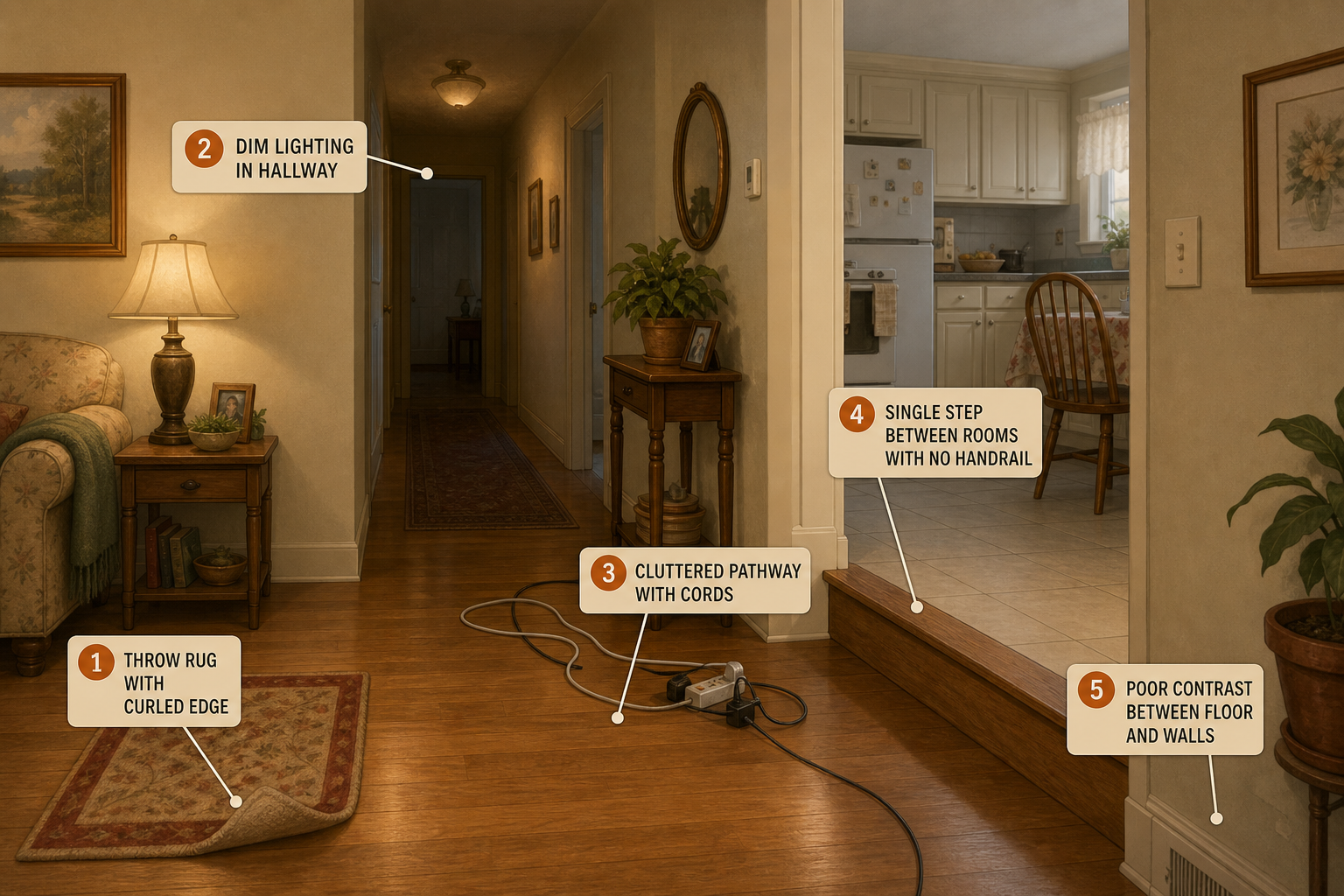
Common but overlooked hazards include:
- Throw rugs or mats without non-slip backing, especially at the bottom of stairs or in doorways
- Dim lighting in hallways, staircases, and entryways — particularly at night
- Steps at every entrance with no handrail or with a handrail on only one side
- Exposed electrical cords or phone chargers crossing walking paths
- Low-contrast transitions between flooring types (e.g., dark rug on dark hardwood) that make depth perception difficult
- No grab bars in the shower or near the toilet
A CAPS provides an expert, unbiased assessment of these hazards. Unlike a family member who has walked past the same throw rug for twenty years, a CAPS sees the home through the lens of current safety standards and the specific needs of an aging resident. The assessment produces a prioritized list of fixes, from immediate low-cost changes (removing rugs, adding lighting) to longer-term structural modifications (installing a ramp, widening doorways).
Sign 5: A Dementia or Parkinson's Diagnosis
A diagnosis of a progressive neurological condition — Alzheimer's disease, another form of dementia, or Parkinson's disease — changes the timeline for home safety planning. Unlike age-related mobility decline, which may progress slowly over years, these conditions introduce unpredictable changes in balance, perception, judgment, and behavior that can make a previously safe home suddenly dangerous.
For someone with dementia, the risks include wandering, poor depth perception, difficulty recognizing familiar spaces, and an increased likelihood of falling due to changes in gait and balance. For someone with Parkinson's, freezing episodes, postural instability, and a shuffling gait create fall risks that standard home modifications may not address. The home that was safe six months ago may no longer be safe today.
A CAPS assessment after a neurological diagnosis is not about making the home perfect for the current stage of the disease — it is about planning for the stages to come. This includes evaluating wandering risks (door alarms, secure exits), improving visibility (contrasting colors on walls and floors, eliminating shadows that may be misinterpreted), and creating safe pathways that reduce confusion. For families managing nighttime wandering, a CAPS can recommend modifications that complement a comprehensive safety plan, such as the strategies covered in our guide on
building a nighttime safety plan for sundowning
.
What Happens When You Call a CAPS: The Assessment Process
If one or more of the five signs above describe your parent's situation, the next step is understanding what a CAPS assessment actually involves. The process is straightforward and typically takes one to two hours:
- The CAPS conducts a room-by-room walk-through of the home, observing how the resident moves through each space and identifying environmental hazards.
- They discuss the resident's current functional abilities and anticipated future needs — including any recent diagnoses, mobility changes, or concerns raised by family members.
- They take measurements, photographs, and notes to document existing conditions and potential modification points.
- They provide a prioritized report with specific recommendations, estimated costs, and in many cases, contractor referrals or project management support.
- The cost for a comprehensive home evaluation with a full report and visuals is approximately $500, according to CAPS professionals, though this varies by region and scope.
The CAPS does not simply point out problems — they provide solutions. The report you receive is a roadmap for making the home safer, organized by priority and budget. Some recommendations may be immediate low-cost fixes; others may be longer-term investments that require planning and funding.
What Happens If You Don't: The Cost of Waiting
The decision to delay a CAPS assessment is not a neutral choice. Every month that passes with unaddressed hazards is a month in which the statistical risk of a fall continues to accumulate. The CDC data is stark: more than one in four older adults falls each year. Falls are the leading cause of injury death for people aged 65 and older. About 37% of those who fall sustain an injury requiring medical treatment or activity restriction, resulting in an estimated 9 million fall injuries annually. In 2019, falls caused 83% of hip fracture deaths and 88% of emergency department visits and hospitalizations for hip fractures.
The emotional and financial toll of a fall extends far beyond the immediate injury. A hip fracture often leads to surgery, rehabilitation, and a permanent loss of mobility. A fall-related hospitalization can trigger a cascade of events — deconditioning, delirium, loss of independence — that ends with a move to assisted living or a nursing home. The cost of assisted living ranges from $3,500 to $10,500 per month, according to AssistedLiving.org. Independent senior living ranges from $1,500 to $4,000 per month. These are costs that a single $500 CAPS assessment and a few thousand dollars in targeted modifications might have prevented.
The Five-Legged Table: A Framework for Aging in Place
Home modifications are only one piece of the aging-in-place puzzle. CAPS professional Valerie Jurik-Henry describes aging in place as a "five-legged table," where each leg represents a critical support system:

- Home design — the physical environment, including modifications that support safe movement and daily activities
- Finances — the ability to afford home modifications, ongoing care, and daily living expenses
- Healthcare — access to medical care, therapy, and in-home support services
- Transportation — the ability to get to appointments, grocery stores, and social activities
- Social engagement — maintaining connections with family, friends, and community
A CAPS assessment addresses the first leg — home design — but it also helps families think holistically about the other four. A modification that makes the home safer is only effective if the resident can afford it, has access to healthcare, can get out of the house, and maintains social connections. The framework is a useful tool for conversations with your parent about what aging in place will actually require, beyond just grab bars and ramps.
Proactive vs. Reactive Costs: Why Early Action Saves Money and Stress
The financial argument for proactive home modifications is straightforward when you compare the numbers side by side.
| Scenario | Typical Cost | Outcome |
|---|---|---|
| CAPS home assessment | $500 (one-time) | Prioritized report with specific recommendations |
| Grab bar installation (bathroom) | $100–$300 | Immediate fall risk reduction in the most hazardous room |
| Raised toilet seat | $30–$80 | Easier transfers, reduced strain on knees and hips |
| Single fall-related emergency department visit | $3,000–$12,000 (average) | Possible injury, no home safety improvement |
| One month of assisted living | $3,500–$10,500 | Loss of independence, ongoing monthly cost |
| One month of independent senior living | $1,500–$4,000 | Loss of home, ongoing monthly cost |
The math is clear. A $500 assessment and a few hundred dollars in targeted modifications can prevent a fall that leads to a $10,000 hospital bill and a $5,000-per-month assisted living facility. Yet most families reverse the order — they pay for the crisis first, then consider modifications.
For families concerned about the cost of modifications, several funding sources are available. The
Habitat for Humanity Aging in Place Program
offers free or low-cost home modifications for qualifying seniors. VA grants, Medicaid waivers, and USDA Rural Development programs can also offset costs. Our
aging in place remodel cost vs. assisted living decision guide
provides a detailed comparison to help families make informed financial decisions.
The takeaway is simple: call a CAPS before a crisis, not after. The five signs in this article are not a checklist of problems to worry about — they are a trigger for action. If one or more of them describes your parent's situation, a professional assessment is the most cost-effective, stress-reducing step you can take. The alternative — waiting until something happens — is the most expensive option of all.
Related reading
Need a professional assessment?
Find a CAPS-credentialed professional or local aging services through our outbound resource list — we never name or rank individual contractors.
Find Local HelpNoticed something outdated or inaccurate on this page? Flag a correction. We review every report against CDC, NIA, and AARP HomeFit guidance before updating a page.