
Room checklist
Occupational Therapist vs. CAPS Specialist: Who Should Assess Your Parent’s Home for Safety?
Many family caregivers don't know whether to call an occupational therapist or a CAPS-certified aging-in-place specialist first. This guide explains the distinct roles each professional plays, where their expertise overlaps, and how a collaborative approach — starting with an OT assessment and moving to CAPS-led construction — can save money, reduce stress, and create a safer home.

Why Families Get Stuck Between Two Professionals
You have heard the terms "aging-in-place specialist" and "occupational therapist" thrown around. Your parent's doctor mentioned an OT evaluation. A neighbor raved about the CAPS contractor who remodeled their bathroom. Your insurance company says it covers "home safety assessments" but you are not sure which professional that applies to. So you freeze — unsure who to call first, worried about paying for the wrong person, and anxious that your parent's home is not getting safer while you decide.
This confusion is understandable. Both professionals assess homes. Both recommend changes. But their training, scope of practice, and payment models are fundamentally different. The short answer is that you likely need both — but in a specific order. An occupational therapist evaluates your parent's functional abilities and clinical needs, often at little to no cost under Medicare Part B. A Certified Aging-in-Place Specialist (CAPS) then translates those clinical recommendations into a construction-ready plan and manages the renovation. The best outcomes happen when these two professionals collaborate.
What an Occupational Therapist Brings to a Home Safety Assessment
An occupational therapist (OT) is a licensed healthcare professional trained to evaluate how a person's physical, cognitive, and sensory abilities interact with their environment. When an OT conducts a home safety assessment, they are not just looking at the width of doorways or the height of countertops. They are assessing the person-in-environment fit — how your parent's specific mobility limitations, balance issues, vision changes, and cognitive patterns interact with every room in the house.
OTs use validated, research-backed assessment tools to structure their evaluations. According to Dr. Sara Story, an occupational therapist and CAPS who wrote for OccupationalTherapy.com, there are at least five validated home safety assessments that OTs commonly use:
- Home Assessment Profile (HAP) — Chandler et al., 2001
- Home Environmental Assessment Protocol (HEAP) — Gitlin et al., 2002
- Home Safety Self Assessment Tool v.3 (HSSAT) — Tomita, 2011/2012
- In-Home Occupational Performance Evaluation (I-HOPE) — Stark et al., 2010
- SAFER-HOME — Chui et al., 2006
Each tool assesses different aspects of home safety — from fall risk identification to task-specific performance — and gives the OT a structured framework for making recommendations. These recommendations often include assistive devices (grab bars, raised toilet seats, shower chairs), behavioral strategies (changing how a task is performed), and environmental modifications (improving lighting, removing tripping hazards).
An OT's scope stops at the recommendation stage. They do not design structural renovations, select specific products for installation, or manage construction crews. That is where the CAPS professional enters the picture.
What a CAPS-Certified Specialist Brings to a Home Modification Project
A Certified Aging-in-Place Specialist (CAPS) is credentialed by the National Association of Home Builders (NAHB) after completing a three-course program: CAPS I (Marketing & Communicating Aging in Place Client), CAPS II (Design Concepts and Methods for Livable Homes and Aging in Place), and CAPS III (Details and Solutions for Livable Homes and Aging in Place). The certification costs approximately $1,000 for a three-day course, according to the Aging in Place Directory.
CAPS professionals come from diverse backgrounds — remodeling, architecture, interior design, occupational therapy, and even nursing, according to both NAHB and Care.com. What unites them is a shared curriculum that teaches:
- How to apply universal design principles (equitable use, flexibility, simple and intuitive use, perceptible information, tolerance for error, low physical effort, and size and space for approach and use)
- How to select and specify products — grab bars, walk-in tubs, stair lifts, ramps, no-step showers, and lever-handle fixtures
- How to coordinate with contractors, manage construction timelines, and integrate budget planning with phased remodeling
- How to avoid common design and installation errors that compromise safety or usability
Unlike an OT, a CAPS specialist is not a healthcare provider. They do not conduct clinical assessments of your parent's balance, cognition, or functional abilities. Their expertise lies in the built environment — translating functional needs into buildable plans, selecting appropriate products, and ensuring the final construction meets safety and accessibility standards.
Valerie Jurik-Henry, a CAPS with over 30 years of experience, describes aging in place as a "five-legged table" with legs including home design, financial ability, healthcare services, transportation, and social engagement, as quoted by Right at Home. A CAPS professional primarily addresses the home design leg, but the best ones understand how it connects to the others.
Where Their Roles Overlap — and Where They Diverge
The table below summarizes the key differences between an OT and a CAPS professional. Use it to decide which professional to call first based on your family's current situation.
| Dimension | Occupational Therapist (OT) | CAPS-Certified Specialist |
|---|---|---|
| Training path | Master's or doctoral degree in occupational therapy; state licensure required | 3-course NAHB certification (~$1,000); open to remodelers, architects, designers, OTs, and others |
| Assessment focus | Person-in-environment fit: mobility, balance, cognition, ADLs, fall risk | Built environment: structural design, product selection, universal design, construction feasibility |
| Validated tools | Uses HAP, HEAP, HSSAT, I-HOPE, SAFER-HOME and other clinical assessments | No standardized clinical assessment tool; relies on design principles and product knowledge |
| Typical recommendations | Assistive devices, behavioral strategies, environmental modifications, fall prevention | Structural modifications, product specifications, contractor coordination, phased remodeling plans |
| Payment model | Often covered by Medicare Part B (with physician referral); private pay $100–$500 per visit | Almost always out-of-pocket; home safety assessment $300–$1,000; hourly consultation $75–$200 |
| Follow-up | Returns to verify modifications work for the person; adjusts recommendations as condition changes | Typically involved through construction completion; may not return for functional follow-up unless separately contracted |
The overlap occurs when an OT also holds CAPS certification — a growing trend, as Dr. Sara Story notes. An OT-CAPS can conduct the clinical assessment and then design the modifications themselves, creating a seamless handoff between evaluation and construction planning. But most families will work with two separate professionals, which is why understanding the workflow matters.
The Ideal Workflow: OT First, Then CAPS, Then OT Again
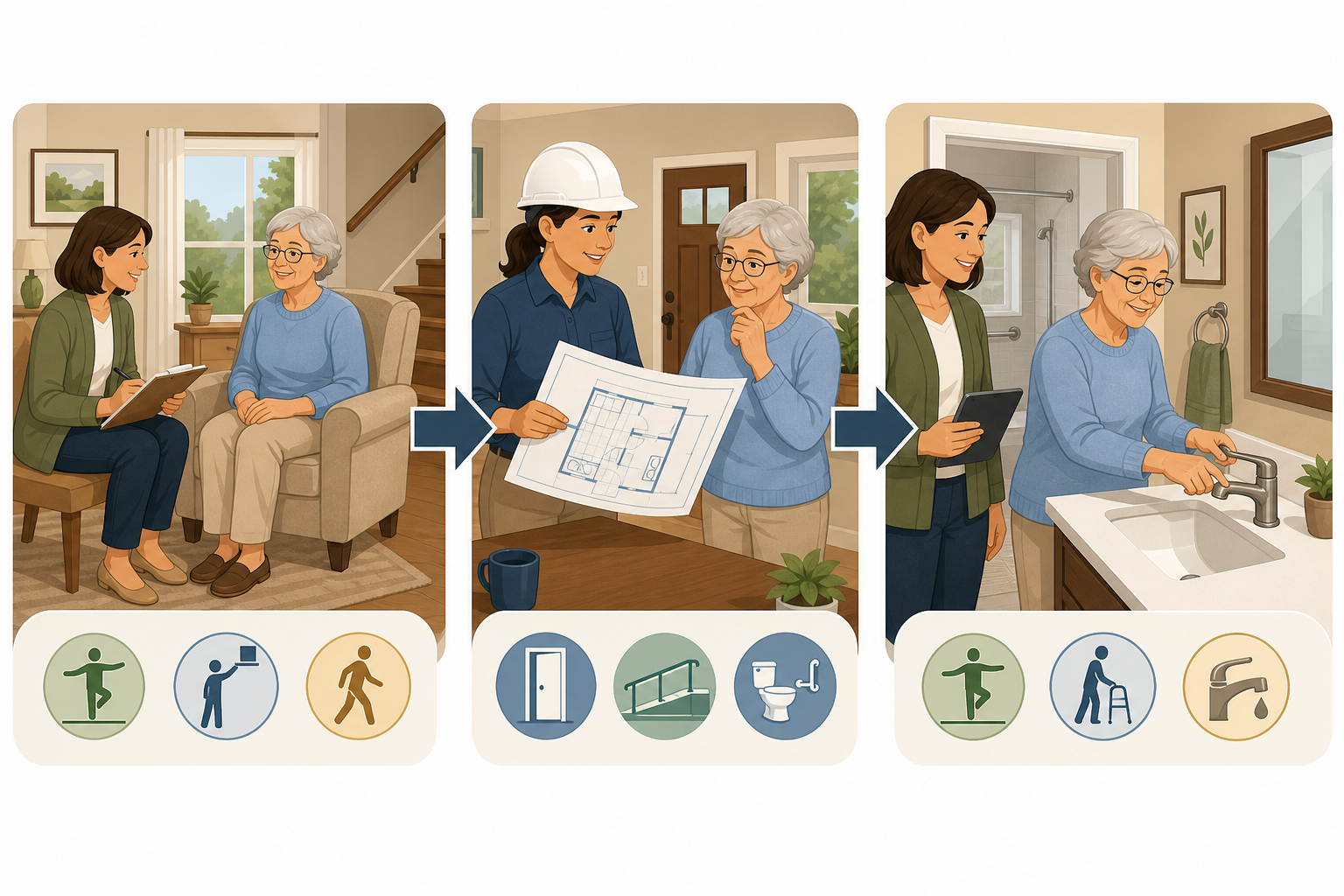
The most effective approach is a three-phase collaborative model. Here is how it works in practice:
- OT conducts a comprehensive functional and home safety assessment. The OT evaluates your parent's mobility, balance, strength, cognition, and vision. They use validated tools to identify fall risks and functional barriers. They produce a written report with specific recommendations — not just "install grab bars" but "install a 24-inch grab bar at a 45-degree angle on the wall adjacent to the toilet, positioned 33–36 inches from the finished floor."
- OT's recommendations are shared with a CAPS professional. The CAPS specialist reviews the OT's report and translates the clinical recommendations into a construction-ready plan. They select specific products (brand, model, finish), design the layout, obtain permits if needed, and manage the contractor. They also help the family prioritize modifications and phase the work to fit the budget.
- OT returns for a follow-up after modifications are installed. This step is often overlooked but critical. The OT verifies that the grab bar is at the correct height, the shower seat is positioned where your parent can actually use it, and the new lighting does not create glare that worsens vision problems. If something is wrong, the OT can recommend adjustments before the contractor leaves.
This collaborative model is not theoretical. The CAPABLE program (Community Aging in Place—Advancing Better Living for Elders) is an evidence-based randomized controlled trial that integrates OT and home modification services to help low-income older adults age in place. According to Dr. Sara Story's article on OccupationalTherapy.com, the CAPABLE program demonstrates the effectiveness of this integrated approach, though specific outcome data from the Liu et al. (2021) study should be reviewed directly for detailed results.
Cost Comparison: What You'll Pay Out of Pocket vs. What Medicare Covers
Cost is often the deciding factor for families. The table below compares what you can expect to pay for each professional's services.
| Service | Typical Cost | Insurance Coverage |
|---|---|---|
| OT home evaluation | $100–$500 per visit (private pay) | Often covered by Medicare Part B with physician referral and qualifying conditions |
| CAPS home safety assessment | $300–$1,000 (one-time) | Almost always out-of-pocket; not covered by Medicare |
| CAPS hourly consultation | $75–$200 per hour | Out-of-pocket |
| OT follow-up visit after modifications | $100–$500 per visit | Often covered by Medicare Part B with ongoing physician referral |
The actual cost of modifications themselves — grab bars ($100–$300 installed), wheelchair ramps ($1,500–$5,000), walk-in tubs ($5,000–$15,000), stairlifts ($3,000–$5,000), and major kitchen or bathroom renovations ($10,000–$50,000 or more) — is separate from the professional fees. These costs are national averages from the Aging in Place Directory and vary significantly by region and project complexity.
How to Set Up Both Professionals: A Step-by-Step Plan for Families
Once you understand the roles and costs, the next step is action. Here is a practical sequence for getting both professionals involved:
- Ask your parent's primary care physician for an OT referral. Explain that you are concerned about home safety and want a functional assessment. The physician's referral is often required for Medicare Part B coverage. If the physician is hesitant, mention that falls are the leading cause of injury among seniors and that an OT evaluation is a covered preventive service.
- Use the NAHB directory to find a CAPS-certified professional. The NAHB maintains a searchable database of CAPS professionals by location. Look for someone with experience in the specific type of modification you need (bathroom, entryway, whole-home). If possible, find a CAPS who has worked with OT reports before — they will be more comfortable translating clinical recommendations into construction plans.
- Share the OT's assessment report with the CAPS specialist. Before the CAPS professional visits, send them the OT's written recommendations. This saves time, reduces the need for the CAPS to re-assess basic functional needs, and ensures the modifications are designed around your parent's specific abilities — not generic assumptions.
- Plan for an OT follow-up after modifications are installed. Schedule this before construction begins. Ask the CAPS professional to coordinate with the OT on the timeline. The follow-up visit is your safety net — it catches installation errors and ensures the modifications actually work for your parent.
For families concerned about how to pay for modifications, explore options like Medicaid waivers, Veterans Affairs grants, and nonprofit programs. Our comprehensive guide on How to Pay for Aging-in-Place Remodeling: A Guide to Grants, Loans, Insurance, and Financial Assistance in 2026 covers these funding sources in detail.
Related reading
- Aging in Place Specialist vs. Occupational Therapist: Who Should You Call for Home Modifications?
- CAPS Specialist vs. Occupational Therapist: Who Should Assess Your Parent's Home for Aging in Place?
- CAPS vs. Occupational Therapist vs. General Contractor: Who Should You Hire for Aging-in-Place Home Modifications?
Need a professional assessment?
Find a CAPS-credentialed professional or local aging services through our outbound resource list — we never name or rank individual contractors.
Find Local HelpNoticed something outdated or inaccurate on this page? Flag a correction. We review every report against CDC, NIA, and AARP HomeFit guidance before updating a page.