
Room checklist
Stair Lift vs. Alternatives: A Decision Guide for Families Aging in Place
A stair lift can be a cost-effective solution for multi-level homes, but it isn't right for everyone. This guide compares stair lifts to one-floor living, wheelchair lifts, home elevators, and handrails, with a decision framework based on user capability, safety, and budget.
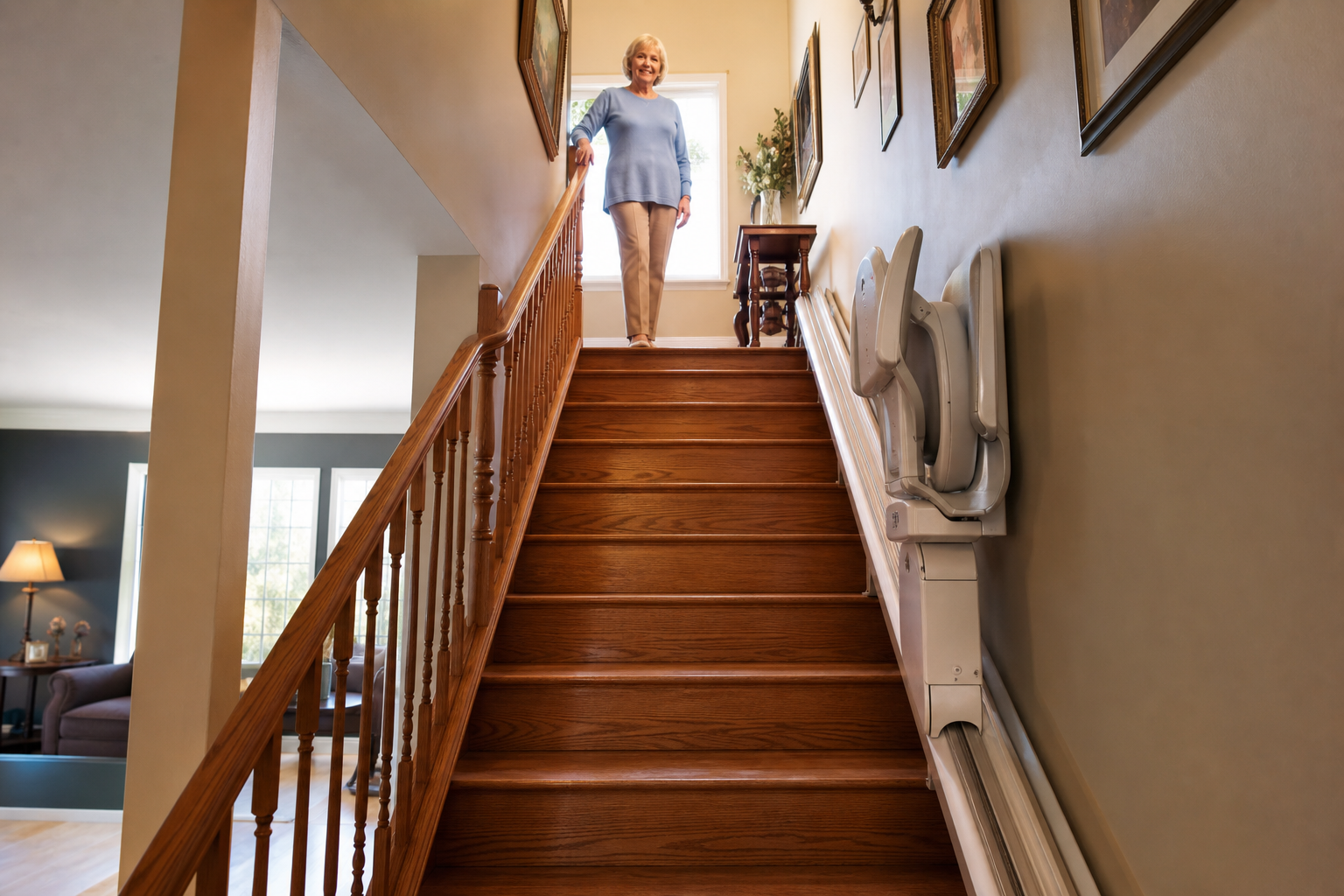
Is a Stair Lift the Right Choice for Your Family?
When a parent or spouse can no longer manage the stairs safely, the first solution many families consider is a stair lift. It is a logical starting point: a stair lift is far less expensive than moving to a single-story home or paying for assisted living, and it allows the older adult to remain in the home they know. A 2024 University of Michigan poll found that 84% of adults age 65 and older plan to age in place, and for those living in multi-level homes, the staircase is often the first barrier to that goal.
But the decision is not as simple as choosing which stair lift model to buy. The more fundamental question is whether a stair lift is the right solution at all — and that depends on the user's physical and cognitive abilities, not just the layout of the home. A stair lift requires the user to sit down, fasten a seatbelt, and operate a control switch. For someone with significant mobility decline, advanced dementia, or the inability to transfer independently, a stair lift can become an unused piece of equipment — or worse, a safety hazard.
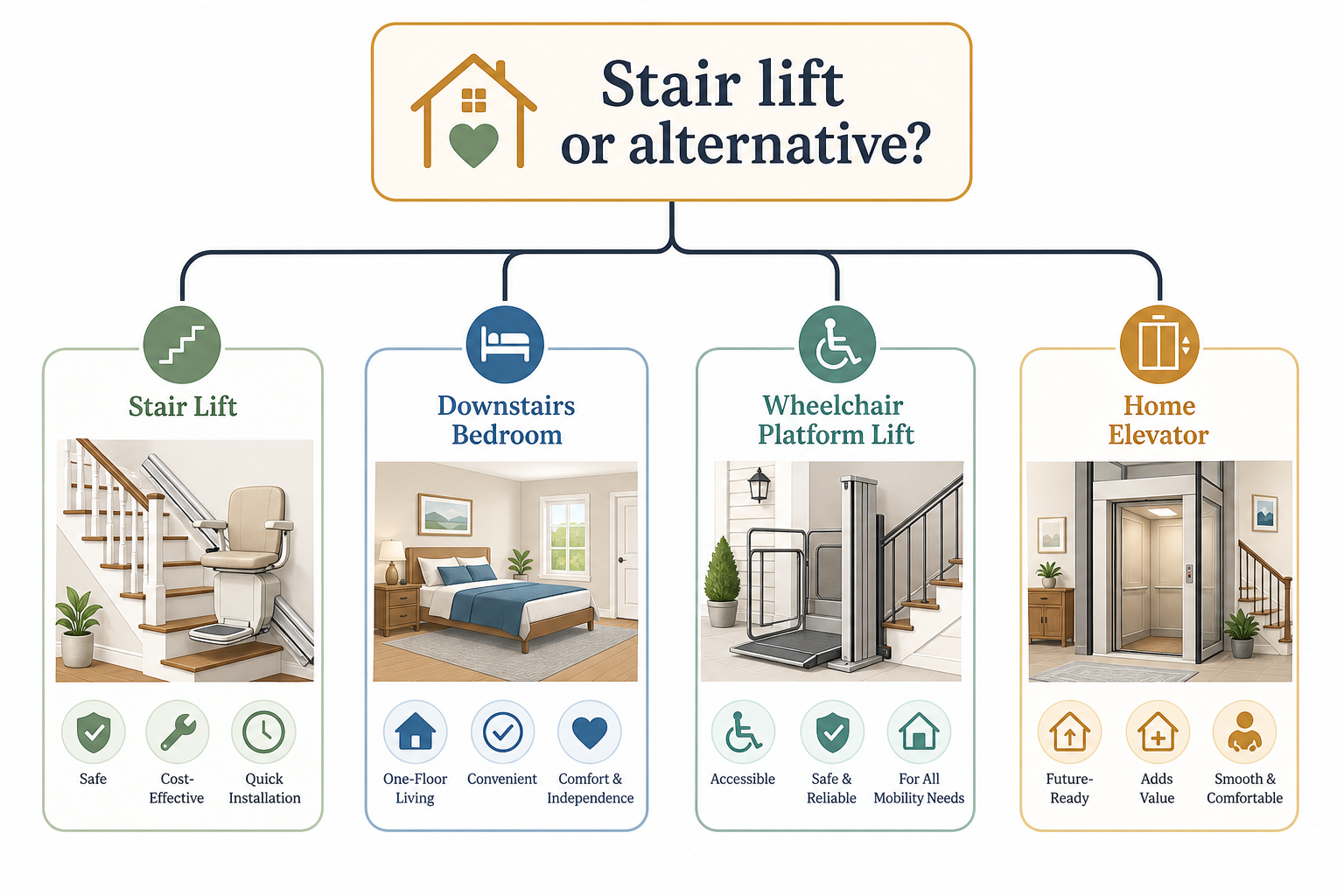
This guide compares stair lifts to four alternatives — one-floor living, wheelchair and platform lifts, home elevators, and low-cost modifications like handrails — so you can match the solution to the person's actual capabilities, not just the home's floor plan.
Stair Lifts: When They Work and When They Don't
A stair lift is a motorized chair that travels along a rail mounted to the stair treads. It is a proven, cost-effective solution for many families, but it is not a universal fix. Understanding the specific requirements for safe use is the first step in deciding whether a stair lift is appropriate.
Requirements for Safe Use
Occupational therapist Celina Hawthorne, quoted by the National Council on Aging (NCOA), explains that stair lifts are classified as home modifications rather than medical equipment because they attach to the home's structure. This classification has implications for insurance coverage, but more importantly, it means the user must be able to perform several actions independently or with minimal assistance:
- Get into and out of the seat safely
- Buckle and unbuckle the safety belt
- Operate the controls (typically a toggle switch or remote)
- Remain seated and still during the ride
- Maintain enough trunk stability to stay upright without leaning
If the older adult cannot meet these criteria — for example, due to advanced Parkinson's disease, moderate-to-severe dementia, or recent hip surgery that limits weight-bearing — a stair lift may not be a safe option. In these cases, an alternative that eliminates the need to transfer onto a moving chair, such as a platform lift or a downstairs conversion, is likely a better fit.
Key Specifications and Costs
For families who determine that a stair lift is appropriate, the following specifications provide a baseline for comparison with other options:
| Feature | Typical Range or Detail |
|---|---|
| Cost (straight staircase) | $2,500 – $5,000 installed (equipment $2,000–$3,500; installation $500–$1,500) |
| Cost (curved staircase) | $8,000 – $15,000+ installed (custom rail required) |
| Cost (outdoor) | $4,000 – $8,000 |
| Standard weight capacity | 300 lbs |
| Heavy-duty weight capacity | 400 – 600 lbs |
| Installation time (straight) | 2 – 4 hours |
| Installation time (curved) | 4 – 8 hours (custom-fitted) |
| Lifespan | 7 – 10 years average; up to 20 years with regular maintenance |
| Annual maintenance | $100 – $300 |
| Rental cost | $300 – $500 per month |
| Medicare coverage | Not covered (classified as home modification, not DME) |
Stair Lifts vs. Other Options: A Cost and Capability Comparison
The table below provides a side-by-side comparison of stair lifts and the four main alternatives discussed in this guide. The goal is not to declare one option universally superior, but to match each solution to a specific set of user circumstances.
| Option | Cost Range | User Mobility Requirement | Removes Stairs Entirely? | Installation Complexity | Best For |
|---|---|---|---|---|---|
| Stair Lift | $2,500 – $15,000 | Must be able to sit, fasten belt, and operate controls | No (rides on stairs) | Low to moderate (rail mounts to treads) | Users who can transfer safely and need occasional stair access |
| One-Floor Living (Downstairs Conversion) | $5,000 – $30,000 | Any mobility level (including wheelchair users) | Yes (all living space on one level) | Moderate to high (may involve bathroom remodel, doorway widening) | Users who cannot use stairs at all; long-term solution |
| Wheelchair / Platform Lift | $10,000 – $20,000+ | Can remain seated in wheelchair or scooter | No (rides on stairs or short vertical rise) | Moderate (requires electrical work, space at top/bottom) | Wheelchair users who cannot transfer to a stair lift seat |
| Home Elevator | $20,000 – $40,000+ | Any mobility level (wheelchair accessible) | Yes (enclosed cab) | High (structural work, shaft, permits) | Users who need full accessibility across multiple floors; highest convenience |
| Handrails / Grab Bars | $200 – $2,000 | Must be able to climb stairs with support | No | Low (mount to wall or treads) | Users with mild balance issues who can still climb stairs |
To put these costs in perspective, the average monthly cost of assisted living in the United States is $4,051 per year (Genworth, as cited by Day Elevator). A $5,000 straight stair lift costs less than two months of assisted living, and even a $15,000 curved stair lift pays for itself in less than four months compared to facility care. This cost comparison is one reason stair lifts remain the most popular solution for multi-level aging in place.
Alternative 1: One-Floor Living (Downstairs Conversion)
One-floor living means relocating the essential daily activities — sleeping, bathing, eating, and laundry — to the ground floor of the home. This approach eliminates the need to use stairs at all, making it the most comprehensive solution for anyone who cannot climb stairs safely, including full-time wheelchair users.
The cost of a downstairs conversion varies widely depending on the existing layout. A home that already has a ground-floor bedroom and a full bathroom may require only minor modifications, such as adding a grab bar or widening a doorway. A home that lacks these features may need a full bathroom remodel, which can run $5,000 to $15,000 or more depending on the scope of work.
Common one-floor living projects include:
- Converting a ground-floor den, office, or dining room into a bedroom
- Installing a walk-in shower or roll-in shower on the ground floor
- Adding a grab bar and raised toilet seat to an existing ground-floor powder room
- Moving the laundry to the ground floor (or installing a compact washer/dryer)
- Widening doorways to accommodate a walker or wheelchair
One-floor living is often more expensive than a stair lift, but it offers a permanent solution that does not depend on the user's ability to transfer or operate equipment. For families who plan to stay in the home for many years, the investment can be worthwhile. For a detailed look at one of the most common downstairs modification projects, see our Bathroom Remodeling for Aging in Place guide.
Alternative 2: Wheelchair and Platform Lifts
Wheelchair and platform lifts are designed for users who cannot transfer from their wheelchair or scooter to a stair lift seat. These lifts carry the user while they remain seated in their mobility device, eliminating the need for a transfer at the top and bottom of the stairs.
There are two main types:
- Vertical platform lifts: These lift a wheelchair or scooter straight up and down, typically for short rises such as a porch, stoop, or single step. They are commonly used for entryway access and cost $3,000 to $10,000.
- Inclined platform lifts: These travel along a rail mounted to the staircase, similar to a stair lift, but with a platform that accommodates a wheelchair or scooter. They are more expensive than vertical lifts, typically ranging from $10,000 to $20,000 or more, and require more space at the top and bottom landings.
Platform lifts are a strong middle-ground option for families who need wheelchair accessibility but cannot justify the cost of a full home elevator. They are also a good solution for homes where a downstairs conversion is not feasible due to space constraints or layout limitations.
For entryway access, a ramp may be a more cost-effective alternative to a vertical platform lift. See our Home Ramp Installation guide for a comparison of ramp types, costs, and safety standards.
Alternative 3: Home Elevators
A home elevator is the most expensive option on this list, but it is also the most convenient and accessible. Unlike a stair lift or platform lift, an elevator provides a fully enclosed cab that can accommodate a wheelchair, walker, and a companion. It does not require the user to transfer onto a seat or platform, and it can be used by anyone in the household regardless of mobility level.
The cost of a home elevator typically ranges from $20,000 to $40,000 or more, depending on the type (hydraulic, cable-driven, or pneumatic vacuum), the number of floors served, and the amount of structural work required. Installation is a major project that may involve cutting through floors, building a shaft, and obtaining permits. The process can take several weeks.
A home elevator is most appropriate for families who plan to remain in the home for a decade or more, who have the budget for a significant renovation, and who need full accessibility across multiple floors. For a deeper comparison of stair lifts, home elevators, and the option of moving to a single-story home, see our dedicated article: Stair Lift vs. Home Elevator vs. Moving.
Alternative 4: Handrails, Grab Bars, and Other Low-Cost Modifications
For older adults who can still climb stairs but need additional support, low-cost modifications can significantly improve safety without the expense of a stair lift or major renovation. These solutions are not a replacement for a stair lift if the user cannot climb stairs at all, but they are often the right first step for someone with mild balance issues or early-stage mobility decline.
Key low-cost modifications for stair safety include:
- Installing handrails on both sides of the staircase (not just one side)
- Adding grab bars at the top and bottom landings for stability during transitions
- Improving stair lighting with motion-activated lights or brighter bulbs
- Applying non-slip treads or adhesive strips to each step
- Marking the edge of each step with high-contrast tape for visual clarity
- Removing loose rugs, clutter, or obstacles from the staircase and landings
The total cost for these modifications is typically $200 to $2,000, depending on the number of handrails and grab bars installed. This makes them accessible to nearly any budget, and they can be completed in a single day by a handyman or family member.
For a comprehensive room-by-room assessment of fall hazards throughout the home, see our Home Fall Prevention Checklist. It covers every room in the house and includes printable checklists for family caregivers.
How to Decide: A Simple Decision Framework
Choosing between a stair lift and its alternatives comes down to three factors: the user's physical and cognitive abilities, the home's layout, and the family's budget and timeline. The following questions can help guide the decision.
Key Questions to Answer
- Can the user sit, stand, and operate controls safely? If yes, a stair lift is a viable option. If no, consider a platform lift, home elevator, or one-floor living.
- Is the user a full-time wheelchair or scooter user? If yes, a stair lift is not appropriate. Consider a platform lift, home elevator, or one-floor living.
- Is the user experiencing significant cognitive decline (dementia, Alzheimer's)? If yes, a stair lift may be unsafe due to difficulty operating controls or remembering to fasten the seatbelt. Consider one-floor living or a home elevator with automatic safety features.
- What is the budget? Under $5,000: low-cost modifications or a straight stair lift. $5,000–$15,000: curved stair lift or partial one-floor living conversion. $15,000–$30,000: full one-floor living conversion or platform lift. Over $30,000: home elevator.
- How long will the solution need to last? If the user is expected to need assistance for 5+ years, a more permanent solution like one-floor living or a home elevator may be worth the higher upfront cost.
- Is the home suitable for a downstairs conversion? If there is no ground-floor space for a bedroom or bathroom, a stair lift or platform lift may be the only practical option.
Decision Paths
Based on the answers above, the following paths summarize the most common scenarios:
| Scenario | Recommended Solution | Why |
|---|---|---|
| User can climb stairs with support but has mild balance issues | Handrails, grab bars, non-slip treads, improved lighting | Low-cost modifications address the specific hazard without over-investing |
| User can transfer safely and operate controls; budget under $5,000 | Straight stair lift | Most cost-effective solution for occasional stair use |
| User can transfer safely but has a curved staircase | Curved stair lift | Custom rail is more expensive than straight, but still far less than alternatives |
| User is a wheelchair user who cannot transfer | Platform lift or home elevator | Stair lift is not an option; platform lift is the lower-cost choice for wheelchair access |
| User has significant cognitive decline and cannot operate controls | One-floor living or home elevator | Stair lift is unsafe; eliminate the need for stairs entirely |
| User needs full accessibility and has a long-term plan to stay in the home | Home elevator or full one-floor living conversion | Higher upfront cost, but provides the most convenience and future-proofing |
| Budget is very limited and user cannot climb stairs | Stair lift rental ($300–$500/month) or partial one-floor living | Rental provides immediate access while saving for a permanent solution |
Next Steps: From Decision to Action
Once you have identified the most appropriate solution, the next step is to gather detailed information about costs, installation, and funding. The following resources on CareWise Guide can help you move forward:
- For a complete breakdown of stair lift costs by type and a guide to funding sources (VA grants, Medicaid waivers, state programs, and more), see Stair Lift Cost and Funding Options for Aging in Place.
- For a deeper comparison of stair lifts, home elevators, and the option of moving to a single-story home, see Stair Lift vs. Home Elevator vs. Moving.
- For a comprehensive guide to funding sources for all types of home modifications, see Funding Sources for Home Modifications: A Complete Guide to VA, Medicaid, Grants, and More.
- For a room-by-room home safety assessment, see the Home Fall Prevention Checklist.
Remember that the right solution is the one that matches the user's current abilities and anticipated future needs. A stair lift is an excellent choice for many families, but it is not the only choice — and for some, it is not the right choice at all. By evaluating the full range of alternatives, you can make a decision that supports safety, independence, and quality of life for years to come.
Related reading
Need a professional assessment?
Find a CAPS-credentialed professional or local aging services through our outbound resource list — we never name or rank individual contractors.
Find Local HelpNoticed something outdated or inaccurate on this page? Flag a correction. We review every report against CDC, NIA, and AARP HomeFit guidance before updating a page.