
Room checklist
Bathroom Modifications to Prevent Falls for Aging in Place
The bathroom is the most injury-prone room in the home for older adults, but a structured, zone-by-zone approach to modifications — from low-cost grab bars to curbless shower conversions — can dramatically reduce fall risk. This guide covers the four key risk zones, tiered modifications by cost and complexity, realistic 2026 cost estimates, and the full range of funding sources available to families and veterans.
Why the Bathroom Demands Immediate Attention
The bathroom is where the risk is highest — and where most homes are least prepared. According to CDC data, approximately 235,000 emergency room visits per year among older adults are directly caused by bathroom falls. A 2016 analysis published in PMC found that falls occurring in the bathroom are 2.4 times more likely to cause injury than falls in the living room — a gap explained by the combination of wet surfaces, hard fixtures, confined space, and the physical demands of transfers and bathing.
Despite this, the U.S. Census Bureau estimates that only about 10% of American homes are adequately designed for an aging population. Most bathrooms were built for younger, fully mobile adults — not for someone navigating balance changes, reduced grip strength, or post-surgical recovery.
The good news is that targeted bathroom modifications have a documented track record. A 2025 systematic review published in Healthcare found that 13 of 20 home modification studies — 65% — confirmed measurable effectiveness in fall prevention, functional independence, and cost savings. One Swiss cohort study found bathroom-related daily activity difficulties dropped by 93.4% following targeted bathroom adaptations. An Australian study found home modifications reduced total weekly caregiver hours by 42%.
The Four Bathroom Risk Zones
Rather than approaching bathroom safety as a checklist of disconnected tips, it is more useful — and more actionable — to think in terms of four distinct risk zones. Each zone has its own injury mechanism, its own set of appropriate modifications, and its own cost profile.
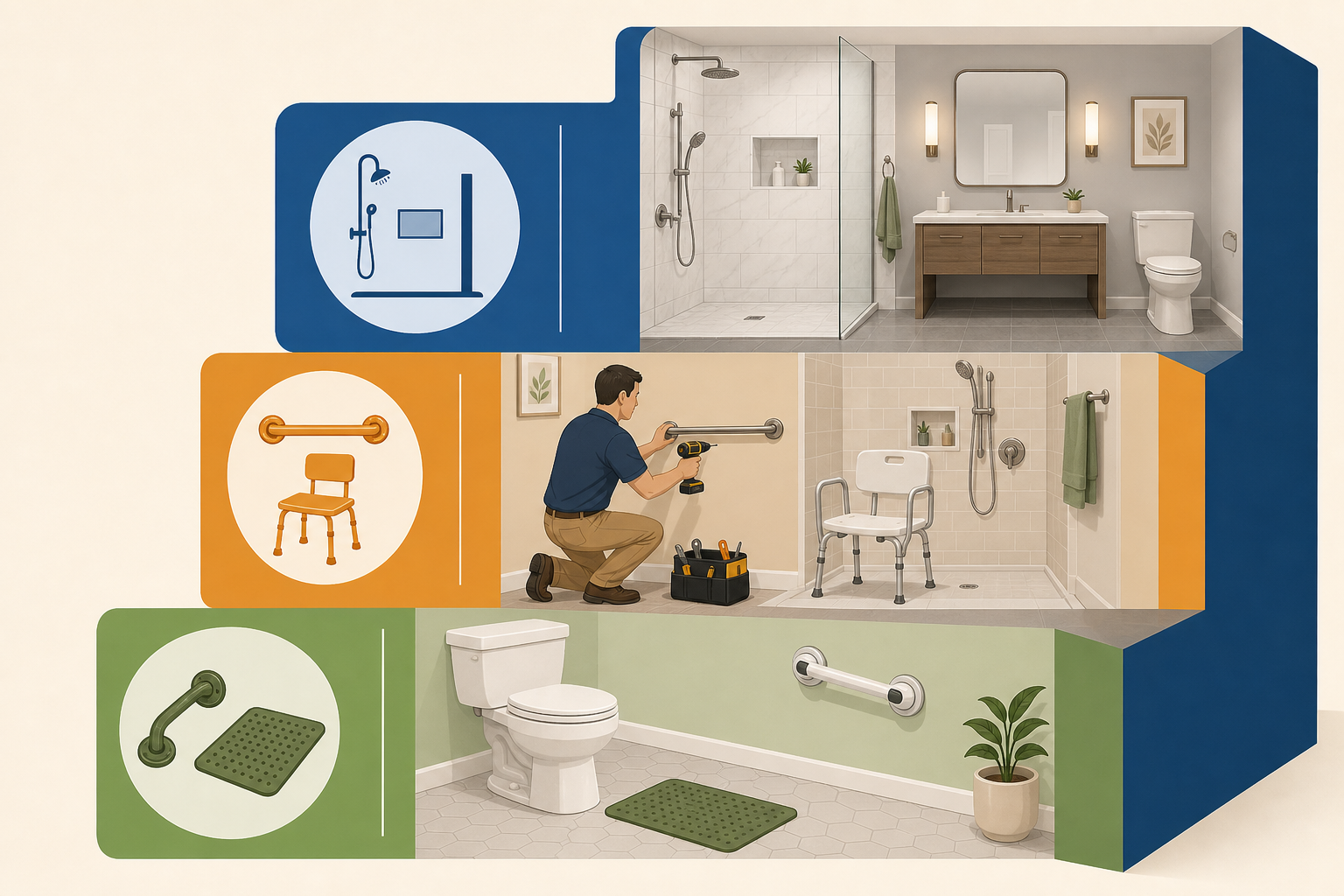
- Toilet area. The act of lowering onto and rising from the toilet is one of the most physically demanding transfers in the home. It requires controlled eccentric and concentric leg strength, balance, and often upper-body support. This zone accounts for a significant share of bathroom fall injuries, particularly among people with hip or knee weakness.
- Shower and tub entry and interior. Stepping over a tub threshold or a shower curb is a high-risk single-leg balance task. Once inside, wet surfaces, soap residue, and the need to shift weight while bathing create ongoing fall hazards. This zone carries the highest injury severity when falls occur.
- Floor surfaces. Wet tile, smooth flooring, and loose bath rugs create a slip hazard throughout the bathroom — not just in the shower. The transition from a wet shower floor to a dry bath mat, or from a mat to bare tile, is a common fall point.
- Lighting and visibility. Older adults require significantly higher light levels than younger adults to see clearly. Nighttime bathroom trips — common with age-related changes in sleep and bladder function — are particularly high-risk when lighting is inadequate and visual contrast is poor.
Each section of this guide is organized around these four zones. Identifying which zone presents the most immediate risk in a specific bathroom is the first step toward an effective modification plan.
Tiered Modification Framework: Matching Urgency to Budget
Not every bathroom modification requires a contractor or a significant budget. A practical way to approach the decision is through three tiers that reflect both cost and complexity — and the important principle that Tier 1 actions should be taken immediately, regardless of whether larger projects are planned.
| Tier | Cost Range | Who Does the Work | Examples |
|---|---|---|---|
| Tier 1 — Immediate | Under $150 | Homeowner / caregiver | Non-slip bath mats, adhesive anti-slip strips, portable grab bar, motion-activated night light |
| Tier 2 — Professional Installation | $150 – $2,000 | Licensed contractor or handyperson | Wall-mounted grab bars, raised toilet seat with arms, handheld showerhead on slide bar, fold-down shower bench, motion-sensor lighting |
| Tier 3 — Structural Renovation | $2,000 – $15,000+ | Licensed contractor, ideally CAPS-certified | Curbless shower conversion, tub-to-shower replacement, walk-in tub, doorway widening, full accessible bathroom remodel |
Grab Bars: Placement, Specifications, and Installation Requirements
Among all bathroom modifications, grab bars offer the strongest combination of evidence, low cost, and immediate impact. Professionally installed, a single grab bar typically costs $200–$350 — and it provides a stable support point at exactly the moments when balance is most challenged.
Placement follows ADA-informed guidelines, which provide a reliable starting point even in residential settings:
- Toilet side wall: A horizontal bar on the side wall, positioned 33–36 inches above the floor, gives support during lowering and rising. The bar should extend forward past the front of the toilet seat.
- Toilet rear wall: A rear bar at 33–36 inches provides additional stabilization, particularly for individuals who lean back during transfers.
- Shower entry: A vertical or angled bar at the shower entrance supports the step-in and step-out movement — the highest-risk moment in shower use.
- Shower interior: A horizontal bar on the shower wall at 33–36 inches provides support while bathing and while seated on a shower bench.
The most critical installation requirement is wall anchoring. Grab bars must be mounted into wall studs or into solid blocking installed between studs. A bar anchored only with toggle bolts into drywall can pull free under load — which is precisely when it is most needed. If the wall does not have studs in the right location, a contractor can install a backing board or blocking during a renovation.
Shower and Tub Decisions: Conversion Options and Trade-offs
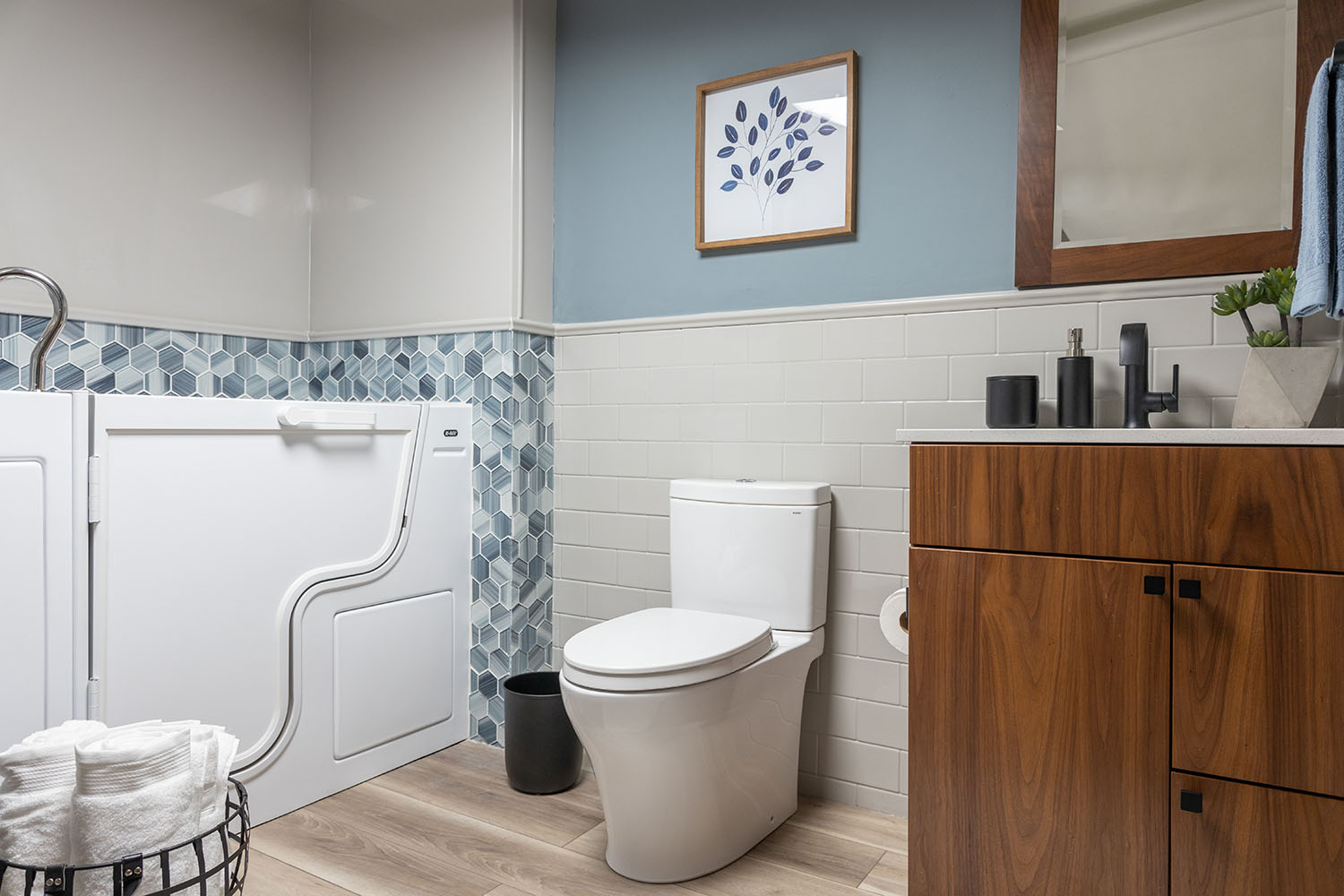
The shower and tub entry zone is where the most serious bathroom injuries occur — and where the most consequential modification decisions need to be made. The right choice depends on the individual's current mobility level, the trajectory of their functional changes, and the available budget.
| Option | Estimated Cost | Best For | Key Limitation |
|---|---|---|---|
| Curbless / zero-threshold shower conversion | $1,500 – $5,000 | Anyone who can stand and walk; eliminates the step-over hazard entirely | Requires waterproofing and proper floor drainage slope; most complex of the three options |
| Tub-to-shower conversion (low-threshold) | $1,200 – $4,000 | Households where the tub is rarely used; low threshold still requires a small step | A low threshold is safer than a tub but not as safe as zero-threshold |
| Walk-in tub | $3,000 – $10,000+ | Individuals who strongly prefer bathing over showering | User must enter before filling and wait for the tub to drain before exiting — a significant limitation for anyone with urgency or fatigue |
Whichever conversion path is chosen, three components should be treated as standard inclusions rather than optional upgrades:
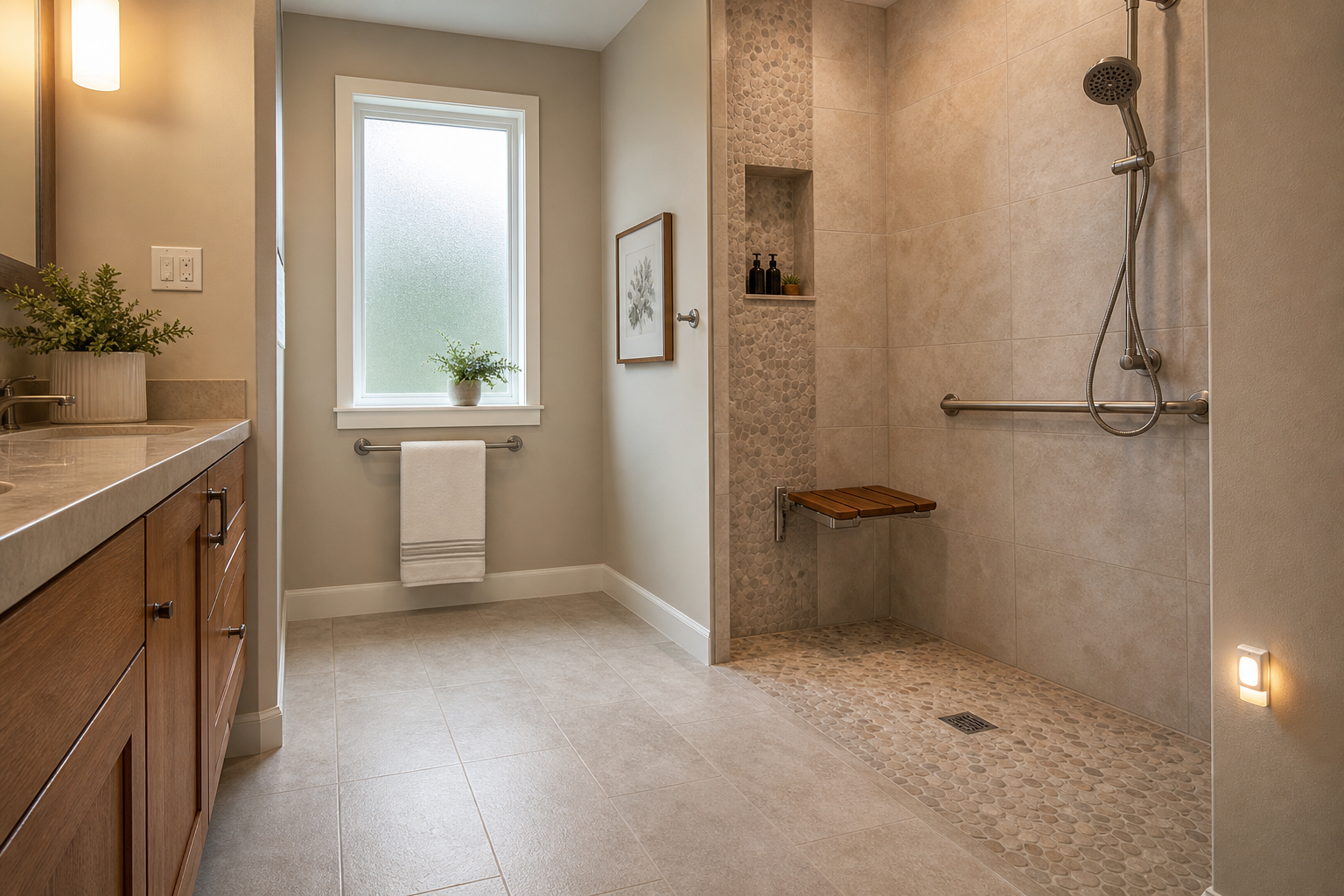
- A fold-down shower bench or built-in seat, which allows bathing in a seated position and eliminates the need to stand on one leg while washing.
- A handheld showerhead on an adjustable slide bar, which allows bathing while seated and reduces the need to rotate or reach.
- Non-slip floor tile or textured shower pan material — a smooth tile floor is a hazard regardless of how well the entry is designed.
Flooring, Lighting, and the Often-Overlooked Risk Zones
Floor surfaces and lighting are the two risk zones most frequently underaddressed — partly because they feel less dramatic than a shower conversion, and partly because the lower-cost interventions are easy to overlook. Both zones deserve systematic attention.
Floor Surfaces
- Tier 1: Non-slip bath mats with strong suction-cup backing placed immediately outside the shower or tub. Adhesive anti-slip strips applied to the tub floor or shower pan. Replace any loose rugs — a rug without a non-slip backing is a trip hazard, not a safety feature.
- Tier 2: Anti-slip coating products applied to existing ceramic or porcelain tile. These are professionally applied treatments that increase the coefficient of friction on wet tile without changing the tile's appearance. Results vary by product and tile type.
- Tier 3: Flooring replacement with textured or matte-finish tile that maintains traction when wet. This is the most durable solution and is typically addressed as part of a larger bathroom renovation.
Lighting and Visual Contrast
Older adults require significantly higher light levels than younger adults to see clearly — a physiological change that begins in the 40s and accelerates with age. A bathroom that feels adequately lit to a 40-year-old may be genuinely inadequate for a 75-year-old navigating it at 2 a.m.
- Install motion-activated night lights at floor level along the path from the bedroom to the bathroom. These provide low-glare orientation lighting for nighttime trips without requiring the older adult to find and operate a switch in the dark.
- Ensure the main bathroom light switch is accessible from the doorway — not positioned inside the room past the threshold, which requires entering an unlit space before reaching the switch.
- Add visual contrast markings at step edges, threshold transitions, and the edge of the tub or shower entry. A contrasting color strip at a threshold makes the transition visible and reduces misjudgment of depth.
- Consider upgrading to brighter overhead fixtures or adding task lighting at the vanity. The general guidance for aging-in-place design is to aim for lighting levels roughly double what would be considered adequate for a younger adult.
Cost Reference: What Bathroom Modifications Actually Cost in 2026
| Modification | Low Estimate | High Estimate | Notes |
|---|---|---|---|
| Non-slip bath mat | $15 | $40 | Tier 1; replace when suction cups degrade |
| Adhesive anti-slip strips (tub/shower) | $10 | $30 | Tier 1; reapply periodically |
| Motion-activated night light | $10 | $30 | Tier 1; plug-in or battery models available |
| Portable / suction-cup grab bar | $25 | $80 | Tier 1; not weight-bearing equivalent to wall-mounted; for temporary use only |
| Wall-mounted grab bar (per bar, professionally installed) | $200 | $350 | Tier 2; must be stud-mounted or blocking-reinforced |
| Raised toilet seat with arms | $40 | $150 | Tier 1–2; freestanding models require no installation |
| Handheld showerhead with slide bar | $50 | $200 | Tier 2; requires basic plumbing connection |
| Fold-down shower bench | $80 | $300 | Tier 2; wall-mounted models require stud anchoring |
| Anti-slip floor coating (professional application) | $200 | $600 | Tier 2; varies by floor area and product |
| Curbless / zero-threshold shower conversion | $1,500 | $5,000 | Tier 3; cost varies significantly by existing plumbing and tile |
| Tub-to-shower conversion (low-threshold) | $1,200 | $4,000 | Tier 3; lower end for prefab unit; higher for custom tile |
| Walk-in tub | $3,000 | $10,000+ | Tier 3; installation additional; note drain-before-exit limitation |
| Full accessible bathroom renovation | $8,000 | $20,000+ | Tier 3; includes widened doorway, curbless shower, all fixtures |
Funding Sources: How to Pay for Bathroom Modifications
Funding for bathroom modifications is available through multiple channels — but no single source covers everyone, and availability varies by income, veteran status, geography, and insurance plan. The most important step is to investigate all applicable sources before assuming the full cost falls to the family.
| Funding Source | Who It Covers | What It Covers | Key Caveat |
|---|---|---|---|
| Original Medicare (Parts A & B) | Medicare enrollees | Generally does not cover home modifications; may cover OT assessment following a fall | Do not assume Medicare covers modifications — verify directly |
| Medicare Advantage (Part C) | Medicare Advantage enrollees | Post-2019 supplemental benefits may include home safety modifications; varies by plan | Coverage varies significantly by plan and state; verify your specific plan annually |
| Medicaid HCBS Waivers | Low-income Medicaid enrollees | Often covers home modifications for income-eligible individuals through Home and Community-Based Services waivers | State-specific and income-dependent; not universally available; contact your state Medicaid office |
| VA HISA Grant | Veterans with service-connected or non-service-connected disabilities | Up to approximately $6,800 for home accessibility improvements (verify current limit at va.gov) | Eligibility requirements apply; limits subject to policy change |
| VA SAH / SHA Grants | Veterans with significant service-connected disabilities | Substantial grants for adaptive housing modifications; higher limits than HISA | More restrictive eligibility than HISA; contact VA for current program details |
| USDA Section 504 Home Repair | Low-income rural homeowners | Grants and loans for home repairs including accessibility modifications | Rural areas only; income limits apply |
| Rebuilding Together / Habitat for Humanity | Low-income homeowners | Free or subsidized home modification services through nonprofit programs | Availability varies by local chapter; often has waitlists |
| Medical expense tax deduction | Taxpayers with qualifying medical expenses | Modifications prescribed for a medical condition may be deductible as medical expenses | Consult a tax professional for individual guidance; subject to AGI threshold |
For Medicare Advantage enrollees, the supplemental benefits landscape has expanded since 2019, but coverage varies dramatically from plan to plan and changes each plan year. Call the member services number on your insurance card and ask specifically whether your plan covers home safety modifications or environmental modifications — and get the answer in writing.
Who Should Do the Work: DIY, CAPS Contractor, or OT Assessment
Three professional pathways are relevant to bathroom modification projects, and they serve distinct — and complementary — roles. Understanding when each is appropriate prevents both under-investment (doing nothing because the project feels overwhelming) and mismatched solutions (making structural changes without understanding the individual's specific functional needs).
- DIY. Appropriate for Tier 1 items — non-slip mats, adhesive strips, motion night lights, and portable grab bars. For wall-mounted grab bars, DIY is only appropriate if the installer is confident in locating studs and anchoring into solid wall structure. A grab bar that pulls free under load is worse than no grab bar. When in doubt, hire a professional for grab bar installation.
- Occupational therapist (OT) home assessment. An OT can evaluate the individual's specific mobility limitations, transfer patterns, and functional trajectory, then recommend modifications matched to those needs. This is the clinical pathway and is often covered by Medicare Part B following a fall, hospitalization, or physician referral. An OT assessment before a major renovation can prevent costly modifications that do not match the person's actual needs.
- CAPS-certified contractor. The Certified Aging-in-Place Specialist (CAPS) credential is issued by the National Association of Home Builders (NAHB). CAPS contractors receive training in ADA standards, aging-in-place design principles, and OT-informed modification planning. For Tier 2 and Tier 3 projects, a CAPS contractor is better positioned to anticipate aging-in-place needs than a general contractor who has not received this training.
Bathroom Safety Modification Checklist
Use this checklist as a starting point for a bathroom safety assessment. Work through each risk zone and note which items are already in place, which need to be added, and which tier of modification is required.
Zone 1: Toilet Area
- [Tier 1] Raised toilet seat with arms installed or available
- [Tier 2] Wall-mounted grab bar on the side wall, 33–36 inches above floor, extending past the front of the seat
- [Tier 2] Wall-mounted grab bar on the rear wall if needed for additional support
- [Tier 3] Comfort-height toilet (17–19 inches) installed if transfers remain difficult after other modifications
Zone 2: Shower and Tub Entry and Interior
- [Tier 1] Adhesive anti-slip strips applied to tub floor or shower pan
- [Tier 2] Vertical or angled grab bar at shower entry for step-in and step-out support
- [Tier 2] Horizontal grab bar on shower interior wall at 33–36 inches
- [Tier 2] Fold-down shower bench or freestanding shower chair
- [Tier 2] Handheld showerhead on adjustable slide bar
- [Tier 3] Curbless / zero-threshold shower conversion to eliminate step-over hazard
- [Tier 3] Tub-to-shower conversion with low-threshold or curbless design if tub is primary fall risk
Zone 3: Floor Surfaces
- [Tier 1] Non-slip bath mat with suction-cup backing placed outside shower or tub
- [Tier 1] All loose rugs removed or replaced with non-slip-backed versions
- [Tier 2] Anti-slip coating applied to existing tile if tile is smooth when wet
- [Tier 3] Flooring replaced with textured or matte-finish tile rated for wet areas
Zone 4: Lighting and Visibility
- [Tier 1] Motion-activated night light at floor level along bedroom-to-bathroom path
- [Tier 1] Light switch accessible from the doorway before entering the room
- [Tier 2] Overhead lighting upgraded to higher lumen output appropriate for older adults
- [Tier 2] Contrasting color strips or tape applied to step edges, threshold transitions, and tub or shower entry edge
- [Tier 2] Task lighting added at the vanity if overhead lighting is insufficient
Related reading
Need a professional assessment?
Find a CAPS-credentialed professional or local aging services through our outbound resource list — we never name or rank individual contractors.
Find Local HelpNoticed something outdated or inaccurate on this page? Flag a correction. We review every report against CDC, NIA, and AARP HomeFit guidance before updating a page.