
Room checklist
How Much Does a CAPS Specialist Cost? A Family Budget Guide for Home Modifications
A realistic cost framework for families hiring a Certified Aging in Place Specialist (CAPS), from the initial assessment fee through phased renovations, with itemized modification ranges, financing options, and a direct comparison to assisted living expenses.
Why Most Homes Aren't Ready for Aging in Place — and What It Costs to Fix Yours
The desire to stay at home is nearly universal among older adults. A 2022 University of Michigan National Poll on Healthy Aging found that 88% of adults aged 50 and older want to remain in their homes for as long as possible. Yet the housing stock tells a different story. According to Census Bureau data cited by Choice Mutual, 9 in 10 U.S. homes are not equipped to accommodate the needs of an aging resident. Only about 10% of homes qualify as "aging-ready."
That gap between intention and reality creates a difficult moment for families. You know your parent wants to stay home. You can see the hazards — the step into the shower, the narrow doorway, the stairs to the only bathroom. But when you start researching what it would cost to fix these problems, the numbers feel abstract and intimidating. How much does a Certified Aging in Place Specialist (CAPS) charge for an assessment? What does a walk-in tub actually run? Is a $50,000 bathroom remodel realistic, or are you being quoted a luxury price?
This guide exists to replace guesswork with a concrete budget framework. We will walk through every layer of cost in a typical CAPS engagement — from the initial assessment fee through individual modifications, major renovations, and the financial assistance programs that can offset them. By the end, you will have a clear picture of what your family should expect to spend, how to phase the work, and why even a substantial upfront investment almost always beats the recurring cost of assisted living.
The CAPS Assessment: What You Pay for the Expert Eye
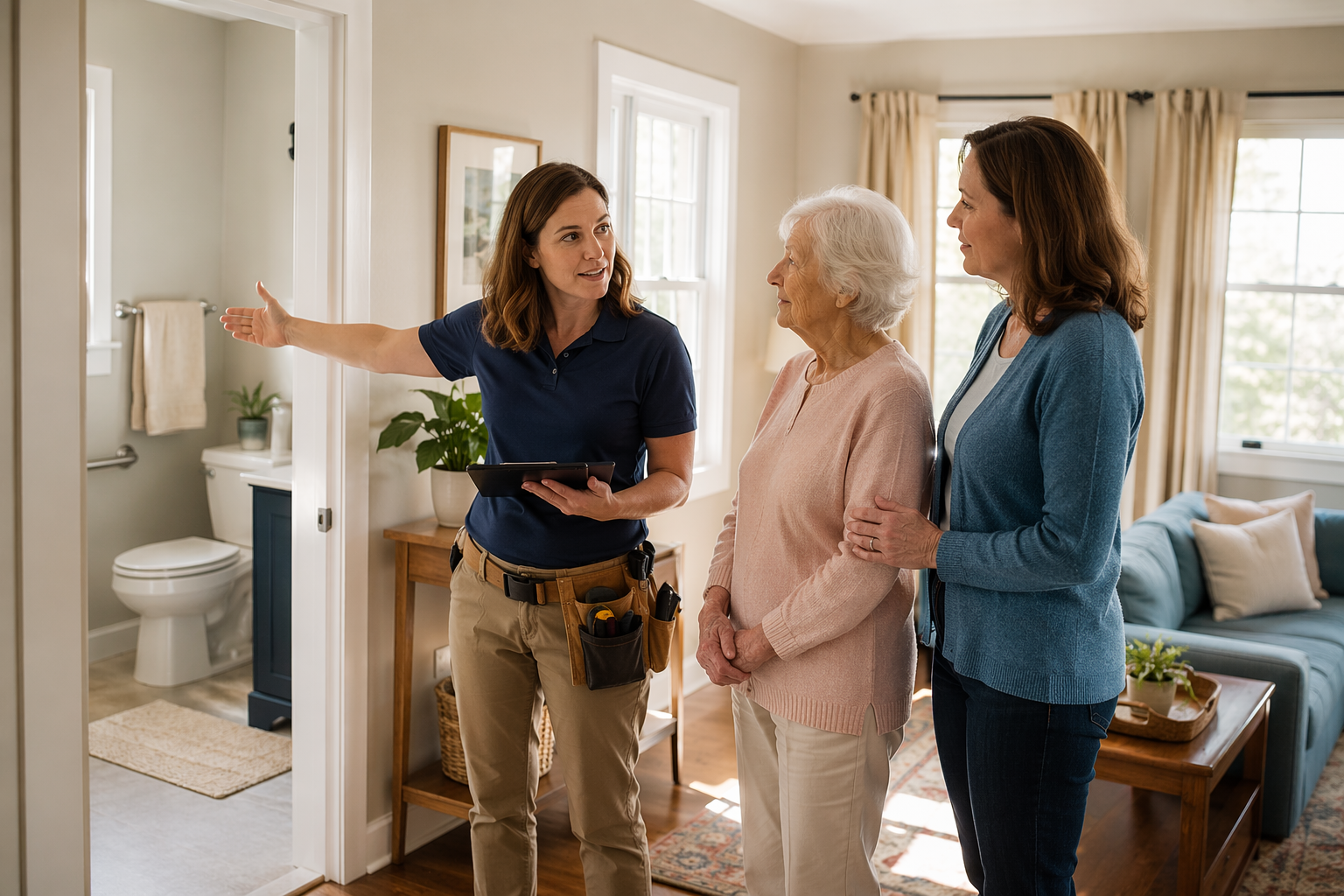
Before any work begins, a CAPS-certified professional conducts a thorough home assessment. This is not a quick walkthrough. The specialist evaluates every room, doorway, threshold, and surface for safety, accessibility, and future adaptability. They measure clearances, test lighting levels, check for trip hazards, and assess the structural feasibility of modifications like stairlifts or roll-in showers.
The deliverable is a written, prioritized modification plan — essentially a roadmap for your entire project. This plan is what makes a CAPS engagement different from hiring a general contractor directly. The CAPS identifies not just what needs to change, but the order in which changes should happen to maximize safety and minimize wasted work.
| Service | Typical Fee Range | What You Get |
|---|---|---|
| Initial home assessment (one-time) | $199 – $500 | Full walkthrough, measurements, hazard identification, prioritized modification plan |
| Hourly consultation (add-on services) | $75 – $200 per hour | Project oversight, contractor coordination, follow-up visits, material selection guidance |
| Comprehensive assessment with detailed report | $300 – $1,000 | In-depth evaluation including structural analysis, lighting assessment, and multi-year phasing plan |
The wide range in assessment fees reflects differences in regional cost of living, the complexity of the home, and whether the CAPS works independently or as part of a design-build firm. Marian Berman, a CAPS professional cited by Care.com, charges $250 for an assessment and report, then $150 per hour for additional services. Fritzi Gros-Daillon, another CAPS, reports charging $199 to $399 for an initial meeting and assessment. At the higher end, comprehensive assessments that include detailed architectural measurements and lighting analysis can reach $1,000.
Room-by-Room Modification Costs: What Each Upgrade Really Runs
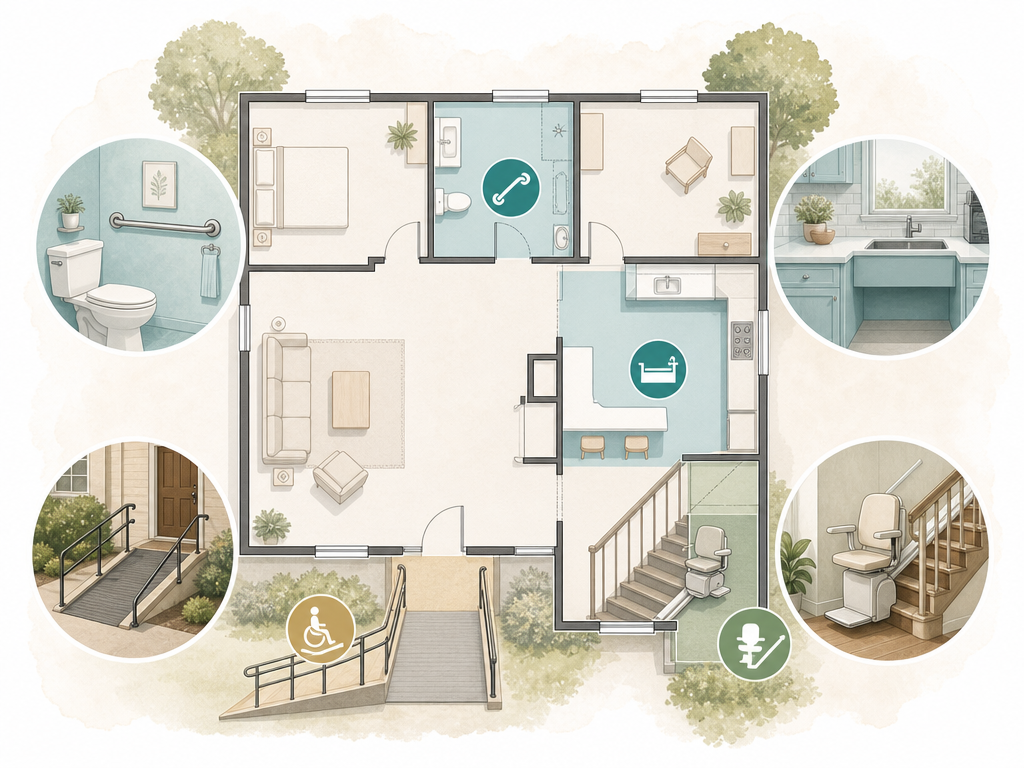
Once the assessment is complete, the CAPS will present a list of recommended modifications. These typically fall into a few common categories. Below is an itemized breakdown of the most frequently recommended upgrades, with cost ranges compiled from multiple industry sources.
| Modification | Cost Range | Notes |
|---|---|---|
| Grab bars (per bar, installed) | $100 – $300 | Stainless steel or brass; cost includes blocking reinforcement in walls |
| Walk-in tub | $5,000 – $15,000 | Includes installation; price varies by size, jet features, and door type |
| Roll-in shower (curbless) | $1,500 – $2,000 (basic) | Full bathroom remodel with roll-in shower can reach $10,000–$50,000+ |
| Stairlift (straight rail) | $3,000 – $5,000 | Curved rail stairlifts cost significantly more ($8,000–$15,000) |
| Wheelchair ramp (permanent) | $1,500 – $5,000 | Cost depends on length, materials (wood vs. aluminum), and site preparation |
| Widened doorways (per doorway) | $200 – $2,000+ | Standard 32-inch widening; automatic door openers add $1,000+ |
| Non-slip flooring (per square foot) | $1 – $4 | Vinyl, rubber, or textured tile; installation additional |
| Kitchen modifications (full) | $15,000+ | Lowered counters, pull-out shelves, touchless faucets, accessible appliances |
| Lever-style door handles (per handle) | $20 – $60 | Simple swap; no structural work required |
| Improved lighting (per room) | $100 – $500 | Motion-sensor lights, nightlights, brighter fixtures, task lighting |
Note the wide range on several items, particularly walk-in tubs and widened doorways. A basic walk-in tub from a big-box retailer might cost $5,000 installed, while a premium model with hydrotherapy jets, heated surfaces, and a quick-drain system can exceed $15,000. Similarly, widening a doorway in a home with standard wood framing might cost $200 to $500, but if the wall is load-bearing or contains plumbing or electrical lines, the price can climb to $2,000 or more.
Major Renovations: When a Room-by-Room Approach Isn't Enough
Some homes require more than individual modifications. If the only full bathroom is upstairs, if the kitchen layout prevents wheelchair access, or if the entire main floor needs reconfiguration, a comprehensive renovation becomes necessary. These projects involve structural work, multiple trades, and significantly higher budgets.
| Project Type | Cost Range | What It Typically Includes |
|---|---|---|
| Full bathroom accessibility remodel | $10,000 – $50,000+ | Roll-in shower or walk-in tub, raised toilet, grab bars, non-slip flooring, widened doorway, accessible sink |
| Whole-home accessibility upgrade | $10,000 – $100,000 | Multiple room modifications, ramp installation, stairlift or elevator, lighting upgrades, doorway widening throughout |
| Main-floor bedroom conversion | $5,000 – $20,000 | Converting a den, office, or dining room into a bedroom with accessible closet and bathroom access |
| Elevator installation (residential) | $20,000 – $40,000 | Through-floor or exterior elevator; requires structural assessment and permits |
The $10,000 to $100,000 range for whole-home upgrades is intentionally broad because the scope varies enormously. A home that needs only a bathroom remodel, a ramp, and better lighting might fall at the lower end. A multi-story home requiring a stairlift or elevator, a full kitchen reconfiguration, widened doorways throughout, and a bathroom gut renovation could approach six figures.
Valerie Jurik-Henry, a CAPS professional quoted by Right at Home, frames this spending as an investment rather than an expense. She notes that a home modification saves the expensive monthly cost of assisted living. The key is to view the total project cost in context — not as a single intimidating number, but as a one-time expense that eliminates a recurring one.
One-Time Cost vs. Recurring Expense: Home Modifications Compared to Assisted Living
The most important financial comparison in this entire discussion is not between different contractors or material choices. It is between a one-time capital expense and a recurring monthly obligation that continues for years.
| Option | Typical Cost | Cost Type |
|---|---|---|
| Whole-home accessibility renovation | $10,000 – $100,000 | One-time (may be spread over months or years with phased approach) |
| Assisted living (national median) | $64,200 per year ($5,350/month) | Recurring monthly expense |
| Assisted living (range) | $45,000 – $126,000 per year | Recurring monthly expense |
| Independent senior living | $18,000 – $48,000 per year ($1,500–$4,000/month) | Recurring monthly expense |
Even at the high end of the renovation range — a $100,000 whole-home accessibility upgrade — the math is straightforward. That amount covers less than two years of assisted living at the national median of $64,200 per year. If your parent lives at home for five more years after the modifications are complete, the savings compared to assisted living range from $221,000 (at $45,000/year) to $530,000 (at $126,000/year).
For a deeper analysis of this trade-off, including a year-by-year break-even calculator and regional cost comparisons, see our dedicated guide: Aging in Place Remodel Cost vs. Assisted Living: A Complete Decision Guide.
How to Pay for It All: Financial Assistance, Grants, and Tax Benefits
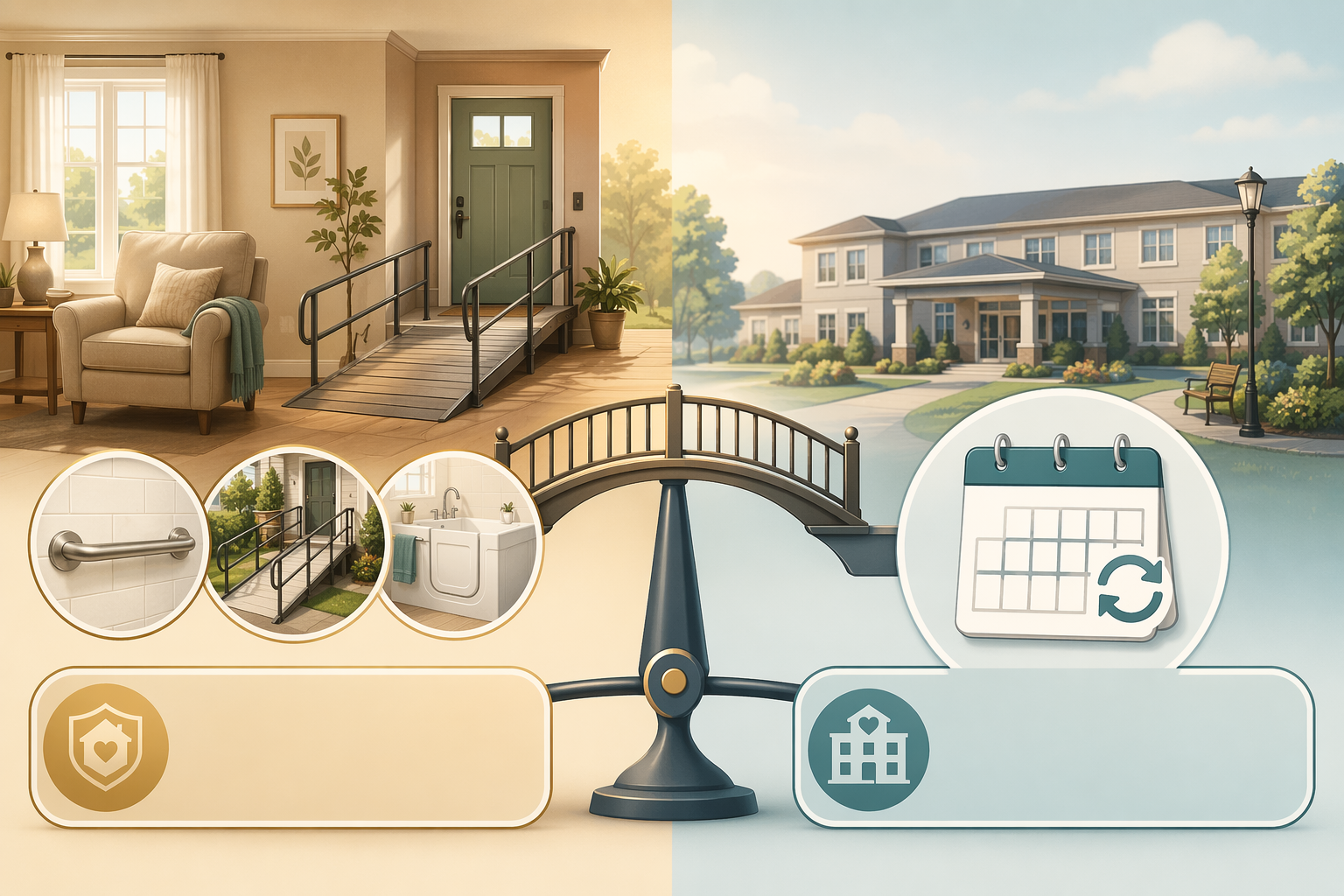
The single biggest reason families delay home modifications is not lack of willingness — it is lack of awareness about available funding. According to research cited by the Alzheimer's Association and other organizations, billions of dollars in benefits and grants go unclaimed each year because families do not know they exist. A CAPS-developed modification plan can strengthen applications for several types of assistance.
- Medicaid waivers: Many states offer Home and Community-Based Services (HCBS) waivers that can cover home modifications for eligible low-income seniors. These waivers vary by state — some cover grab bars and ramps, others cover full bathroom remodels. A CAPS assessment report provides the documentation needed to support a waiver application.
- VA grants: Veterans and surviving spouses may qualify for the Specially Adapted Housing (SAH) grant or the Special Home Adaptation (HISA) grant. These can fund modifications like ramps, widened doorways, and bathroom accessibility improvements. The VA requires a physician's statement and a detailed cost estimate — both of which a CAPS can provide.
- IRS medical expense deduction: Under IRS Publication 502, the cost of home modifications made for medical care — including grab bars, ramps, stairlifts, and walk-in tubs — may be deductible as a medical expense if they do not increase the home's value. The deduction applies to the portion of the cost that exceeds 7.5% of your adjusted gross income. Keep all receipts and the CAPS assessment report as documentation.
- Nonprofit and community programs: Organizations like Habitat for Humanity's Aging in Place program, Rebuilding Together, and local Area Agencies on Aging (AAAs) offer free or low-cost modification services for qualifying low-income seniors. Availability varies by location, and waitlists can be long.
- Home equity and personal loans: For families who do not qualify for grants, a home equity line of credit (HELOC) or a personal loan for home improvement can spread the cost over several years. Some lenders offer specialized programs for aging-in-place renovations.
For a comprehensive overview of all funding options — including state-by-state Medicaid waiver details, VA grant application steps, and IRS deduction rules — see our complete guide: How to Pay for Aging in Place Home Modifications: A Complete Guide to Grants, Loans, Tax Deductions, and Insurance Coverage.
Building a Phased Plan: How to Spread Costs Over Time Without Sacrificing Safety
Few families can write a $50,000 check for a full bathroom remodel. The good news is that most CAPS professionals design modification plans with phasing in mind. The assessment report explicitly prioritizes modifications by urgency, allowing you to tackle the most critical safety issues first while budgeting for larger projects later.
A typical phased plan might look like this:
- Phase 1 (Immediate — $500–$2,000): Install grab bars in the bathroom, add non-slip flooring, improve lighting with motion-sensor nightlights, and replace round doorknobs with lever-style handles. These low-cost, high-impact changes address the most common fall hazards immediately.
- Phase 2 (Short-term — $3,000–$8,000): Install a stairlift or build a permanent ramp. Widen the most critical doorway (usually the bathroom or bedroom). Add a raised toilet seat and a shower chair or transfer bench.
- Phase 3 (Medium-term — $10,000–$25,000): Complete a bathroom accessibility remodel with a roll-in shower or walk-in tub. Modify the kitchen with pull-out shelves, a touchless faucet, and lowered counter sections.
- Phase 4 (Long-term — $15,000–$50,000+): Address remaining structural changes — full kitchen reconfiguration, main-floor bedroom conversion, or elevator installation. These projects often coincide with other home renovations to maximize efficiency.
Right at Home's Valerie Jurik-Henry confirms that remodeling can be done in sections to spread costs. The key is having a master plan — which the CAPS assessment provides — so that early work does not have to be undone or redone when later phases begin. For example, if you plan to install a roll-in shower in Phase 3, the grab bars installed in Phase 1 should be positioned to align with the future shower layout.
For guidance on which modifications to prioritize first based on fall prevention research, see: Home Modifications That Actually Prevent Falls: What the Research Says and What to Prioritize.
What CAPS Certification Costs the Professional (and Why It Matters for You)
Understanding what a CAPS pays to earn and maintain their credential helps explain why their services carry a premium over a general contractor's. The certification is offered jointly by the National Association of Home Builders (NAHB) and AARP, and it requires completing three courses covering marketing, design concepts, and technical solutions.
| Certification Cost Component | NAHB Members | Non-Members |
|---|---|---|
| Application fee (initial) | $299 | $399 |
| Annual renewal fee | $65 | $95 |
| Continuing education requirement | 4 hours/year | 4 hours/year |
| Total estimated cost for all three courses | $880 | $900 |
These fees are modest compared to many trade certifications, but they represent a commitment to specialized knowledge that a general contractor may not have. A CAPS has studied universal design principles, fall prevention strategies, and the specific needs of aging adults. They understand clearances for wheelchairs and walkers, the structural requirements for grab bar installation, and the latest products designed for accessibility.
The cost of the certification — roughly $800 to $900 — is a one-time investment for the professional. But the knowledge they gain from that training can save your family thousands of dollars by preventing costly mistakes, ensuring modifications are done correctly the first time, and creating a plan that maximizes the value of every dollar spent.
For a broader perspective on how home modification costs compare to the financial impact of a fall, see: The Financial Case for Fall-Proofing a Senior's Home: Cost of Modifications vs. Cost of a Fall.
Related reading
Need a professional assessment?
Find a CAPS-credentialed professional or local aging services through our outbound resource list — we never name or rank individual contractors.
Find Local HelpNoticed something outdated or inaccurate on this page? Flag a correction. We review every report against CDC, NIA, and AARP HomeFit guidance before updating a page.