
Room checklist
What Your Parent's Home Needs Now: A Caregiver's Decision Framework for Aging in Place Modifications
After a parent's fall or functional decline, the list of recommended home modifications can feel overwhelming. This article provides a four-factor decision framework to help adult children triage modifications by safety risk, frequency of use, ease of installation, and likelihood of future need — so you know what to do today, what to budget for this year, and what can wait.
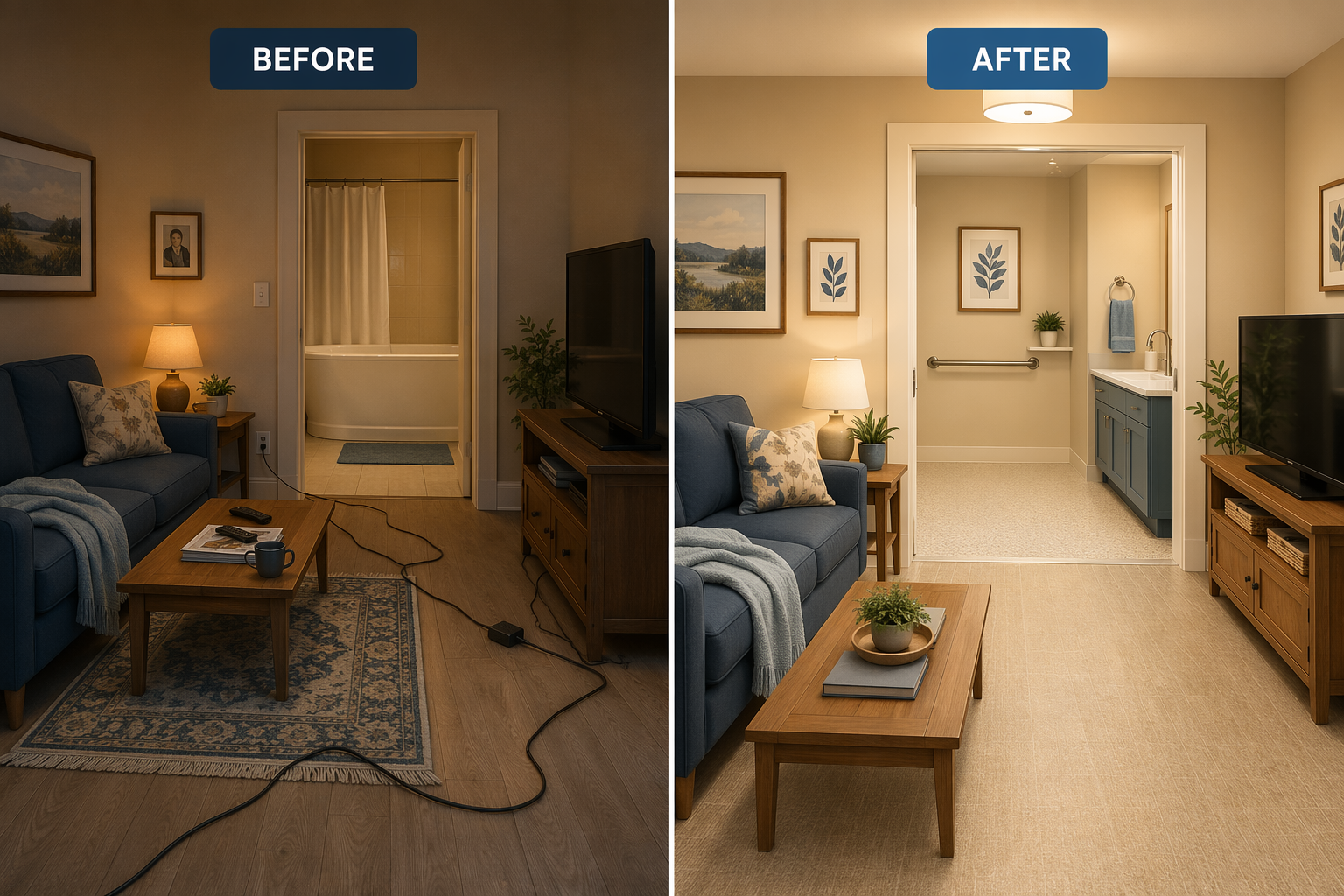
The Caregiver's Dilemma: Too Many Recommendations, Not Enough Time or Budget
Your parent has had a fall. Or maybe the decline has been slower — a series of near-misses, a new diagnosis, a growing stack of unopened mail because the walk to the mailbox feels too far. The doctor, the physical therapist, the well-meaning neighbor, and the internet have all offered advice: install grab bars, widen the doorways, rip out the tub, put in a ramp, move the bedroom downstairs. The list is long, the price tag is intimidating, and you need to know what actually matters right now.
You are not alone in this feeling. More than one in four adults aged 65 and older falls each year, according to the National Institute on Aging, and the majority of those falls happen at home. The desire to stay home is strong — roughly three-quarters of people over 50 say they want to age in place — but the reality is that most homes were never designed for the bodies that live in them decades later. The gap between the desire to stay home and the home's actual readiness is what makes this moment so stressful.
What you need right now is not another list of every possible modification. You need a way to decide which changes are urgent, which can wait, and which will matter most as your parent's needs evolve. This article gives you a four-factor decision framework designed for exactly that purpose. It will help you triage the recommendations, protect your budget, and give you a clear path forward — starting with what you can do this week.
The Four-Factor Prioritization Framework: How to Decide What Comes First
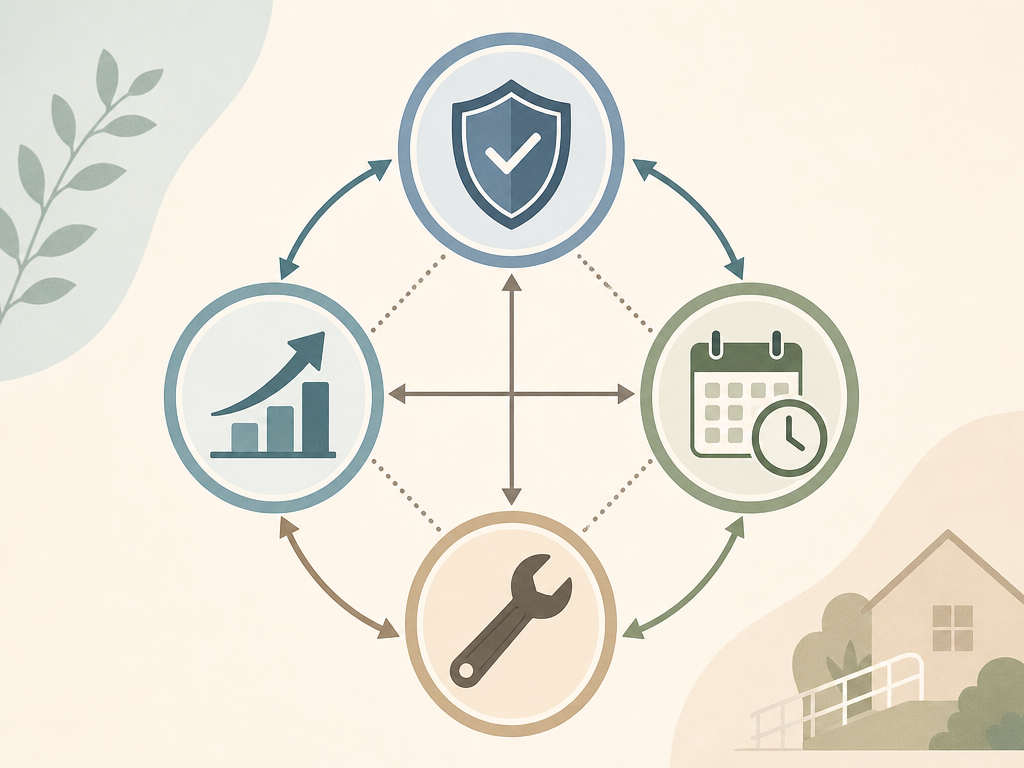
Every home modification competes for two scarce resources: your attention and your money. To allocate both wisely, you need a consistent way to compare one change against another. The four-factor framework gives you that consistency. It asks four questions about each potential modification:
- Safety risk: How likely is a fall or injury in this area, and how severe would the consequences be?
- Frequency of use: How often does your parent use this space or perform this activity every day?
- Ease of installation: Can this be done in an afternoon for under $500, or does it require a contractor and a permit?
- Likelihood of future need: Is your parent's condition stable, or is it likely to progress (mobility decline, dementia, Parkinson's) and make this modification essential later?
A modification that scores high on safety risk and frequency of use but low on ease of installation — like a grab bar in the shower — jumps to the top of the list. A modification that scores low on all four factors can wait. A modification that scores low on safety risk today but high on likelihood of future need — like widening a hallway for a future wheelchair — belongs in the long-term plan, not the emergency budget.
To see how this works in practice, consider the grab bar. A study published in Human Factors (2021) found that people who had a grab bar in their shower were nearly 76% more likely to recover their balance during a bathroom fall. The bathroom is the room your parent uses every day, multiple times. A grab bar costs between $150 and $400 installed and can be mounted in an afternoon. Safety risk: high. Frequency of use: high. Ease of installation: high. Likelihood of future need: high. The framework says: do this now.
Quick-Win Decision Tree: Modifications You Can Do This Week for Under $500
The first tier of the framework is where you start. These are modifications that score high on safety risk and frequency of use but low on installation complexity. They cost under $500, take an afternoon or less, and immediately reduce the most common fall hazards.
The bathroom is almost always the first room to address. Occupational therapists consistently identify it as the most dangerous room in the house. As one occupational therapist told Wirecutter: "You're naked and wet." The numbers back this up: nearly 28% of bathroom injuries in people aged 65 and older are toilet-related, according to CDC data cited by Wirecutter. That means the area around the toilet — standing up, sitting down, turning — is a higher-risk zone than the shower or tub for many older adults.
Here is the quick-win decision tree for the bathroom:
- Install grab bars near the toilet and in the shower or tub. Standard models cost $15 to $80 each; floor-to-ceiling tension models run $140 to $300. They must be anchored to wall studs — do not use suction-cup models as primary safety devices.
- Add a raised toilet seat ($27 to $85) or replace the existing toilet with an ADA-height model (17 to 19 inches seat height). This alone can eliminate the most common bathroom fall scenario.
- Place a shower chair or transfer bench ($50 to $300) in the tub or shower so your parent can sit while bathing.
- Install a handheld, removable showerhead so bathing can happen from a seated position.
- Replace standard faucets with lever-handle models to reduce the grip strength needed to control water temperature — this also reduces burn risk.
- Add motion-sensor night-lights along the path from the bedroom to the bathroom. This is the most common fall route in the middle of the night.
Outside the bathroom, the quick-win list includes: removing throw rugs and securing loose carpet edges (the single cheapest fall prevention measure), improving lighting in hallways and stairwells, installing handrails on both sides of any staircase, and clearing walking paths of cords, furniture, and clutter. These changes cost little to nothing and can be completed in a single weekend.
Mid-Term Investment Guide: What to Budget for Over the Next 6 to 12 Months
Once the quick wins are in place, the next tier of modifications requires more planning, more budget, and often a contractor. These are the changes that score high on safety risk and likelihood of future need but lower on ease of installation. They are not emergency-level urgent, but they should not be deferred indefinitely.
The table below summarizes the most common mid-term investments, their cost ranges, and how the four-factor framework applies to each. Cost figures are consolidated from multiple authoritative sources including Forbes, NerdWallet, and 3 Birds Accessibility, and reflect national averages as of early 2026. Actual costs vary by region, home age, and contractor rates.
| Modification | Cost Range | Safety Risk Score | Frequency Score | Installation Score | Future Need Score |
|---|---|---|---|---|---|
| Stair lift (straight staircase) | $2,500 – $5,000 | High | High | Medium | High |
| Stair lift (curved staircase) | $10,000 – $18,000+ | High | High | Low | High |
| Wheelchair ramp installation | $1,500 – $12,000+ | High | Medium | Medium | High |
| Doorway widening (per doorway) | $700 – $2,000 | Medium | Medium | Medium | High |
| Barrier-free shower conversion | $8,000 – $18,000+ | High | High | Low | High |
| Walk-in tub | ~$10,000 | Medium | Medium | Low | Medium |
| Vertical platform lift | $9,000 – $20,000+ | High | Low | Low | High |
Notice how the framework clarifies the decision. A stair lift for a straight staircase scores high on safety risk (falling on stairs is often catastrophic), high on frequency of use (stairs are used daily), medium on ease of installation (requires professional measurement and mounting), and high on likelihood of future need (mobility rarely improves). It belongs in the 6-to-12-month plan. A walk-in tub, by contrast, scores medium on safety risk (the user is seated and the risk is primarily during entry and exit) and medium on likelihood of future need (many families find barrier-free showers more practical long-term). It can wait longer or be replaced by a different solution.
Long-Term Structural Planning: Renovations That Anticipate Future Needs
The third tier of the framework is where the "likelihood of future need" factor becomes the primary driver. These are major renovations that prepare the home for progressive conditions — mobility decline, dementia, Parkinson's disease, or the eventual use of a wheelchair or walker full-time. They are expensive, disruptive, and often emotionally difficult to contemplate. But planning for them early, before a crisis forces the decision, gives you more options and lower costs.
The most significant long-term modifications include:
- Full bathroom and kitchen conversions for wheelchair accessibility. A complete aging-in-place remodel of a bathroom and kitchen can range from $15,000 to $60,000 or more, depending on the scope. This includes barrier-free showers, roll-under sinks, pull-out shelves, under-cabinet lighting, and non-slip flooring throughout.
- Zero-step entries at all exterior doors. A single step at the front door becomes an insurmountable barrier for a wheelchair user. Grading the walkway, pouring a concrete ramp, or installing a prefabricated ramp system creates a seamless transition.
- Widening hallways to at least 36 inches of clearance. The ADA standard for wheelchair passage is 32 inches, but 36 inches is preferred for comfort and maneuverability. This may require moving walls, which is a structural project.
- Installing wall blocking for future grab bars. During any renovation, have the contractor install plywood blocking between studs in the bathroom, shower, and toilet areas. This costs almost nothing during construction but saves hundreds of dollars later when grab bars can be mounted anywhere without searching for studs.
- Planning for a first-floor bedroom or converting a den or dining room into a bedroom. If the home has stairs and your parent's mobility is declining, the long-term plan should include a sleeping and bathing space on the main level.
Occupational therapists strongly recommend a phased approach to these major renovations. As one OT told Wirecutter: "If you try to do everything at once, it's like drinking out of a fire hydrant." Most families spread these changes over two to five years, tackling one or two significant projects annually. The four-factor framework helps you decide which project comes first: the bathroom conversion (high safety risk, high frequency of use) before the kitchen (medium safety risk, high frequency of use), and both before the hallway widening (low safety risk today, high future need).
Red Flags That Mean Hire a Professional Now: When to Call a CAPS Specialist or Occupational Therapist
The four-factor framework helps you decide what to do, but it does not tell you how to do it. Some modifications are genuinely DIY-friendly — installing a raised toilet seat, mounting a motion-sensor night-light, replacing faucets. Others require professional assessment and installation. Knowing the difference is a safety issue, not a budget issue.
Here are the red flags that mean you should hire a professional before proceeding:
- Grab bars must be anchored to wall studs or structural blocking. A grab bar that pulls out of drywall during a fall is worse than no grab bar at all — it creates a false sense of security. If you cannot locate studs or are unsure about the wall construction, hire a contractor or a CAPS-certified specialist.
- Staircases with landings, curves, or non-standard dimensions require a custom stair lift. A curved stair lift costs significantly more than a straight one ($10,000+ vs. $2,500–$5,000) and requires professional measurement and installation. Do not attempt to install a stair lift yourself.
- Doorway widening and wall removal may involve load-bearing walls. Removing or altering a load-bearing wall without proper support can compromise the entire structure. A structural engineer or general contractor must assess the wall before any work begins.
- If your parent has a recent stroke, Parkinson's disease, dementia, or another progressive neurological condition, an occupational therapist should conduct a home assessment before any modifications are made. An OT evaluates the person's functional abilities — balance, strength, vision, cognition — and recommends modifications tailored to their specific needs, not generic solutions. For more on what an OT assessment involves, see
- our occupational therapist guide.
- If the modification requires a building permit (most structural changes do), you must use a licensed contractor. Permits ensure the work meets local building codes, which exist for safety reasons. A CAPS-certified contractor — Certified Aging-in-Place Specialist — has specific training in home modifications for older adults and understands the relevant codes and standards.
A CAPS certification does not guarantee a specific outcome, but it does indicate that the contractor has completed training through the National Association of Home Builders on aging-in-place design principles. For a detailed breakdown of what CAPS specialists charge and how to find one, see our CAPS cost and funding guide.
Funding Stack Examples: How Different Families Pay for Modifications
The cost of modifications is the single biggest barrier families face. But few families pay for everything out of pocket. Most use a "funding stack" — combining multiple sources of money to cover the total cost. The right stack depends on your parent's veteran status, income level, insurance coverage, and home equity.
The table below shows three realistic funding scenarios for different family situations. These are illustrative examples based on current program guidelines for fiscal year 2026. Actual eligibility and amounts depend on individual circumstances and program availability.
| Scenario | Primary Funding Source | Secondary Source | Total Available | Best For |
|---|---|---|---|---|
| Veteran family | VA SAH grant (up to $126,526 for FY 2026) | Personal savings or VA HISA grant ($6,800 for service-connected) | $126,526+ | Major structural modifications: full bathroom conversion, stair lift, ramp, doorway widening |
| Low-income homeowner (age 62+) | USDA Section 504 grant (up to $10,000) | USDA Section 504 loan (up to $40,000 at 1% interest over 20 years) + local Area Agency on Aging programs | $50,000+ | Combination of quick wins and mid-term investments: grab bars, ramp, bathroom safety improvements |
| Middle-income family (no veteran, not Medicaid-eligible) | Phased approach over 2–3 years using personal savings | Low-interest home equity loan or state Assistive Technology Loan Program | Varies by home equity and state program limits | Prioritizing high-safety-risk modifications first, spreading larger projects across multiple years |
A few important notes about funding: Original Medicare (Parts A and B) does not cover home modifications. However, some Medicare Advantage plans may cover certain home accessibility improvements for enrollees with chronic conditions. Medicaid Home and Community-Based Services (HCBS) waivers may cover modifications for eligible individuals in some states. The best place to start is your local Area Agency on Aging, which can connect you with state-specific programs and grants.
For a broader overview of financial assistance programs for family caregivers, including state-specific resources and tax deduction guidance, see our financial help guide.
Presenting the Plan to Your Parent: A Conversation Guide Based on Your Priority Findings
You have used the four-factor framework. You have identified the quick wins, mapped the mid-term investments, and sketched out the long-term plan. Now comes the part that many caregivers find harder than the budgeting: talking to your parent about it.
The framework itself gives you a way to have this conversation that is collaborative rather than confrontational. Instead of saying "You need grab bars in the shower because I'm worried you'll fall," you can say: "I used a simple system to figure out what changes would make the biggest difference for your safety. The grab bar in the shower came up first because it addresses the highest safety risk in the room you use every day. Let me show you what I found."
Here is how to structure the conversation using the framework's output:
- Start with the quick wins. Present the low-cost, high-impact changes first — better lighting, a raised toilet seat, a handheld showerhead. These are easy to agree on because they are inexpensive and non-disruptive. Getting a "yes" on the first item builds momentum.
- Explain the logic, not the fear. Use the framework's language: "This change matters because you use this room every day, and this is where the highest risk is." Avoid language that implies your parent is incapable or a burden.
- Show the plan, not just the list. Present the modifications in priority order, with the reasoning for each. Your parent may disagree with the order — and that is okay. The framework gives you a shared reference point for the discussion, not a unilateral decision.
- Acknowledge the emotional weight. For many older adults, home modifications feel like an admission that they are losing independence. Validate that feeling: "I know this is a lot to take in. These changes are about helping you stay in this house, not about taking anything away from you."
- Offer a trial period for small changes. Install a raised toilet seat or a handheld showerhead and agree to revisit the decision in two weeks. Many parents who resist the idea initially change their minds once they experience the improvement in comfort and ease.
The goal of this conversation is not to convince your parent to accept every modification on your list. It is to share the output of a thoughtful, evidence-based process and invite them into the decision. When the framework does the work of prioritizing, the conversation becomes about the logic of the priorities — not about who is right and who is wrong.
If your parent remains resistant to specific changes, that is a signal to slow down, not to push harder. Revisit the conversation in a few weeks, or ask an occupational therapist or primary care provider to raise the topic during a routine visit. Sometimes the same recommendation carries more weight coming from a professional than from a child.
You now have a framework, a priority list, a budget plan, and a conversation guide. The work of modifying a home for aging in place is not a single project — it is a process that unfolds over months and years. The four-factor framework gives you a way to navigate that process with clarity and confidence, one decision at a time.
Related reading
Need a professional assessment?
Find a CAPS-credentialed professional or local aging services through our outbound resource list — we never name or rank individual contractors.
Find Local HelpNoticed something outdated or inaccurate on this page? Flag a correction. We review every report against CDC, NIA, and AARP HomeFit guidance before updating a page.