
Room checklist
What to Expect When You Hire a CAPS: The Home Assessment and Renovation Process, Step by Step
A practical, chronological roadmap for family caregivers who have already decided to hire a Certified Aging-in-Place Specialist (CAPS). This guide walks you through the four-phase process — assessment, design and quote, renovation coordination, and post-project walkthrough — so you know what to prepare, how long each stage takes, and how the experience differs from working with a general contractor.
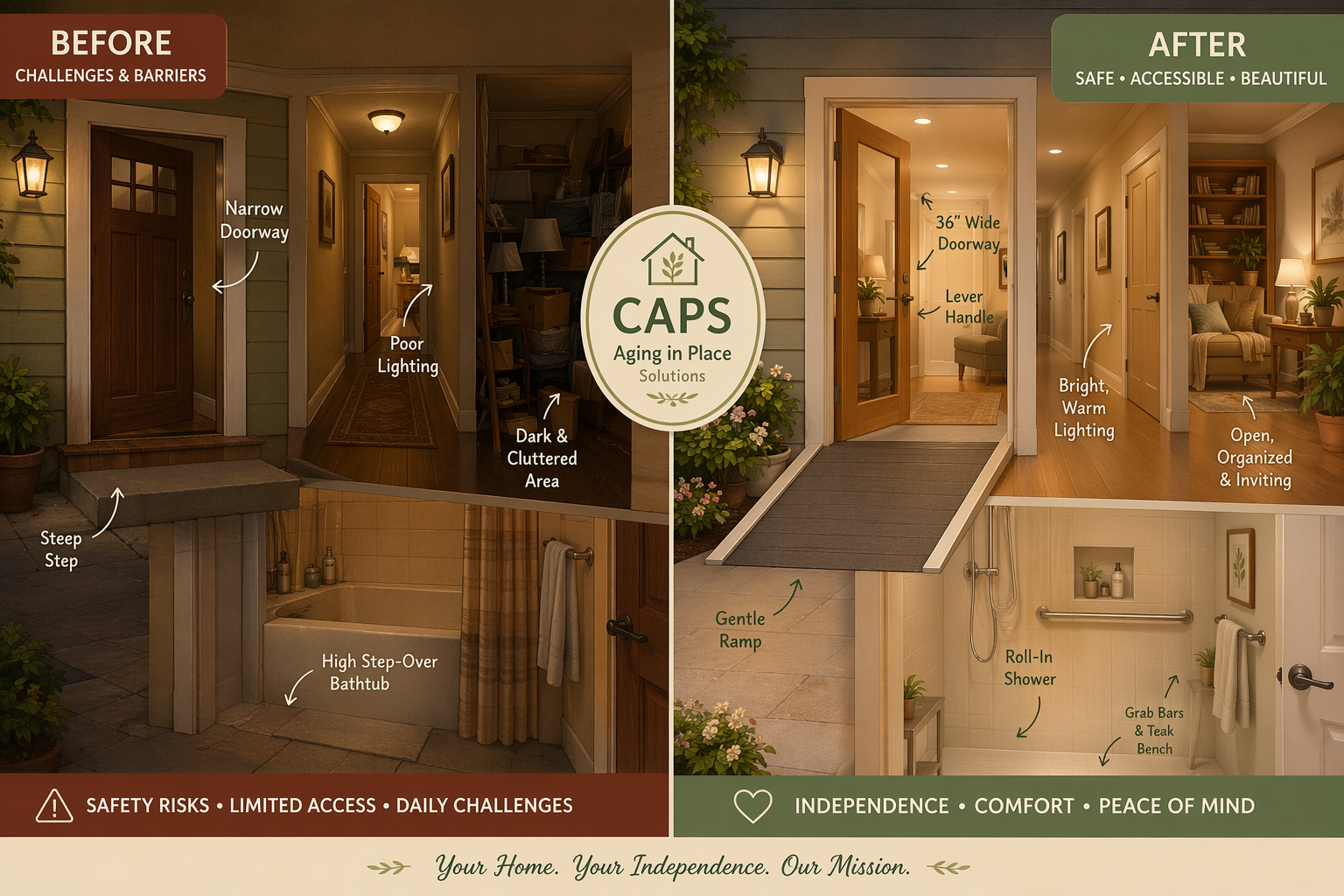
Introduction: You’ve Hired a CAPS — Here’s What Comes Next
Making the decision to bring in a Certified Aging-in-Place Specialist is a significant step. You've recognized that your parent's home needs more than a few grab bars and a new bath mat — it needs a coordinated, professional approach to safety and accessibility. But once you've made that call, the question becomes: what actually happens now?
The CAPS process follows a clear, four-phase lifecycle that is fundamentally different from hiring a general contractor. A general contractor builds what you tell them to build. A CAPS assesses how your parent moves through their home today, anticipates how their needs will change over the next decade, and designs modifications that work for both the present and the future. Knowing what to expect at each stage — from the initial walkthrough to the final safety inspection — helps you prepare, reduces anxiety, and ensures you get the full value of the specialist's expertise.
This guide walks you through the four phases chronologically: the home assessment, the design and quote phase, the renovation itself, and the post-project walkthrough. We've also included a preparation checklist and a comparison table so you can see exactly how this process differs from a standard contractor engagement.
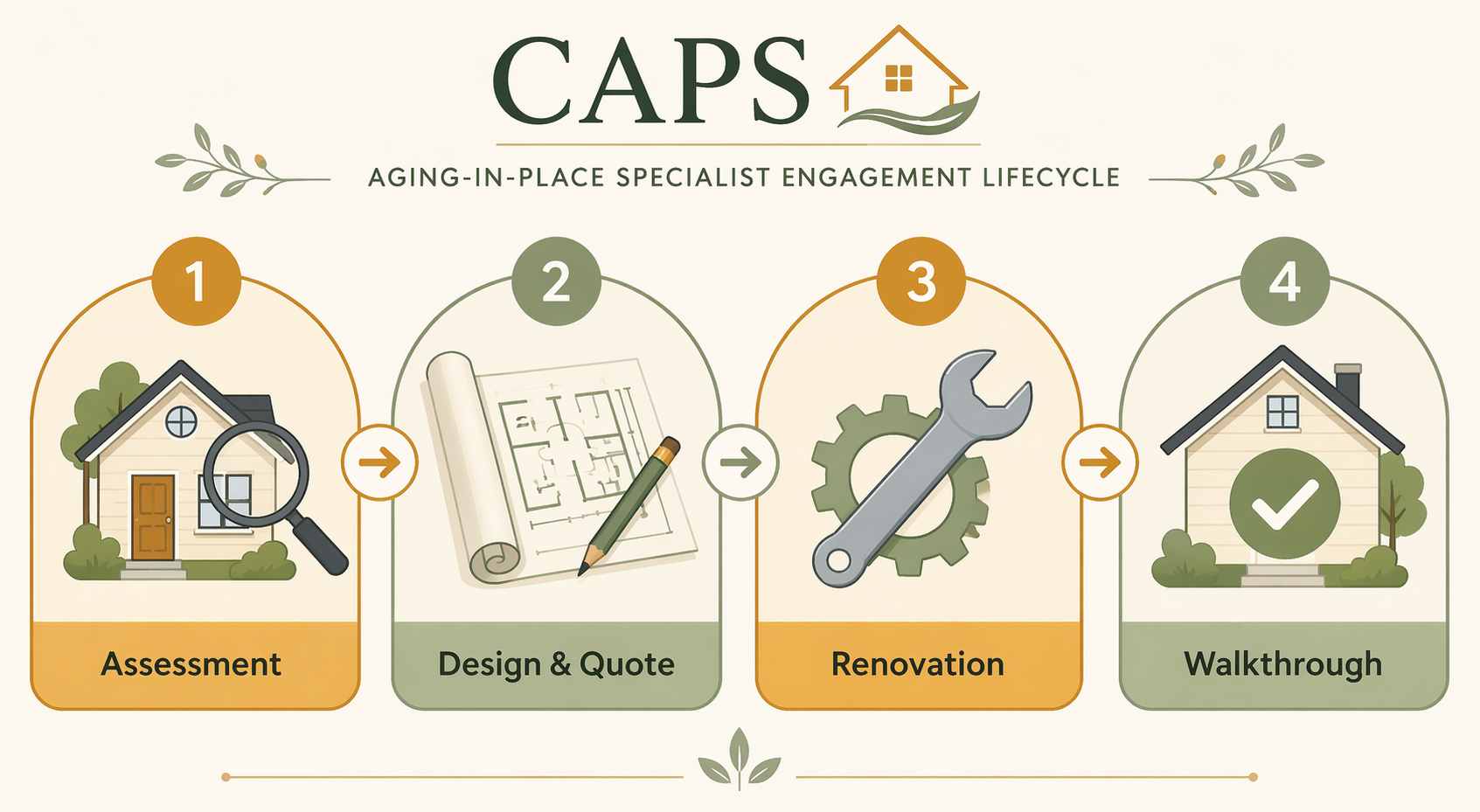
Phase 1: The Home Assessment (1–3 Hours)
The first and most critical phase is the in-home assessment. This is not a quick walkthrough. A thorough CAPS assessment typically takes one to three hours, depending on the size of the home and the complexity of your parent's needs. During this time, the specialist will move room by room, observing how your parent navigates their daily environment.
What the CAPS Looks For
A CAPS assessment goes far beyond the obvious hazards that most family members notice. According to Home Healthsmith, a provider of comprehensive home safety audits, a CAPS identifies risks that family members commonly overlook — subtle issues like the angle of a hallway turn, the height of a light switch, or the way a door swing interferes with a walker's path.
The specialist will observe your parent performing everyday tasks: getting in and out of bed, walking to the bathroom, opening cabinets, using the shower, and navigating stairs. They are not just looking at the house — they are watching how the person interacts with the house. This distinction is what separates a CAPS assessment from a general contractor's estimate.
- Current mobility and balance: How does your parent move between rooms? Do they use a cane, walker, or wheelchair? Are there areas where they steady themselves on furniture or walls?
- Daily routine observation: The CAPS may ask to see a typical morning or evening routine — from waking up to bathing to preparing meals — to identify pain points your parent may have stopped mentioning.
- Future needs projection: Valerie Jurik-Henry, a CAPS with over 30 years of experience in healthcare and housing, recommends planning for health needs 10 years into the future. The assessment will consider how your parent's condition is likely to progress and what modifications will be needed down the road.
- Structural evaluation: The specialist examines door widths, hallway dimensions, bathroom layouts, stair configurations, and entryway thresholds to determine what changes are structurally possible.
What to Prepare Before the Assessment
A little preparation goes a long way toward making the assessment productive. The CAPS will ask questions, but the more information you bring, the more tailored the recommendations will be. Here is what to gather before the specialist arrives.
- A list of specific concerns: Write down every incident, near-miss, or difficulty you have observed. Did your parent trip on the threshold to the back door last week? Do they avoid using the upstairs bathroom? Specific examples help the CAPS prioritize.
- Medical conditions and anticipated progression: Share your parent's diagnosis and any known trajectory. For example, if they have Parkinson's disease, the CAPS will plan for worsening mobility and balance over time. If they have early-stage dementia, the specialist will consider cognitive safety features.
- Budget parameters: Be honest about what you can spend. The CAPS can design a phased approach — tackling the most critical modifications now and planning for future stages. Valerie Jurik-Henry recommends a phased approach, remodeling in sections over time to spread costs.
- Doctor or therapist recommendations: If your parent's physician, occupational therapist, or physical therapist has made specific recommendations (e.g., a roll-in shower, a stairlift), bring those notes. The CAPS will incorporate them into the design.
- A completed room-by-room fall prevention checklist: Before the CAPS visit, walk through the home with our Room-by-Room Fall Prevention Checklist. This will help you identify hazards yourself and give the CAPS a head start on the assessment.
Phase 2: Design and Quote — The Detailed Report
After the assessment, the CAPS produces a comprehensive report. This is not a simple list of recommendations. A thorough report includes photographs, diagrams, specific product specifications, and detailed cost estimates for each modification. According to Care.com, a personalized home evaluation with a full report on necessary modifications, including visuals, typically costs around $500 from a CAPS professional.
Key Design Specifications You Will See in the Report
A CAPS designs to specific accessibility standards that most general contractors do not know. These specifications are based on universal design principles and ADA guidelines, adapted for residential settings. Here are the most common ones you will encounter.
| Design Specification | Why It Matters | Typical Requirement |
|---|---|---|
| Turning radius | Allows a wheelchair or walker user to turn around without backing up | 5 feet by 5 feet of clear floor space |
| Doorway width | Ensures a wheelchair or walker can pass through without scraping | 32 inches minimum; 36 inches preferred |
| Lever handles | Easier to operate than round knobs for someone with arthritis or limited hand strength | Single-lever handles on all doors and faucets |
| Bathroom clearance | Provides space for a shower chair, transfer bench, or caregiver assistance | Minimum 36 inches of clear space in front of toilet and shower |
| Shower entry | Eliminates the need to step over a tub wall, reducing fall risk | Curbless or low-threshold roll-in shower |
| Lighting | Reduces shadows and glare that can cause missteps | Motion-sensor night lights in hallways and bathrooms; soft, even lighting throughout |
| Stair tread contrast | Helps visually distinguish each step, reducing missteps | High-contrast edge markings on the first and last stair treads |
The report will also include a timeline estimate and a recommended order of work. The CAPS will explain which modifications are urgent (e.g., a grab bar in the shower where your parent has already fallen) and which can wait for a later phase. This phased approach allows you to spread costs over time, which Valerie Jurik-Henry notes is a key advantage of working with a CAPS.
The Collaborative Review Process
This phase is collaborative. The CAPS presents the report, walks you through each recommendation, and explains the rationale. You have the opportunity to ask questions, adjust priorities, and approve the plan before any work begins. If the budget is tight, the CAPS can help you decide which modifications to do now and which to defer. If your parent is resistant to certain changes, the CAPS can suggest alternatives that achieve the same safety goal with a different aesthetic.
For readers who want to understand the evidence behind the modifications a CAPS recommends, our article on Home Modifications That Actually Prevent Falls provides the research foundation for the most common interventions.
Phase 3: Renovation — How the CAPS Manages the Project
Once you approve the plan, the CAPS takes on the role of project manager. This is where the value of the certification becomes most visible. A CAPS does not just hand you a list of contractors and walk away. They hire and coordinate the full team — plumbers, electricians, engineers, and designers — and manage the timeline from start to finish.
What the CAPS Handles During Construction
- Contractor selection and vetting: The CAPS brings in tradespeople who have experience with aging-in-place work. A plumber who has installed a dozen roll-in showers knows the critical details — proper slope for drainage, correct placement of grab bar blocking, and the right shower valve height.
- Permitting and code compliance: Many modifications require building permits. The CAPS ensures all work meets local building codes, which is especially important for structural changes like widening doorways or installing stairlifts.
- Quality control: The CAPS inspects work at key milestones. For example, they verify that grab bars are installed with medical-grade stainless steel and proper anchors — not just screwed into drywall. Home Healthsmith emphasizes the importance of using wing-it toggle anchors or wood screws for secure installation.
- Minimizing disruption: A good CAPS schedules work to minimize the time your parent is without a functioning bathroom or kitchen. They may recommend completing one room at a time so the rest of the home remains livable.
Timeline Expectations
How long the renovation takes depends entirely on the scope of work. Here is a general guide based on common project types.
| Project Type | Typical Timeline | Examples |
|---|---|---|
| Simple modifications | 1 day | Grab bar installation, lever handle replacement, motion-sensor lighting, raised toilet seat |
| Moderate modifications | 2–5 days | Widening a doorway, installing a ramp, adding a stairlift, replacing a tub with a walk-in shower |
| Full room remodel | 1–4 weeks | Bathroom remodel with roll-in shower, kitchen remodel with accessible counters and pull-out shelves |
| Whole-home renovation | 4–8 weeks or more | Multiple room remodels, structural changes, full accessibility retrofit |
Phase 4: The Post-Project Walkthrough
The final phase is one of the most valuable — and most overlooked by general contractors. After all work is complete, the CAPS returns to the home to conduct a formal walkthrough. This is not a quick glance to make sure the paint is dry. It is a structured safety inspection and satisfaction check.
What Happens During the Walkthrough
- Safety inspection: The CAPS verifies that every modification meets the specifications in the design report. They check that grab bars are securely anchored, that ramps have the correct slope, that doorways are the agreed-upon width, and that all electrical work is up to code.
- Client satisfaction check: The CAPS asks your parent to use the new modifications — open the lever-handle door, sit on the raised toilet, test the shower bench — to ensure everything feels right. If something is uncomfortable or difficult, adjustments are made on the spot.
- Equipment training: If the project includes new equipment — a stairlift, a walk-in tub, a smart-home system — the CAPS provides hands-on training so your parent knows how to use it safely and confidently.
- Documentation: The CAPS provides a final report summarizing all completed work, including warranty information for installed products and contact information for follow-up.
Some CAPS professionals offer ongoing check-in programs. Home Healthsmith, for example, offers a membership program called SafeHome Advantage that includes trimester audits every four months. These follow-up visits ensure that modifications continue to meet your parent's needs as their condition evolves.
How the CAPS Process Differs from Hiring a General Contractor
If you have ever hired a general contractor for a home renovation, you might wonder how this experience is different. The answer is: significantly. The table below summarizes the key differences.
| Dimension | General Contractor | CAPS-Certified Specialist |
|---|---|---|
| Clinical understanding of aging | Limited; focuses on construction and design | Trained to understand how mobility, balance, vision, and cognition affect daily function |
| Future-proofing recommendations | Rarely considers how needs will change over time | Explicitly plans for health needs 5–10 years ahead |
| Design specifications | Uses standard residential dimensions | Designs to accessibility standards: 5x5 ft turning radius, 32-inch+ doorways, lever handles, curbless showers |
| Team coordination | May subcontract but does not specialize in aging-in-place trades | Hires and manages plumbers, electricians, and engineers experienced with accessibility modifications |
| Post-project follow-up | Typically ends at final payment | Includes a structured safety inspection, client satisfaction check, and equipment training |
| Phased planning | May offer phased work but does not prioritize clinical urgency | Recommends a phased approach based on fall risk and functional decline trajectory |
Final Checklist: Your CAPS Engagement at a Glance
Use this checklist as a quick-reference tool throughout the process. Print it, save it, or keep it open on your phone. Each phase has its own preparation steps and key questions to ask.
Before the Assessment
- Write down specific incidents and concerns
- Gather medical history and anticipated progression
- Determine your budget range
- Collect any doctor or therapist recommendations
- Complete the room-by-room fall prevention checklist
- Ask the CAPS: How many assessments have you done for someone with my parent's condition?
During the Design and Quote Phase
- Review the full report with visuals and cost estimates
- Ask about the rationale behind each recommendation
- Discuss the phased approach: what is urgent, what can wait
- Verify that design specifications meet accessibility standards (5x5 ft turning radius, 32-inch+ doorways, etc.)
- Ask the CAPS: Can you show me examples of similar projects you have completed?
During Renovation
- Confirm the timeline and key milestones with the CAPS
- Ensure the CAPS inspects work at each milestone
- Plan for disruption: arrange alternative bathroom or kitchen access if needed
- Ask the CAPS: Who is my point of contact if I have a question during construction?
After the Walkthrough
- Participate in the safety inspection with the CAPS
- Have your parent test every new modification
- Receive training on any new equipment
- Collect warranty information and final documentation
- Ask the CAPS: Do you offer ongoing check-in or follow-up programs?
Related reading
Need a professional assessment?
Find a CAPS-credentialed professional or local aging services through our outbound resource list — we never name or rank individual contractors.
Find Local HelpNoticed something outdated or inaccurate on this page? Flag a correction. We review every report against CDC, NIA, and AARP HomeFit guidance before updating a page.