Room-by-Room Flood Safety Checklist for Elderly
A practical, room-by-room flood safety checklist designed for older adults with mobility limitations, sensory impairments, and chronic conditions. Covers emergency kit placement, modifications for each room, evacuation vs. shelter decisions, and a maintenance calendar for caregivers.
A flood safety checklist for elderly family members has to start where the warning usually becomes real: in the doorway at night, with the power flickering, a walker in the wrong corner, and someone trying to decide whether there is still time to leave. A kit by the front door helps only if the person can reach it, lift it, hear the alert that says to use it, and get through the house without falling.
Older adults are not just another group on a general preparedness list. After Hurricane Katrina, people age 75 and older were 6% of New Orleans’ population but 50% of the fatalities.[1] In a study of tropical cyclone flooding using 35.6 million death records through 2018, adults 65 and older had a 24.9% higher injury death rate during very severe flooding, compared with 10.2% for people under 65.[2] Those numbers are not a reason to panic. They are a reason to stop pretending that a standard three-day kit and a cheerful reminder to “leave early” cover the problem.
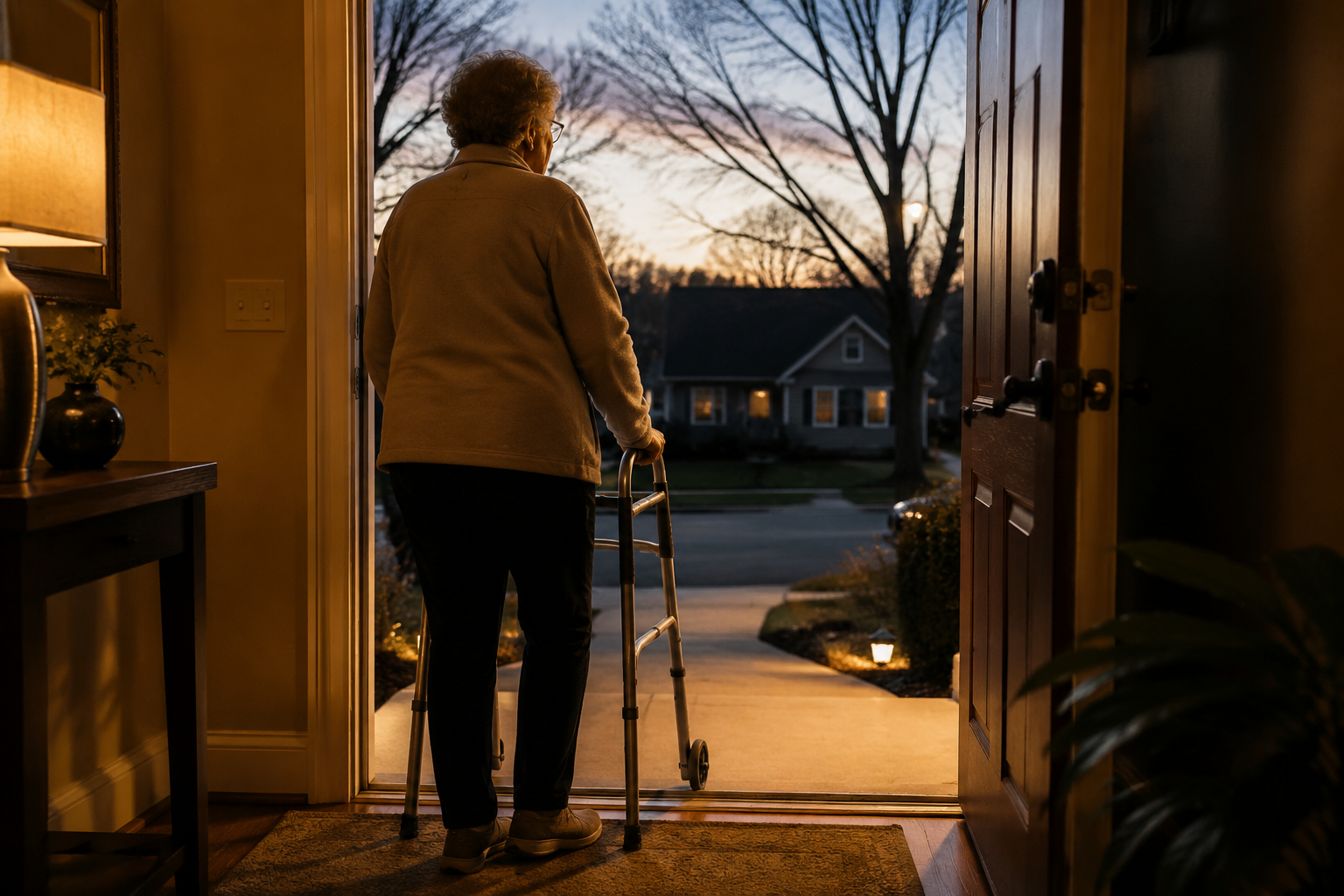
The safer question is room by room: what can stop this person from getting out, staying dry, keeping medicine usable, hearing instructions, or being found by the people assigned to help? Walk the house with the actual body in mind: the weak knee, the oxygen tubing, the hearing aids, the low vision, the bathroom schedule, the person who forgets under stress, the spouse who cannot lift, and the adult child who may be calling from another town.
Start With The Person, Not The Supplies
Before buying another bin, write down the few facts that decide everything else. Keep this page on the refrigerator, in the bedroom kit, and with the person who is most likely to answer the phone.
- Mobility: cane, walker, wheelchair, stair lift, transfer board, lift chair, or two-person assist.
- Senses: hearing aids, cochlear implant equipment, glasses, magnifier, large-print instructions, or bed shaker alert.
- Medical dependence: oxygen concentrator, CPAP, powered bed, suction equipment, dialysis schedule, refrigerated medication, wound supplies, insulin, or controlled substances.
- Thinking and communication: dementia, aphasia, anxiety, confusion at night, language needs, or inability to use a smartphone.
- Helpers: who lives nearby, who has a key, who can drive, who can lift, who can sit with the person, and who only calls.
This page is not paperwork for paperwork’s sake. It tells you whether the “go bag” belongs on a hook, in a walker basket, beside the bed, in a car, or duplicated in all four places. It also tells you whether evacuation means one person driving over, two people transferring someone safely, or calling a medical transport number before streets are under water.
The Room-By-Room Flood Safety Checklist
Do this walk-through in daylight first, then again after dark. Night changes everything. So does rain noise, a dead phone, a wet porch, and a caregiver trying to carry both a purse and a walker.
Entryways: The Door Has To Work For The Slowest Person
The front door is often treated as the finish line. For an older adult, it may be the first hard obstacle: a swollen door, a threshold lip, a storm door that swings the wrong way, a walker that catches on a mat, or a key hidden where no one with stiff hands can retrieve it.
- Clear the entry of loose rugs, plant stands, shoe piles, umbrella buckets, and anything that narrows the walker or wheelchair path.
- Add bright, automatic lighting near the door and test whether it still helps when the power is out; keep a flashlight at hand height, not in a low drawer.
- Place a copy of the emergency contact sheet, medication list, house key instructions, and evacuation destination in a waterproof sleeve near the exit.
- Use a small crossbody pouch, walker bag, or wheelchair pouch for essentials instead of one heavy backpack.
- Give a key or entry code to at least one nearby helper who has agreed to come during a warning, not just after the storm.
When a flood watch is issued, move the mobility device to the normal exit route and unlock any interior door that could slow a helper. When a warning is issued, the helper who has the key should confirm by voice call, not text alone, that the older adult is awake, dressed, and using the planned exit.
Bedroom: Plan For 2 A.M., Not A Calm Afternoon
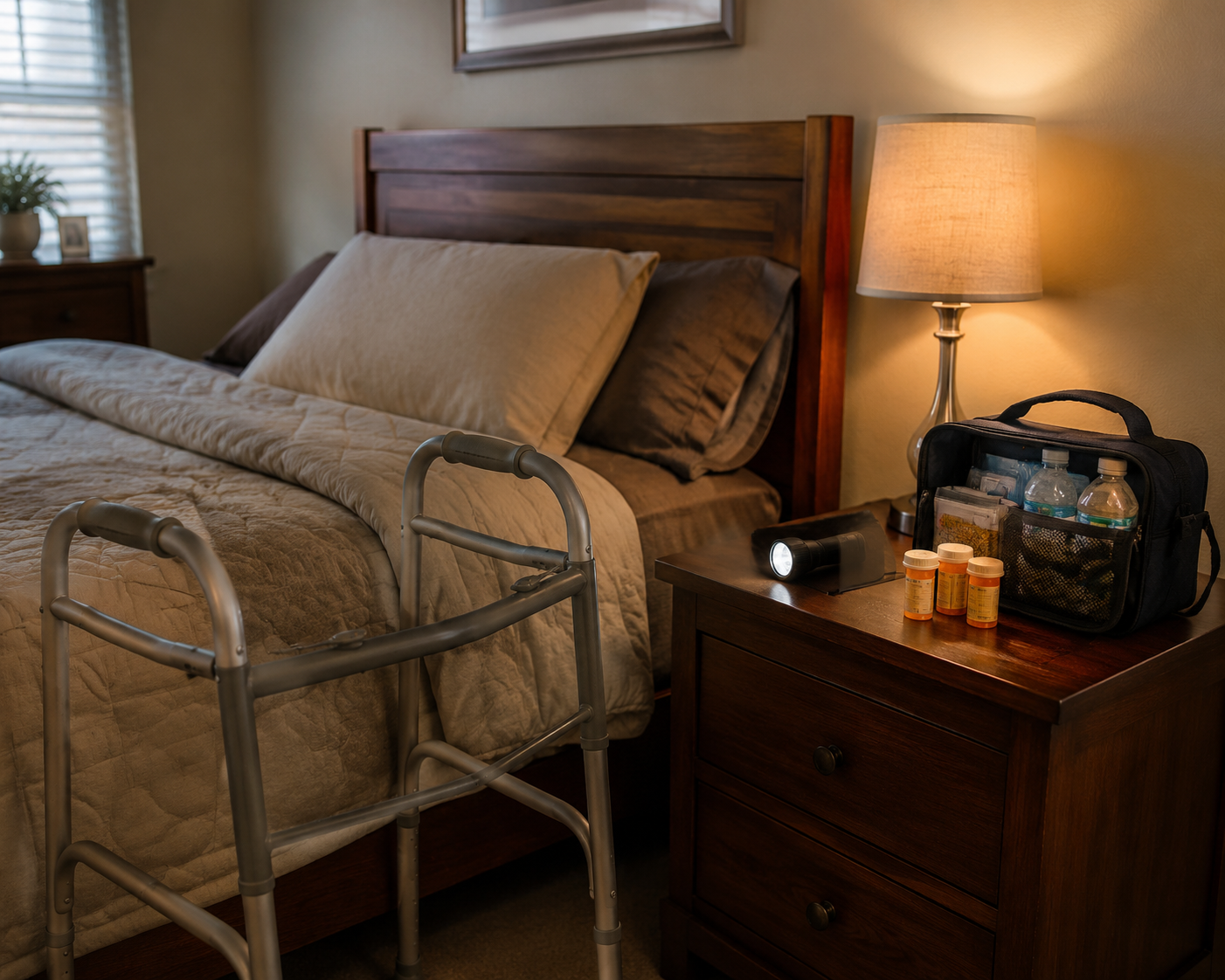
The bedroom is where flood safety either holds or fails. Many evacuations begin with a person waking from deep sleep, disoriented, without glasses or hearing aids, in a room that looks different when the power is gone. If the walker is across the room because someone vacuumed, that is not a small housekeeping detail. It is a delay.
- Park the walker, cane, wheelchair, or transfer device on the side of the bed the person actually uses, with wheels locked where appropriate.
- Keep glasses, hearing aids, spare hearing aid batteries, dentures, phone, charger, flashlight, and shoes in the same reachable place every night.
- Use shoes with backs and non-slip soles; do not rely on slippers for wet floors or outdoor evacuation.
- Place a lightweight bedroom emergency pouch on the nightstand or attached to the walker, with a medication list, emergency contacts, a small flashlight, whistle, spare glasses if available, and copies of critical documents.
- Use alerts the person can perceive: loud tone, vibration, flashing light, bed shaker, or a helper phone call, depending on hearing and cognition.
If the person uses electrically powered medical equipment at night, this room needs more than a flashlight. Only 25% of older adults who rely on electrically powered medical equipment have a backup power source, according to emergency preparedness materials cited by AARP and the Red Cross.[1] That gap matters for oxygen concentrators, CPAP machines, powered beds, lift chairs, and refrigerated medication stored nearby.
Write the backup-power plan in plain language: what runs on battery, how long the battery is expected to last, who charges it, where the cords are, and who is called if power fails before evacuation. Do not leave that knowledge in one caregiver’s head.
Bathroom: Treat Wet Tile As A Flood Hazard
Bathrooms are small, hard, slippery rooms. During normal weeks, that already makes them fall-risk rooms. During a flood warning, they become places where urgency and water meet: someone rushes to toilet before leaving, steps over a rug, reaches for a towel bar that cannot hold weight, or tries to bathe because they are afraid of being away from home.
- Remove loose bath mats or replace them with non-slip options that do not bunch under a walker.
- Install grab bars where the person actually reaches: by the toilet, shower, and tub edge. A towel bar is not a grab bar.
- Keep a nightlight or battery light between the bedroom and bathroom, especially if the person toilets at night.
- Place incontinence supplies, wipes, gloves, plastic bags, and a change of clothing in a waterproof container that can be reached without bending to the floor.
- If the person cannot safely hurry, add a bedside commode to the flood plan rather than forcing repeated bathroom trips during a warning.
After flood exposure, health problems do not stop when the water recedes. A Columbia and Harvard Medicare study of 4.5 million hospitalizations from 2000 to 2016 found that within four weeks of flood exposure, hospitalizations among adults 65 and older increased 3.1% for skin diseases, 2.5% for nervous system conditions, and 1.1% for injuries; the researchers linked many of these problems to disrupted care and contaminated water contact.[3] That makes bathroom supplies part of medical protection, not comfort packing.
When a warning is issued, stop nonessential bathing, move towels and dry clothing above likely water level, and keep the bathroom path dry. If water is already entering the home, no one should go into a lower-level bathroom to retrieve toiletries.
Kitchen: Protect Medication, Water, And Instructions
The kitchen usually holds the calendar, pill organizer, refrigerator, phone charger, and family notes. That makes it useful, but also dangerous if the plan depends on someone bending into a low cabinet during a warning.
- Keep shelf-stable food and drinking water where the older adult or helper can reach them without a step stool.
- Tape or magnet a large-print contact sheet to the refrigerator and put a duplicate in a waterproof sleeve.
- Store a manual can opener, disposable utensils, gloves, hand sanitizer, and trash bags together.
- If medication is refrigerated, label the container clearly and write who moves it to a cooler, which cooler to use, and where the ice packs are.
- Keep appliance cords and power strips off the floor where minor water intrusion can reach them.
The Red Cross recommends that older adults keep a 30-day supply of medications in emergency kits.[4] That is sound advice and also harder than it sounds. Insurance refill timing, controlled-substance rules, mail-order delays, and prescriber policies can all limit what a family can actually store. The practical step is to ask the prescriber and pharmacist before flood season what emergency refill options exist, how refrigerated medication should travel, and what documentation is needed if the person evacuates.
Stairs And Hallways: The Route Must Stay Open In The Dark
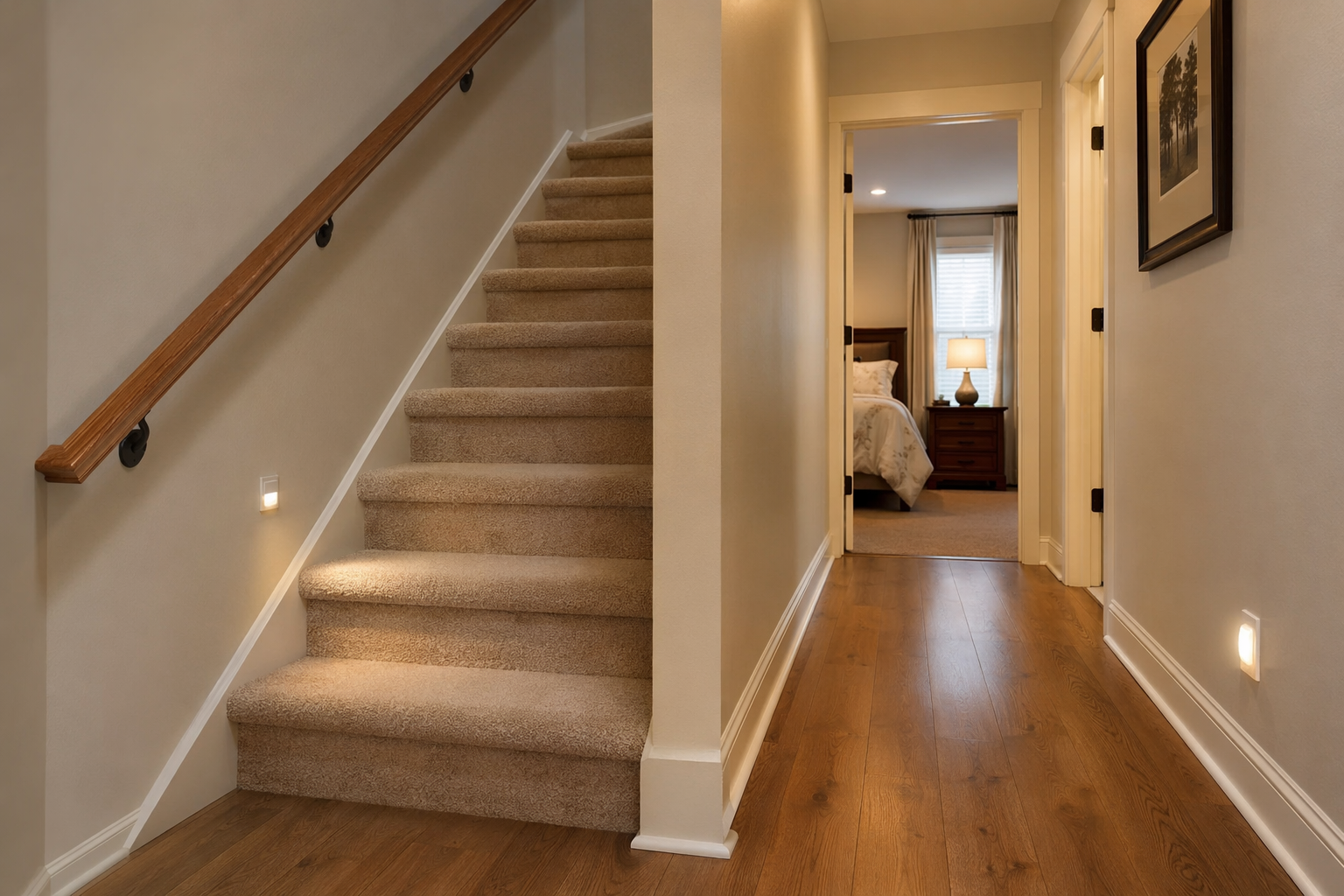
Hallways collect laundry baskets, pet bowls, oxygen tubing, shoes, side tables, and good intentions. Stairs add the hard truth that some people who can manage them on a normal day cannot manage them while frightened, rushed, or carrying anything.
- Measure the route with the actual walker or wheelchair. If it catches at a corner, the plan is not ready.
- Remove low furniture, cords, rugs, baskets, and decorations from the bedroom-to-exit route.
- Install nightlights or battery lights at floor changes, turns, stairs, and the bathroom path.
- Put sturdy handrails on both sides of stairs if stairs must be used, and mark stair edges with high-contrast tape for low vision.
- Keep a small seated-rest option near a long hallway only if it does not narrow the evacuation route.
If the older adult lives above ground level and cannot descend stairs without help, the support network needs a time trigger. “Come if it gets bad” is too vague. Use a rule such as: when a flood watch is issued, one helper confirms readiness; when a warning is issued, the helper arrives or transportation is activated; if the road to the house commonly floods early, the arrival trigger moves earlier.
Basement Or Lower Level: Do Not Make It A Rescue Mission
Basements are where families store the things they suddenly remember during an emergency: photo boxes, medical equipment, paper files, extra walkers, and holiday bins full of extension cords. During a flood warning, a basement is not an errand.
- Move critical medical supplies, backup equipment, chargers, and documents out of the basement before flood season.
- Label shutoff locations for utilities, but do not assign an older adult with limited mobility to reach them during rising water.
- Keep mobility backups, such as a spare cane or walker, on the living level rather than below grade.
- If the laundry is downstairs, keep enough clean clothing, briefs, bedding pads, and towels upstairs for several days.
When a warning is issued, close the basement door and leave it closed. No medication, charger, or document should be important enough to send a slow-moving person or a single exhausted caregiver downstairs as water approaches.
Outdoor Routes: The Porch, Ramp, Driveway, And Curb Count
Many home plans stop at the door. Flood movement does not. The outdoor route may include a slick ramp, a porch step without a rail, a gravel driveway, a curb cut that ponds early, a locked gate, or a sidewalk that disappears under water before the street looks dangerous from the window.
- Walk the route from bed to vehicle with the mobility device, including the porch, ramp, driveway, gate, sidewalk, and curb.
- Add railings, non-slip ramp surface, exterior lighting, and clear house numbers visible from the street.
- Keep the vehicle facing out if possible during flood season, with enough fuel or charge to leave without stopping immediately.
- Choose a pickup spot that does not require the older adult to stand in rain while a caregiver loads supplies.
- Identify a backup route if the usual road, bridge, underpass, or low intersection floods first.
Practice the outdoor route once in dry weather and once in dim light. The point is not speed. The point is to discover that the walker wheels sink into the grass, the ramp is slick, the porch light is burned out, or the helper cannot manage the oxygen tank and the door at the same time.
Where Emergency Supplies Actually Belong
A single heavy emergency kit is usually designed for a strong person with two free hands. Many older adults need distributed supplies: small, duplicated, reachable, and attached to the equipment they already use.
| Supply | Best placement | Why it matters |
|---|---|---|
| Medication list and diagnoses | Bedroom pouch, kitchen sleeve, caregiver phone | A helper or clinician can act even if the main caregiver is absent. |
| Daily medications | Original storage plus emergency supply when allowed | Evacuation and pharmacy closures can interrupt daily management. |
| Hearing aid batteries and glasses | Nightstand and go pouch | Warnings and instructions are useless if the person cannot hear or see them. |
| Flashlights or battery lights | Bedroom, bathroom path, entryway | Darkness turns familiar rooms into fall hazards. |
| Incontinence and hygiene supplies | Bathroom and evacuation bag | Dignity and skin protection matter during delays. |
| Chargers and backup power instructions | Bedroom or medical equipment area | Powered medical devices need a written plan, not a guess. |
| Waterproof document copies | Entryway and caregiver copy | Identification, insurance, medication, and contact information may be needed away from home. |
| Small cash and keys | Entry pouch and trusted helper | Power outages and locked doors can slow evacuation. |
For a walker user, a bag attached to the walker may beat a backpack. For a wheelchair user, supplies should not interfere with brakes, transfers, or balance. For someone with memory loss, fewer visible choices are better: one labeled pouch, one printed instruction sheet, one helper to call first.
Evacuate Or Shelter: Make The Decision Before The Siren
Evacuation is not automatically safer for every older adult in every circumstance. Staying is not automatically safer either. The decision depends on flood exposure, warning time, mobility, medical dependence, road conditions, available helpers, and the stress of transfer.
AARP’s disaster materials report that 61 of 87 Hurricane Ian fatalities were people age 60 and older, while also noting evidence that nursing home evacuations during Hurricane Irma were associated with higher death rates than sheltering in place.[1] That tension is exactly why families need triggers, not arguments, when the weather turns.
| Condition | Evacuation becomes more important when... | Sheltering may be considered only when... |
|---|---|---|
| Flood exposure | The home is in a flood-prone area, water has reached roads before, or officials order evacuation. | The home is outside the expected flood area and local officials have not advised evacuation. |
| Mobility | The person needs help with stairs, transfers, toileting, or outdoor walking and help is available before roads worsen. | Moving the person would create serious immediate risk and qualified support is present in the home. |
| Medical equipment | Oxygen, CPAP, lift equipment, powered bed, dialysis needs, or refrigerated medication cannot be supported during outage. | Backup power, medication storage, and caregiver coverage are confirmed for the expected outage. |
| Cognition | The person becomes confused, wanders, resists instructions, or cannot respond reliably to alerts. | A familiar caregiver can remain, the home is safe from expected water, and instructions are simple. |
| Transportation | A helper, accessible vehicle, medical transport, or community evacuation option is available early. | Roads are already unsafe and officials advise staying put unless rescue is needed. |
| Money and destination | A confirmed place exists with needed accessibility, medication storage, pets if relevant, and caregiver space. | No safe destination exists yet, but the home remains safe and the support network is actively solving transportation and lodging. |
Money belongs in this decision because families make real choices with real limits. AARP reports that 24% of older adults surveyed said it would be difficult to afford staying somewhere else for a week.[1] If that is true in your family, name it before the storm. Ask local emergency management, the Area Agency on Aging, faith communities, relatives, or neighbors what accessible shelter or temporary lodging options exist. Waiting until the driveway is wet is when shame and logistics start working together.
The most useful flood plan has three triggers written out: watch, warning, and leave-now. A watch means prepare the person and house. A warning means activate helpers and transportation. A leave-now trigger means the debate is over unless officials say the route is unsafe.
- Flood watch: charge devices and backup batteries, move supplies to reachable locations, confirm medications, fuel or charge the vehicle, and call the first helper.
- Flood warning: dress the older adult in shoes and weather-appropriate clothing, move mobility equipment to the exit, load medication and documents, and begin the agreed evacuation or shelter plan.
- Leave-now trigger: follow official evacuation orders, rising-water thresholds already written into the plan, or caregiver judgment that waiting will make transfer unsafe.
- Shelter trigger: only use this when the home is outside expected flood danger, power and medical needs are covered, a caregiver or helper can stay in contact, and officials have not ordered evacuation.
Assign The Support Network By Job, Not Good Intentions
A list of names is not a support network. A support network has jobs. One person calls. One person drives. One person brings the wheelchair van or accessible vehicle. One person checks medication. One person takes the pet. One person can stay overnight. One person has the house key. If everyone thinks someone else is doing it, no one is.
| Role | Assigned person | What they must know |
|---|---|---|
| First call | Name and phone | How to reach the older adult if they do not answer the first call. |
| In-home helper | Name and phone | Where the key is, how to transfer safely, and which route to use. |
| Driver or transport coordinator | Name and phone | Vehicle needs, pickup spot, destination, and backup route. |
| Medication lead | Name and phone | Medication list, refrigerated medication plan, pharmacy, and prescriber contact. |
| Medical equipment lead | Name and phone | Backup power, oxygen supplier, CPAP or device instructions, and equipment limits. |
| Out-of-area contact | Name and phone | Who has evacuated, where they went, and who still needs help. |
Put this role sheet where helpers will see it and send a photo to everyone on it. If a helper cannot physically lift, drive at night, or leave work quickly, that is not a character flaw. It just means they should not be assigned a job that depends on those abilities.
A Maintenance Calendar Caregivers Can Actually Keep
Preparedness fails quietly. Batteries die, walkers move, pills change, keys disappear, ramps grow slick, and the person who promised to drive moves across town. A short calendar is better than a beautiful binder no one opens.
| When | What to check |
|---|---|
| Monthly during flood season | Test flashlights and battery lights; confirm walker or wheelchair path is clear; check phone numbers; charge backup batteries; review weather alert settings. |
| Every medication change | Update the medication list, prescriber contacts, pharmacy information, allergies, and refrigerated medication instructions. |
| Every three months | Check emergency food, water, hygiene supplies, hearing aid batteries, spare glasses, gloves, incontinence supplies, and document copies. |
| Before peak local flood season | Practice the bed-to-door route, outdoor pickup route, and support-network call sequence; confirm transportation and destination. |
| After any power outage | Review what failed: backup power, charging habits, lighting, medical equipment, communication, refrigeration, and caregiver response time. |
| After any fall, hospitalization, or mobility change | Redo the room-by-room walk-through using the person’s current strength, device, vision, hearing, and transfer ability. |
Do not wait for a full free Saturday. Check the bedroom one evening. Do the bathroom after laundry. Walk the outdoor route when taking out trash. A flood plan becomes dependable because it is touched often enough to stay true.
The Finished Plan Should Be Usable By Someone Else
A good flood safety checklist for an older adult is not the one with the most items. It is the one a tired spouse, neighbor, aide, firefighter, or adult child can use without guessing. They can see where the walker belongs. They know which pouch holds the hearing aid batteries. They know who handles medication, who drives, where the backup power is, and when the family stops debating evacuation.
That is the point of walking the house room by room. Flood safety for an older adult is not one kit by the door. It is a home plan rebuilt around the person’s actual body, senses, routines, medical needs, and helpers.
References
- Disaster Resilience Tool Kit, AARP, 2022
- Mortality caused by tropical cyclone exposure in the United States, Nature Medicine
- Large study uncovers specific impacts of flooding on older adult health, Columbia University Mailman School of Public Health
- Older Adults, American Red Cross
Related decisions
Suggest a correction
We keep this content strictly product-neutral and reviewed against CDC STEADI, NIA, and AARP HomeFit guidance. If something here looks outdated, unclear, or inaccurate, tell us — this page does not carry open public comments, because it touches medical urgency, cost, or capacity-adjacent decisions where a discussion thread is a trust liability rather than a trust asset.
See the correction process on our editorial standards page →