
Room checklist
Room-by-Room Home Modification Priority Guide: Where to Invest First for Maximum Safety Impact
This guide helps family caregivers and older adults prioritize aging-in-place home modifications by identifying the highest-risk areas — bathrooms, entryways, and stairs — and outlining a staged approach that starts with low-cost, high-impact changes (often under $500) before moving to larger renovations.
After a parent falls, the house can suddenly look guilty. The bathroom rug looks loose. The front step looks taller than it did last week. The stairs, the hallway, the kitchen cabinets, the bed height — everything seems urgent at once. That is the moment when aging in place home modifications need a triage rule, not a shopping list.
Start where a small failure has the worst consequence: wet places, dark places, raised or lowered transitions, and places where someone has to shift weight with one hand unavailable. In most homes, that puts the bathroom first, then entries and stairs. Kitchens and bedrooms matter, but they usually come after the rooms and thresholds most likely to turn one awkward movement into an injury.
More than one in four adults age 65 and older falls each year, and over half of falls happen at home, so the first question is not “What would make this house ideal?” It is “Where is the next fall most likely to start?”[1][2]
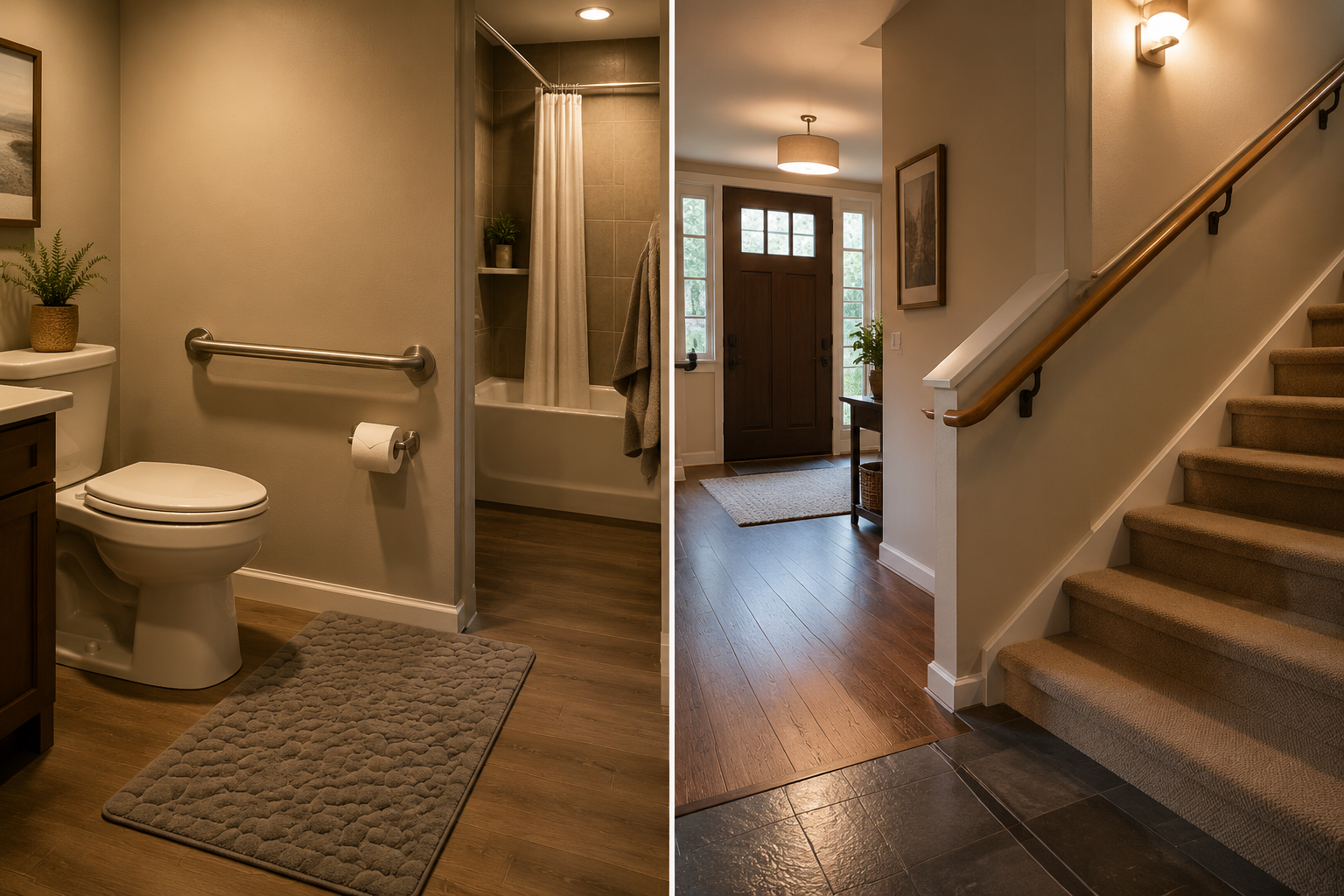
The first pass: separate urgent hazards from later improvements
A useful first walk-through is not a design consultation. It is closer to watching the house interrupt a person’s body. Where does your parent pause? Where do they reach for furniture? Where do they turn sideways? Where do they carry something while stepping up, bending down, or opening a door?
Give the highest priority to any spot that combines two or more of these conditions:
- Water or slippery flooring, especially around showers, tubs, toilets, laundry areas, and exterior doors.
- A change in height, including steps, curbs, thresholds, sunken rooms, and low toilet seats.
- Poor lighting, glare, shadows, or switches that cannot be reached before entering the space.
- A transfer point where someone sits, stands, turns, or changes direction.
- A reach hazard, such as everyday dishes stored overhead or toiletries kept below knee level.
- A place where the person is usually alone, undressed, tired, rushed, or carrying something.
That last line is why the bathroom deserves more attention than almost any other room. It is not simply a “high-risk room” in the abstract. It is where a person is often barefoot, wet, unclothed, and trying to sit, stand, turn, wash, or step over a tub edge without much margin for error. Occupational therapist Cheryl Hall’s plain explanation, quoted by Wirecutter, is hard to improve on: “You’re naked and wet.”[3]
Bathroom first, because balance is already being tested
The bathroom is where many families should spend their first serious hour and their first modest dollars. Not the guest bathroom that photographs better. The bathroom the older adult actually uses at night, when they are half-awake and trying not to turn on too many lights.
Start beside the toilet. Nearly 28% of bathroom injuries among people 65 and older are toilet-related, according to CDC bathroom injury data discussed in aging-in-place guidance.[3] That makes the toilet area one of the least glamorous and most important places in the house. A low seat, slick tile, a towel bar used as a handhold, and no nearby support can turn a routine sit-to-stand movement into the fall that changes everything.
The first bathroom upgrades are usually simple in concept: real grab bars mounted into proper support, brighter and more even lighting, a non-slip bath mat that does not curl, a clear path to the toilet, and a safer way to bathe. A study discussed by Wirecutter found that people using grab bars were 76% more likely to recover their balance, though that finding reaches most readers through a secondary source chain rather than a direct review of the original study.[3]
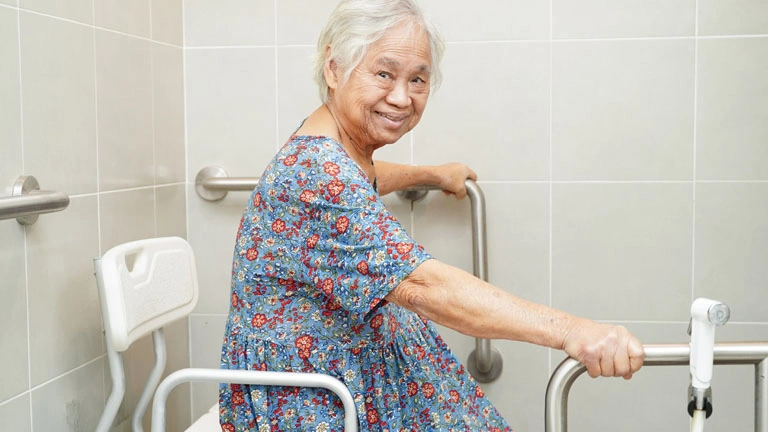
The distinction between a towel bar and a grab bar matters. A towel bar is placed for a towel and usually installed for light pulling. A grab bar is placed where a body needs leverage and installed to hold meaningful force. If the person is already reaching for the towel bar, that is not reassurance that they have support. It is evidence that the support is missing.
In a month-one bathroom pass, look for the specific movements that repeat every day:
- Standing from the toilet: add a correctly placed grab bar or other stable support; consider toilet seat height if standing is difficult.
- Entering the shower or tub: remove loose rugs, add non-slip surfaces, and decide whether a shower chair would reduce fatigue or rushing.
- Reaching for soap, towels, or toilet paper: move supplies between waist and chest height so no one has to bend deeply or twist.
- Using the bathroom at night: improve the path lighting from bed to bathroom and inside the bathroom itself.
- Closing doors or maneuvering walkers: clear the swing path and remove objects that force sideways stepping.
A full shower remodel may eventually make sense, especially if the tub edge is becoming the barrier between the person and safe bathing. But it does not have to be the first decision. Many families can reduce immediate danger with well-placed grab bars, lighting, mats, storage changes, and bathing supports while they take time to evaluate whether a larger renovation is truly needed.
Entryways are fall hazards disguised as arrivals
The front door, garage door, porch, and back entrance deserve early attention because they combine several problems at once: weather, thresholds, packages, keys, poor lighting, and often one or two steps that nobody considered dangerous when everyone was younger.
Watch the entry routine rather than the doorway itself. Does your parent carry groceries while stepping up? Do they unlock the door in the dark? Is there a lip at the threshold that catches a toe or walker wheel? Is the welcome mat thick enough to shift? Does the storm door pull against them while they are trying to balance?
The first fixes are usually lighting, surface, and support. Add brighter exterior lighting. Remove or replace loose mats. Clear planters, hoses, and seasonal decorations from the walking path. Put a stable chair or bench near the entry if the person needs to set down bags before managing the door. If there is a single step that has become a regular problem, a ramp or no-step access may move from “nice someday” to “serious year-one planning.”
Ramps are often discussed as if they are only for wheelchair users. In practice, the question is broader: is the current entrance forcing a person to negotiate elevation while distracted, loaded down, tired, or exposed to rain and ice? If yes, the entrance has moved up the priority list.
Stairs: start with visibility and hand support, then decide whether the stairs still belong in the daily plan
Stairs are not automatically a stair lift problem. Sometimes the immediate issue is dim lighting, a missing second handrail, loose carpet, objects left on steps, or a habit of carrying laundry baskets that block the view of the tread. Those are first-pass hazards.
A practical stair review starts at the body, not the product. Can the person go up and down without pulling heavily on one rail? Do they pause midway? Are they avoiding a bathroom or bedroom because of the stairs? Are they taking the stairs when tired, medicated, or in a hurry? Is there a main-floor bathroom and a realistic place to sleep if stairs become temporarily unsafe?
The lower-cost stair changes are clear: improve lighting at the top and bottom, make switches reachable before stepping onto the stairs, add or repair handrails, remove clutter, secure loose flooring, and increase visual contrast at edges if depth perception is a problem. These changes do not pretend stairs are harmless. They buy safety where the person can still use the stairs with reasonable control.
A stair lift or room relocation enters the conversation when the problem is no longer mainly the stair environment. If the person lacks the strength, balance, endurance, or confidence to use the stairs safely even after lighting and hand support improve, the house plan has to change. That might mean a stair lift, a first-floor bedroom setup, moving laundry access, or rethinking whether the current home can keep matching the person’s mobility.
The first $500 should reduce fear, not decorate the plan
The most useful part of a staged plan is emotional as much as financial. Families often feel trapped between doing nothing and approving a renovation they do not understand. A first-month, roughly $0–$500 safety pass gives everyone something better: reduce the most obvious hazards now, then make slower decisions about construction.
| Stage | Best use | Typical examples |
|---|---|---|
| $0–$500 in month one | Immediate fall-risk reduction in the highest-risk areas | Decluttering, lighting, non-slip mats, safer storage, basic bathroom supports, night lights |
| $1,000–$5,000 in year one | Targeted work when daily movement is still difficult after small fixes | More substantial bathroom modifications, ramp planning or installation, handrail work, fixture changes |
| $5,000–$15,000 in year two or later | Larger changes when mobility, layout, and budget justify construction | Shower remodel, stair lift, doorway widening, more involved access changes |
Forbes Health and other aging-in-place cost guides group common modifications into broad cost categories, but those ranges should be treated as planning tools rather than promises. A small bathroom change in one area can cost less than a similar-looking project in another if the wall structure, plumbing, labor market, or permitting requirements differ.[4]
A good first-month pass may feel almost too ordinary: remove the throw rug, install brighter bulbs, clear the path from bed to bathroom, move toiletries off the floor, put a lamp within reach, relocate the coffee mugs, and stop using the towel bar as a brace. That ordinariness is the point. The body falls on ordinary days.
What belongs in the no-cost or low-cost pass
- Move everyday kitchen items, medications, towels, and toiletries between waist and chest height.
- Remove loose rugs, floor clutter, extension cords, and decorative objects from walking paths.
- Add night lights from bedroom to bathroom and brighter lighting at entries and stairs.
- Replace unstable bath mats with non-slip options that lie flat and dry predictably.
- Place frequently used seating, phones, chargers, glasses, and remotes where they do not require bending or rushing.
- Identify where real grab bars are needed instead of relying on towel bars, door frames, or sink edges.
Occupational therapist Matt Haase told Wirecutter that in 90% of the homes he visits, plates and cups are stored up high. Moving them to chest-to-waist level costs nothing and removes a common reach-and-balance problem from every breakfast, every glass of water, every late-night snack.[3]
Kitchens and bedrooms matter, but usually after the first hazards
The kitchen can become safer without becoming a remodel. The highest-value change is often storage: daily plates, cups, pans, pet food, coffee supplies, and medications should not require a step stool, overhead reaching, or deep bending. If a parent has already started climbing onto a stool to reach the cereal or dragging a heavy pot from a low cabinet, that is not a quirk. It is a fall mechanism waiting for the wrong morning.
Bedroom changes tend to be most urgent when they connect to nighttime bathroom use, medication timing, or getting in and out of bed. Improve the path first. Make sure lighting can be reached before standing. Remove footboard obstacles, laundry baskets, shoes, and cords. Check whether the bed height lets the person sit with feet stable on the floor before standing.
This is also where many smart-home ideas should wait their turn. A voice assistant, sensor, or monitoring plan can be useful, especially when someone lives alone, but it should not distract from the loose rug, dark hallway, or unsupported toilet transfer in front of you. Technology that notices a fall is not the same as fixing the place where the fall begins.
DIY, handyman, or professional assessment?
Some aging in place home modifications are safe family projects. Others only look simple. The deciding factor is not pride or thrift; it is whether the change must hold body weight, alter access, affect plumbing or electrical systems, or compensate for a medical or mobility problem you do not fully understand.
| Who can usually handle it | Appropriate work | When to pause |
|---|---|---|
| Family or caregiver | Decluttering, storage changes, replacing loose mats, adding plug-in night lights, clearing pathways | If the person has fallen repeatedly or cannot describe what happened |
| Handyman or qualified installer | Installing grab bars into proper support, repairing handrails, improving basic lighting fixtures, securing thresholds | If walls, wiring, plumbing, or structural support are uncertain |
| Occupational therapist, CAPS-informed remodeler, or other professional | Matching modifications to mobility, bathing transfers, stairs, ramps, doorways, or larger remodel decisions | If the project is expensive, permanent, or tied to changing function |
Certified Aging-in-Place Specialist training, associated with the National Association of Home Builders, can be useful when a family is planning larger access or remodeling work, but the credential does not make every project necessary or guarantee a good outcome.[5] In some rural areas, a CAPS-certified professional may not be available. In others, the right starting point may be an occupational therapist who can watch transfers, gait, fatigue, and daily routines before anyone cuts into a wall.
The safest sequence is usually observation, small corrections, then professional design where the stakes justify it. If a parent cannot step over a tub wall, a shower remodel may be sensible. If they simply need a stable place to sit while bathing and a grab bar placed where the hand naturally goes, the first job is not to buy a new bathroom. It is to make the current routine less dangerous while you gather better information.
When a larger renovation is worth considering
Larger renovations belong in the plan when the home’s layout keeps forcing unsafe movements after the basic hazards are fixed. A curbless or low-threshold shower may be worth considering when bathing requires stepping over a tub edge that has become unsafe. Doorway widening may matter when a walker or wheelchair cannot pass without twisting, scraping, or abandoning the device. A ramp or no-step entry becomes more compelling when exterior steps are a repeated barrier, not a rare inconvenience.
Stair lifts sit in the same category. They can be valuable, but they are not a moral victory over aging and not a substitute for asking whether the upstairs bedroom, downstairs laundry, and daily bathroom access still make sense. A stair lift solves one path of travel. It does not solve poor lighting, unsafe bathing, loose rugs, or a kitchen that requires climbing.
This is where cost claims can become unhelpful. Broad remodeling ranges and return-on-investment language may help with planning, but they cannot tell you whether your parent needs a ramp before a shower, a first-floor sleeping setup before doorway widening, or a $50 grab bar before a $10,000 renovation. The correct order comes from the person’s movement through the actual home.
A practical room order for the next walk-through
If you are standing in the house this week, start with a short, disciplined pass. Do not try to solve the whole future. Walk the home in the order a fall is most likely to become serious.
- Bathroom used most often: toilet transfer, shower or tub entry, wet flooring, lighting, towel-bar-as-grab-bar habits, and storage.
- Bedroom-to-bathroom path: nighttime lighting, floor clutter, bed height, cords, shoes, and obstacles.
- Primary entry: steps, threshold, weather exposure, mats, door handling, lighting, package and grocery routines.
- Stairs: handrails, lighting, clutter, tread visibility, fatigue, and whether stairs still belong in daily use.
- Kitchen: everyday items stored too high or too low, step stools, heavy cookware, pet bowls, and slippery floor areas.
- Living areas and secondary rooms: throw rugs, cords, unstable furniture, crowded pathways, and chairs that are too low to rise from safely.
The order matters because it gives families permission to ignore lower-priority upgrades for now. You do not have to choose paint colors, compare every monitoring device, or redesign the whole kitchen before the toilet has a real handhold and the entry has enough light. Make the wet, dark, elevated, and transitional places safer first. Then expand the plan as mobility, budget, and the home’s limits become clearer.
References
Related reading
Need a professional assessment?
Find a CAPS-credentialed professional or local aging services through our outbound resource list — we never name or rank individual contractors.
Find Local HelpNoticed something outdated or inaccurate on this page? Flag a correction. We review every report against CDC, NIA, and AARP HomeFit guidance before updating a page.