
Room checklist
Stair Lift Cost and Funding Options for Aging in Place: A Family Caregiver's Guide
A practical guide for adult children and spousal caregivers navigating a stair lift decision — covering 2026 cost ranges by lift type, why Medicare doesn't cover them, and how to sequence through Medicaid waivers, VA grants, federal programs, tax strategies, and private options to reduce out-of-pocket costs.
When a Stair Lift Becomes the Right Solution
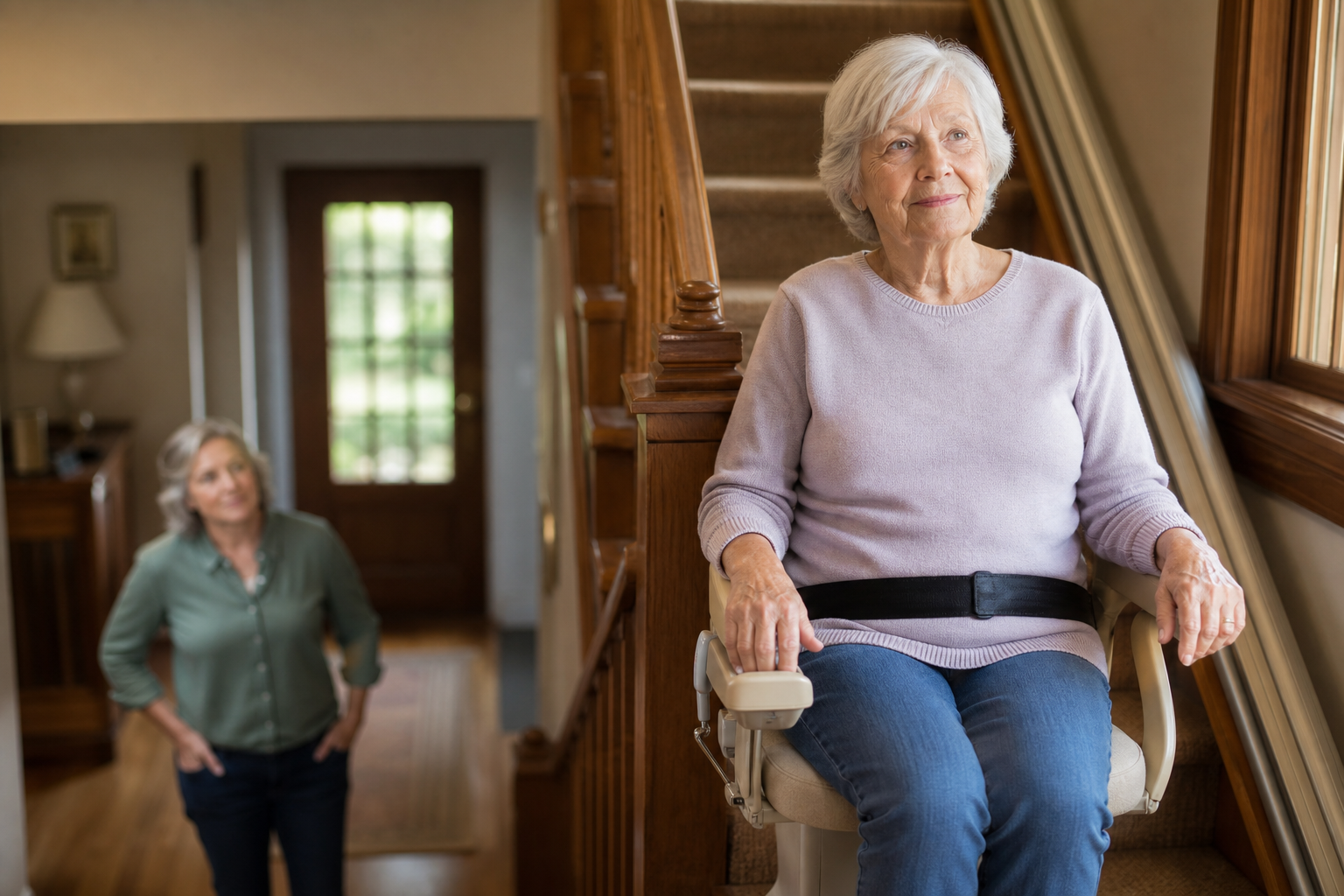
Stairs are one of the most consistent fall hazards in the home for older adults. If you've noticed your parent gripping the banister with both hands, pausing to rest mid-flight, avoiding the upper floor entirely, or recovering from a stair-related fall, the staircase has likely become a functional barrier — not just a safety concern.
According to a University of Michigan poll cited by the National Council on Aging, 84% of adults age 65 and older plan to stay in their homes for the rest of their lives. For families managing a multi-story home, a stair lift is often the modification that makes that preference realistic rather than aspirational.
As the person coordinating this decision, your first step before shopping or calling for quotes is to arrange an occupational therapy (OT) assessment. An OT can evaluate your parent's functional mobility, document the medical necessity of the modification, and provide written justification — which is required for most public funding programs. This assessment is not optional if you plan to pursue Medicaid, VA benefits, or a tax deduction; it is the foundation that unlocks those pathways.
Common clinical trigger signs that indicate a stair lift evaluation is warranted include:
- Visible stair avoidance — sleeping on the main floor to avoid climbing, or avoiding rooms on other levels
- Bilateral banister gripping or wall-bracing to ascend or descend
- A recent fall on the stairs, or a near-fall your parent mentioned or you witnessed
- Diagnosed conditions affecting leg strength, balance, or joint mobility (e.g., Parkinson's disease, severe arthritis, post-stroke weakness)
- Shortness of breath or fatigue that makes stair climbing unsafe
What a Stair Lift Costs in 2026
Stair lift pricing varies significantly by lift type, staircase configuration, and geographic labor costs. The table below shows current installed cost ranges by category. All figures are ranges — final pricing for any specific installation requires an in-home assessment by a qualified installer.
| Lift Type | Equipment Cost | Installation Cost | Total Installed Range | Notes |
|---|---|---|---|---|
| Straight stairlift | $2,000–$3,500 | $500–$1,500 | $2,500–$5,000 | Standard rail; minimal customization; most common type |
| Curved stairlift | $7,000–$13,000 | $1,000–$2,000 | $8,000–$15,000+ | Custom-fabricated rail for each staircase; price varies with complexity |
| Outdoor straight stairlift | $3,000–$6,000 | $1,000–$2,000 | $4,000–$8,000 | Weather-resistant components; requires outdoor-rated electrical |
| Used / reconditioned (straight only) | $500–$1,500 | $500–$1,500 | $1,500–$3,500 | From authorized dealers with warranty; saves 25–50% off new |
| Rental (straight only) | N/A | N/A | $175–$500/month | Cost-effective only for short-term needs; see note below |
| Annual maintenance plan | N/A | N/A | $100–$300/year | Optional; recommended for ongoing reliability |
| Battery replacement | N/A | N/A | $200–$300 every 1–3 years | Most lifts run on battery backup; replacement is routine |
Key Factors That Affect the Final Price
The lift type is the largest cost driver, but several additional variables determine where within a given range your installation will land.
- Staircase geometry. Curves, intermediate landings, tight turns, and non-standard rail lengths each add to the cost of a curved lift. Staircase width and slope also affect installation complexity.
- Optional features. Power swivel seats, folding rails, battery backup systems, powered footrests, obstruction sensors, and additional remote controls each add to the base price. These are worth evaluating against your parent's specific functional needs — not all are necessary for every user.
- Weight capacity. Standard models typically accommodate up to 300–350 lbs. Bariatric models rated up to 600 lbs are available but add approximately $500–$2,000 to the equipment cost.
- Electrical and structural requirements. If the staircase lacks a nearby outlet or requires a dedicated circuit, electrical work adds to the total. Some older homes may need minor structural preparation.
- Geographic labor costs. Installation labor varies significantly by region. Urban markets and high cost-of-living areas typically run toward the higher end of installation ranges.
- Warranty terms. Longer manufacturer warranties and extended service agreements affect upfront cost and long-term value. Clarify what is covered before signing.
Medicare Coverage: What It Pays and What It Doesn't
The reason is structural: Medicare's DME benefit covers items like walkers, wheelchairs, and hospital beds that a patient uses repeatedly for a medical condition. Stair lifts are attached to the home rather than the person, which places them in the home modification category — and Medicare does not fund home modifications.
Medicare Advantage (Part C): Possible, But Not Reliable
Some Medicare Advantage plans include supplemental benefits that can cover certain home safety modifications. However, as the NCOA notes, this "isn't common, though, and likely will only cover a small percentage of the cost." Coverage is entirely plan-specific — there is no standard benefit, and many plans do not include it at all.
If your parent has a Medicare Advantage plan, contact the plan directly and ask specifically whether home modification benefits are included, what the annual allowance is, and whether a stair lift qualifies. Do not assume coverage exists without confirming it in writing.
- Medigap (supplemental) policies do not cover stair lifts — they supplement Original Medicare benefits, and since Original Medicare excludes stair lifts, Medigap follows.
- FSA (Flexible Spending Account) and HSA (Health Savings Account) funds can be applied to a stair lift purchase with a physician's prescription. This is a meaningful tax benefit covered in more detail in the tax strategies section below.
Medicaid HCBS Waivers: Coverage When It Prevents Nursing Home Placement
Medicaid's Home and Community-Based Services (HCBS) waiver programs are the most significant public funding pathway for stair lifts for income-eligible older adults. Most states operate waiver programs that can fully or partially cover a stair lift when a physician or occupational therapist documents that the modification is necessary to prevent nursing home placement.
The relevant benefit category is called Environmental Accessibility Adaptations (EAA). Under this benefit, covered modifications typically include stairlifts, wheelchair ramps, accessible bathroom conversions, and widened doorways — when an OT or physician provides written justification. The underlying logic is that Medicaid has a strong financial incentive to fund home modifications that keep people out of nursing homes, which are far more expensive for the program to fund.
Typical Medicaid financial eligibility thresholds (based on 2024 figures — confirm current thresholds with your state office) are approximately $2,829 per month in income and $2,000 in countable assets, with the primary home generally excluded from asset calculations. These figures vary by state and change annually.
Practical steps to pursue HCBS waiver coverage:
- Obtain an OT home safety assessment with written documentation of medical necessity and nursing-home-prevention rationale.
- Contact your state Medicaid office and ask specifically about HCBS waiver programs covering Environmental Accessibility Adaptations or home modifications.
- Request a contractor-ready itemized estimate — many programs require this for pre-authorization.
- Ask about current waitlist status and estimated timelines before relying on this funding for a time-sensitive installation.
The same HCBS waiver programs that cover stair lifts can also fund bathroom safety modifications. For deeper background on these programs, see the guide to bathroom modifications to prevent falls for aging in place, which covers shared funding sources in more detail.
VA Benefits for Veterans: What's Covered and What's Not
Veterans seeking stair access funding should look to the SAH and SHA grant programs, or to Veterans Directed HCBS, rather than HISA. Here is a summary of the relevant VA programs:
| VA Program | What It Covers | Who Qualifies | Key Notes |
|---|---|---|---|
| HISA Grant | Structural home modifications: ramps, roll-in showers, entrance/exit access, plumbing/electrical for home medical equipment | Veterans with service-connected or qualifying non-service-connected disabilities | Explicitly excludes stair glides and porch lifts. Do not use for stair lift funding. |
| SAH Grant (Specially Adapted Housing) | Major structural changes to build or adapt a home for independent living, including stair access solutions | Veterans with qualifying severe service-connected disabilities (e.g., loss of limb, blindness, certain burns) | Higher benefit amounts; for significant structural adaptation needs. Verify current eligibility at va.gov. |
| SHA Grant (Special Housing Adaptation) | Modifications to an existing home to accommodate qualifying disabilities | Veterans with specific service-connected mobility or vision impairments | Smaller scope than SAH; still may cover stair access solutions. Verify at va.gov. |
| Veterans Directed HCBS (VD-HCBS) | Flexible care budget that the veteran directs — may include a stair lift as a self-directed purchase | Veterans enrolled in VA healthcare who need home- and community-based services | Availability varies by VA medical center and state. Ask your VA case manager. |
Federal and State Programs: USDA Section 504 and Area Agencies on Aging
USDA Section 504 Home Repair Program
The USDA Section 504 Home Repair Program is a federal program specifically designed for low-income rural homeowners. For families helping a parent in a rural area, it is one of the most direct public funding pathways available.
- Grants up to $10,000 are available to homeowners age 62 or older who meet very-low-income thresholds. Grants must be used to remove health and safety hazards — a stair lift addressing fall risk qualifies under this purpose.
- Loans up to $40,000 at 1% fixed interest for 20 years are available to very-low-income homeowners of any age.
- Combined assistance up to $50,000 is possible when a grant and loan are combined.
- Grant repayment requirement: If the property is sold within 3 years of receiving a grant, the full grant amount must be repaid. Loans do not carry this restriction.
Area Agencies on Aging: Your Fastest First Call for Local Programs
Area Agencies on Aging (AAAs) are federally funded local organizations that connect older adults and caregivers to community services. For stair lift funding, they are often the fastest first contact — many AAAs administer direct grants, home repair programs, and assistive technology loan programs that are not widely advertised and not available through a national search.
To find the AAA serving your parent's area, use the Eldercare Locator at eldercare.acl.gov or call 1-800-677-1116. When you call, ask specifically about home modification grants, minor home repair programs, and assistive technology loan programs for older adults.
Roughly half of states also operate non-Medicaid home modification programs through their state agencies on aging or housing finance agencies. State Assistive Technology programs, funded under the federal AT Act, provide low-interest loans and sometimes refurbished equipment. Your local AAA can direct you to both.
These same state and local programs can also fund bathroom safety modifications. For additional program context, see the guide to bathroom modifications to prevent falls for aging in place.
Tax Strategies: FSA, HSA, and the IRS Medical Deduction
Tax strategies will not eliminate the cost of a stair lift, but they can meaningfully reduce the after-tax expense for families who qualify. There are two distinct mechanisms: spending account funds and the IRS itemized medical deduction.
FSA and HSA Funds
Flexible Spending Account (FSA) and Health Savings Account (HSA) funds can be used to pay for a stair lift with a physician's prescription documenting medical necessity. This allows you to pay for the lift using pre-tax dollars, effectively reducing the cost by your marginal tax rate. If your parent has an HSA with a balance, this is often the simplest and most immediate tax benefit to apply.
IRS Medical Expense Deduction
IRS Publication 502 (2025 edition) confirms that stair lifts and porch lifts qualify as capital medical expenses when the modification is medically necessary. The rules are specific:
- Full cost is deductible if the stair lift does not increase the home's market value (which is typically the case for a stair lift, unlike a room addition).
- If the modification increases home value, only the cost above the value increase is deductible.
- The deduction only applies to total medical expenses exceeding 7.5% of adjusted gross income (AGI) for the tax year.
- You must be itemizing deductions rather than taking the standard deduction for this to apply.
- A physician's prescription or OT documentation establishing medical necessity is essential to support the deduction if audited.
Private Payment Options: LTC Insurance, Financing, and Used Equipment
When public programs are not available or do not fully cover the cost, several private options are worth evaluating — and they can be combined with each other or with partial public funding.
- Long-term care (LTC) insurance. Some LTC policies cover medically necessary home modifications, which may include a stair lift. Coverage varies significantly by policy. Review your parent's policy documents and contact the insurer directly to ask whether home modification benefits are included and what documentation is required.
- Dealer financing and installment plans. Many stair lift installers offer financing options, including consumer installment plans. Interest rates and terms vary. For a straight stairlift, this can spread a $3,000–$5,000 cost over 12–36 months at manageable monthly payments.
- Home equity options. Home equity loans or lines of credit are available to homeowners with sufficient equity. These carry interest costs and use the home as collateral — appropriate for some families, but worth careful consideration before use.
- Used and reconditioned stairlifts. Used models — available for straight staircases only — from authorized dealers with a warranty can save 25–50% compared to new equipment. Total installed cost for a used straight stairlift typically runs $1,500–$3,500. Curved staircases cannot use used equipment because the rail is custom-fabricated for one specific staircase.
- Nonprofit programs. Organizations including Rebuilding Together and Habitat for Humanity operate aging-in-place home repair programs in some communities. Availability is local and program-specific. Your Area Agency on Aging can identify which programs are active in your parent's area.
Funding Decision Framework: Where to Start Based on Your Situation
The sequence in which you pursue funding sources matters. Starting with the highest-value programs before moving to private options can significantly reduce or eliminate out-of-pocket cost. Use the framework below to identify your starting point based on your parent's eligibility profile.
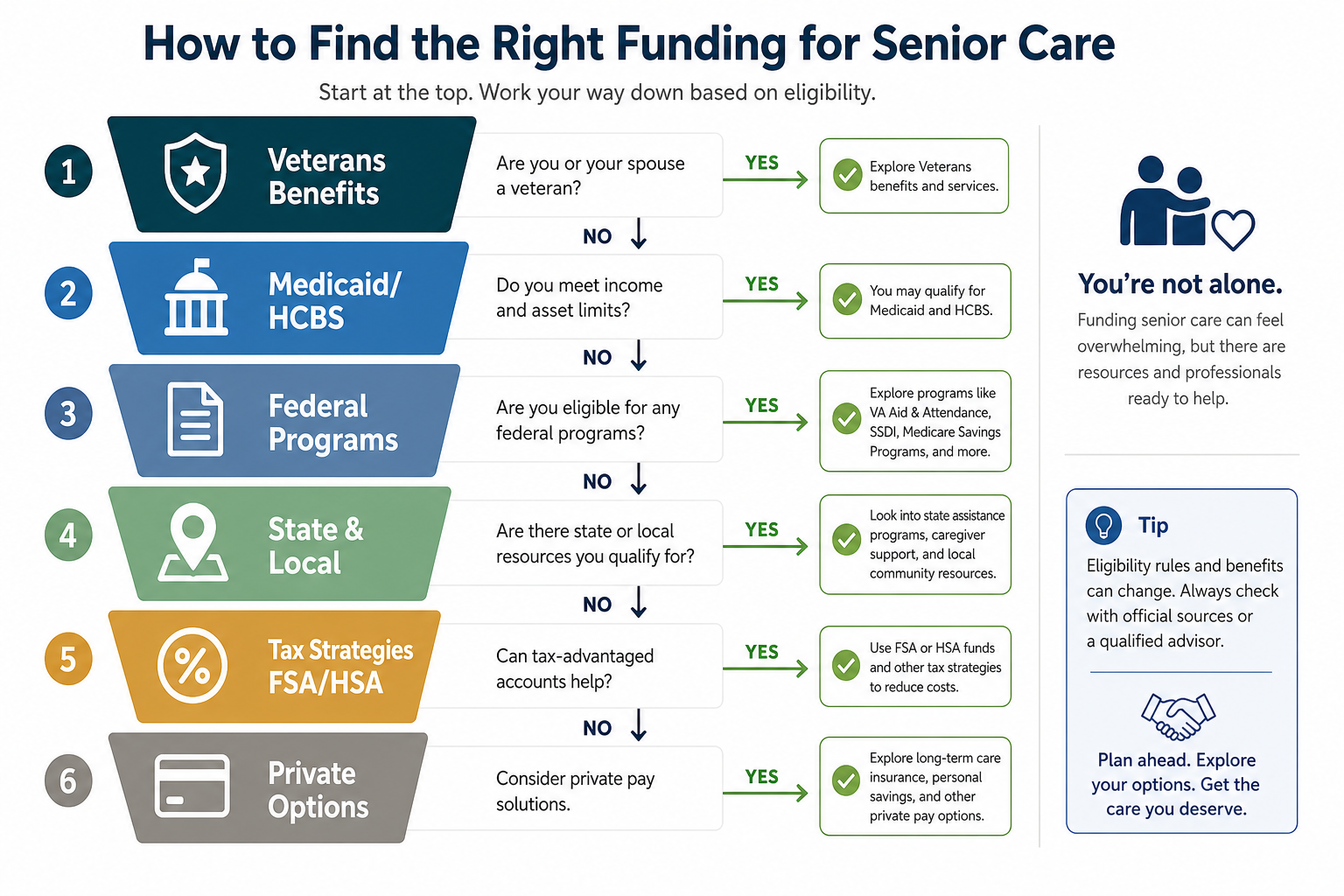
| Eligibility Profile | Start Here | Key Action |
|---|---|---|
| Veteran with service-connected disability | SAH or SHA grant (not HISA for stair lifts) | Contact VA benefits office; obtain OT documentation; verify eligibility at va.gov |
| Veteran needing flexible care support | Veterans Directed HCBS (VD-HCBS) | Ask VA case manager whether VD-HCBS is available through your VA medical center |
| Medicaid-eligible (income and asset thresholds met) | HCBS waiver — Environmental Accessibility Adaptations benefit | Contact state Medicaid office; obtain OT home safety assessment; request itemized estimate |
| Rural homeowner, age 62+, very low income | USDA Section 504 grant (up to $10,000) | Contact local USDA Rural Development office; apply early due to potential waitlists |
| Any income level — first contact for local programs | Area Agency on Aging | Call Eldercare Locator (eldercare.acl.gov) or 1-800-677-1116; ask about home modification grants and AT loans |
| Has FSA or HSA balance | FSA/HSA funds with physician prescription | Obtain prescription; confirm with plan administrator that stair lift qualifies |
| Itemizing deductions, high medical expenses | IRS medical expense deduction (Publication 502) | Consult tax professional; document medical necessity; confirm home value impact |
| Has LTC insurance policy | LTC policy home modification benefit | Review policy documents; contact insurer directly to confirm coverage and documentation requirements |
| No public program eligibility | Dealer financing + used equipment (straight staircase) | Request itemized quotes; compare financing terms; ask about certified used models |
| Short-term need only (post-surgery, rehabilitation) | Rental ($175–$500/month) | Confirm the need is truly short-term; calculate break-even against purchase before committing |
Frequently Asked Questions
Does Medicare cover stair lifts?
No. Original Medicare does not cover stair lifts because they are classified as home modifications, not durable medical equipment. Some Medicare Advantage (Part C) plans include supplemental home modification benefits, but this is plan-specific, not common, and typically covers only a small portion of cost. Contact your plan directly to ask. Medigap policies also do not cover stair lifts.
Is renting a stair lift cheaper than buying?
Only for short-term needs. At $175–$500 per month, rental costs can reach or exceed the full purchase price of a straight stairlift within 12–18 months. Rental is appropriate for post-surgery recovery or a temporary bridge period — not for a parent who will need stair access indefinitely. Rental is also only available for straight staircases.
Can I use my HSA or FSA to pay for a stair lift?
Yes, with a physician's prescription documenting medical necessity. FSA and HSA funds can be applied to the purchase, allowing you to pay with pre-tax dollars. Confirm with your plan administrator before purchasing.
Is a stair lift tax-deductible?
It can be, under specific conditions. IRS Publication 502 (2025) confirms that stair lifts qualify as capital medical expenses. The deduction applies only if you are itemizing deductions and your total medical expenses exceed 7.5% of AGI. The full cost is deductible if the installation does not increase the home's market value. Consult a tax professional to determine whether this applies to your situation.
Do I need a prescription or OT assessment?
Not to purchase a stair lift privately. However, an OT assessment and physician documentation are required for Medicaid HCBS waiver applications, VA grant applications, FSA/HSA reimbursement, and the IRS medical expense deduction. Obtaining the assessment early in the process opens all of these pathways.
How long does a stair lift last?
Most stair lifts are designed for 10 or more years of regular use with proper maintenance. An annual maintenance plan ($100–$300/year) and periodic battery replacement ($200–$300 every 1–3 years) are the primary ongoing costs. Ask about warranty terms and service availability in your area before purchasing.
What is the difference between a straight and curved stair lift?
A straight stairlift uses a standard rail system and works on staircases with no turns, curves, or intermediate landings. It is significantly less expensive ($2,500–$5,000 installed) and may be available in used or reconditioned form. A curved stairlift uses a custom-fabricated rail built specifically for one staircase — it accommodates curves, turns, and landings, but costs $8,000–$15,000 or more and cannot be reused on a different staircase. An in-home assessment by a qualified installer will determine which type your staircase requires.
Related reading
- Funding Sources for Home Modifications: A Complete Guide to VA, Medicaid, Grants, and More
- The Evidence for Aging-in-Place Home Modifications: What Research Says About Fall Prevention, Independence, and Cost Savings
- Hidden Disparities in Bathroom Safety: Why Non-Hispanic Black and Hispanic Seniors Are Far Less Likely to Have Bathroom Modifications — and What Caregivers Can Do
Need a professional assessment?
Find a CAPS-credentialed professional or local aging services through our outbound resource list — we never name or rank individual contractors.
Find Local HelpNoticed something outdated or inaccurate on this page? Flag a correction. We review every report against CDC, NIA, and AARP HomeFit guidance before updating a page.