
Room checklist
Rainy Day Fall Prevention Starts Outside
A rainy day creates a predictable fall-hazard chain: wet outdoor steps, a slippery threshold, and water tracked indoors. This plan-ahead audit shows caregivers and older adults what to check and fix around the exterior and entryway before the wet season — handrails, traction surfaces, drainage, lighting, and dry-shoe stations — with product-neutral, measurable home-modification guidance.
- Room
- entryway
- Modification type
- thresholds, lighting, traction
- Install complexity
- varies; DIY to professional
- Reviewed by
- Editorial Team
Rainy day fall prevention for seniors starts before anyone opens the front door. The first problem is usually not the rain itself. It is the route rain creates: water collects on the walk, the bottom step stays slick, the threshold becomes a narrow slippery edge, and wet shoes, cane tips, or walker legs carry that hazard onto the floor.
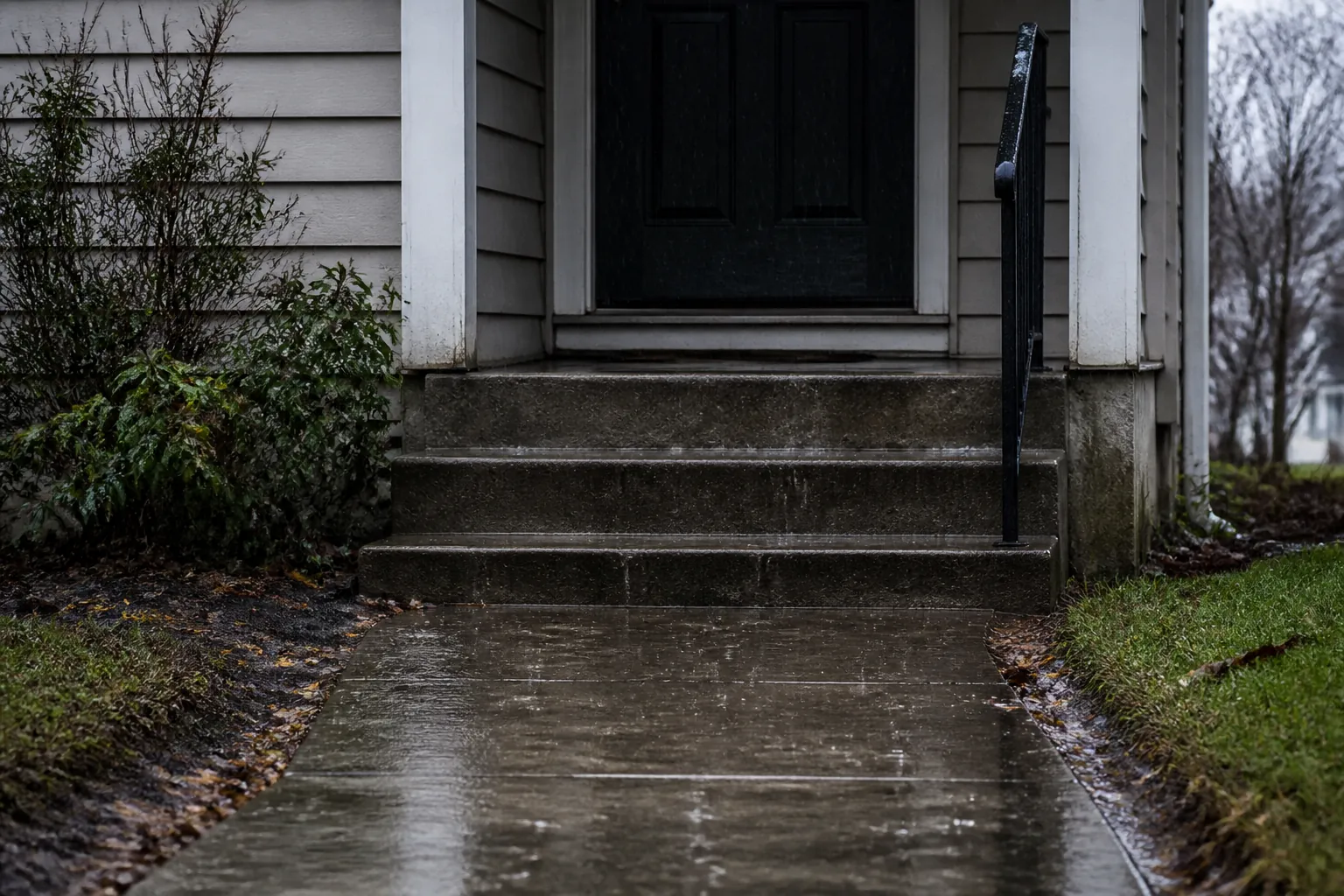
That route is worth inspecting at the property line, not after water has already reached the living room. In a 2006 study of adults age 45 and older, 58% of participants’ most recent falls happened outdoors; among outdoor falls, about 73% were linked to environmental causes such as uneven or wet surfaces, and wet surfaces were cited by roughly 1 in 5 outdoor fallers.[1] The study is not current surveillance, and it should not be stretched into a claim that ordinary rain raises falls by a precise percentage. It does make one point hard to ignore: exterior conditions deserve the same attention families often reserve for bathrooms and hallways.
The scale of fall injuries adds urgency without changing the inspection route. The CDC reports that about 1 in 4 older adults falls each year, with about 3 million emergency department visits, about 1 million hospitalizations, and about 41,000 deaths annually related to older-adult falls.[2] A wet-season audit will not remove every risk. It can remove the ones a caregiver can point to, photograph, measure, repair, and check again.
Follow the water from the curb to the chair
Do the walkthrough in the direction an older adult actually travels. Start where the car parks, the bus drops off, or the mailbox path begins. End at the first stable place indoors where shoes can come off, walking-aid tips can dry, and groceries can be set down.
A fast reminder to “be careful” does not change the porch edge, the missing rail, or the wet cane tip. The audit should leave behind a short repair list with owners and dates: who will clear leaves from the drain, who will tighten the handrail, who will replace worn shoe soles, who will put a towel and tray by the door before the next storm.
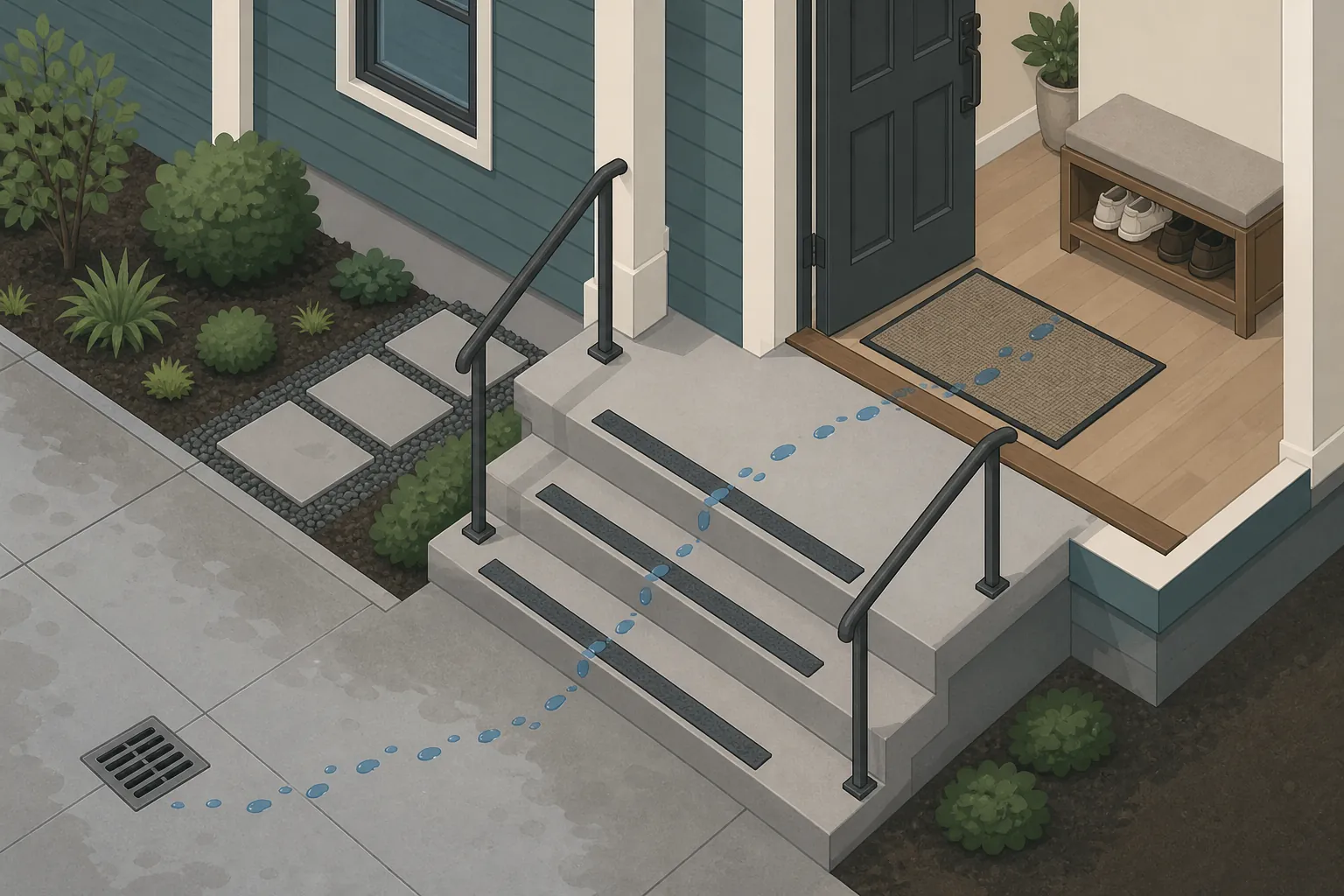
| Zone | What to check in rain | Measurable fix or decision |
|---|---|---|
| Approach and parking path | Puddles, moss, mud, uneven paving, loose stones, dim lighting | Mark pooling spots after rain; clear debris; improve lighting; escalate uneven or settled surfaces that change footing |
| Walkway and drainage edge | Water crossing the walking path, wet leaves, clogged drains, downspout discharge | Redirect water away from the route; schedule leaf and drain clearing; keep the walking path continuous and visible |
| Porch, exterior steps, and ramp | Rail presence, rail movement, slick treads, worn edges, shallow puddles at the bottom step | Install or repair stable handrails; add wet-rated traction surfaces; repair step defects rather than covering them |
| Threshold | Raised lip, slick metal or painted surface, mat edge that curls or slides | Secure or replace mats; reduce tripping edges where possible; make the door-opening area dry and well lit |
| Indoor landing zone | Water tracked by shoes, cane tips, walker feet, umbrellas, bags, and pets | Create a dry-shoe station with a stable seat, towel, tray, and dry footwear within reach |
| First indoor route | Wood, tile, vinyl, or rugs that become slippery once wet | Keep the route clear; remove loose rugs; use nonskid backing where rugs remain; dry visible water immediately |
The approach: where puddles predict the first bad step
Walk the route after a normal rain, not on a perfect dry afternoon. The useful evidence is ordinary and visible: a puddle at the bottom step, mud tracked across the walkway, leaves packed against a drain, a downspout emptying onto the path, or a patch of algae where shade keeps concrete damp.
Take photos from the older adult’s eye level and from the ground facing the doorway. A puddle that looks minor from across the yard may be exactly where a walker has to turn or where a cane tip lands before the door can be unlocked. If the older person carries groceries, uses one hand for a railing, or pauses to find keys, that standing spot matters more than the prettiest section of walkway.
Small maintenance belongs here: sweep leaves before they mat down, clear drainage grates, trim plants that push people toward the edge of the path, and move planters or hoses that narrow the route. If water repeatedly crosses the walkway or pools where the foot must land, treat that as a drainage problem, not a rainy-day inconvenience.
This is also where a DIY walkthrough reaches its limit. A loose paver, sunken slab, step that tilts, or ramp that stays slick because water flows across it may need a contractor, not another mat. Covering an uneven surface can hide the defect without making the step predictable.
Steps and porch: rails first, then traction
At the steps, check the part a person grabs before checking what a catalog calls “non-slip.” A handrail should be present where the older adult actually needs support, reachable without leaning, and stable under a firm pull. The National Institute on Aging’s room-by-room fall-prevention guidance includes handrails on both sides of stairs and nonskid mats, strips, or carpet on surfaces that may get wet; the American Academy of Orthopaedic Surgeons similarly includes handrails on both sides of stairs, nonskid strips on bare wood steps, lighting, and non-slip rugs in its home safety checklist.[3][4]
For an exterior rainy-day audit, that guidance needs a wet-surface test. A tread that feels secure in dry weather may be slick when water sits on it. Look for shiny painted steps, smooth tile, worn wood, loose outdoor carpet, or adhesive strips whose edges are lifting. Press on each strip or mat edge with a shoe. If it moves, curls, or traps water underneath, it has become part of the hazard.
Traction products should be chosen for the surface and installed as carefully as the package claims are read. Tape on a crumbling step, a mat on an uneven porch, or a coating applied over dirt and algae can fail exactly when someone trusts it. For a product-neutral way to compare mats, tapes, grab bars, and other safety items, use the site’s guide to evaluating home safety products for seniors before buying.
Do not import winter advice without translating it. Ice cleats, ice grippers, grit, or salt may be relevant in freezing conditions, but they are not universal rainy-day solutions. Rain calls first for drainage, clean walking surfaces, secure rails, wet-rated traction, and a place to dry what comes inside.
The threshold is a transfer point, not just a doorway
The threshold asks an older adult to do several things at once: stop on a wet surface, reach for keys or a handle, shift weight, lift a foot, cross a lip, and enter a different lighting condition. If a walker is involved, the front legs may cross first while the back legs remain outside. If groceries are involved, one hand may be unavailable. This is where a small defect becomes a decision under pressure.
Check the doorway during rain with the door open and closed. Look for water dripping from the roofline, splashback from the step, a slick metal sill, a raised strip that catches toes, or a mat that bunches when the door swings. If the person uses a walker, confirm there is enough flat space to place all walker legs securely before opening the door or turning.
Lighting belongs in this same check. A threshold that is safe at noon may disappear at dusk, especially when dark wet surfaces reduce contrast. The goal is not decorative brightness. The goal is for the older adult to see the step edge, the mat edge, the keyhole or keypad, the handrail, and any standing water without guessing.
What gets tracked inside needs its own protocol
The wet-weather route does not end when the door closes. The Ohio Department of Aging warns that rain-wet surfaces and mud can be as slippery as snow and ice, that wet shoes can be as dangerous as wet floors, and that shoes and walking aids should be dried immediately after coming inside.[5] That last step is easy to skip because everyone feels “home” already. It is also the step that determines whether the entryway becomes a second slippery surface.
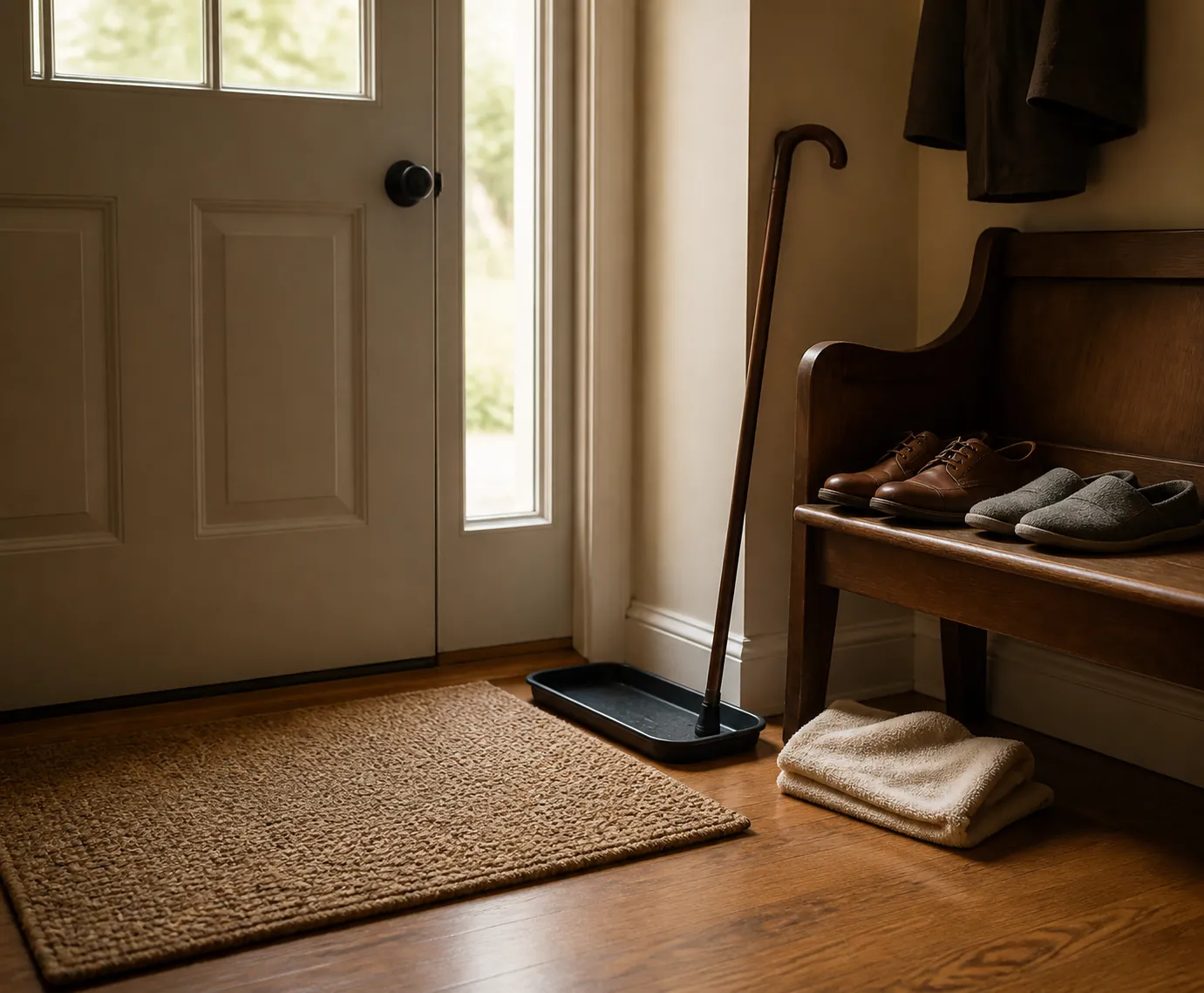
A useful landing zone is not a pile of towels by the door. It is a planned transfer station that lets the older adult stop without balancing on one foot, set down bags, sit if needed, remove or dry shoes, and dry cane or walker tips before moving across wood, tile, vinyl, or a rug.
- Place a stable chair or bench close enough to reach before crossing the room.
- Keep a towel within arm’s reach for shoe soles, cane tips, walker feet, and umbrella handles.
- Use a tray or other contained drying spot so water does not spread underfoot.
- Keep dry shoes or slippers where they can be reached while seated.
- Move mail bins, pet bowls, decorative baskets, and loose rugs out of the first few steps indoors.
- Check that the mat itself does not slide, curl, bunch, or create a raised edge.
The person responsible for the home should practice this once on a dry day. Walk in with an umbrella, a bag, and the mobility aid normally used outside. If the towel is too far away, the chair blocks the walker, or dry shoes require standing on one foot, the setup is not finished.
Shoes, cane tips, and walker feet wear out before they look dramatic
Footwear advice often turns vague: wear good shoes, avoid slippery soles, be careful outside. For a rainy-day audit, the inspection can be more concrete. Turn the shoes over. Look for smooth patches, uneven wear, hardened rubber, separated edges, or tread that no longer channels water away from the sole.
A 2024 footwear design review describes treaded rubber outsoles and slip-resistant sole features as important design elements for older-adult footwear, while a 2026 Journal of the American Geriatrics Society article on footwear recommendations for older adults includes replacing worn soles and worn walking-aid tips before wet weather as part of practical fall-prevention guidance.[6][7] These sources do not give a universal household cutoff for exactly when a sole is unsafe. They do support treating worn tread, smooth rubber, and worn cane or walker tips as maintenance items rather than personal preferences.
Harvard Health also advises paying attention to outdoor traction and to the fit and condition of walking aids when preventing falls outside the home.[8] For rain, that means the cane tip or walker foot should be checked the same day as the shoes. A tip that is flat, cracked, loose, or packed with grit should not be expected to grip a wet threshold.
When to stop patching and bring in help
Many rainy-day hazards can be handled with maintenance: clearing leaves, securing a mat, drying shoes, changing a worn cane tip, or improving a light. Some should not be patched casually.
- A handrail moves when pulled or is mounted into weak material.
- A step is uneven, crumbling, tilted, too narrow for the person’s foot, or difficult to see.
- Water repeatedly pools at the bottom step or flows across a ramp or walkway.
- The threshold height makes the person lift a walker, drag a foot, or pause without stable support.
- A traction product will not stay flat, dry, or bonded to the surface.
- The older adult has recently fallen, changed mobility aids, had new dizziness, or seems less steady than during the last season.
Those findings call for a qualified home-modification professional, occupational therapist, physical therapist, contractor, or clinician, depending on the problem. A family member can document the hazard; the repair may still need someone who understands mounting, drainage, stair geometry, mobility aids, or health changes.
Document the wet-season audit before the first storm
The simplest record is enough: date, zone, hazard, photo, action, owner, and recheck date. Write “bottom step pools after rain” rather than “front steps unsafe.” Write “left handrail wiggles when pulled” rather than “needs rail work.” Specific notes make it harder for a visible problem to drift into the next storm unchanged.
| Audit note | Good record | Weak record |
|---|---|---|
| Hazard | Water pools at bottom step after 20 minutes of rain | Steps get wet |
| Repair | Clear drain edge; ask contractor about downspout and step drainage | Watch the step |
| Entry setup | Bench, towel, tray, and dry shoes placed inside front door | Be careful when coming in |
| Mobility aid | Replace cracked cane tip before wet season | Cane looks old |
| Recheck | Photograph same area after next rainfall | Check later |
Use this article as the outdoor and entryway pass, then connect it to a broader plan-ahead home assessment for bathrooms, bedrooms, kitchens, stairs, medications, vision, and mobility changes. This guide is educational and is not medical advice. If falls, dizziness, medication changes, or sudden changes in walking are part of the picture, involve the older adult’s clinician as well as the person repairing the home.
References
- Outdoor Falls Among Middle-Aged and Older Adults: A Neglected Public Health Problem, American Journal of Public Health, 2006.
- Facts About Falls, CDC.
- Preventing Falls at Home: Room by Room, National Institute on Aging.
- Home Safety Checklist, American Academy of Orthopaedic Surgeons.
- Falls Prevention in Every Season, Ohio Department of Aging.
- Footwear Design Parameters for Preventing Falls in Older Adults: A Review, 2024.
- Footwear Recommendations for Older Adults, Journal of the American Geriatrics Society, 2026.
- Protect yourself from falls outside the home, Harvard Health.
Related reading
This change typically needs a professional
Find a CAPS-credentialed professional or local aging services through our outbound resource list — we never name or rank individual contractors.
Find Local HelpNoticed something outdated or inaccurate on this page? Flag a correction. We review every report against CDC, NIA, and AARP HomeFit guidance before updating a page.