
Room checklist
How Seniors Can Prevent Falls on Ice Outdoors
The highest-risk ice falls for seniors happen on the familiar outdoor route at the door, steps, driveway, and walkway. This before-the-storm checklist covers traction treatments applied before ice forms, entryway lighting, handrail checks, and one assigned person to clear the path.
- Room
- Entryway
- Modification type
- Traction, lighting, handrails
- Install complexity
- DIY-friendly
- Reviewed by
- Editorial Team
The most useful winter safety tips for seniors to prevent falls on ice start at the front door, not with a general warning to “be careful.” Around an older adult’s home, the risky part is often the short, familiar route that gets used without much thought: threshold, porch, steps, walkway, driveway, curb, mailbox, car, or street.
Falls deserve that level of attention. The CDC reports that more than 1 in 4 older adults falls each year, and about 37% of those falls cause an injury that requires medical treatment or at least one day of restricted activity.[1] The same agency reports that the age-adjusted fall death rate for older adults rose 21% from 2018 to 2024, from 64.7 to 78.4 deaths per 100,000.[2]
Snow and ice add a particular route problem. In a preliminary, EHR-based Truveta Research analysis that was not peer-reviewed, falls on snow or ice accounted for 13.1 emergency department visits per 10,000 winter ED visits, with a rate roughly three times higher in freezing-winter states; 22.5% of those snow- or ice-related falls involved a specific injury.[3] That dataset should not be treated as a universal injury rate, but it is enough to justify looking closely at the few outdoor feet an older adult has to cross before reaching a car, sidewalk, or cleared street.
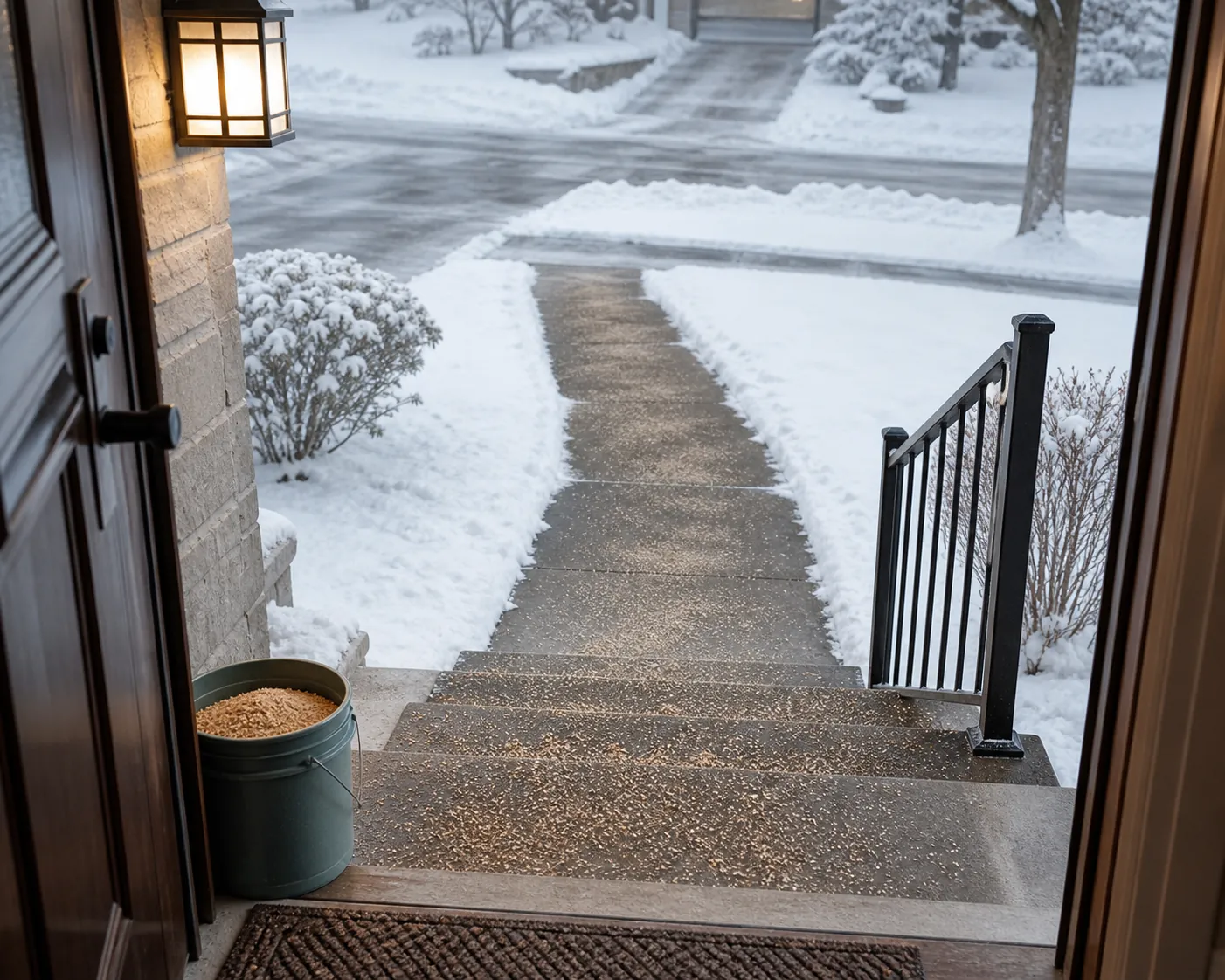
Start with the route an older adult actually uses
A winter fall plan gets much clearer when it begins with one question: from the door they use most often, what exact path does your parent take when they leave the house?
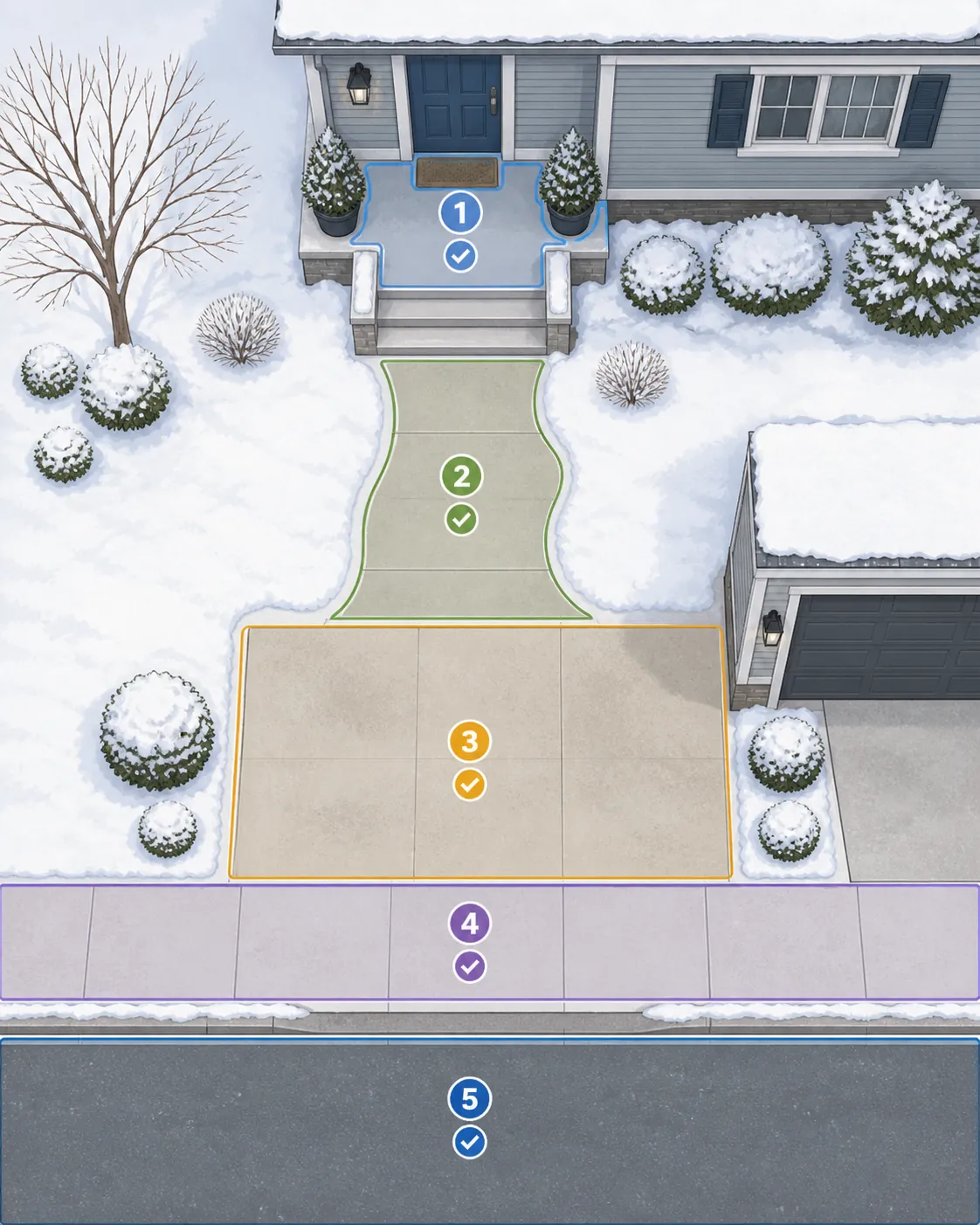
Not the ideal path. Not the path someone would use if the side door were locked or the garage were cleaner. The real path. Stand inside the doorway, open it fully, and look outward. The route may run across a porch, down two steps, along a narrow walk, over the driveway apron, and toward the mailbox or passenger-side car door. That whole route needs to be inspected as one connected surface because a safe-looking porch does not help much if it empties onto an untreated driveway.
| Zone | What to verify before the first storm |
|---|---|
| Door and threshold | Door opens fully, mat lies flat, light reaches the threshold, and traction supplies are reachable from inside. |
| Porch and steps | Treads are visible, edges are not slick, traction is ready, and the handrail does not shift when gripped. |
| Walkway | The walking line is clear of clutter, uneven edges are easy to see, and there is a plan to treat the full width that will be used. |
| Driveway | The path continues to the car or street, not just to the end of the walkway. |
| Street, curb, mailbox, or pickup spot | The final destination is included in the clearing plan or replaced with delivery, pickup help, or telehealth when conditions are poor. |
This is a home-modification task more than a lecture about balance. Balance, vision, medications, footwear, and strength all matter, but the property route is the part a family can inspect before weather arrives. A loose railing, a dark lower step, or a bag of ice melt stored in the garage behind the snowblower is not an aging issue. It is a fixable setup problem.
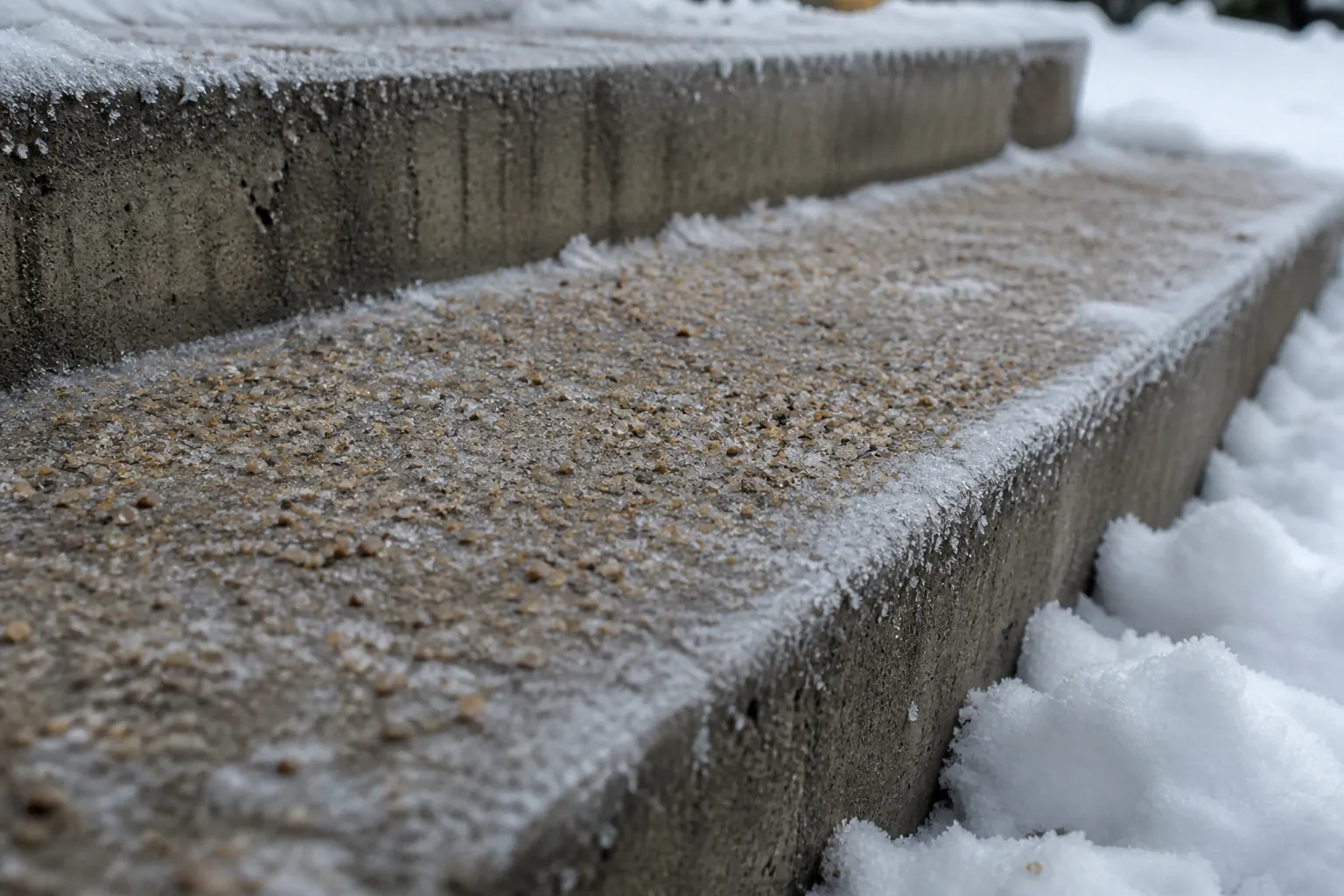
Put traction down before the surface turns dangerous
The cheapest winter safety improvement is often the one that has to be done early. NCOA recommends preparing for winter falls by keeping supplies such as salt, sand, or ice melt available, and AGS HealthInAging also advises using salt, sand, or cat litter on icy walkways.[4][5] Ohio’s aging guidance similarly points to salt, sand, ice melt, or clay cat litter for traction and advises older adults not to try to walk through more than an inch of snow.[6]
That timing matters. If the only bag of traction material is outside at the far end of the garage, the first person to need it may have to cross the slick area to get it. A better setup is plain and visible: a small bucket or handled container near the door used most often, a scoop inside it, and enough material to treat the steps, the landing, and the walking line to the car or street.
What should be ready at the door
- A traction material the household is willing and able to use, such as sand, salt, ice melt, or clay cat litter, selected with local surface, pet, and landscaping concerns in mind.
- A scoop or handled cup so the material can be spread without bending deeply or reaching into a heavy bag.
- A storage spot reachable from inside or from a covered area, so nobody has to step onto ice to retrieve it.
- A clear decision about which surfaces get treated first: threshold, landing, steps, main walking line, and the place where a person enters or exits the car.
For an older adult who still values going out independently, this is also a dignity issue. The goal is not to forbid the trip to the mailbox forever. The goal is to stop pretending that an untreated step and an untreated driveway are personal judgment tests.
Make the step edges visible
A step that is easy to use in July can disappear in a winter dusk. Mayo Clinic’s fall-prevention guidance recommends keeping homes brightly lit and placing night lights in bedrooms, bathrooms, and hallways; for the outdoor route, that same visibility principle belongs at thresholds, stairs, and entry areas.[7] Oakland County’s winter fall guidance for older adults specifically emphasizes making sure outdoor areas are well lit and that handrails are secure when dealing with snow and ice.[8]
Check the light from the position where it has to work. Stand inside with the door open. Stand on the porch. Stand at the bottom step and look back up. If the lowest tread blends into the walkway, the bulb above the door may be bright enough for the lock but not bright enough for the descent.
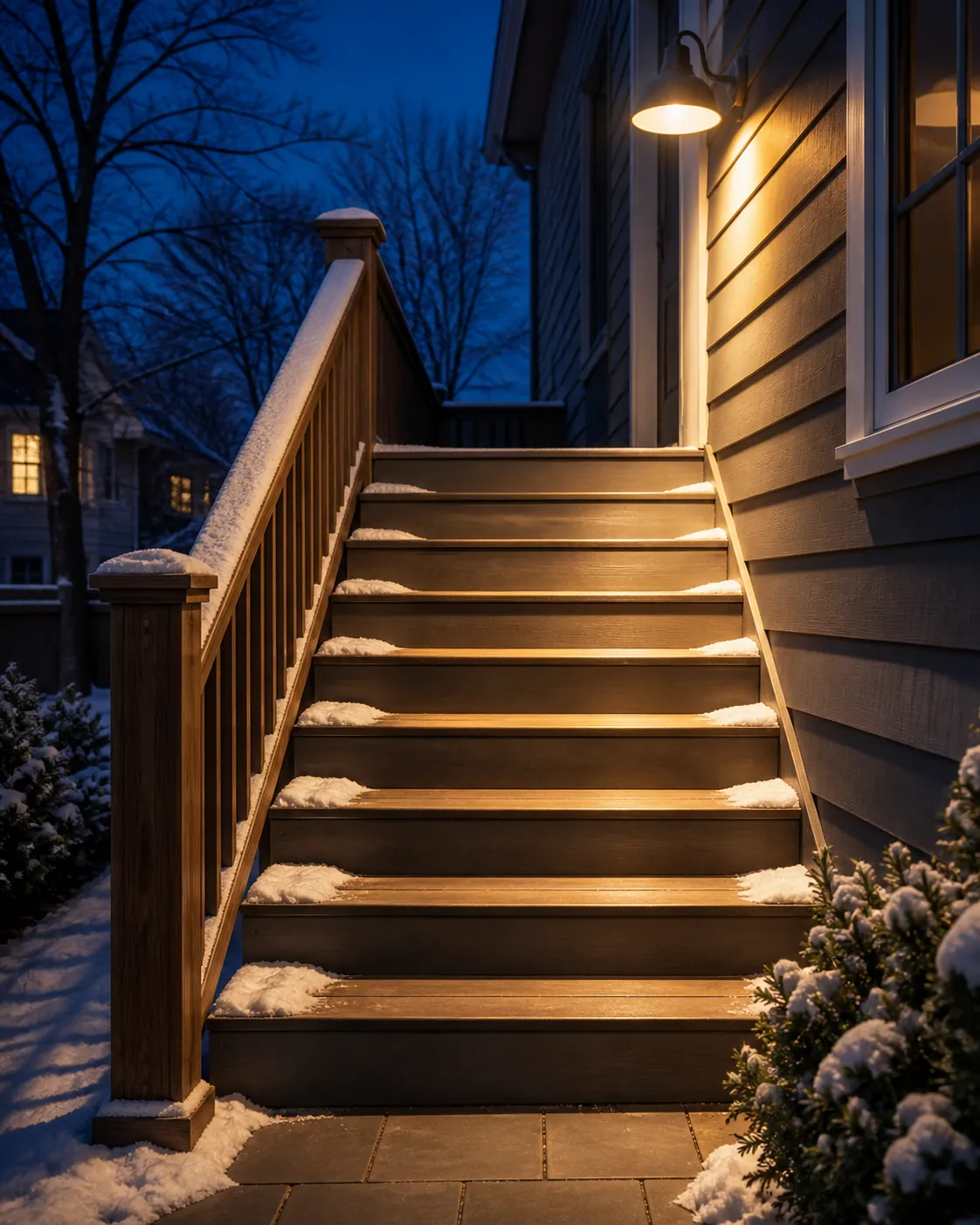
Look especially for the dark patch at the bottom step. It is easy to miss during a quick daytime visit and exactly the kind of place where a foot lands half on cleared concrete and half on refrozen slush. A motion light can help only if it turns on soon enough and reaches the walking surface. If it leaves the stairs in shadow until someone is already on them, it is not solving the main problem.
Pull on the handrail as if someone will need it
A railing should not merely exist. It should hold when a person grabs it suddenly. Mayo Clinic includes handrails on both sides of stairways among home fall-prevention measures, and Oakland County’s winter guidance tells older adults to ensure handrails are secure.[7][8]
So test it without being polite. Grip it at the top, middle, and bottom. Pull toward yourself. Push down. Watch the posts and brackets, not just the rail. If it wiggles, the inspection is not finished; the next step is repair, replacement, or a temporary change in which entrance is used until the rail can be trusted.
Also check whether the rail runs far enough. A rail that stops before the final step leaves the person unsupported at the exact moment they are transitioning to the walkway. If the safer entrance is the garage or side door because it has fewer steps or a better rail, the winter route should move there intentionally, with the same traction and lighting checks applied to that route.
Assign the clearing job to a named person
The weakest winter safety plan is “someone will shovel.” Someone usually means the person who notices too late, the neighbor who might be busy, or the older adult who decides to do it quickly before anyone worries.
AARP’s caregiver winter-safety guidance recommends arranging snow removal and considering alternatives such as grocery delivery and telehealth so an older loved one does not have to go out in unsafe conditions.[9] That is the missing piece in many household checklists: not just what should happen, but who is responsible when conditions change.
- Name the primary clearing person or service before the first storm.
- Name a backup person for weekends, travel, illness, or heavy accumulation.
- Define the route to be cleared: not just “the walk,” but door, steps, walkway, driveway crossing, car-entry area, mailbox path, and curb as needed.
- Decide how the older adult will know the path has been cleared and treated: a phone call, text, camera check, or in-person confirmation.
- Set the alternative plan for unsafe days: delivery, postponed appointment, ride help, telehealth, or asking the visitor to come to the door.
Verification is the part that prevents wishful thinking. If a caregiver lives nearby, that may mean walking the route after the first real snow and seeing where meltwater refreezes. If the caregiver lives farther away, it may mean paying a service, asking a specific neighbor, or using a simple photo check. The point is to avoid leaving the older adult to discover, with one foot already outside, that the plan ended at the porch.
Keep footwear and walking technique in their proper place
Footwear, shorter steps, balance work, and careful walking techniques still matter. They just should not be used to excuse a dark stair, loose rail, or icy driveway. If the route is untreated, the burden has quietly shifted from the property setup to the older adult’s reflexes.
For a broader five-layer approach that includes footwear, walking technique, balance, and what to do after a fall, use How to Prevent Falls on Ice for Older Adults. This article stays narrower on purpose: it is about the outdoor home route that can be inspected and prepared before the weather turns.
Run the doorway-to-street check once before the first storm
Do the check in normal shoes, with the door used most often, and with winter lighting conditions in mind. If your parent usually leaves through the garage, inspect the garage route. If they use the front door for visitors and the side door for the car, inspect both or choose one winter route and make it obvious.
- Open the door fully and confirm there is no curled mat, loose threshold, or object that narrows the first step out.
- Turn on the exterior light and check whether the threshold, stair edges, and bottom landing are actually visible.
- Grip every railing and support as if catching yourself. If it moves, treat that as a repair item, not a cosmetic flaw.
- Place traction material and a scoop where they can be reached before stepping onto the slick surface.
- Walk the full route to the car, sidewalk, mailbox, or street and mark where clearing often stops too soon.
- Assign the clearing job and backup, then decide how the older adult will know the route is safe enough to use.
- Choose the stay-inside alternative for days when snow depth, ice, wind, darkness, or fatigue makes the route a bad bet.
Some hazards will still be outside your control: a sudden freeze, poor plowing at the curb, an unexpected medical issue, or a moment of dizziness. A home-route checklist does not replace a clinical fall-risk review. It does remove the preventable failures that are sitting in plain sight.
What this plan does not cover
Outdoor ice preparation is only one part of winter safety. For the indoor side of the season, use A Measurable Winter Safety Checklist for Seniors at Home. For cold-related risks inside the home, see Cold Weather Safety for Seniors Starts With the Thermostat. For a broader before, during, and after weather plan, use the Storm Preparedness Checklist Built for Elderly Parents.
Then come back to the door. Look outward once, before the first storm, and make the route boring: visible steps, usable traction, a handrail that holds, a cleared path that reaches the driveway or street, and one named person accountable when snow and ice arrive.
References
- Facts About Falls, CDC, Jan. 2026
- Older Adult Falls Data, CDC, Feb. 2026
- Winter Falls and Injuries, Truveta Research
- Winterize to Prevent Falls, NCOA
- Tip Sheet: Winter Safety for Older Adults, AGS HealthInAging
- Winter Safety, Ohio Department of Aging
- Fall prevention: Simple tips to prevent falls, Mayo Clinic
- How Older Adults Can Avoid Falls on Snow and Ice, Oakland County, Jan. 22, 2026
- How Family Caregivers Can Keep Loved Ones Safe in Winter, AARP
Related reading
Need a professional assessment?
Find a CAPS-credentialed professional or local aging services through our outbound resource list — we never name or rank individual contractors.
Find Local HelpNoticed something outdated or inaccurate on this page? Flag a correction. We review every report against CDC, NIA, and AARP HomeFit guidance before updating a page.