
Room checklist
Can Current Reverse Mortgage Rates Cover Your Home Modifications?
See how much a typical senior could borrow with a reverse mortgage at current 2026 rates to fund home modifications, and whether the rate forecast makes this a favorable time to act.
- Room
- bathroom
For a homeowner who already knows the bathroom is unsafe, the first useful question is not whether reverse mortgage rates will be prettier next spring. It is whether today's proceeds can cover the work without squeezing the monthly budget. At mid-2026 HECM assumptions, one published illustration shows a 70-year-old homeowner with a $400,000 home receiving about $221,600 in available reverse mortgage proceeds at a 2.36% expected rate.[1] That is a large enough envelope for many common safety projects: grab bars and non-slip surfaces, a ramp, a stair lift, a walk-in shower, or even a full accessible bathroom remodel, which are commonly discussed in the roughly $2,500 to $25,000 range depending on the job.[2][3]
That does not make the money free, and it does not make every house or borrower qualify. It does mean the rate question can be made practical. If the project is $10,000, $25,000, or even $75,000, the borrower can compare that bill with estimated usable proceeds after costs, required repairs, and any existing mortgage payoff. That is the household math that matters.
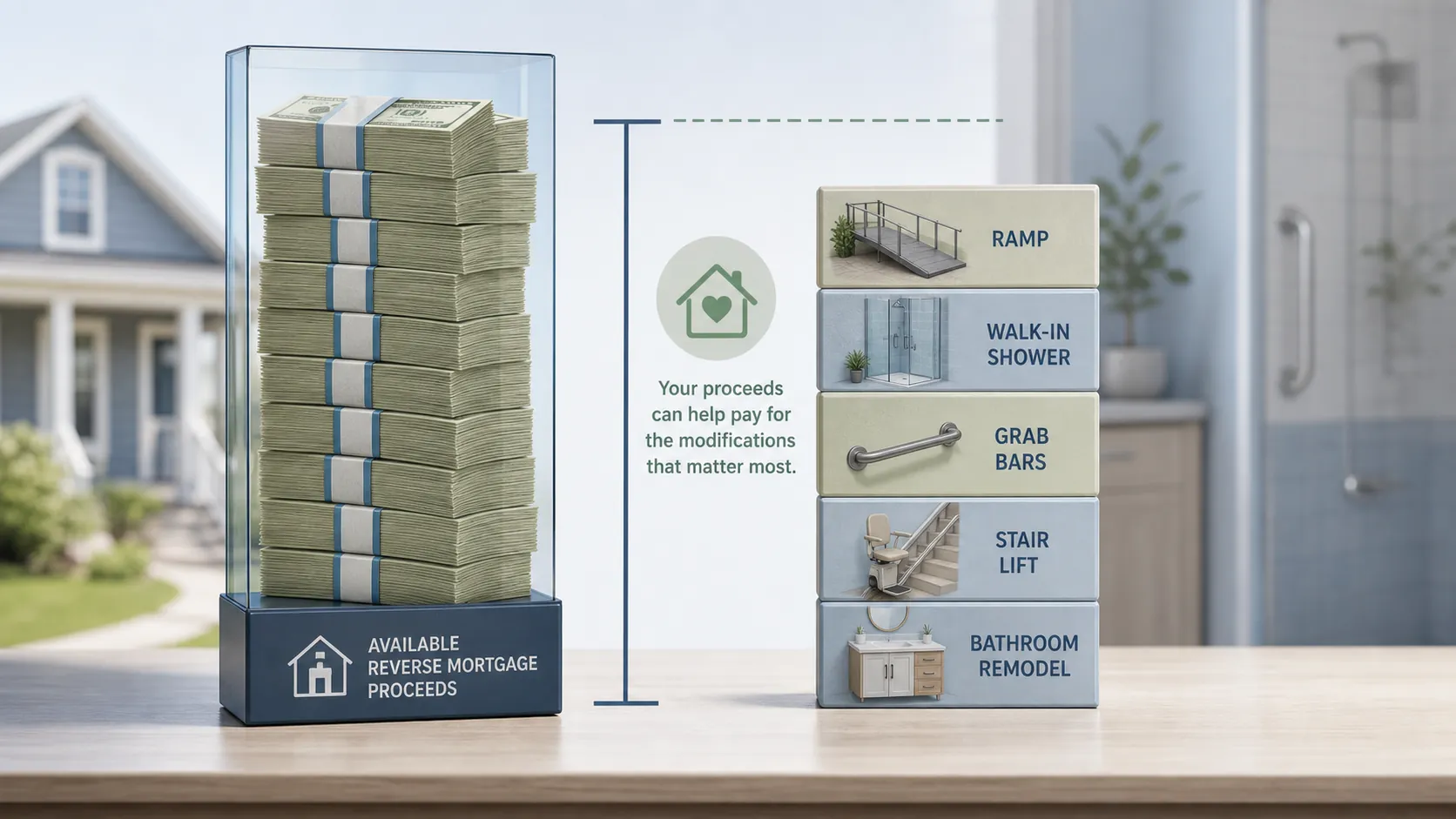
The Proceeds Test: Does the Envelope Fit the Work?
Here is the cleanest way to read the mid-2026 numbers. In Longbridge Financial's example, a 70-year-old homeowner with a $400,000 home could receive about $221,600 at a 2.36% expected rate. If the expected rate rises to 2.86%, proceeds fall to about $208,800. At 3.36%, they fall to about $197,200.[1]
| Illustrative HECM expected rate | Illustrative available proceeds | Change from 2.36% |
|---|---|---|
| 2.36% | $221,600 | Baseline |
| 2.86% | $208,800 | -$12,800 |
| 3.36% | $197,200 | -$24,400 |
A half-point move is not a rounding error when the family is pricing a stair lift or shower conversion. In this example, the first 0.50 percentage-point increase reduces proceeds by $12,800. The next 0.50 percentage-point increase reduces them by another $11,600.[1] That can equal the whole cost of a stair lift in many homes, or a large share of a walk-in shower conversion.
But the same table also shows why waiting for a perfect rate forecast can become expensive dithering. Even at the higher 3.36% expected-rate illustration, the proceeds are still about $197,200.[1] Against the home-modification costs most families are actually trying to solve, that leaves room for a substantial project before considering loan costs, repairs, or mortgage payoff.
| Home modification | Common cost range | How it compares with $221,600 proceeds |
|---|---|---|
| Bathroom grab bars plus non-slip surfaces | $2,500-$5,000 | Usually a small draw |
| Ramp | $1,500-$8,000 | Usually a small draw |
| Stair lift | $3,000-$10,000 | Can be covered in many proceeds scenarios |
| Walk-in shower conversion | $5,000-$15,000 | Often fits with room for related work |
| Full accessible bathroom remodel | $10,000-$25,000 | Often fits, but costs and repairs matter |
The awkward part is that families often talk about proceeds as if the gross number is what they can spend at the hardware store. It is not. Reverse mortgage origination fees can run from $2,000 to $6,000, and upfront mortgage insurance is 2%.[4] These costs can often be rolled into the loan balance, but that still reduces what is left for the ramp, doorway widening, or bathroom work.
The home also has to pass FHA minimum property standards through the appraisal process. If the appraiser flags required repairs, those repairs may have to be handled before or as part of closing. For a tidy house with one unsafe bathroom, that may be a nuisance. For a house with deferred maintenance, it can change the whole budget before the first grab bar is installed.
Why the Same Rate Does Not Give Every Senior the Same Result
Reverse mortgage proceeds are driven by more than the rate. Age matters, home value matters, and the FHA lending limit matters. For 2026, the HECM maximum claim amount is $1,249,125, up from $1,209,750.[5] A homeowner with a $400,000 house is well below that ceiling; a homeowner with a much more expensive property needs to know that the calculation is capped.
Age changes the principal limit because the loan is designed around life expectancy and home equity protection. ARLO's rate materials show how strongly age can matter: at a 5.875% expected rate, an age-62 borrower has a principal limit factor of about 35.1% of home value, an age-70 borrower about 40.9%, and an age-90 borrower around 61% to 62%.[6] Those are not the same assumptions as the Longbridge example, but they make the point: a neighbor's proceeds estimate is not your estimate.
Existing debt also gets first claim on the proceeds. If there is a current mortgage, it usually must be paid off with the reverse mortgage at closing. That can still help cash flow if the old payment disappears, but it also means the amount available for modifications may be far lower than the gross proceeds figure.
Lump Sum or Line of Credit Is Not a Small Detail
The way the money is taken should match the way the work will be done. A fixed-rate lump sum can make sense when the project is already defined: the contractor has priced a curbless shower, the doorway widening is in the same contract, and the family wants the work finished now. The borrower receives the available funds in one draw, and the plan is simple.
Many aging-in-place projects do not unfold that neatly. A fall-risk assessment may start with grab bars and lighting, then expose a threshold problem, then lead to a stair decision six months later. An adult child may push for the bathroom first while the parent wants to wait on the ramp until winter. In that kind of house, an adjustable-rate HECM line of credit often fits the actual sequence better than a lump sum.
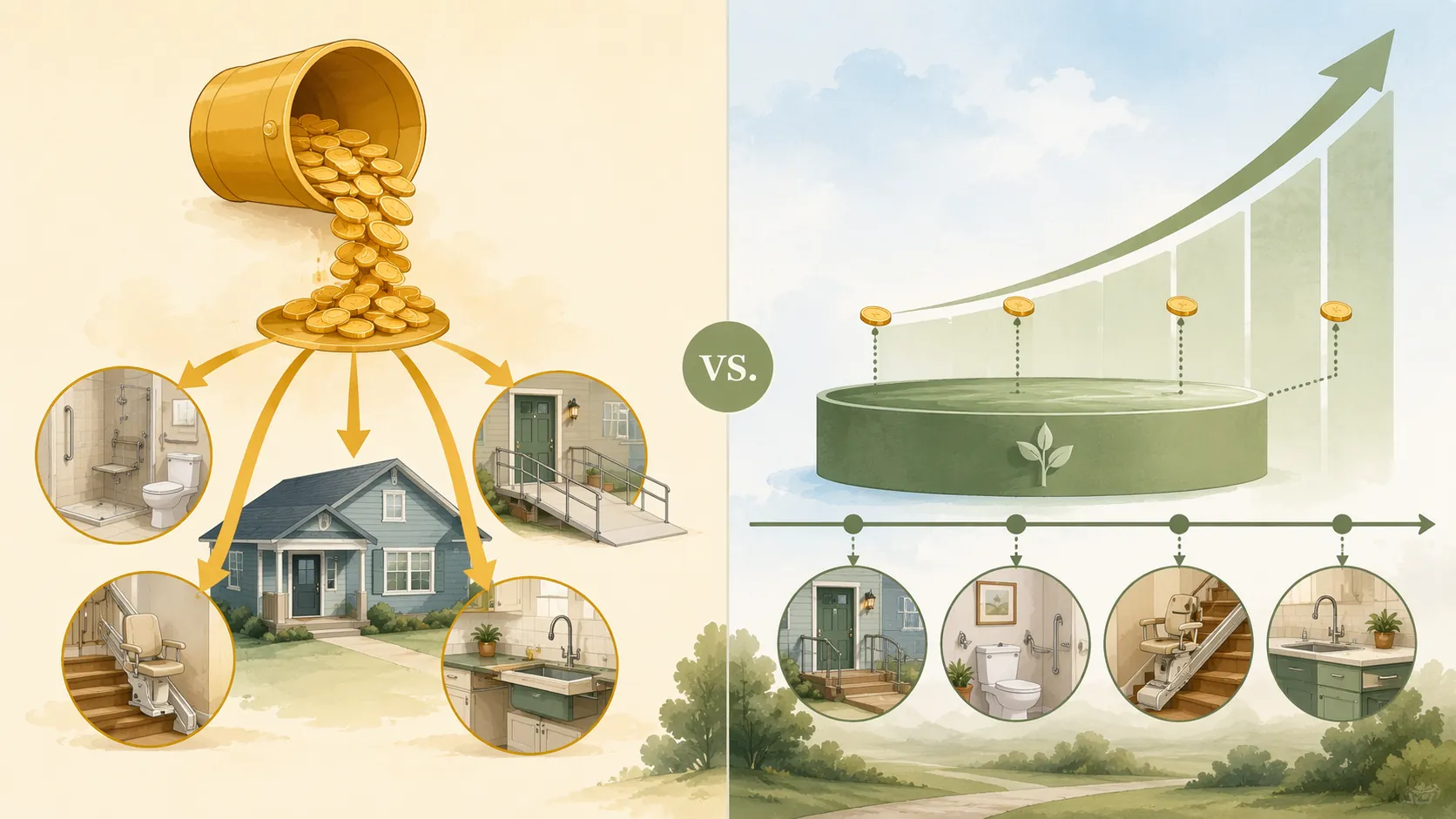
The line of credit has two features worth separating from ordinary bank-credit thinking. First, the unused credit line grows at the loan's note rate plus the 0.50% annual mortgage insurance premium. Second, unlike a HELOC, the available HECM line cannot be frozen or reduced because home values fall, as long as the borrower meets loan obligations.[7] That does not mean the borrower has more home equity; it means the borrowing capacity available under the reverse mortgage line can grow if left unused.
For phased modifications, that can be the difference between borrowing for every imagined project today and leaving some decisions until the house proves what it needs. A family might draw for the bathroom now, wait on the stair lift until mobility changes, and keep the ramp decision tied to a real need rather than a fear. That is more disciplined than taking the whole available amount just because the closing table makes it possible.
There is a tradeoff. Adjustable-rate reverse mortgages carry rate uncertainty, and future draws may accrue interest under future note-rate conditions. Still, for room-by-room work, the line of credit deserves more than a passing glance. It is not just a financing product; it is a better match for the way many families discover safety problems.
What Rate Forecasts Can and Cannot Tell You
The phrase “reverse mortgage rate predictions for seniors” can mislead if it quietly borrows forecasts from ordinary 30-year mortgages. HECM expected rates are not the same as conventional mortgage rates. HECM expected rates derive from the 10-year CMT plus a lender margin. Conventional-rate forecasts can provide context, but they do not precisely predict HECM expected rates.
The mid-2026 context is not wild enough to justify putting a needed safety project on ice by default. HSH's May 2026 rate snapshot placed HECM adjustable traditional rates around 5.6% to 5.8%, while its conventional 30-year figure was 6.52% in June 2026.[8] That tells us current reverse mortgage note rates are not sitting in the ultra-low world families remember from years ago, but it also does not show a sudden spike that would make all planning useless.
Conventional mortgage forecasts lean stable to slightly favorable, with some disagreement. Fannie Mae had projected rates below 6% by the end of 2026, around 5.9% in a September 2025 forecast.[9] Bankrate's 2026 forecast put the average at 6.1% with a possible low of 5.7%.[10] MBA's forecast pointed to 6.5% in Q3 and Q4 2026, while Reuters polling pointed to 6.4% in Q3 and 6.3% in Q4.[11][12]
Those are conventional 30-year forecasts, not HECM expected-rate forecasts. Their main use here is a guardrail: they do not give a strong reason to assume a dramatic near-term rate collapse. If the bathroom is already unsafe, a family waiting for a perfect prediction may be asking an interest-rate forecast to do a safety job.
Timing still matters because HECM expected-rate locks are generally valid for 120 days. A borrower who starts the process, waits on counseling, appraisal, repairs, or contractor decisions, and closes near the end of that window may not receive the same proceeds as a quick online illustration suggested. That is why the rate quote, the repair list, and the project estimate belong in the same folder, not in three separate conversations.
Where the Modification Plan Should Drive the Loan Plan
Nearly half of adults 50 and older believe their homes need modifications, and 75% say they want to age in place.[2] Those numbers explain why the financing question keeps coming up, but they do not decide anything for one household. The deciding document is the home's own work list.
Start with the unsafe room, not the loan product. If the bathroom floor is slick, the tub wall is high, and there is no place to grip, price the bathroom. If the front steps make every appointment a production, price the ramp. If the second-floor bedroom is no longer realistic, compare the cost of a stair lift with moving the sleeping area downstairs. CareWise Guide's room-by-room safety checklist and home-modification cost guide are useful before a lender conversation because they turn general worry into line items.
After a fall, the order of work may matter more than the total wish list. The post-fall remodel priority guide can help separate urgent hazards from improvements that can wait. That distinction pairs naturally with a HECM line of credit: draw for the urgent work, then keep future borrowing tied to actual changes in mobility, caregiving, and use of the home.
Some homes need a specialist before they need a financing decision. If several rooms are failing at once, a Certified Aging-in-Place Specialist can help prevent expensive piecemeal work that has to be torn out later. CareWise Guide's CAPS specialist red-flag guide is a good checkpoint when the project list is starting to sprawl.
A Sensible Mid-2026 Decision Rule
If the needed modifications are known, the home has enough equity, and the borrower can tolerate the HECM costs and continuing obligations after counseling, mid-2026 looks like a reasonable time to price the loan rather than wait for an ideal forecast. The available-proceeds illustrations still clear many ordinary home-safety budgets, even when expected-rate assumptions rise by a half point or a full point.[1]
If the project is one defined job, compare a lump sum with the contractor's written bid and the loan's net proceeds after fees, mortgage insurance, payoff of existing liens, and required repairs. If the project is phased, give the adjustable HECM line of credit special attention because it matches staged work better and unused credit can grow over time.[7]
If the house has deferred maintenance, slow down. FHA-required repairs and closing costs can change the budget before the safety project begins. A $25,000 bathroom plan is not really a $25,000 financing need if the appraisal also forces repair work or if an existing mortgage must be paid off first.
For households still comparing options, CareWise Guide's funding guide for aging-in-place modifications belongs beside the reverse mortgage quote. Grants, home equity products, tax deductions, insurance coverage, family contributions, and delaying nonurgent work may all have a place. A reverse mortgage is one tool, not a household virtue test and not a magic wallet.
This article is educational financial content, not personal financial advice. Before applying, review the numbers with a HUD-approved reverse mortgage counselor and a qualified financial advisor; if possible, ask for review by someone with reverse mortgage credentials such as a Certified Reverse Mortgage Professional or a HUD-approved counselor.
References
- Understanding the Reverse Mortgage Principal Limit Factor and Expected Interest Rate, Longbridge Financial
- Get the Facts on Reverse Mortgages, National Council on Aging
- Age in Place in Comfort and Safety: Fund Home Modifications with HECMs, CrossCountry Mortgage
- Home Equity Conversion Mortgages for Seniors, U.S. Department of Housing and Urban Development
- FHA Announces New Single Family Title II Forward and Home Equity Conversion Mortgage Loan Limits for 2026, U.S. Department of Housing and Urban Development
- Reverse Mortgage Rates, All Reverse Mortgage / ARLO
- HELOC vs. reverse mortgage: Which will be better for seniors in 2026?, CBS News
- Today's Mortgage Rates, HSH.com
- Fannie Mae Economic and Housing Outlook, Fannie Mae
- Mortgage Rate Forecast For 2026, Bankrate
- Mortgage Finance Forecast, Mortgage Bankers Association
- US mortgage rates expected to drift lower as Fed cuts loom, Reuters
Related reading
Need a professional assessment?
Find a CAPS-credentialed professional or local aging services through our outbound resource list — we never name or rank individual contractors.
Find Local HelpNoticed something outdated or inaccurate on this page? Flag a correction. We review every report against CDC, NIA, and AARP HomeFit guidance before updating a page.