
Room checklist
Home Modifications That Actually Prevent Falls: What the Research Says and What to Prioritize
Not all home modifications are equally effective. This evidence-based guide helps adult children prioritize the interventions that deliver the greatest fall-reduction return — from grab bars and lighting to stair handrails — so you can make informed decisions about your parent's safety.
The Fall Problem by the Numbers
Every year, one in three adults aged 65 and older experiences a fall. That statistic alone is sobering, but what many family caregivers don't realize is where those falls happen: roughly two-thirds occur in and around the home — the very environment most people assume is safe. The gap between perception and reality is wide, and the data makes it clear why intentional home modifications matter.
Consider this: a 2020 report estimated that only about 10% of U.S. homes meet basic criteria for aging readiness — defined as having a step-free entry, a first-floor bedroom and bathroom, and at least one accessibility feature. That means 9 out of 10 homes are structurally unprepared for the mobility and balance changes that come with aging. For adult children whose parent has recently fallen or is showing signs of instability, this statistic reframes the problem: the house itself is often a contributing factor.
The good news is that the market is responding. A 2023 survey found that 76% of home remodelers reported an increase in requests for aging-in-place features compared to three years earlier. And 93% of remodelers said they had installed a grab bar in a bathroom that year, making it the single most requested modification. The demand is there, but the challenge for families is knowing where to start — and which investments actually reduce fall risk.
What the Research Says About Home Modifications and Fall Reduction
A 2025 systematic review of 20 studies on home modifications for aging in place delivered a clear verdict: 13 of the 20 studies — 65% — confirmed that home modifications are effective in reducing falls, improving functional independence, and generating cost savings. The interventions studied included grab bars, non-slip flooring, improved lighting, stair handrails, threshold removal, and doorway widening. Among these, bathroom modifications, grab bars, and stair railings were identified as the most impactful.
But the review's headline figure — 65% effectiveness — only tells part of the story. Several individual studies within the review provide more precise, actionable data on what families can expect from targeted modifications.
The Stark et al. (2017) randomized controlled trial is one of the most cited. In that study, 300 older adults with a mean age of 77 received home modifications delivered by occupational therapists through the Home Hazards Removal Program. The result: falls were reduced by 39% compared to the control group, with 80% adherence to the modifications. The intervention included grab bars, slip-resistant flooring, improved lighting, and other environmental changes — and it was found to be cost-effective.
At a population level, the findings are equally compelling. Hollinghurst et al. (2022) conducted a longitudinal study of 657,536 older adults in Wales and found that fall-related emergency hospital admissions dropped by 3% per quarter after home adaptations were installed. That may sound modest, but over time, a sustained quarterly reduction translates into thousands of avoided hospitalizations and significant healthcare savings.
Beyond falls, the benefits extend to caregiver burden. Carnemolla & Bridge (2019) found that home modifications reduced weekly care hours by 42% and informal care by 46%. For adult children who are balancing work, their own families, and caregiving responsibilities, this is a meaningful reduction in the daily demands of supporting an aging parent.
Room-by-Room Priority Map: Where to Start for the Greatest Impact
When you're facing a list of possible modifications — grab bars, stair lifts, walk-in tubs, widened doorways, new lighting — it's easy to feel paralyzed. The key is to prioritize by evidence strength, not by what looks most impressive or expensive. The research consistently points to a small set of high-impact, relatively low-cost interventions that should come first.
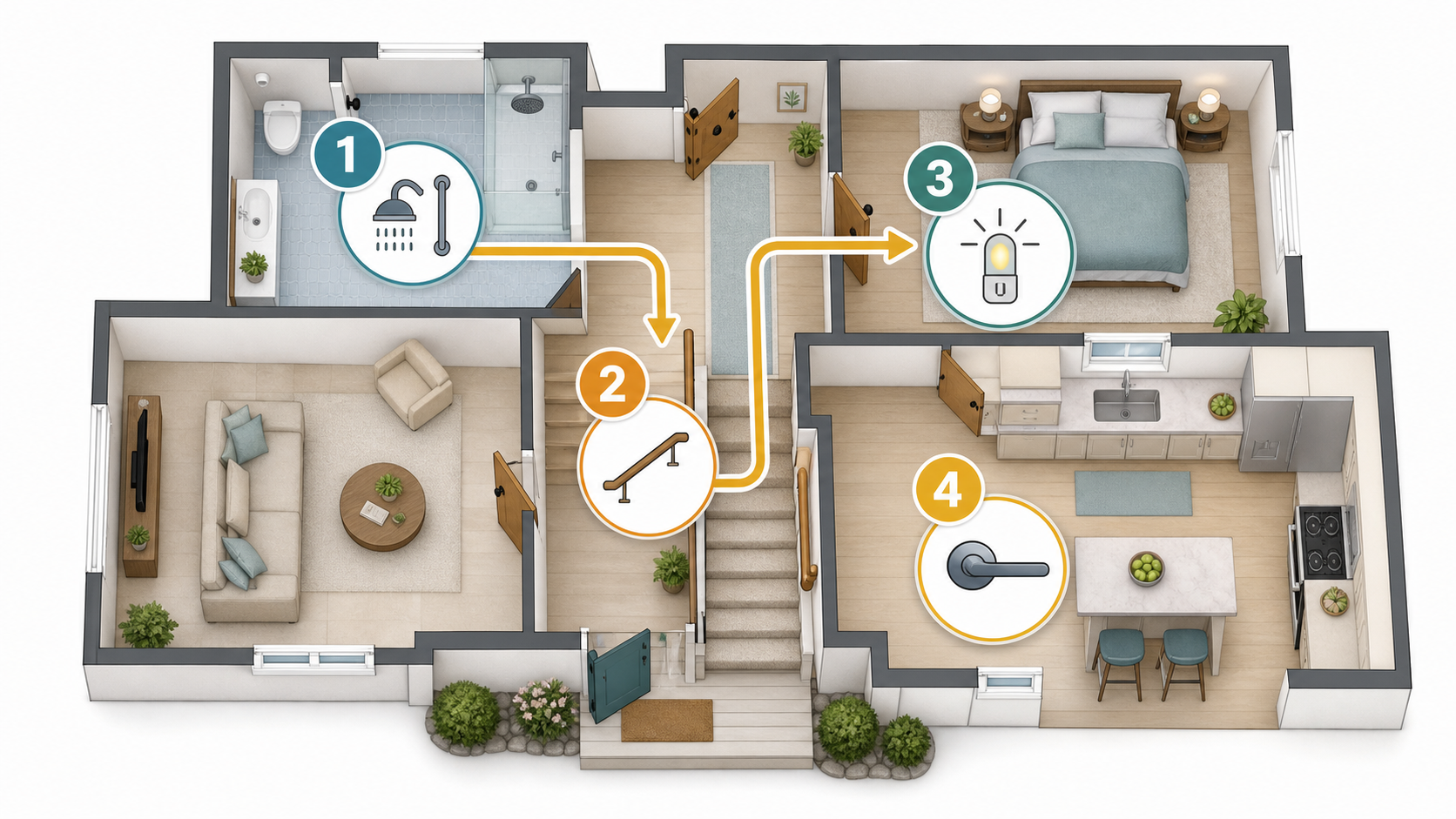
Priority 1: The Bathroom
The bathroom is the highest-risk room in the house. Wet surfaces, hard tile, and the need to transfer on and off the toilet and into the shower create multiple opportunities for a fall. The 2025 systematic review identified bathroom modifications as among the most impactful interventions, and the market data backs this up: 93% of remodelers reported installing a grab bar in a bathroom in 2023.
Start with these specific changes:
- Grab bars near the toilet and inside the shower or tub, properly secured into wall studs. These are the single most effective modification for bathroom fall prevention.
- Non-slip strips or flooring in the shower and on the bathroom floor. The AARP recommends non-slip strips on shower floors and avoiding scatter rugs, which are a major trip hazard.
- A comfort-height toilet or toilet riser, which reduces the effort and balance required to sit and stand.
- A walk-in shower or curbless shower with a shower bench or chair, eliminating the need to step over a tub wall.
- Lever-style faucets and a handheld showerhead, which reduce reaching and twisting motions.
Priority 2: Stairs and Entryways
Stair railings and handrails were identified by the systematic review as one of the most impactful modifications. Many homes have handrails on only one side of the staircase, or none at all. Installing sturdy handrails on both sides provides support during the most physically demanding movement many older adults perform daily.
At entryways, the priority is eliminating trip hazards. Thresholds that are more than half an inch high are a common fall point. Threshold ramps or zero-step entries reduce this risk. The 2006 HRS data found that railings at the entrance were the second most commonly added home feature, after grab bars, suggesting that families already recognize this as a high-priority area.
Priority 3: Bedrooms and Hallways
Falls at night are particularly dangerous because they often go undiscovered for hours. Improved lighting is the primary intervention here. The AARP recommends night-lights in bedrooms and bathrooms, easy-access light switches, and voice-activated smart lighting as options. Motion-activated night-lights along the path from bed to bathroom can prevent the disoriented, half-asleep stumble that leads to many nighttime falls.
In hallways, clear pathways free of clutter, cords, and scatter rugs are essential. If rugs are present, they should be secured with tape or slip-resistant backing.
Priority 4: The Kitchen
The kitchen presents fewer fall risks than the bathroom or stairs, but it still deserves attention. Lever-style handles on faucets and cabinet doors reduce the grip strength and twisting required. Improved task lighting under cabinets and over work surfaces helps prevent accidents during food preparation. Non-slip flooring in the kitchen is also a worthwhile investment, especially if the existing floor is smooth tile or linoleum.
Quick-Reference Table: Evidence-Backed Modifications and Cost Ranges
The table below summarizes the modifications with the strongest evidence for fall reduction, along with typical cost ranges. Use this as a starting point for planning and budgeting.
| Modification | Evidence Strength | Typical Cost Range | Notes |
|---|---|---|---|
| Grab bars (bathroom) | Strong — identified as most impactful by 2025 systematic review; 93% remodeler adoption | $50–$200 per bar (installed) | Must be secured into wall studs; professional installation recommended |
| Non-slip flooring / strips | Strong — included in Stark et al. RCT and systematic review | $200–$800 per room (strips or flooring) | Avoid scatter rugs entirely; use non-slip backing on any remaining rugs |
| Improved lighting (night-lights, motion-activated) | Moderate to strong — recommended by AARP and systematic review | $20–$150 per fixture | Focus on path from bed to bathroom; motion-activated preferred |
| Stair handrails (both sides) | Strong — identified as most impactful by systematic review | $150–$500 per rail (installed) | Ensure rails extend beyond the top and bottom steps for support |
| Threshold removal / ramps | Moderate — included in systematic review | $100–$1,000 per threshold | Thresholds over 0.5 inches are a common trip hazard |
| Doorway widening | Moderate — included in systematic review | $500–$2,000 per doorway | Primarily needed for wheelchair or walker access; less urgent for fall prevention alone |
| Walk-in shower / curbless shower | Moderate — recommended by AARP and systematic review | $3,000–$8,000 | High cost; prioritize grab bars and non-slip flooring first |
| Stair lift | Limited for fall prevention — primarily for mobility access | $3,000–$10,000 | Reserve for later-stage mobility decline; not a first-line fall prevention intervention |
Why Combining Modifications with Exercise Produces the Best Outcomes
One of the most important findings from the 2025 systematic review is that home modifications work best when combined with exercise. The review found that older adults who participated in both home modifications and a structured exercise program had a significantly lower incidence of falls compared to those who received only modifications.
This makes intuitive sense. Modifications address environmental hazards — the slippery floor, the missing handrail, the dim hallway. Exercise addresses the person's own physical capacity — balance, strength, and coordination. Neither alone is sufficient for comprehensive fall prevention. A grab bar won't help if your parent lacks the leg strength to stand, and balance exercises won't prevent a fall on an unlit staircase.
For families, this means the action plan should include both tracks: schedule the grab bar installation and the lighting upgrade, but also encourage your parent to participate in a balance and strength program. The CDC's STEADI model — which stands for Screen, Assess, Intervene — provides a framework for this combined approach, and our Fall Prevention section includes detailed guidance on balance exercises and medication fall risk.
How to Get Started: A Practical Action Plan for Families
If you're reading this after your parent has had a fall, or because you're worried about the risk, here is a step-by-step plan to move from concern to action.
Step 1: Conduct a Room-by-Room Safety Audit
Use the priority map above as your guide. Walk through each room with a critical eye: Are there grab bars in the shower and near the toilet? Are handrails present on both sides of the stairs? Is the path from bed to bathroom lit at night? Are scatter rugs present? Are thresholds higher than half an inch? Our Fall Prevention section offers room-by-room checklists that can help you be thorough.
Step 2: Start with the Highest-Impact, Lowest-Cost Modifications
Based on the evidence, your first investments should be grab bars in the bathroom, improved lighting along nighttime pathways, non-slip flooring in high-risk areas, and stair handrails on both sides. These modifications are relatively inexpensive — often under $1,000 total — and deliver the greatest fall-reduction return. For detailed guidance on grab bar installation, see our complete installation guide.
Step 3: Consider a Professional Assessment
For complex needs — multiple rooms, significant mobility limitations, or structural challenges — a professional assessment can be invaluable. Occupational therapists can conduct a comprehensive home safety evaluation and recommend specific modifications tailored to your parent's functional abilities. CAPS-certified contractors (Certified Aging-in-Place Specialists) can then execute the structural work. Our article on how an aging-in-place specialist prevents falls explains when to call in a professional and what to expect.
Step 4: Explore Funding Options
Home modifications can be expensive, but several funding sources may help offset the cost. The 2006 HRS data found that only about 6% of older adults reported that insurance or government programs paid any of the cost of their modifications — but awareness of available programs has likely increased since then. Current options include:
- VA grants: The Department of Veterans Affairs offers Home Improvement and Structural Alterations (HISA) grants for eligible veterans, as well as Specially Adapted Housing (SAH) grants for those with service-connected disabilities.
- Medicaid waivers: Some states offer Home and Community-Based Services (HCBS) waivers that can cover home modifications for eligible individuals.
- USDA Rural Development: The Section 504 Home Repair program provides grants and loans to low-income homeowners in rural areas for home repairs and modifications.
- Nonprofit programs: Habitat for Humanity's Aging in Place program and local Area Agencies on Aging may offer assistance or referrals.
Step 5: Have the Conversation
Before any work begins, you'll need to talk to your parent about fall risk and home modifications. This can be one of the hardest parts of the process — many older adults resist changes to their home because they see them as a loss of independence. Our guide on how to talk to your aging parent about fall risk and home safety offers practical strategies for navigating this conversation with empathy and respect.
The evidence is clear: home modifications work. But they work best when they are targeted, prioritized, and combined with exercise and professional guidance. By starting with the interventions that deliver the greatest fall-reduction return — grab bars, lighting, non-slip flooring, and handrails — you can make your parent's home safer without overwhelming your budget or your relationship.
Related reading
- The Evidence for Aging-in-Place Home Modifications: What Research Says About Fall Prevention, Independence, and Cost Savings
- The Evidence for Home Modifications: What Research Says About Preventing Falls, Reducing Caregiver Burden, and Keeping Older Adults Independent
- The Caregiver's Guide to Home Modifications for Aging in Place: What Actually Works, What It Costs, and What to Do First
Need a professional assessment?
Find a CAPS-credentialed professional or local aging services through our outbound resource list — we never name or rank individual contractors.
Find Local HelpNoticed something outdated or inaccurate on this page? Flag a correction. We review every report against CDC, NIA, and AARP HomeFit guidance before updating a page.