Dementia Behavior Quick-Reference Cards: What to Do When Wandering, Sundowning, and Aggression Happen
behavior referenceall stageReviewed: 2026-06-23
Dementia Behavior Quick-Reference Cards: What to Do When Wandering, Sundowning, and Aggression Happen
By Editorial Team
wandering
sundowning
agitation
repetitive questioning
dementia communication
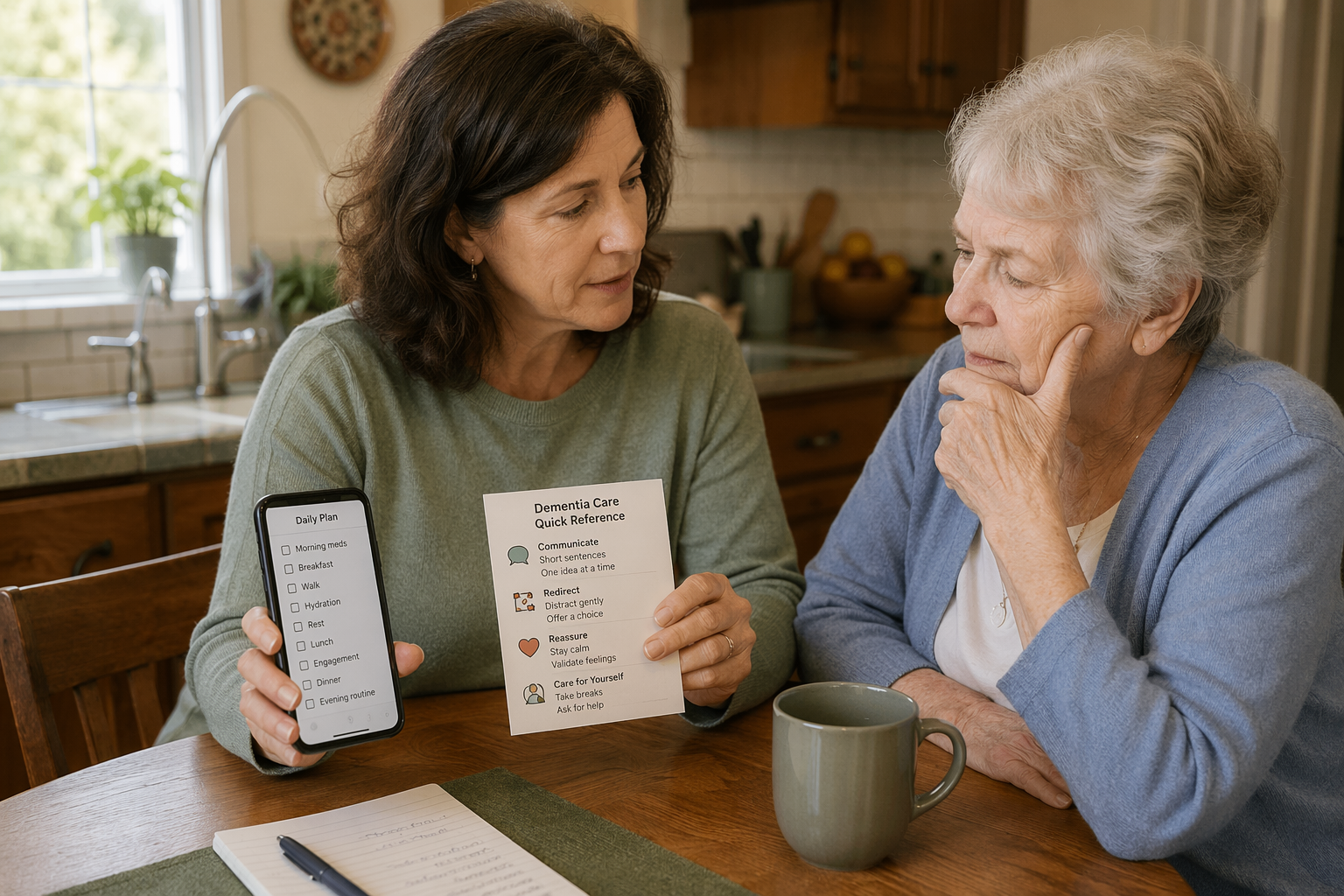
The moment when a caregiver needs guidance — not a long article, but a card they can hold and use now.
I have been the person standing in the kitchen at 5:30 p.m., phone in one hand, scrolling through an article while my mother paces and shouts at nothing. The article said “redirect gently to a calming activity.” That sentence is not wrong, but it is useless when your hands are shaking and you haven't slept through the night in weeks.
That gap is not rare. A 2025 survey of more than a thousand family caregivers found that 78% report burnout and only about 1 in 4 felt prepared when caregiving began. The Alzheimer’s Association reports that 59% of dementia caregivers experience high emotional stress. The advice is not missing — it is buried. When you need it most, you cannot find the right step.
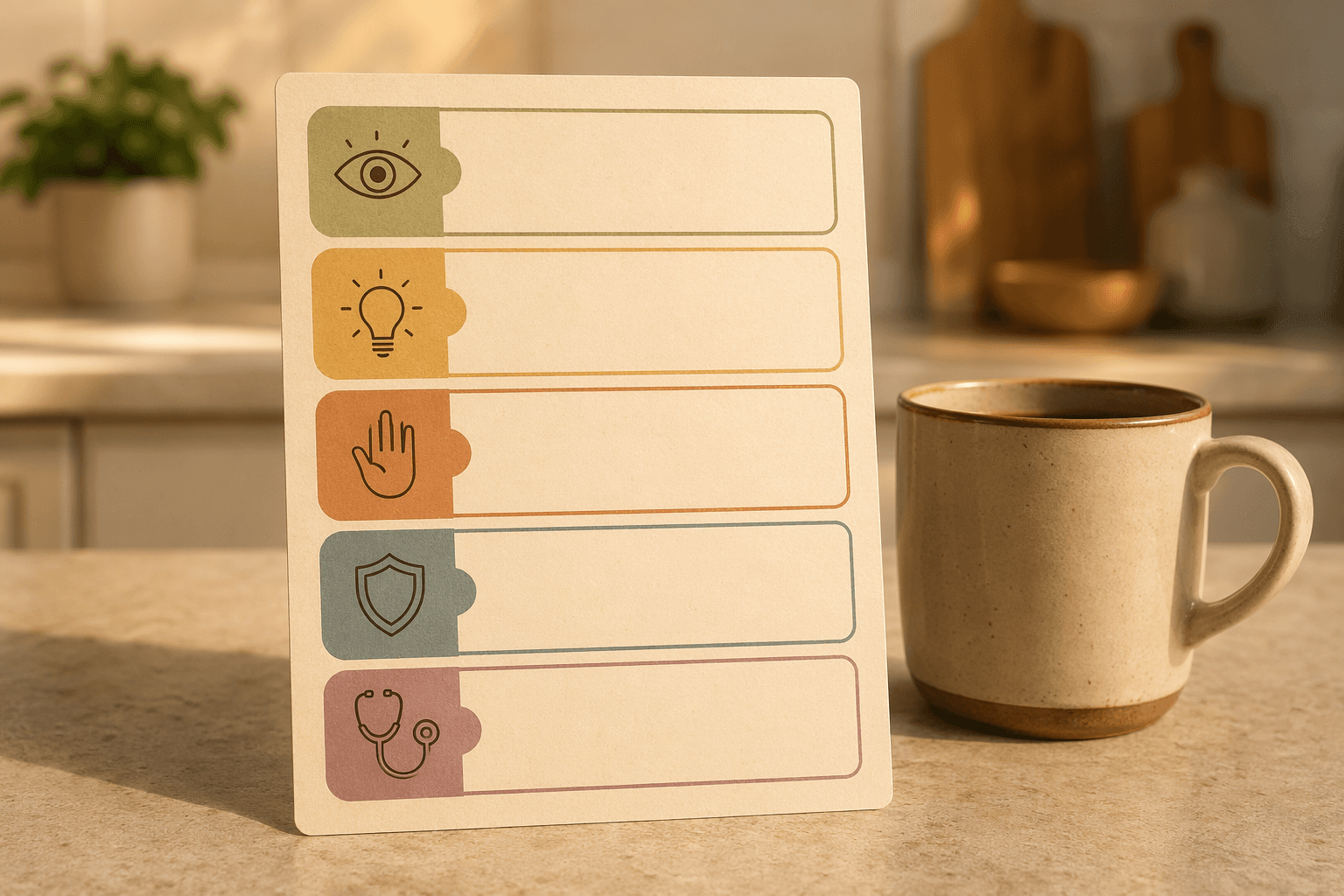
That gap is what quick-reference cards are designed to close. Not another article. A card you can keep on the fridge, open on your phone in ten seconds, and follow when the person is already upset. Each card has the same five-section structure: Recognize, Understand, Act, Prevent, When to Call the Doctor. The format forces the writer to be precise, and it gives the caregiver a clear path from recognition to de-escalation.
The consistent five-section format: Recognize, Understand, Act, Prevent, When to Call the Doctor.
Each section earns its place. Here is the logic, and where it works or fails.
Recognize gives you concrete signs — not “agitation,” but “pacing, raised voice, clenched fists, repeated phrases.” You match what you see. But the card must also list medical mimics. Many caregivers assume agitation in late afternoon is sundowning. The National Institute on Aging defines sundowning as “restlessness, agitation, irritability, and confusion as daylight begins to fade.” Those same symptoms can come from a urinary tract infection, pain, or a medication side effect. If you treat a medical problem as a behavioral one, you lose hours or days. That is why the Recognize section of every card must explicitly say: “Sudden onset within hours — consider infection, pain, medication reaction. If the behavior is new and came on fast, rule out a physical cause first.”
Understand forces a pause to ask what need might be behind the behavior. The Family Caregiver Alliance puts it plainly: “Always consider what need the person might be trying to meet.” Pain? Hunger? Overstimulation? Fear? The card lists the most common triggers so you do not have to guess. This takes about 30 seconds, and it can save an entire evening.
Act is the section that determines whether the card works. I do not accept “redirect gently” as an Act step. It is too vague. The card must pass a simple test: Could I say this sentence to the person right now, without needing to invent or adapt? If the answer is no, the guidance is still too abstract. Take wandering. The Alzheimer’s Association reports that 6 in 10 people with dementia will wander at least once; many do so repeatedly. A generic Act step — “redirect to a calming activity” — leaves the caregiver without a single usable sentence. A specific version looks like this:
Say: 'I see you are looking for something. Let us check the kitchen together.' Then guide them slowly while naming objects you pass — 'Here is the table. Here is the window. Here is the coffee pot.'
The difference is the difference between an instruction you can follow and a suggestion you have to interpret. The Family Caregiver Alliance notes that changing the caregiver’s own behavior or the physical environment often results in a change in the person with dementia’s behavior. That principle works only if the caregiver knows exactly what new behavior to try. A script gives them that. Test every Act step: Could I say this sentence right now? If not, make it more concrete.
The Act section for wandering should also include a safety note: the Alzheimer’s Association states that when a person with dementia wanders, many are found within 1.5 miles of where they disappeared. That statistic is not in the Act step itself, but it informs the urgency: do not assume a quick search will succeed.
Prevention Without Adding Exhaustion
The Prevent section is a trap. It can easily become a list of tasks that add to the caregiver’s exhaustion. “Install locks. Get alarms. Rearrange the furniture.” Each of these costs money, time, or energy that a burnt-out caregiver may not have. For wandering, the card must acknowledge that. Instead of just saying “install locks,” it should say: “Door alarms cost under $30 and can be installed yourself. Deadbolts may need a handyman. See the monitoring technology guide for a breakdown of options and costs.” That turns a burden into a decision you can make when you have a moment to breathe. The same principle applies to every card: prevention advice should be prioritized — which single change will have the biggest effect with the least effort? Often it is as simple as adjusting the daily routine, like eating dinner earlier to reduce late-afternoon fatigue, or adding a walk before sundowning typically begins.
When to Call the Doctor: Clear Thresholds, Not Panic
Many articles make caregivers feel like every new behavior warrants a call. That is paralyzing, not helpful. A good “When to Call the Doctor” section reads: “Call within 24 hours if the behavior came on suddenly (within hours), is accompanied by fever, confusion that is worse than usual, or signs of pain (guarding, grimacing). Call immediately if the person falls, hits their head, or has difficulty breathing.” That is concrete. It covers the most common medical mimics — infection, pain, medication reaction — without crying wolf. The NIA notes that agitation can be caused by infection or pain; a sudden onset is the key signal. The card makes that explicit.
Cards on the fridge — the simplest way to keep crisis guidance within arm's reach.
What the Cards Cannot Do
No card can replace knowing the person. Every person with dementia is different. What calms one may agitate another. The cards are a scaffold — a starting point that gives you a reliable response while you learn what works for your specific person. The 2025 caregiver survey found that only 1 in 4 caregivers felt prepared when caregiving began. The cards are not a replacement for that missing preparation. They are a tool to close the gap while you gain experience. The format works precisely because it does not assume you already know what to do.
But the site must commit to testing these cards with actual caregivers. What works in a writer’s notebook may fail in a real kitchen at 6 p.m. with a person who is already agitated. The cards need to be updated based on what caregivers report — which scripts land, which triggers are missed, which prevention ideas are too expensive. That is the only way they remain trustworthy.
What to Do Now
If you need something to grab when the person is already upset and your hands are shaking, these cards are your best bet right now. Print them. Put them on the fridge. Bookmark them on your phone. But bring your own knowledge to them. You know the person better than any card ever will. And tell us what did not work. That is how the cards get better.



Comments
Join the discussion with an anonymous comment.