The Dementia Behavior Toolkit: Practical Strategies for Managing Common Memory-Care Challenges at Home
stage guidemiddle-stage stageReviewed: 2026-06-23
The Dementia Behavior Toolkit: Practical Strategies for Managing Common Memory-Care Challenges at Home
A practical guide for family caregivers of a parent or spouse with moderate to advanced dementia, offering a structured framework (Reassure, Routine, Reminisce, Redirect) to reduce distressing behaviors and improve daily life without medication.
By Editorial Team
wandering
sundowning
agitation
dementia communication
BPSD
31 Hours a Week, 28% Physical Strain — This Is Not a Normal Caregiver Job
It is 9 p.m. on a Tuesday. You have already worked a full day, made dinner, helped your mother through a sundowning episode that started at 4, and now you are sitting in the hallway outside her room, waiting to see if she will settle. Tomorrow you will do it again. The numbers confirm what you already feel. According to a 2025 Johns Hopkins study, family caregivers of older adults with dementia provide an average of 31 hours of care per week — nearly 50% more than caregivers of older adults without dementia. The Family Caregiver Alliance, citing NAC/AARP 2015 data, reports that 28% of dementia caregivers experience high physical strain, compared with 17% of other caregivers. I mention these numbers not to depress you, but to set the bar for what a behavior strategy must actually deliver. If you are running on fumes, you need tools that work within your limits — not frameworks designed for a rested person in a quiet room.
Behaviors Are Messages, Not Mischief
Most caregivers start from the same assumption: the person with dementia is acting out. The wandering, the repeated questions, the sudden anger — it looks like willful misbehavior. But the research points elsewhere. The Family Caregiver Alliance says plainly: "Most dementia behaviors are triggered and have a purpose; changing the caregiver's response or the physical environment can reduce the behavior without medication." That reframe — from misbehavior to unmet need — is the foundation. When you start asking "What is this behavior trying to communicate?" instead of "How do I make it stop?", you shift from fighting your loved one to understanding them.
The National Council of Certified Dementia Practitioners (NCCDP) offers a structured framework: the Four R's — Reassure, Routine, Reminisce, and Redirect. They are not a magic fix. They are a practical lens for decoding what is happening and choosing a response that fits both the person with dementia and your own energy level.
Reassure First, Ask Questions Later — Even When You Have No Patience Left
Reassure sounds soft. It is not. It is the single highest-return, lowest-effort move you can make, especially when you are exhausted. Consider sundowning. The person becomes agitated in the late afternoon. You are tired. Your instinct might be to reason, argue, correct. But Alzheimer's.gov advises: speak calmly, listen, reassure. The NCCDP adds: use gentle touch, provide a safe environment, offer positive reinforcement. Here is a concrete version: when the agitation starts, pause what you are doing. Take a breath. Then say, "I'm right here. Everything is okay." You are not fixing anything. You are signaling safety. The Family Caregiver Alliance also recommends increasing daytime activity, limiting caffeine and sugar after noon, turning on lights well before sunset, and closing curtains to reduce shadows — all proactive environmental reassurance. But when you are already in the middle of an episode, a calm voice and a gentle touch can de-escalate faster than any reasoning. I have seen caregivers dismiss Reassure as too simple. But simple is exactly what you need when your brain is fried. It costs zero energy beyond what you are already spending to react.
Routine: The Anchor That Frees You From Constant Decisions
A predictable daily schedule reduces confusion and agitation for the person with dementia. It also reduces your own cognitive load. When the morning, afternoon, and evening follow a pattern, you stop having to decide what comes next forty times a day. The NCCDP describes Routine as establishing a consistent schedule for meals, activities, and rest, breaking tasks into manageable steps, and maintaining consistency in caregivers and environment. Wandering often happens when the person is disoriented, searching for something familiar. A routine that includes a daily walk at the same time, a consistent place to sit after lunch, and familiar cues (like a clock visible from the living room) can reduce the urge to wander because the environment feels more predictable. The Family Caregiver Alliance also suggests practical safety tools: install new locks that require a key, position locks high or low on the door, consider a GPS tracking device. But those tools work best when the routine is already in place — they are the backup, not the primary strategy. If you are too exhausted to build a full schedule from scratch, start with one anchor: a fixed bedtime routine. That alone can reduce nighttime agitation and give you a predictable window of rest.
Reminisce When the World Feels Unrecognizable — and Redirect When You're Spent
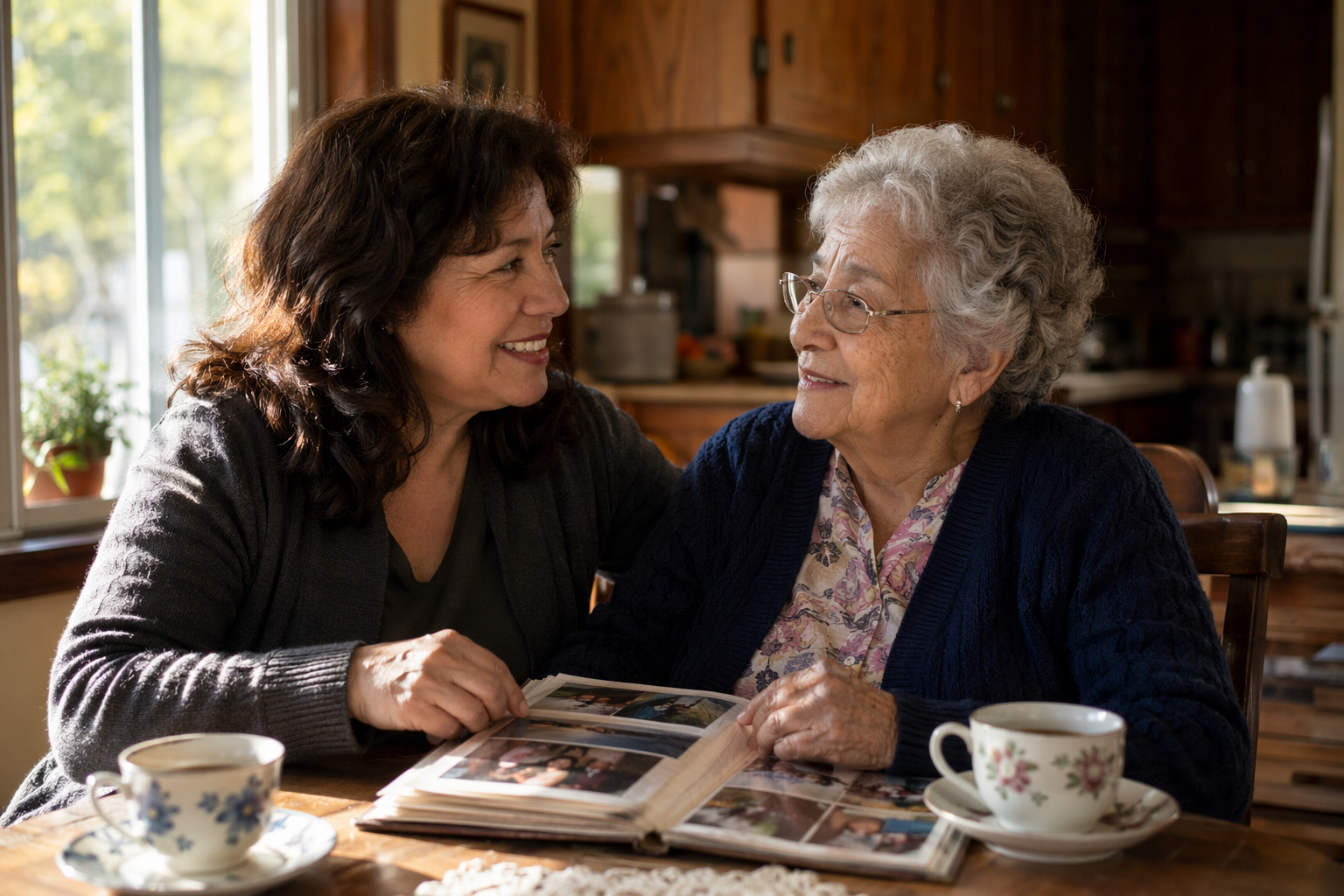
These two R's often work as a pair. You use Reminisce to connect, then Redirect to get out of a loop. Reminisce uses music, photo albums, storytelling, or familiar objects from the person's past to ground them in a sense of identity and comfort. A 1960s ballad or a photograph of their childhood home can sometimes break through agitation when nothing else can. The NCCDP recommends photo albums, music from the person's past, and memory boxes.
Redirect is the emergency exit. When the person is stuck in repetitive questioning — the same question every 90 seconds — trying to answer logically will exhaust both of you. Instead, acknowledge the feeling behind the question ("I know you're worried about dinner; it's under control") and then shift to a different activity. The NCCDP advises distraction: move to a quieter area, offer a favorite snack, suggest a simple task like folding napkins. The key is to avoid arguing. Arguing escalates; redirecting dissolves.
Bathing resistance is a classic place where Reminisce and Redirect together are far more effective than force or pleading. The Family Caregiver Alliance describes the "towel bath" method: a large bath towel and no-rinse soap in a plastic bag of warm water. Keep the person covered and warm. Massage the dampened towel over the body. Before starting, you might say, "Remember how your mother used to give you a warm towel after a bath?" — that is Reminisce. Then you proceed with the bath, which is a form of Redirect: the task itself becomes the focus, not the fear. If you have no energy for the elaborate version, skip the Reminisce step and go straight to Redirect. A change of scene or a simple task can be enough. Do not feel guilty for taking the shortcut.
When to Call the Doctor: A Clear Threshold, Not One More Burden
I want to give you a rule that reduces uncertainty, not adds to it. Call the doctor within 24 hours if a behavior appears suddenly — sudden aggression with no obvious trigger, a new hallucination, a change in sleep-wake cycle that seems related to pain or illness. That is a potential medical problem (infection, medication side effect, pain) that needs evaluation. If the behavior has been building gradually over weeks or months, it is more likely disease progression. The Four R's can help manage it, but if you have tried them consistently and the behavior continues to escalate, that is also a signal — not that you failed, but that the disease is advancing and your care approach may need to shift. The Medicare GUIDE model, launched in 2024, offers up to $2,500 per year in respite services for dementia caregivers. Eligibility varies by plan and region, so check with your Medicare plan. If you are considering whether in-home care is still sustainable, our article Is It Time for Memory Care? A Functional Sign-Based Decision Guide for Families can help you recognize the functional signs that signal a transition may be necessary.
The Strategy That Works Only If You Can Still Stand
I have walked you through the Four R's because I believe they are the most useful framework we have for managing dementia behaviors without medication. But I also have to tell you this: no strategy works if you are too depleted to use it. The same Johns Hopkins study that reported 31 hours of care per week also found that the number of family caregivers rose 32% between 2011 and 2022. More people are doing this, alone, for longer periods. The Family Caregiver Alliance reports that 40% to 70% of dementia caregivers have clinically significant symptoms of depression. That is not a weakness. It is a consequence of doing an impossible job without enough support.
Pick one behavior this week — wandering, sundowning, repetitive questions — and try the corresponding R. If you cannot even manage that, it is not a failure. It is data. It means your own reserves are too low. That is the moment to ask for help: a private sitter, adult day care, or even a few hours of respite. Our guide on Caregiver Burnout: Warning Signs and How to Recover can help you recognize when you have crossed that line.
The Four R's are powerful tools. But they are tools, not a test of your worth. Use what you can, when you can. You are not failing. You are doing something brutally hard, and you deserve a strategy that starts from that truth.



Comments
Join the discussion with an anonymous comment.