
Is It Time for Memory Care? A Functional Sign-Based Decision Guide for Families
For adult children caring for a parent with dementia, the decision to move to memory care is driven by observable functional signs, not a diagnosis alone. This guide covers eight key signs, a cost comparison of in-home vs. residential memory care, what to look for on tours, and how to plan payment.
The Weight of the Memory Care Decision

Few caregiving decisions carry as much emotional weight as determining whether a parent with dementia needs memory care. The question arrives slowly at first — a missed medication here, a strange bruise there — and then all at once, after a fall, a wandering episode, or a call from a concerned neighbor. Adult children in their 40s and 50s often find themselves caught between two equally uncomfortable positions: the guilt of considering a move and the fear of what happens if they don't.
This guide is built on a straightforward premise: the decision to transition to memory care should be driven by observable functional signs, not by a diagnosis alone or by an arbitrary timeline. Families who track these signs systematically — rather than reacting to individual incidents — can time the move to preserve their parent's dignity, maintain more facility choices, and avoid the financial and emotional toll of a crisis placement.
The sections that follow cover the eight functional signals that indicate home care is no longer sufficient, the real cost math that often surprises families, what memory care actually provides that assisted living doesn't, and a practical framework for evaluating communities and planning payment. The goal is not to push a particular outcome but to give you a systematic method for making one of the hardest calls you will face as a caregiver.
Eight Functional Signs That Signal It's Time
The following eight signs, adapted from clinical guidance reviewed by dementia care practitioners, represent the observable changes that indicate a person with dementia may no longer be safe or well-supported at home. No single sign alone mandates a move, but when two or three cluster together — or when any single sign becomes recurrent — it is time to begin a formal evaluation.
1. Difficulty with Activities of Daily Living (ADLs)
The most fundamental signal is a decline in the ability to perform basic self-care tasks: forgetting to eat or drink, dressing inappropriately for the weather, refusing to bathe, or losing bladder and bowel control. When a person with dementia can no longer manage these tasks safely even with prompting, the level of supervision required often exceeds what a single family caregiver can provide at home. The ADL and IADL assessment framework offers a structured way to track these changes over time.
2. Behavior, Mood, and Personality Changes
Verbal or physical aggression, severe confusion, disorientation in familiar settings, and sundowning — increased agitation in the late afternoon and evening — are among the strongest signals that home care is no longer sufficient. These behaviors are not the person's fault, and they are not a reflection of the caregiver's efforts. They are symptoms of the disease's progression in the brain, and they often require a trained, rotating team to manage safely.
3. Wandering and Forgetfulness Becoming Dangerous
Wandering far from home, leaving the stove on, attempting to leave the house at night, or forgetting that they are home alone are red-flag events. A single wandering episode that requires police involvement is enough to warrant an immediate safety assessment. Memory care communities are designed with secured environments specifically to prevent wandering-related harm.
4. Abandoning Healthy Habits and Routines
When a person stops taking medications as prescribed, becomes sedentary, or loses interest in activities they once enjoyed, the decline is not just emotional — it is functional. Missed medications can accelerate cognitive decline and cause secondary health crises. A structured environment with scheduled medication management and daily programming can restore a rhythm that is difficult to maintain at home.
5. Getting Hurt More Often
An increase in falls, unexplained bruises, or frequent emergency room visits is a clear signal that the home environment is no longer safe. Falls are the leading cause of injury among older adults, and a single fall can permanently reduce mobility and independence. Memory care communities have lower resident-to-staff ratios and environments designed to minimize fall risks.
6. No Longer Taking Care of Pets or the Home
Neglect of a beloved pet, a visibly unkempt home, or unpaid bills piling up are signs that executive function — the brain's ability to plan, organize, and follow through — has significantly declined. These are not signs of laziness or disinterest; they are neurological symptoms that indicate the person needs a higher level of support.
7. Caregiving Is Becoming More Difficult (Caregiver Burnout)
This is the sign that caregivers most often ignore. The symptoms of caregiver burnout — persistent headaches, poor sleep, anxiety, forgetfulness, social withdrawal, and resentment toward the person they are caring for — are not a personal failing. They are a documented syndrome that signals the current care arrangement is unsustainable. A Place for Mom's medically reviewed guidance explicitly lists caregiver burnout as a legitimate indicator that it is time to consider memory care.
8. The Doctor Has Noticed Changes
When a physician observes declining performance on a mental status exam or a clock-drawing test, or when they express concern about the person's safety at home, that professional observation carries weight. Doctors see hundreds of dementia patients and can often identify the tipping point before families do, because they have a comparative baseline.
Understanding the Three Types of Memory Care
Memory care is not a single product. It exists on a spectrum of service intensity, and understanding the three primary types can help families choose the right level of support without over- or under-committing.
- In-home memory care: A trained caregiver comes to the home to provide dementia-specific support — medication reminders, meal preparation, companionship, and supervision. This is appropriate for early to middle stages when the person is still safe at home but needs structured daily assistance. It is not appropriate for wandering, aggression, or 24/7 supervision needs.
- Respite memory care: A short-term stay — typically one to four weeks — in a memory care community. Respite serves two purposes: it gives the primary caregiver a break to recover from burnout, and it allows the person with dementia to try the environment before a permanent move. Some families use respite as a trial period before committing.
- Residential memory care: A dedicated secured living environment with 24/7 specialized staff, structured programming, and medical oversight. This is the appropriate level for middle to late-stage dementia when safety, behavior management, and full-time supervision are required.
The Senior Care Options Glossary provides a quick-reference definition of each care type and how they differ from assisted living and skilled nursing.
The Cost Math: In-Home Care vs. Residential Memory Care
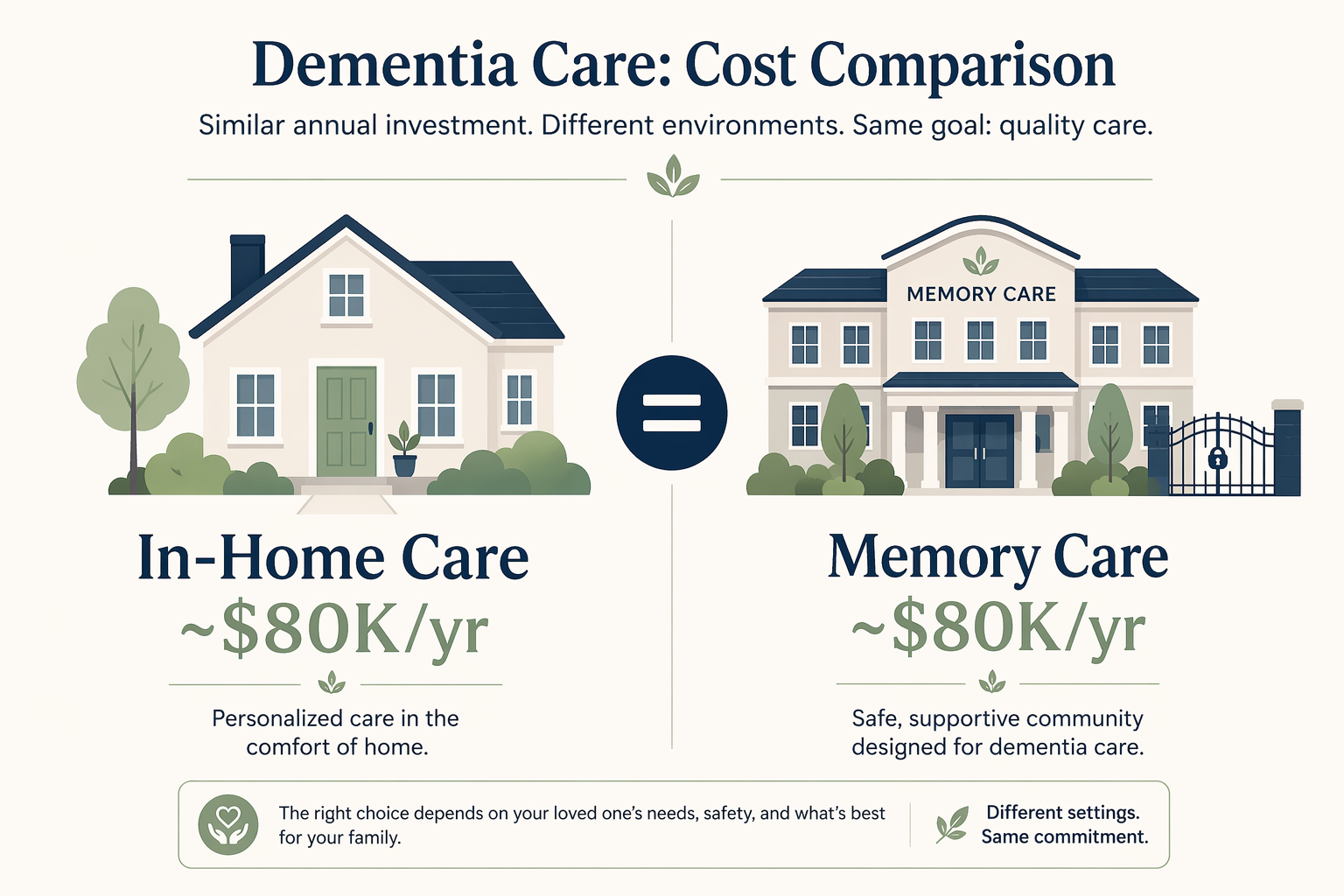
One of the most persistent myths in senior care is that staying at home with paid help is always cheaper than moving to a facility. For dementia care, the math often tells a different story.
Non-medical in-home care costs a national median of $35 per hour, according to the CareScout 2025 Cost of Care Survey. At 44 hours per week — roughly six hours of daily coverage — that comes to $80,080 per year. For context, the national median cost of residential memory care is approximately $6,690 per month, or $80,280 per year, based on A Place for Mom's 2026 analysis of 10,474 resident moves.
| Care Option | Monthly Cost | Annual Cost | Key Consideration |
|---|---|---|---|
| In-home care (44 hrs/week) | $6,673 | $80,080 | Does not include 24/7 overnight coverage |
| Residential memory care (national median) | $6,690 | $80,280 | Includes housing, meals, 24/7 supervision, programming |
| Residential memory care (lowest state: Utah) | $4,806 | $57,672 | State median; actual costs vary by location |
| Residential memory care (highest state: Vermont) | $11,195 | $134,340 | State median; actual costs vary by location |
| Assisted living (national median) | $6,200 | $74,400 | Does not include dementia-specific programming or secured unit |
| Nursing home semiprivate (national median) | $9,842 | $118,104 | Medical model; appropriate for late-stage with complex medical needs |
The critical insight is that in-home care costs scale linearly with hours. If your parent needs 12 hours of daily coverage — which is common in middle-stage dementia — the annual cost jumps to over $153,000, far exceeding memory care. As Jacqui Clark, a senior care consultant quoted in U.S. News, puts it: "Staying at home with care is the most expensive option. It's a big myth that it's cheaper to stay at home with care."
For a deeper dive into the cost threshold where in-home care becomes more expensive than facility care, see the companion article Home Care vs. Assisted Living: The 40-Hour Cost Threshold Families Need to Know. For a broader look at 2026 cost trends across all care types, see Senior Care Options in 2026: A Cost Reality Check for Families.
What Memory Care Provides That Assisted Living Doesn't
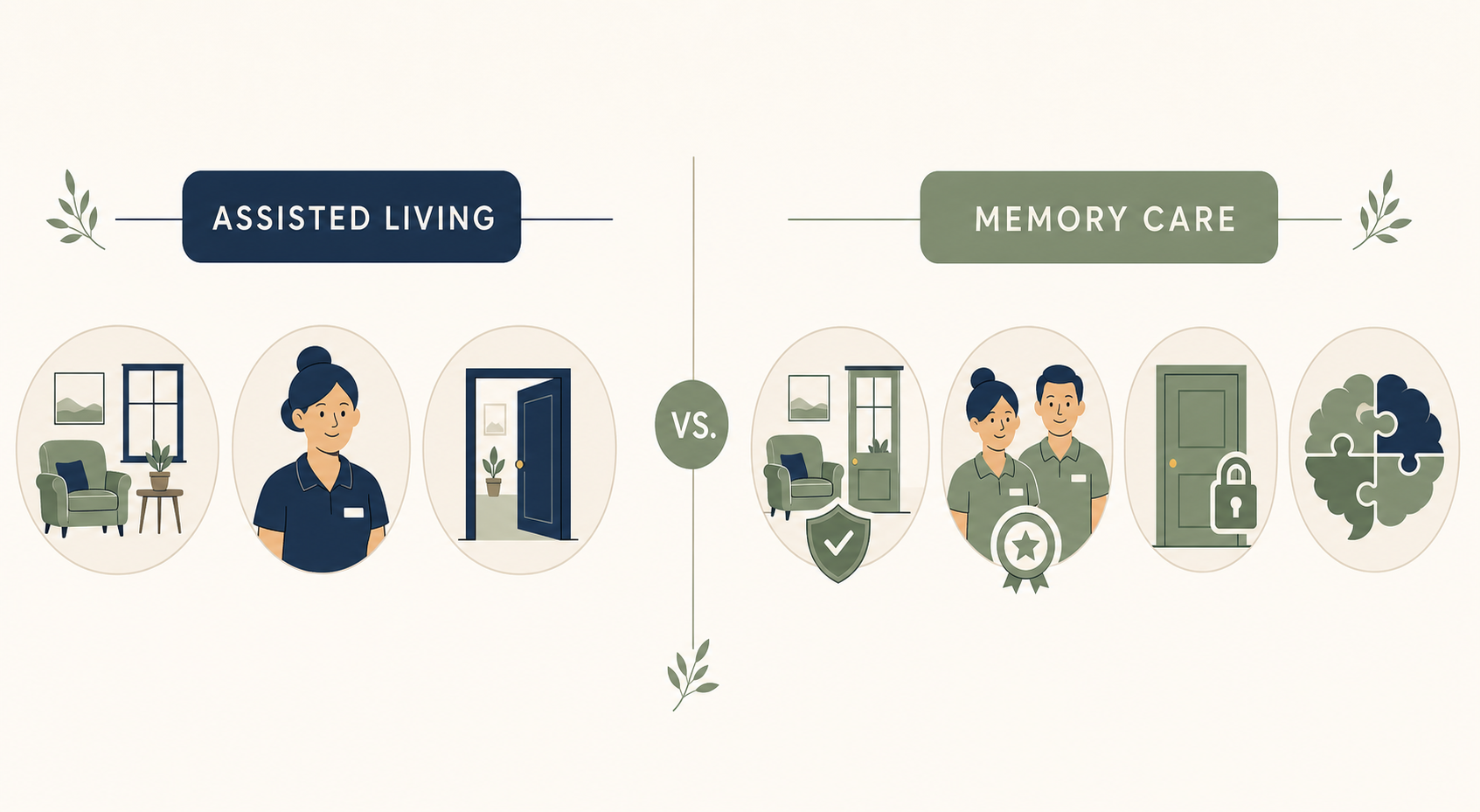
Memory care costs roughly 25% more than standard assisted living, according to A Place for Mom's 2026 data. That premium pays for four structural differences that directly affect safety and quality of life for a person with dementia.
- Secured environments: Memory care units have locked doors, alarmed exits, and enclosed outdoor spaces designed to prevent wandering. Assisted living communities typically do not have these features because their residents do not need them.
- Specially trained staff: Staff in memory care receive training in dementia-specific communication techniques, behavior de-escalation, and person-centered care. Assisted living staff are trained in general elder care but not necessarily in the nuances of dementia behavior management.
- Lower resident-to-staff ratios: Memory care communities maintain lower ratios because residents require more hands-on assistance and supervision. This is the single most important operational difference for safety.
- Cognition-focused programming: Activities in memory care are designed to stimulate cognitive function, reduce agitation, and provide meaningful engagement at the resident's current ability level. Assisted living activities are typically social and recreational, not cognition-specific.
These differences matter most when a person with dementia can no longer follow verbal safety instructions, becomes disoriented in unfamiliar spaces, or requires redirection throughout the day. In those situations, an assisted living apartment — no matter how nice — becomes an unsafe environment.
14 Questions to Ask When Touring Memory Care Communities
The National Institute on Aging recommends making both scheduled and unannounced visits to any facility you are considering. A scheduled tour shows you the community at its best. An unannounced visit — especially during a meal time or in the evening — shows you how it operates on a normal day. Bring the following questions with you.
- How do you keep families involved in care planning and daily updates?
- What support can my parent expect with daily activities like bathing, dressing, eating, and toileting?
- Is medical care provided on-site, or do you coordinate with outside providers? How are medication changes communicated to families?
- What can my parent bring when they move in? Are personal furnishings, photos, and familiar objects encouraged?
- How will you keep my parent active and engaged despite their dementia? What does a typical daily schedule look like?
- How will you help my parent feel at home during the first few weeks? What is your transition protocol?
- How do you get to know each resident's personal background, life story, and preferences?
- What is the rate of falls in this community? How do you track and respond to falls?
- How well do residents get along with each other? How do you manage conflicts between residents?
- How does staff manage challenging behaviors like aggression, sundowning, or repetitive questioning? What de-escalation techniques do you use?
- Are indoor and outdoor spaces safe and secure? Can residents go outside independently? How do you prevent wandering?
- How will my parent's nutrition and hydration be monitored? Can family visit during mealtimes to observe?
- Will my parent be forced to move to a higher level of care as their condition progresses, or can they age in place here?
- How long have the director and key department heads worked at this facility? What is staff turnover like?
How to Pay for Memory Care: VA, Medicaid, and State Programs
Medicare does not cover memory care. This is one of the most important financial facts for families to understand. Medicare Part A covers short-term skilled nursing stays (up to 100 days with conditions) but not the long-term custodial care that memory care provides. The 2026 Part A deductible is $1,736, and days 21-100 require a $217 daily copay — but these figures apply only to post-hospital rehabilitation, not to memory care.
The primary payment sources for memory care are:
- VA Aid & Attendance benefits: Eligible veterans and surviving spouses can receive monthly payments to help cover the cost of memory care. Current maximums are $2,874 per month for a married veteran, $2,424 for a single veteran, and $1,558 for a surviving spouse. These benefits can be used at any VA-approved memory care community.
- Medicaid waiver programs: Many states offer Home and Community-Based Services (HCBS) waivers that can help pay for memory care. Eligibility and coverage vary significantly by state. Some states have waiting lists that can extend for months or years, so it is important to apply early.
- State-specific assistance programs: Some states have additional programs for low-income seniors or for those with dementia. Your local Area Agency on Aging can provide state-specific guidance.
- Long-term care insurance: If your parent has a long-term care insurance policy, review it carefully. Some policies cover memory care, but coverage limits, elimination periods, and benefit triggers vary widely.
| Payment Source | Maximum Monthly Benefit | Key Limitation |
|---|---|---|
| VA Aid & Attendance (married veteran) | $2,874 | Must have served 90+ days active duty with at least 1 day during wartime |
| VA Aid & Attendance (single veteran) | $2,424 | Same eligibility requirements |
| VA Aid & Attendance (surviving spouse) | $1,558 | Must not have remarried |
| Medicaid HCBS waiver | Varies by state | Waiting lists in many states; eligibility based on income and assets |
| Long-term care insurance | Varies by policy | Coverage triggers and elimination periods vary; review policy carefully |
| Medicare | $0 | Does not cover memory care; covers only short-term skilled nursing after hospitalization |
Tips for Negotiating Costs and Timing the Move
Memory care is expensive, but families who approach the process strategically can reduce costs and preserve more options. The following strategies are based on industry patterns and the experience of senior placement advisors.
- Move at the end of a month, quarter, or year: Communities often have occupancy targets and may offer lower rates or waived entry fees when they need to fill units before a reporting period ends.
- Ask about move-in incentives: Some communities offer discounted first-month rent, waived community fees, or reduced rates for the first three months. These incentives are not always advertised.
- Consider a shared room: Splitting a room with a roommate can significantly reduce monthly costs. This is not appropriate for every resident, but it is worth asking about.
- Look for memory-care-only communities: According to A Place for Mom's 2026 data, 14% of communities in their network provide memory care only. These communities may have more specialized pricing and programming than mixed-use facilities.
- Time the move before a crisis: This is the single most important strategy. Families who wait until after a hospitalization, a fall, or a wandering episode have fewer facility choices, less time to negotiate, and higher stress. A planned move preserves your leverage and your parent's dignity.
The decision to move a parent to memory care is never easy, but it does not have to be made in the dark. By tracking functional signs systematically, understanding the real cost comparison, evaluating communities with a structured question set, and planning payment in advance, families can make the transition at the right time — on their terms, not in crisis.
Related reading
Noticed something outdated or inaccurate on this page? Flag a correction. We review every report against CDC, NIA, and AARP HomeFit guidance before updating a page.
Part of the Fall Prevention section.