
Dementia Wandering Safety Plan for Caregivers at Home
A practical, tiered guide for family caregivers to prevent, manage, and respond to wandering in a loved one with dementia at home — covering environmental modifications, daily routines, monitoring technology, and emergency preparedness.
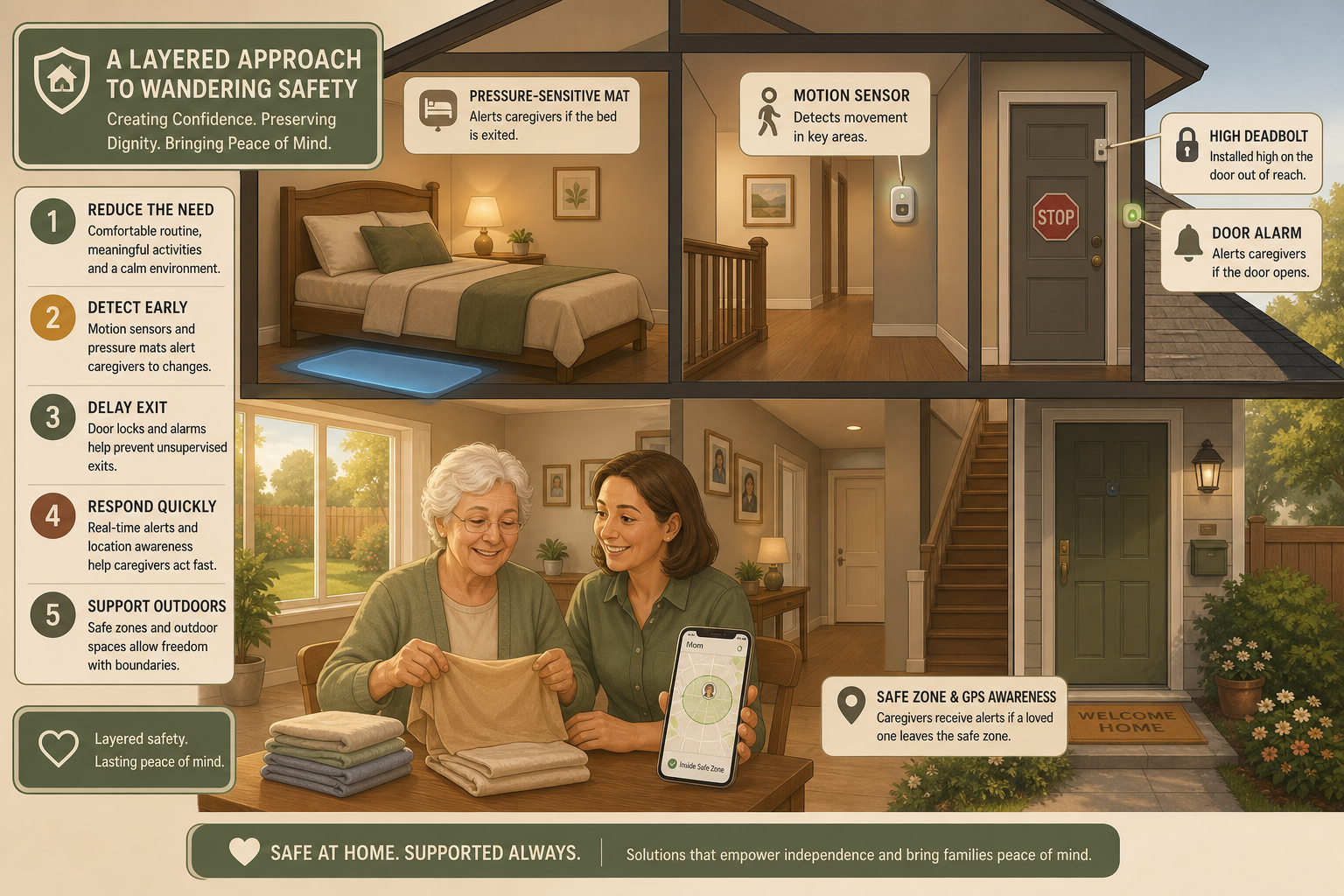
Why People With Dementia Wander
Wandering is not a random or defiant act. It is a symptom of the underlying neurological changes caused by dementia, and understanding its drivers is the first step toward effective prevention. When a person with dementia wanders, they are usually responding to an internal or external trigger that their damaged brain cannot process in a typical way.
The most common cognitive drivers include:
- Disorientation and memory loss: The person may no longer recognize their own home, believing they are in a strange place and need to "go home" to a house they lived in decades ago. They may set out for a former workplace, a childhood home, or a place of worship that holds deep emotional meaning.
- Unmet basic needs: Hunger, thirst, a full bladder, pain, or the need to use the bathroom can create a sense of urgency that the person cannot articulate. Instead of asking for help, they may begin pacing or searching for a solution, which escalates into leaving the house.
- Restlessness and boredom: A lack of meaningful activity during the day can lead to agitation and a drive to "do something." This is especially common in the late afternoon and early evening, a phenomenon known as sundowning.
- Anxiety or fear: A person with dementia may feel threatened by noise, clutter, or unfamiliar people in the home. Their instinct may be to flee the perceived danger.
- Following a former routine: Someone who walked to a bus stop or a store every day for decades may continue to do so out of habit, even if they no longer remember the purpose of the trip.
Recognizing these drivers reframes wandering from a behavioral problem to a symptom that can be anticipated and managed. When a caregiver understands that the person is not trying to escape but is instead responding to an internal cue they cannot control, the response shifts from frustration to problem-solving.
How Common Is Wandering? Key Statistics
The prevalence of wandering is one of the most compelling reasons to build a safety plan before an incident occurs. According to the Alzheimer's Association, six in 10 people living with dementia will wander at least once. Many will do so repeatedly. This is not a rare or exceptional event — it is a predictable part of the disease trajectory for the majority of individuals.
A 2024 peer-reviewed study published in JMIR Aging by Miguel-Cruz and colleagues analyzed 560 missing incidents involving 434 older adult MedicAlert subscribers between January 2015 and July 2021. The findings provide a detailed picture of when, where, and how wandering incidents unfold:
| Metric | Finding |
|---|---|
| Origin of incidents | 67.1% originated from private homes in the community |
| Mode of travel | 91.9% were on foot |
| Time of day | 46.8% occurred in the afternoon (noon–5:59 PM); 31.1% in the evening (6–11:59 PM) |
| Who found them | 47.7% located by first responders; 46.1% by Good Samaritans |
| Outcome | 90.6% returned home safely; 9.2% experienced harm or injury; 0.2% died |
| Repeat incidents | 22.5% of incidents were repeat events; mean time between incidents was 11 months |
| Living situation | 64% lived with family; average age was 82.56 years |
The study also found that most individuals who wander are found within 1.5 miles of where they disappeared, and that wandering patterns generally follow the direction of the person's dominant hand. This geographic constraint is a critical piece of information for search planning, which we will cover in the emergency preparedness section.
Tier 1: Environmental Modifications to Prevent Wandering
The first line of defense against wandering is a home environment that makes it physically difficult to leave without a caregiver's awareness. These modifications are low-cost, do not require structural renovation, and can be implemented in a single afternoon. The goal is not to imprison the person but to create gentle barriers that interrupt the impulse to wander before it becomes an exit.
Doors and Locks
Standard door locks at eye level are easy for a person with dementia to operate, often without conscious thought. The Alzheimer's Association recommends installing deadbolts that are placed either high above eye level or low near the floor — out of the person's natural line of sight. This simple change can prevent a person from instinctively unlocking and opening a door while still allowing the caregiver easy access.
- Install deadbolts out of sight: Place them at the very top or very bottom of the door frame, where the person is unlikely to look.
- Camouflage doors: Paint the door the same color as the surrounding wall, or hang a curtain over it. This reduces the visual cue that says "this is an exit."
- Create a black threshold: Apply a two-foot strip of black tape or paint across the floor in front of the door. Many people with dementia perceive a dark area as a hole or drop-off and will hesitate to step over it.
- Remove interior door locks: On bedrooms, bathrooms, and closets, remove or disable locks that could allow the person to lock themselves in.
- Keep an extra set of keys hidden near the door: In case of emergency, you need to be able to unlock any door quickly without searching for keys.
Windows and Sliding Doors
Windows and sliding glass doors are common exit points, especially on the ground floor. Install locks that require a key or a tool to open, and consider placing a decorative film on sliding doors to make them look like a wall or a bookshelf rather than an exit. Remove or secure any window treatments that could be used as a climbing aid.
Lighting and Visibility
Poor lighting can increase disorientation and anxiety, especially at night. The Alzheimer's Association recommends using night lights in hallways, bedrooms, and bathrooms to create a clear, safe path. Extra lighting at entries, landings, and stairways reduces the risk of falls and helps the person orient themselves if they get up during the night.
Securing Potential Hazards
A person who wanders may also be at risk of injury from household hazards. Remove tripping hazards such as throw rugs and extension cords. Secure large furniture to the wall to prevent tipping. Keep car keys out of sight — a person with dementia may attempt to drive without remembering they are no longer able to do so safely. In the garage and basement, limit access to tools, chemicals, and vehicles.
Tier 2: Daily Routines That Reduce Wandering Triggers
Environmental modifications address the physical opportunity to wander. Daily routines address the underlying triggers that make a person want to wander in the first place. When basic needs are met, anxiety is reduced, and the day has structure, the urge to wander often diminishes significantly.
Addressing Unmet Needs Before They Escalate
Many wandering episodes are preceded by a period of restlessness or agitation that signals an unmet need. The Alzheimer's Association recommends a proactive approach: scheduled toileting, regular hydration and meals, and pain management. If the person tends to wander in the late afternoon, consider whether they are hungry, tired, or need to use the bathroom at that time.
| Time of Day | Common Trigger | Preventive Strategy |
|---|---|---|
| Morning | Disorientation upon waking | Open curtains, establish a consistent wake-up routine, offer a familiar breakfast |
| Midday | Boredom, restlessness | Engage in a meaningful task: folding laundry, setting the table, sorting mail |
| Late afternoon | Sundowning, fatigue, hunger | Offer a snack, reduce noise and stimulation, dim lights, play calming music |
| Evening | Need to use the bathroom, confusion | Reduce liquids before bedtime, guide to the bathroom before sleep, use a night light |
| Night | Sleep disturbance, pain | Check for discomfort, use a pressure mat to alert you if they get out of bed |
Structured Activity and Purposeful Engagement
A person with dementia who has nothing to do is more likely to become restless and seek stimulation by wandering. The Alzheimer's Association suggests involving the person in daily chores and activities that feel familiar and meaningful. Folding laundry, wiping counters, sorting silverware, watering plants, or setting the table can provide a sense of purpose and reduce the urge to "go somewhere" to find something to do.
Daytime physical activity is equally important. A walk around the block, gentle stretching, or supervised gardening can help expend restless energy and improve sleep quality at night. The key is to match the activity to the person's abilities and interests — not to impose a schedule that feels foreign or demanding.
Managing Sundowning
Sundowning — increased confusion, agitation, and restlessness in the late afternoon and early evening — is a major trigger for wandering. The Alzheimer's Association identifies this as a high-risk time. A calming evening routine can help: reduce noise and stimulation, close curtains to dim the room, play familiar music, offer a warm drink, and avoid arguments or corrections. If the person becomes fixated on "going home," validate the feeling rather than arguing: "I understand you want to go home. Let's sit down and have a cup of tea first."
Tier 3: Monitoring and Alerting Technology
Even with environmental modifications and structured routines, no prevention strategy is 100% effective. Monitoring technology provides a safety net — it alerts you when the person is attempting to leave or has already left, and it helps you locate them quickly if they do wander.
The Alzheimer's Association recommends using technology alongside other safety measures, noting that no single device is foolproof. The following table summarizes the most common technology categories for home-based wandering prevention:
| Technology | How It Works | Best For | Key Limitation |
|---|---|---|---|
| Door and window alarms | A magnetic sensor triggers an audible chime or alert when a door or window is opened | Alerting the caregiver immediately when an exit is attempted | Can be disabled by the person if they are determined; requires caregiver to be within earshot |
| Pressure-sensitive mats | A thin mat placed beside the bed or in front of a door that triggers an alert when stepped on | Nighttime wandering detection; alerting when the person gets out of bed | Limited to a single location; does not track movement beyond the mat |
| Motion sensors | Ceiling- or wall-mounted sensors that detect movement in hallways, rooms, or near exits | Monitoring movement patterns throughout the home; identifying restlessness | May generate false alerts from pets or other household movement |
| GPS trackers (wearable) | A watch, pendant, or shoe insert that transmits the person's location to a smartphone app | Locating the person if they leave the home and cannot be found nearby | Battery life varies; some devices do not work well indoors; weather can affect accuracy |
| Smart-home cue lighting | Motion-activated lights that automatically illuminate a path to the bathroom or exit | Guiding the person safely during nighttime wandering; reducing falls | Does not alert the caregiver; must be combined with other monitoring devices |
| Smart locks | Locks that can be controlled remotely via smartphone; can send alerts when locked or unlocked | Preventing exit while allowing caregiver to unlock remotely in an emergency | Requires reliable Wi-Fi; some models are complex to operate |
A 2020 pilot study by Ault and colleagues, published in the Journal of Rehabilitation and Assistive Technologies Engineering, tested a Night-time Wandering Detection and Diversion (NWDD) system that combined pressure mats, motion sensors, smart bulbs, and speakers. When the system detected the person getting out of bed, it automatically illuminated a path to the bathroom. If the person moved toward an exit, a prerecorded audio prompt in the caregiver's voice redirected them back to bed. If the exit door was opened, a text message alerted the caregiver. In the first five dyads studied, average caregiver depression scores decreased from 5.2 to 3.6, and anxiety scores decreased from 6.8 to 5.8 after 12 weeks. While this was a small pilot study, it suggests that integrated smart-home systems can meaningfully reduce caregiver stress.
Emergency Preparedness: What to Do When Wandering Happens
Despite the best prevention efforts, wandering can still occur. The difference between a safe outcome and a dangerous one often comes down to how quickly and systematically the caregiver responds. The Alzheimer's Association provides a clear emergency protocol that every caregiver should memorize and post in a visible location.
The 15-Minute Rule
If you discover the person is missing, begin searching immediately. Check the immediate area — inside the house, the yard, the garage, and any outbuildings. If you have not found the person within 15 minutes, call 911 and file a missing person report. Inform the dispatcher that the person has dementia and may be confused or disoriented. Do not wait longer than 15 minutes — the data shows that most people are found within 1.5 miles, but the window for a safe recovery narrows with every passing minute.
Immediate Steps to Take
- Call 911 after 15 minutes of searching. Tell them the person has dementia and provide a recent photo and description.
- Notify neighbors. Ask them to check their yards, garages, and properties. Give them a recent photo and your phone number.
- Search within a 1.5-mile radius. The Alzheimer's Association notes that most people are found within this distance. Focus on the direction of the person's dominant hand — wandering patterns often follow that side.
- Check dangerous areas first: bodies of water (ponds, pools, creeks), open stairwells, heavy traffic roads, dense tree lines, and fence lines.
- Contact local hospitals and emergency rooms. The person may have been found by someone else and taken to a medical facility.
- Enroll in a wandering response service. Programs like MedicAlert's Safe Return or Project Lifesaver can help first responders locate the person more quickly. The Miguel-Cruz study found that 47.7% of missing persons were located by first responders, and 46.1% by Good Samaritans — both groups can be mobilized faster if the person is enrolled in a tracking program.
What to Do When You Find the Person
The moment of return is emotionally charged for both the caregiver and the person with dementia. The person may be confused, frightened, or agitated. They may not understand why you are upset or why they left. How you approach them in this moment can determine whether the situation de-escalates or escalates further.
Approach With Calm, Not Alarm
- Approach from the front. Approaching from behind or the side can startle the person and trigger a fear response.
- Use a calm, reassuring tone. Say their name and speak slowly. Avoid any hint of anger or frustration in your voice.
- Do not scold or interrogate. The person did not wander deliberately. Scolding will only increase their confusion and anxiety, and it will not prevent future episodes.
- Validate their experience. If they say they were "going home," do not argue that they are already home. Say something like, "I understand you wanted to go home. Let's go inside and have a drink."
- Offer a drink and a snack. Dehydration and hunger may have contributed to the wandering episode. A warm drink and a familiar food can help the person settle.
- Check for injuries. Look for cuts, bruises, or signs of exposure. If the person was outside for an extended period, check for hypothermia or heat exhaustion.
Document the Episode
After the person is safe and calm, take a few minutes to document what happened. Note the time of day, what the person was doing before they left, any potential triggers (noise, hunger, a change in routine), and how they exited. This information can help you identify patterns and adjust your prevention strategy. For example, if the person always wanders in the late afternoon after a period of inactivity, you may need to add a structured activity at that time. If they always exit through the back door, you may need to reinforce the lock or add an alarm there.
The Miguel-Cruz study found that 22.5% of missing incidents were repeat events, with an average of 11 months between incidents. This means that a single wandering episode is often not an isolated event — it is a signal that the current prevention strategy needs to be strengthened. Use each episode as a learning opportunity to build a more robust safety plan.
Building Your Wandering Safety Plan: A Summary Checklist
A comprehensive wandering safety plan is not a one-time task — it is a living document that evolves as the disease progresses. Use the following checklist as a starting point, and revisit it every three months or after any significant change in the person's condition.
| Tier | Action Items | Frequency |
|---|---|---|
| Tier 1: Environmental | Install deadbolts out of sight; camouflage doors; apply black threshold tape; install night lights; secure car keys; remove tripping hazards | Initial setup; review monthly |
| Tier 2: Daily Routines | Schedule toileting, hydration, and meals; plan structured activities; manage sundowning with calming evening routine; include daytime physical activity | Daily; adjust as needs change |
| Tier 3: Technology | Install door/window alarms; place pressure mats at bed and exits; set up motion sensors; consider GPS tracker; test smart-home cue lighting | Initial setup; test weekly; replace batteries as needed |
| Emergency Preparedness | Prepare emergency kit (photo, destinations list, medication list); post 15-minute rule; enroll in wandering response service; notify neighbors | Initial setup; update photo every 6 months; review protocol quarterly |
| Post-Incident | Document episode details; identify triggers; adjust prevention strategy; check for injuries; provide comfort and reassurance | After every wandering incident |
Related reading
Noticed something outdated or inaccurate on this page? Flag a correction. We review every report against CDC, NIA, and AARP HomeFit guidance before updating a page.
Part of the Fall Prevention section.