
The Unspoken Transition: What Changes When Alzheimer's Moves From Early to Middle Stage
A practical roadmap for family caregivers navigating the shift from early to middle-stage Alzheimer's. Learn to recognize the five key inflection points—driving cessation, hygiene dependence, wandering risk, communication changes, and leaving alone—and get actionable checklists for each transition.

How to Tell You've Crossed the Boundary: Recognizing the Early-to-Middle Transition
The shift from early to middle-stage Alzheimer's rarely arrives with a formal announcement from a doctor. More often, it creeps in through a series of small, unsettling changes: the parent who always managed their own medications starts missing doses. The spouse who navigated familiar grocery routes now gets confused on the way home. The person who could hold a conversation begins jumbling words or withdrawing when asked a simple question.
The Alzheimer's Association describes the middle stage as typically the longest, lasting for many years. The Alzheimer's Society (UK) narrows this to an average of two to four years. Both agree on one critical point: this stage brings a cascade of changes that fundamentally alter the caregiver's role. You move from providing occasional reminders and emotional support to offering hands-on assistance with daily activities, managing safety risks, and making decisions your loved one can no longer make for themselves.
The pattern of change matters more than any single symptom. If you notice several of the following happening within a few months, you have likely entered the transition:
- Forgetfulness of recent events or personal history becomes more pronounced
- The person needs help choosing appropriate clothing for the weather or occasion
- Mood changes — withdrawal, suspiciousness, or uncharacteristic frustration — become more frequent
- Confusion about time of day or place begins to appear
- Routine tasks like bathing, dressing, or using the toilet start requiring prompting or assistance
This is not a comprehensive symptom list. It is a pattern-recognition tool. If you are seeing this cluster of changes, the transition is underway, and the five inflection points below will soon demand your attention.
The Five Key Transitions That Define This Stage
Families rarely experience these changes one at a time. They arrive as a cascade — driving becomes unsafe, then bathing turns into a battle, then wandering becomes a real risk, all while communication frays and the question of whether the person can be left alone becomes unavoidable. Naming these five transitions gives you a framework for planning rather than reacting.
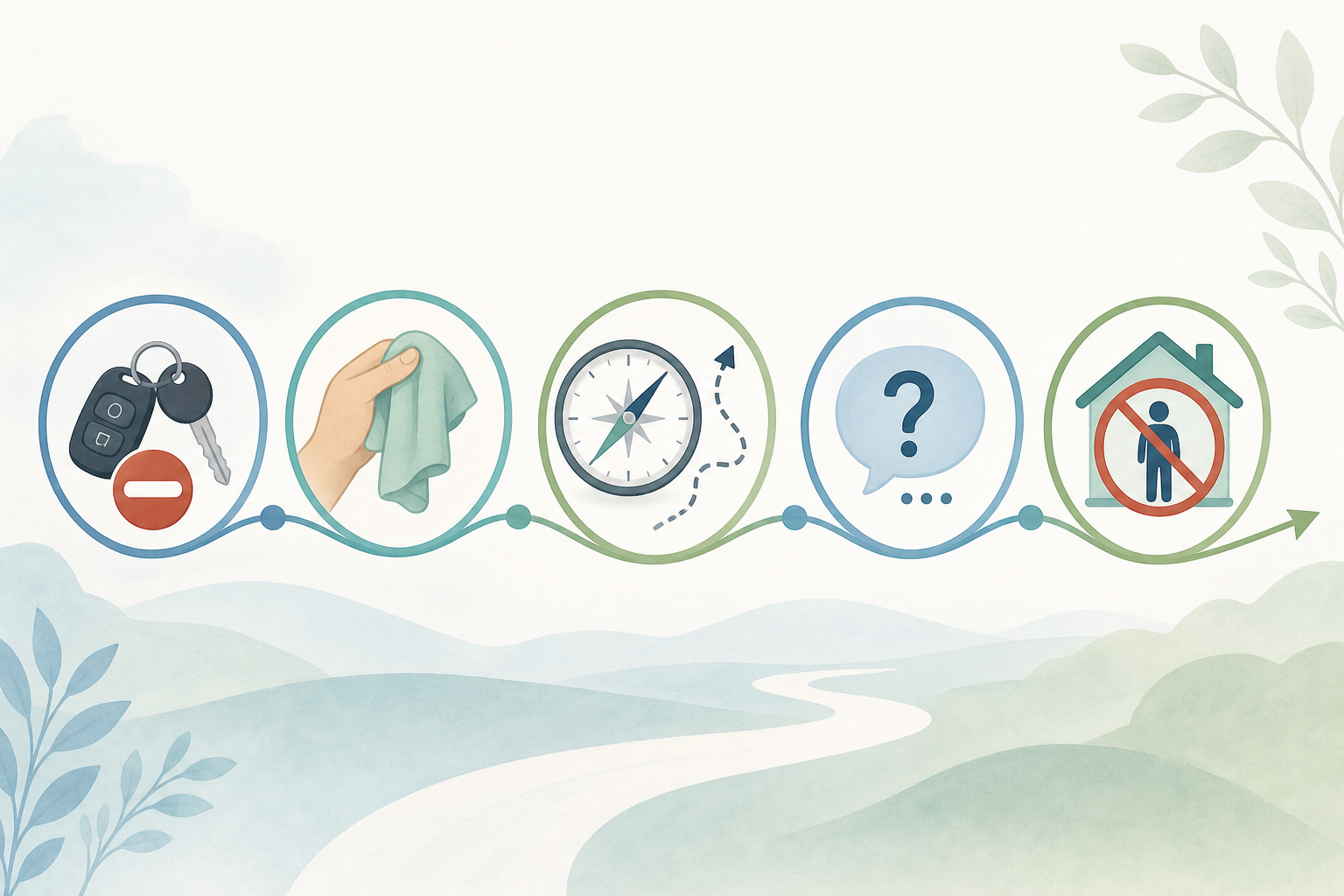
Each transition is predictable. Each can be planned for. And each carries an emotional weight that caregivers rarely anticipate. The sections that follow provide a practical checklist for navigating each one.
Transition 1: Driving Cessation — Planning the Conversation Before It's a Crisis
The National Institute on Aging (NIA) states that in the early stages of Alzheimer's, some people can still drive safely. But as memory and decision-making skills worsen, a point arrives when continuing to drive endangers the person and everyone on the road. The transition to middle stage is that point.
The NIA lists specific warning signs that indicate driving is no longer safe:
- New dents or scrapes on the car that the person cannot explain
- Multiple near misses or crashes
- Two or more traffic tickets in a short period
- Confusing the brake and gas pedals
- Speeding or driving too slowly for conditions
- Getting lost on familiar errands
The Alzheimer's Association advises that involving the person in the decision and explaining concerns with specific examples can reduce conflict. A practical approach includes:
- Schedule a professional driving evaluation through a driving rehabilitation specialist — this removes the decision from you and places it with an objective third party
- Ask the person's doctor to address driving directly during an appointment; many families find the physician's authority carries more weight than their own pleas
- Identify alternative transportation options in advance — buses, taxis, ride services, family carpools, and volunteer driver programs available through the Eldercare Locator at 800-677-1116
- If the person refuses to stop, take practical steps: hide the car keys, disable the car, or sell it. These actions feel extreme but may be necessary for safety
Transition 2: Hygiene Dependence — Navigating Bathing Resistance and Dressing Changes
The NIA describes bathing as one of the hardest caregiving tasks, and for good reason. A person with middle-stage Alzheimer's may regard bathing as scary, embarrassing, or physically unpleasant. They may refuse outright, become agitated, or accuse you of trying to harm them. This is not personal — it is the disease altering how the brain processes sensation, privacy, and safety.
The NIA offers concrete strategies that reduce resistance:
| Challenge | Strategy | Why It Works |
|---|---|---|
| Bathing feels cold and exposed | Warm the bathroom beforehand; use a towel over the person's shoulders during the bath | Reduces the physical shock and sense of vulnerability |
| Person refuses to undress | Offer limited choices: 'Do you want a bath or a shower?' or 'Now or in 15 minutes?' | Preserves a sense of control within safe boundaries |
| Person cannot follow multi-step instructions | Give step-by-step verbal guidance or demonstrate each action | Reduces confusion and anxiety about what comes next |
| Person is afraid of falling or water | Use a handheld showerhead; never leave the person alone | Increases safety and reduces fear |
| Dressing becomes overwhelming | Lay out clothes in the order they should be put on; keep only one or two outfits in the closet | Reduces decision fatigue and confusion |
For dressing, the NIA recommends buying loose-fitting clothing with elastic waistbands and slip-on shoes or hook-and-loop fastener straps. These adaptations preserve the person's ability to dress themselves with minimal assistance, which supports dignity and reduces frustration on both sides.
Transition 3: Wandering Risk — Safety Upgrades Before the First Episode
The Alzheimer's Association reports that six in 10 people living with dementia will wander at least once, and many do so repeatedly. Wandering is not random — it is often triggered by unmet needs, restlessness, or confusion about time and place. The transition to middle stage is when this risk becomes acute.
Prevention must begin before the first episode. The Alzheimer's Association recommends the following home safety measures:
- Install deadbolts out of the person's line of sight — at the top or bottom of the door rather than at eye level
- Use night lights throughout the home to reduce disorientation during nighttime wandering
- Camouflage doors by painting them the same color as the wall or covering them with a curtain
- Place pressure-sensitive mats in front of exterior doors to alert you when someone steps on them
- Identify the time of day the person is most likely to wander — often late afternoon or evening — and plan structured activities during those hours
The Alzheimer's Association also advises that if the person is not found within 15 minutes, call 911 immediately. Most individuals who wander are found within 1.5 miles of where they disappeared, but the first 15 minutes are critical.
This section focuses on dementia-specific wandering safety, which is distinct from general fall prevention. For room-by-room fall prevention checklists, see the Fall Prevention section of this site.
Transition 4: Communication Change — When Words Become Unreliable
In early-stage Alzheimer's, conversation is still largely possible. The person may repeat themselves or struggle to find the right word, but they can express needs, share memories, and participate in decisions. The transition to middle stage changes this fundamentally.
The Alzheimer's Association notes that during the middle stages, damage to the brain can make it difficult to express thoughts. The person may jumble words, have trouble following conversations, or become frustrated and angry when they cannot make themselves understood. They may also withdraw from social interaction entirely.
Practical strategies for this transition include:
- Use simple, short sentences. One idea per sentence. Avoid complex questions or multi-step instructions.
- Ask yes/no questions rather than open-ended ones. Instead of 'What do you want for lunch?' try 'Do you want soup for lunch?'
- Avoid correcting the person when they use the wrong word or confuse names. Correction causes frustration and erodes trust. Focus on the emotion behind the words, not the accuracy.
- Watch for nonverbal cues — facial expressions, body language, tone of voice — that may communicate needs the person can no longer put into words.
- Reduce background noise and distractions during conversations. Turn off the television, close the window, and face the person directly.
This communication shift is one of the hardest transitions for caregivers because it changes the nature of the relationship. You can no longer rely on conversation to connect. Finding new ways to connect — through touch, music, shared activities, or simply sitting together in silence — becomes essential.
Transition 5: Leaving Alone — When It's No Longer Safe
The Alzheimer's Association states clearly that early in the middle stages, it will become too difficult or dangerous for a person with Alzheimer's to be left alone. This is not a recommendation — it is a safety threshold. The person may forget to turn off the stove, wander out of the house, fall and be unable to get up, or become frightened and confused without someone present.
Making the decision to stop leaving the person alone is emotionally brutal. It feels like a loss of freedom for both of you. But the alternative — a crisis that could have been prevented — is worse.
A decision framework for this transition:
- Assess wandering risk: Has the person shown any signs of wandering or attempting to leave? If yes, they cannot be left alone.
- Assess emergency response: Can the person use a phone, call 911, or explain their address in an emergency? If no, they cannot be left alone.
- Assess medication safety: Can the person take the correct medications at the correct times without supervision? If no, they cannot be left alone.
- Consider alternatives: adult day services, in-home care, family care rotation, or a combination of these
The Emotional Impact on the Caregiver: Normalizing Grief, Anger, and Guilt
The early-to-middle transition is not just a series of logistical challenges. It is an emotional earthquake. The person you knew is changing in ways that cannot be reversed. The caregiving role you imagined — providing occasional support while maintaining your own life — is being replaced by something far more consuming.
The data on caregiver mental health is sobering. The Alzheimer's Association reports that 59% of dementia caregivers report high levels of stress, according to its annual Facts and Figures report. The Family Caregiver Alliance notes that 40% of family caregivers of people with dementia suffer from depression, compared to 5–17% of non-caregivers of similar ages. Rates of depression increase with the severity of cognitive impairment.
The Alzheimer's Association lists 10 symptoms of caregiver stress: denial, anger, social withdrawal, anxiety about the future, depression, exhaustion, sleeplessness, irritability, lack of concentration, and health problems. If you recognize several of these in yourself, you are not weak — you are responding normally to an abnormal situation.
A brief self-assessment adapted from the Alzheimer's Association caregiver stress check:
- Have you been feeling overwhelmed or unable to cope in the past month?
- Have you withdrawn from friends, family, or activities you used to enjoy?
- Are you sleeping significantly more or less than usual?
- Do you feel angry at your loved one, the situation, or yourself?
- Have you experienced changes in appetite or physical health since caregiving began?
If you answered yes to two or more of these, consider it a signal to seek support — not a diagnosis. The Caregiver Wellbeing section of this site offers deeper resources on burnout, respite, and difficult conversations. If you are experiencing symptoms of clinical depression or anxiety, please consult a licensed mental health professional.

Building Your Support System Before You Need It: Respite, Support Groups, and Care Coordination
The early-to-middle transition is the ideal time to build a support structure — not because you are failing, but because the middle stage lasts years, and no one can sustain full-time care without help. The Alzheimer's Association emphasizes that using respite care, building a care team calendar, and joining a support group are not signs of weakness; they are signs of good planning.
| Support Type | What It Provides | When to Start |
|---|---|---|
| Respite care (in-home or facility-based) | Temporary relief for the primary caregiver — hours, days, or weeks | Before you feel desperate. Start with a few hours per week to test the arrangement |
| Caregiver support group | Emotional validation, practical tips, and a community that understands | As soon as the transition begins. The Alzheimer's Association 24/7 Helpline (800-272-3900) can connect you to local groups |
| Care team calendar | Shared schedule for family members, friends, and paid caregivers to coordinate coverage | When you realize you cannot do it alone — which is usually earlier than you think |
| Adult day services | Structured activities and supervision during daytime hours | When leaving the person alone becomes unsafe but you still need time for work, errands, or rest |
The Alzheimer's Association 24/7 Helpline (800-272-3900) is available around the clock for guidance on any of these options. The Medicare GUIDE Model, introduced in recent years, also provides support for people living with dementia and their caregivers, including care coordination and respite services.
Legal and Financial Preparation: The Window of Opportunity
The early-to-middle transition is the last window during which the person with Alzheimer's can meaningfully participate in legal and financial decisions. Once the middle stage progresses further, the ability to understand and consent to legal documents may be lost.
Key actions to take now:
- Establish or update a durable power of attorney for finances and healthcare
- Complete advance directives (living will, healthcare proxy)
- Review insurance coverage, including Medicare, Medicaid eligibility, and any long-term care insurance policies
- Consult an elder law attorney who specializes in dementia-related planning
Looking Ahead: What Late-Stage Signs to Watch For
The middle stage lasts years, and your focus should remain on the present. But knowing what signals the eventual transition to late stage can reduce fear of the unknown and help you plan appropriately.
Signs that the late stage is approaching include:
- Significant weight loss despite adequate nutrition
- Inability to communicate verbally or understand language
- Loss of bladder and bowel control
- Increased sleep and decreased awareness of surroundings
- Difficulty swallowing or eating
For now, focus on the transitions in front of you. The Memory Care section of this site provides late-stage guides when you need them. You will cross that bridge when you come to it — and you will be better prepared because you took the time to understand this transition first.
Related reading
Noticed something outdated or inaccurate on this page? Flag a correction. We review every report against CDC, NIA, and AARP HomeFit guidance before updating a page.
Part of the Fall Prevention section.