Repetitive Questioning in Alzheimer's: Why It Happens and How to Respond
By Editorial Team
repetitive questioning
dementia communication
BPSD
caregiver stress
validation therapy
Creating a calm, reassuring environment with visual cues can help reduce the anxiety that drives repetitive questioning.
You Are Not Alone: The Reality of Repetitive Questioning
If you have answered the same question four times before breakfast, you are in good company. Repetitive questioning — asking "When are we leaving?" or "What time is dinner?" a dozen times in an hour — is one of the most common and emotionally draining behaviors in Alzheimer's care. It is also one of the most misunderstood.
The frustration is real. You may feel your patience thinning, then immediately feel guilty for being annoyed at someone who cannot help what they are doing. That cycle — frustration, guilt, exhaustion — is not a sign that you are a bad caregiver. It is a sign that you are human, and that the approach you have been using is not working.
Here is the core insight that changes everything: repetitive questioning is not willful behavior. It is not an attempt to annoy you, test your patience, or manipulate the situation. It is a symptom — a direct result of short-term memory loss combined with an underlying emotional need that the person cannot articulate any other way. Once you understand what is actually driving the question, the way you respond shifts from correction to connection, and the dynamic changes for both of you.
Why Does This Happen? The Brain and Emotional Roots
To respond effectively, you first need to understand what is actually happening inside your loved one's brain. The Alzheimer's Association explains that the main cause of behavioral symptoms like repetition is the deterioration of brain cells, which leads to a decline in the person's ability to make sense of the world around them. In practical terms, this means your parent may genuinely not remember that they just asked the question — the memory of asking it never formed in the first place.
But memory loss alone does not tell the whole story. Repetitive questioning is almost always driven by one or more of the following underlying factors:
Anxiety and insecurity: The person feels confused or uncertain about what is happening next. Asking the same question over and over is a way of seeking reassurance. The Alzheimer's Society UK notes that often, the person needs an emotional rather than factual response — they need comfort, security, or to feel included, not the repeated answer to their question.
Unmet physical needs: Hunger, thirst, needing to use the bathroom, or physical discomfort can all manifest as repetitive questioning. The person may not be able to identify or communicate the need directly.
Boredom and under-stimulation: UCLA Health identifies boredom as a common trigger. When there is nothing engaging to focus on, the mind latches onto a question as a way to interact.
Sundowning fatigue: Late afternoon and evening hours often bring increased confusion, agitation, and repetitive behaviors. This is not a choice — it is brain fatigue after a long day of processing a confusing world.
Environmental triggers: Certain sounds, sights, or even the presence of specific people can trigger anxiety-driven repetition. A clock showing the wrong time, a coat by the door, or an unfamiliar visitor can all set off a loop of questioning.
HopeHealth dementia expert Lisa Wasson, RN, CHPN, CMDCP, puts it plainly: "Even if the repetitive behavior is disruptive, the person is doing it to try to calm themselves, or communicate something." Reframing the behavior as a communication of need rather than a problem to be stopped is the single most important mental shift a caregiver can make.
What Not to Say: Why Correction Backfires
Your first instinct when you hear the same question for the tenth time is probably to say something like, "I already told you that," or "Don't you remember? We just talked about this." These responses feel natural because they are what you would say to anyone else. But in the context of Alzheimer's, they do not just fail to help — they actively make things worse.
Here is why. When you say "Don't you remember?" you are asking the person to confront the very thing their brain can no longer do. Lisa Wasson explains that this only reminds them that their brain does not work properly anymore, which is deeply upsetting. The result is a spike in anxiety, which in turn drives more repetition, not less.
The alternative is counterintuitive but powerfully effective. Wasson states: "Every time they ask, they need you to answer again. Because every time you answer, you calm their nervous system just a little bit." Each calm, patient answer is a small dose of reassurance that lowers their anxiety. Over time, this builds a sense of safety that can reduce the overall frequency of the behavior.
The Core Response Framework: Validate, Answer, Redirect
When the question comes — and it will come again — you need a simple, repeatable sequence that addresses the emotion first and the information second. The Alzheimer's Association recommends: "Focus on the emotion, not the behavior." Here is a three-step framework built on that principle.
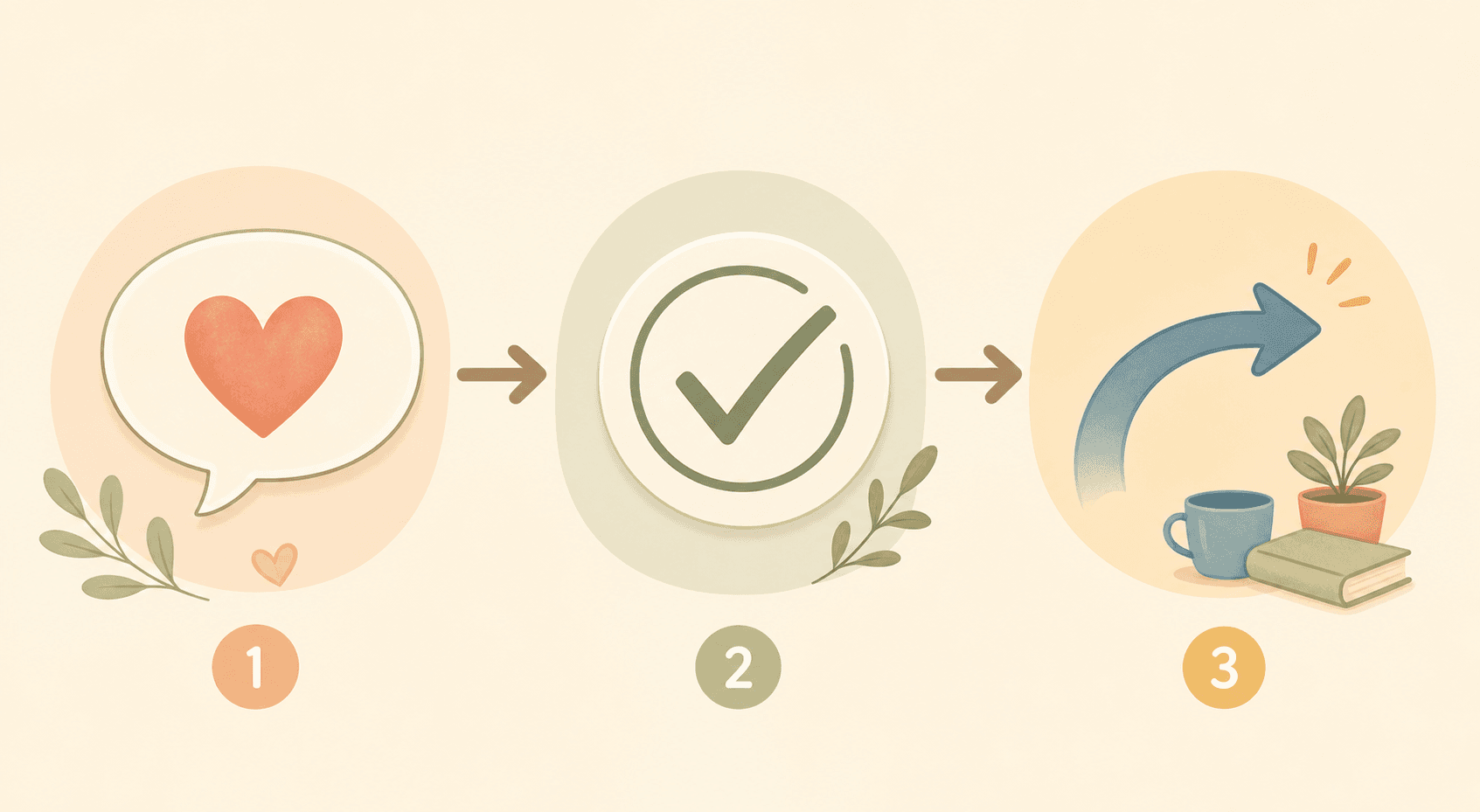
The three-step response sequence: validate the feeling, answer the question, then gently guide attention elsewhere.
Step 1: Validate the Emotion
Before you answer the question, address the feeling behind it. Use a calm voice and gentle touch. Say something like, "I know you are worried about when we are leaving. That is understandable." This tells the person: I see you. I hear you. You are safe. The Alzheimer's Association specifically recommends reassuring the person with a calm voice and gentle touch, and advises not to argue or try to use logic.
Step 2: Answer Briefly and Calmly
Provide the answer as if you are saying it for the first time. Keep it short. Do not add extra information or explanations — that increases cognitive load. "We are leaving after lunch, at about 1 o'clock." That is all. The Alzheimer's Association advises: "Provide an answer... even if you have to repeat it several times." Your calm, consistent tone matters more than the specific words.
Step 3: Redirect to a Different Activity
After you have answered, gently guide the person's attention toward something else. This is not a dismissal — it is a rescue from the anxiety loop. "Let's go see what is on the porch. The birds are active this afternoon." Or: "Could you help me fold these napkins? I could use a hand." The key is to offer an activity that feels meaningful or pleasant, not to simply change the subject.
Wasson offers a powerful real-life example of redirection done well: a care team worked with a man who had been a bus driver and repeatedly asked to go drive his bus. Instead of correcting him or saying no, they painted a school bus on a wall and set up a bench nearby. The repetitive behaviors stopped. The redirection honored his identity rather than fighting it.
Proactive Strategies to Reduce Repetitive Questioning
While the validate-answer-redirect framework helps you respond in the moment, proactive strategies can reduce how often the questions arise in the first place. These approaches address the root causes — anxiety, boredom, fatigue, and unmet needs — before they trigger a repetition loop.
Proactive strategies to reduce the frequency of repetitive questioning by addressing underlying causes.
Strategy
What It Addresses
How to Implement
Visual memory aids
Anxiety about time and schedule
Place a large clock, a day/date calendar, and a whiteboard with the daily schedule in a prominent location. UCLA Health recommends posting the schedule in plain view and reviewing it with the person several times a day.
Scheduled rest periods
Sundowning fatigue
Plan 15–30 minutes of quiet, restful time in the late afternoon. Wasson notes this can significantly reduce sundowning-driven repetition.
Unmet needs check
Hunger, thirst, discomfort, bathroom
Before responding to a repetitive question, quickly scan for physical needs. Is the person hungry? Too warm? Do they need to use the bathroom? Address the need first.
Environmental audit
Triggers in the surroundings
Remove items that trigger repetitive questions. UCLA Health demonstrates removing triggers and posting schedules as a combined approach to reduce anxiety and uncertainty.
Meaningful engagement
Boredom and under-stimulation
Offer simple, purposeful activities — folding laundry, sorting photos, looking at a bird feeder. The activity should match the person's abilities and interests.
Wasson also emphasizes that redirection alone is temporary if the root issue is not addressed. If the repetition is driven by hunger, redirecting to a puzzle will only work until the hunger returns. Always check for unmet needs first.
Advanced Techniques: The Four R's and Validation Therapy
When the basic framework is not enough — and there will be days when it is not — structured approaches from dementia care experts can provide a more robust toolkit.
The NCCDP Four R's Framework
The National Council of Certified Dementia Practitioners (NCCDP) offers a structured four-step approach that builds on the validate-answer-redirect model with additional depth.
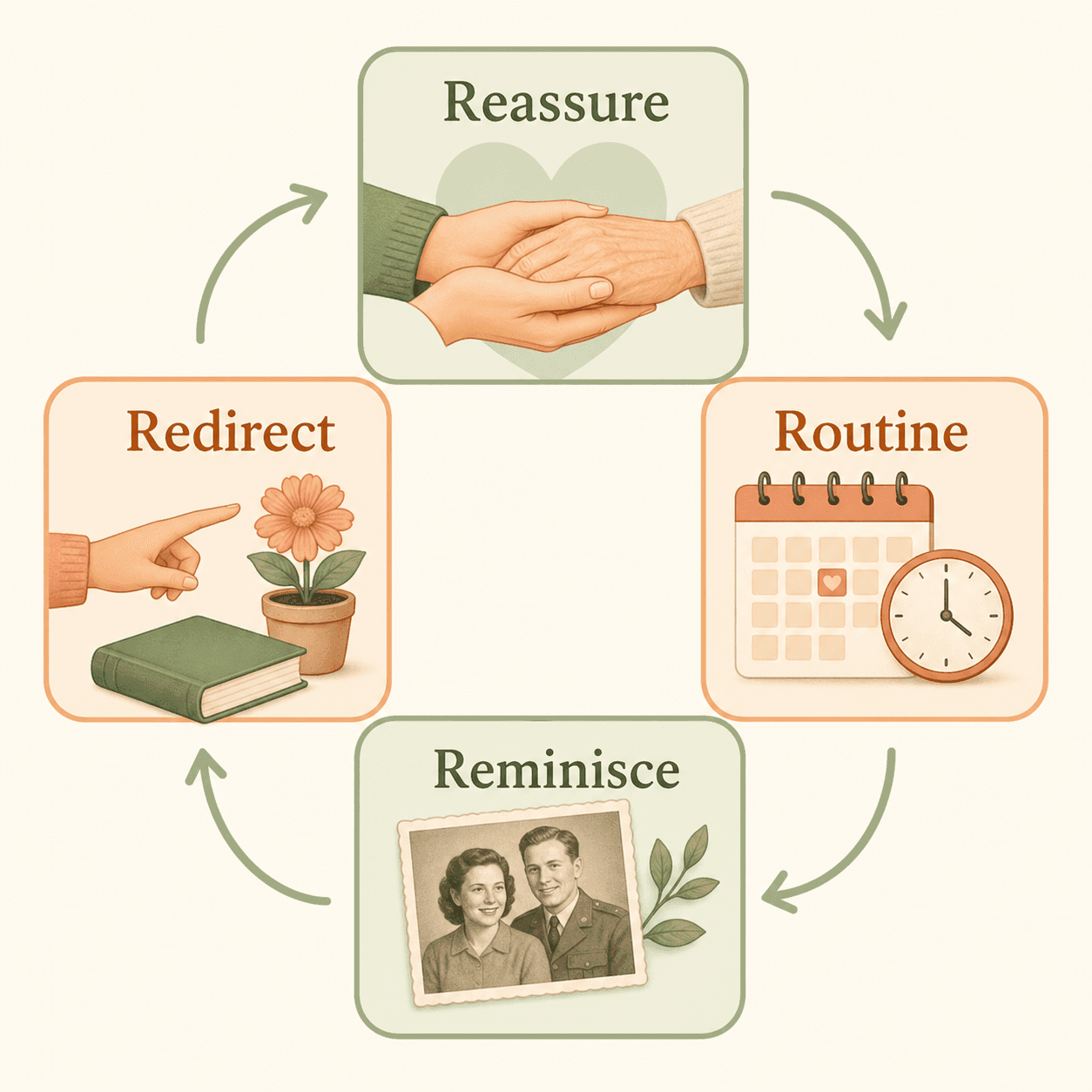
The NCCDP Four R's framework provides a structured, compassionate sequence for responding to dementia-related behaviors.
Reassure: Use consistent, calm communication. Gentle touch, a soft voice, and a safe environment all signal to the person that they are secure. This is the foundation — without reassurance, the other R's will not work.
Routine: A structured daily schedule reduces uncertainty. When the person knows (or can see from visual aids) what comes next, the anxiety that drives repetition decreases. Consistency with caregivers also matters.
Reminisce: Engage long-term memory, which is often preserved longer than short-term memory. Photo albums, music from the person's past, storytelling, and memory boxes can provide comfort and a sense of identity. Sometimes the repetitive question is a veiled attempt to connect with the past.
Redirect: Use distraction techniques — moving to a quiet area, engaging in a simple activity like folding laundry, or making a gentle suggestion without arguing. The NCCDP emphasizes that redirection should feel like a natural shift, not a confrontation.
Validation Therapy: Responding to the Emotion, Not the Fact
Validation therapy takes the "focus on the emotion" principle to its logical conclusion. Instead of trying to reorient the person to objective reality, you enter their emotional reality and validate the feeling. If your mother asks repeatedly, "Where is my mother?" — even though her mother died decades ago — validation therapy would not correct her. Instead, you might say, "You sound like you are missing your mother. Tell me about her." This approach honors the emotion behind the question and often reduces the need to keep asking.
The Alzheimer's Society UK supports this approach, stating that when someone repeats the same question, they often need comfort, security, or reassurance rather than the repeated answer to their question. Validation therapy is not about agreeing with false beliefs — it is about recognizing that the emotional need is real, even if the factual premise is not.
When to Accept the Behavior and When to Seek Help
Not every instance of repetitive questioning needs to be addressed or reduced. The Alzheimer's Association advises: "Accept the behavior, and work with it" if it is not harmful. Sometimes the repetition is a self-soothing mechanism, and intervening disrupts the person's sense of calm. If the question is harmless and the person is not distressed, it may be kinder to simply answer patiently each time than to try to stop it.
However, there are clear situations where medical consultation is warranted.
Sudden or dramatic worsening: If repetitive questioning appears suddenly or escalates sharply over a day or two, this may signal delirium — a medical emergency often caused by infection, medication changes, or dehydration.
Signs of physical illness: Fever, confusion, lethargy, or changes in appetite or mobility alongside increased repetition require immediate medical attention.
Medication side effects: New or changed medications can cause increased confusion or agitation. A medication review with the prescribing doctor may be needed.
Significant distress or safety concerns: If the repetition is accompanied by agitation, aggression, or attempts to act on the question (e.g., trying to leave the house repeatedly), professional guidance is essential.
Protecting Yourself: Caregiver Self-Care Is Not Optional
Repetitive questioning is not just annoying — it is genuinely stressful. A 2022 study of 200 U.S. Alzheimer's caregivers published in PMC found that 58% report extreme stress levels and 47% report significant sleep deprivation since becoming caregivers. The same study found that 65% find caring for a patient difficult or extremely difficult, and 43% feel more socially isolated.
You cannot pour from an empty cup. When you are sleep-deprived, stressed, and isolated, your patience thins, your responses become sharper, and the repetitive questioning actually gets worse because your loved one picks up on your tension. Protecting your own reserves is not selfish — it is a caregiving strategy.
Give yourself permission to step away. If you feel your frustration rising, it is okay to say, "I need a moment," and step into another room for five minutes. The person will be safe. You will return calmer.
Use respite care. Even a few hours a week of adult day care or in-home respite can break the cycle of constant vigilance and give you space to recharge.
Find your people. Online caregiver communities, local support groups, or even one friend who understands can make the difference between coping and collapsing. You do not have to do this alone.
Track what works. Keep a simple log of when repetition peaks and what strategies help. Patterns will emerge — certain times of day, certain triggers, certain responses that work better than others. Data reduces the feeling of helplessness.
The goal is not to eliminate repetitive questioning entirely. In many cases, that is not realistic. The goal is to respond in a way that preserves your loved one's dignity and your own sanity — to shift from a cycle of frustration and guilt to a cycle of patience and self-compassion. Every calm answer you give is a small act of love. And every moment you take to care for yourself is an act of love too.



Comments
Join the discussion with an anonymous comment.