
Senior Care Assistance Options: A Stage-Aware Decision Guide for Families Caring for a Parent with Dementia
This guide helps adult children caring for a parent with dementia understand the full spectrum of senior care assistance — from in-home care and adult day programs to memory care and hospice — and match each option to their parent's current disease stage and their family's financial reality.

The Overwhelming Moment That Brings You Here
You are here because something has shifted. Maybe your parent forgot to pay bills for three months in a row. Maybe a neighbor called to say they found your mother walking down the street at 11 p.m. Maybe the hospital discharge planner handed you a list of "home care agencies" and said, "You'll need to arrange follow-up," and you nodded as if you knew what that meant.
That moment — the one where you realize you are now responsible for navigating a system you have never used — is disorienting. You are not alone in it. According to the 2025 AARP and National Alliance for Caregiving report, nearly 63 million Americans are now family caregivers, a 45% increase since 2015. The average caregiver is 52 years old, spends 22.8 hours per week on caregiving duties, and loses an estimated $21,500 in annual income as a result.
This guide is built on a single premise: senior care assistance is not one decision you make and forget. It is a sequence of stage-aware choices that evolves as dementia progresses. Families who understand the full continuum of options — from a few hours of companionship each week to around-the-clock skilled nursing — and who learn to layer public funding programs, can extend a parent's independence at home longer, avoid crisis-driven placement decisions, and preserve financial resources.
The Full Assistance Spectrum: What Each Option Provides (and Doesn't)
The first step is understanding the landscape. The terms "home care" and "home health care" sound similar but describe fundamentally different services. Adult day care is not "daycare for seniors" — it is a structured program that can provide meaningful social engagement and supervision. Memory care is not simply assisted living with a locked door — it is a distinct clinical environment designed for people with cognitive impairment.
The table below defines each option, clarifies who provides the service, and — just as importantly — states what it does not cover.
| Assistance Type | What It Provides | Who Provides It | What It Does NOT Cover |
|---|---|---|---|
| Home Care (Companion / Personal Care) | Assistance with bathing, dressing, toileting, meal preparation, light housekeeping, transportation, and companionship. | Home care aides employed by agencies or hired privately. | Skilled medical care (wound care, injections, physical therapy). |
| Home Health Care (Skilled Medical) | Part-time nursing care, physical therapy, occupational therapy, speech therapy, and wound care — ordered by a physician. | Medicare-certified home health agencies; licensed nurses and therapists. | Custodial care (bathing, dressing, meals) unless also receiving skilled services. |
| Adult Day Care | Structured social activities, meals, supervision, and some health services in a group setting during daytime hours. | Adult day centers; some offer specialized dementia programs. | 24-hour care, overnight stays, or skilled nursing (most centers). |
| Respite Care | Short-term care (a few hours to several weeks) to give the primary caregiver a break. | Home care agencies, adult day centers, or short-term stays in assisted living or nursing facilities. | Continuous long-term care; Medicare covers only up to 5 days for hospice patients in a facility. |
| Assisted Living | Housing with meals, housekeeping, medication management, and personal care assistance in a residential setting. | Assisted living communities; staff includes aides and some licensed nurses. | Skilled nursing or 24/7 medical supervision for advanced dementia. |
| Memory Care | Secure residential environment with specialized programming, staff trained in dementia care, and higher staff-to-resident ratios. | Memory care units within assisted living or stand-alone communities. | Skilled nursing for non-dementia medical conditions (e.g., post-surgery recovery). |
| Hospice Care | Comfort-focused care for people with a terminal diagnosis (typically 6 months or less); includes pain management, emotional support, and respite for caregivers. | Hospice agencies; care is provided at home, in a facility, or in a hospice center. | Curative or life-prolonging treatment. |
A critical distinction: home care aides do not provide skilled medical care. If your parent needs wound care, physical therapy after a hip replacement, or monitoring of a chronic condition like congestive heart failure, you need home health care — which must be ordered by a physician. The National Institute on Aging notes that Medicare has limited coverage for short-term home health from Medicare-certified agencies, but it does not cover non-medical home care.
Matching Assistance to Dementia Stage: A Practical Framework
Dementia is not a static condition. The type of assistance your parent needs today will be different from what they need next year. A stage-aware approach prevents two common mistakes: over-buying (placing someone in memory care when they could thrive at home with a few hours of help) and under-buying (assuming home care is sufficient when 24/7 supervision is actually required).
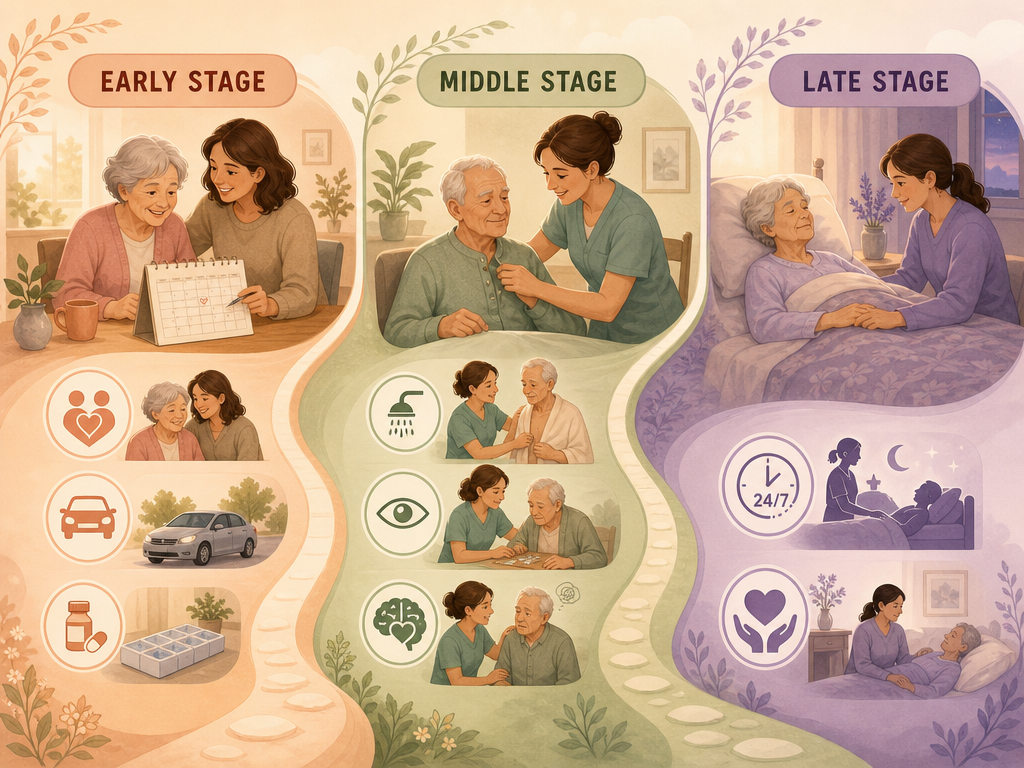
Early-Stage Dementia: Companionship, Transportation, and Medication Management
In early-stage Alzheimer's or other dementias, your parent may still live independently but struggle with complex tasks: managing finances, remembering medications, cooking safely, or driving to appointments. The goal at this stage is to supplement independence, not replace it.
- Home care (companion level): A few hours a week for transportation to medical appointments, grocery shopping, or meal preparation. This is often enough to keep a parent safe and socially engaged without overwhelming them with help they do not want.
- Adult day care: Two to three days per week provides structured social engagement, which can slow cognitive decline and reduce isolation — while giving you predictable respite.
- Medication management services: A home care aide can set up pill organizers or a pharmacy can provide blister packs. For complex regimens, a geriatric care manager (licensed nurse or social worker) can coordinate.
For a deeper look at early-stage care approaches, see our Early-Stage Alzheimer's Care Guide for Family Caregivers.
Middle-Stage Dementia: Personal Care, Supervision, and Behavior Management
As dementia progresses to the middle stage, the needs shift dramatically. Your parent may need help with basic activities of daily living (ADLs) — bathing, dressing, toileting, and transferring. Wandering, sundowning, agitation, and repetitive questioning become common. The goal shifts from supplementing independence to ensuring safety and managing behaviors.
- Home care (personal care level): Daily assistance with bathing, dressing, and toileting. A home care aide can also provide supervision to prevent wandering and redirect during episodes of agitation.
- Adult day care (dementia-specific programs): Some centers offer specialized memory care programming with structured activities designed to reduce agitation and provide meaningful engagement.
- Respite care: Regular respite — even a few hours a week — is essential for caregiver sustainability. The National Institute on Aging notes that Medicare covers up to 5 consecutive days of respite for hospice patients in a facility, and Medicaid may assist in some states.
- Memory care: If your parent's wandering becomes unsafe, if they cannot be left alone even for short periods, or if caregiver burnout is severe, a memory care community may be the safest option.
For detailed guidance on managing behaviors and safety at home during this stage, see our Dementia Care at Home guide.
Late-Stage Dementia: 24/7 Skilled Nursing and Hospice
In late-stage dementia, your parent may lose the ability to walk, speak, or swallow. They require around-the-clock care, often including skilled nursing for pressure ulcer prevention, feeding tube management, or pain control. The goal is comfort, dignity, and quality of life.
- Skilled nursing facility (SNF) or nursing home: Provides 24/7 nursing care for residents who need medical supervision. Medicare covers short-term stays after a hospital discharge; Medicaid covers long-term custodial care for eligible individuals.
- Hospice care: When a physician certifies that the person has 6 months or less to live, hospice provides comfort-focused care — pain management, emotional support, and respite for caregivers — at home, in a facility, or in a hospice center. Medicare, Medicaid, VA benefits, and most private insurance cover hospice.
- In-home hospice: Many families prefer to keep their loved one at home during the final months. A hospice team (nurse, social worker, chaplain, aide) visits regularly, and family caregivers receive training and support.
2026 Cost Benchmarks Across the Care Continuum
Cost is the single most stressful variable for most families. The good news: understanding the numbers — even approximate ones — allows you to plan rather than react. The table below presents 2026 national median costs for each assistance type.
| Assistance Type | National Median Cost (2026) | Notes |
|---|---|---|
| Home care (non-medical) | $34/hour (state range: $25–$44) | 7 hrs/week = ~$1,031/month; 15 hrs/week = ~$2,208/month; 30 hrs/week = ~$4,416/month |
| Home health care (skilled) | Varies; typically $50–$150/hour depending on service | Medicare may cover short-term skilled care if prescribed by a physician |
| Adult day care | $1,700–$2,500/month (national average) | Significantly less expensive than in-home or residential care; Medicare does not pay, but Medicaid may |
| Respite care (in-home) | $34/hour (same as home care rate) | Medicare covers up to 5 days for hospice patients in a facility; Medicaid may assist |
| Assisted living | $4,500–$5,500/month | Varies widely by state and level of care needed |
| Memory care | $6,800–$7,200/month | Higher staff-to-resident ratios and specialized programming drive the premium over assisted living |
| Hospice care | Covered by Medicare, Medicaid, VA, and most private insurance | No out-of-pocket cost for covered services; respite care included |
A critical insight from the data: even small amounts of paid care can extend independence at home. As Vicki Demirozu, a home care expert, notes, even help with meals or light housekeeping a few hours a week can make the difference between a parent living safely at home and needing residential care. At $34/hour, 7 hours per week costs approximately $1,031 per month — far less than the $6,800+ for memory care.
How to Pay for Care: Layering Public and Private Funding Sources
Most families assume they will pay for care out of pocket until they run out of money, at which point Medicaid will take over. This is a common — and costly — misconception. A strategic approach involves layering multiple funding sources to extend resources and delay or avoid the spend-down to Medicaid eligibility.

Layer 1: Personal Funds and Private Resources
Most families start here. Personal savings, retirement accounts (IRAs, 401(k)s, pensions), Social Security income, and home equity (via a reverse mortgage for those 62+) are the first line of funding. The Alzheimer's Association notes that retirement benefits can be accessed early without the 10% early withdrawal penalty if the person is disabled.
Layer 2: Medicare (Limited — Does NOT Cover Custodial Care)
This is the most misunderstood funding source. Medicare does not cover long-term custodial care — meaning it will not pay for a home care aide to help with bathing and dressing, and it will not pay for a memory care community. Medicare covers only:
- Short-term skilled nursing facility stays (up to 20 days fully covered, with a co-pay for days 21–100) after a qualifying hospital stay.
- Part-time home health care (skilled nursing, physical therapy) if ordered by a physician and provided by a Medicare-certified agency.
- Hospice care for those with a terminal diagnosis.
- Prescription drugs (Medicare Part D).
Layer 3: Medicaid and HCBS Waivers (The Primary Public Program for Long-Term Care)
Medicaid is a joint federal and state program for low-income individuals. It is the primary payer for long-term custodial care in the United States. However, eligibility rules and covered services vary significantly by state.
The most important Medicaid program for families who want to keep a parent at home is the Home and Community-Based Services (HCBS) waiver. HCBS waivers can cover in-home care, adult day care, respite care, home modifications, and case management. The catch: most states have waiting lists, and eligibility is based on both financial need and functional need (typically requiring a nursing-home level of care).
Layer 4: PACE (Program of All-Inclusive Care for the Elderly)
PACE is a combined Medicare and Medicaid program for people 55+ who are eligible for nursing home care but want to remain in the community. It provides comprehensive medical and social services — including primary care, adult day care, home care, transportation, and prescription drugs — through a single coordinated team. The National Institute on Aging notes that PACE enables most participants to continue living at home. However, PACE is available only in certain states and locations, and there may be a monthly charge for participants who do not qualify for Medicaid.
Layer 5: VA Aid & Attendance (for Eligible Veterans and Surviving Spouses)
The VA provides an additional monthly pension payment — called Aid & Attendance — for eligible veterans and their surviving spouses who need assistance with daily living activities. This benefit can be used to pay for home care, adult day care, assisted living, or memory care. The TOOTRiS 2026 federal programs guide notes that there may be a waiting list for VA nursing homes, but the Aid & Attendance pension is a non-institutional benefit that can be used flexibly.
Layer 6: National Family Caregiver Support Program (NFCSP) and Older Americans Act (OAA) Services
These programs are often overlooked but can provide meaningful support at low or no cost:
- NFCSP: Provides grants to states for caregiver counseling, respite care, training, and resource access. Services are typically low-cost or free.
- OAA services: Funds senior centers, congregate and home-delivered meals (Meals on Wheels), transportation, and caregiver support. Generally available to anyone 60+ without a means test.
- Supplemental Nutrition Assistance Program (SNAP): Monthly food assistance for low-income older adults.
Where to Start: A Needs Assessment and Action Workflow
You now have the landscape. The next step is to translate that knowledge into action. The workflow below is designed to move you from overwhelm to a concrete plan — one step at a time.
Step 1: Conduct a Needs Assessment Using the ADL/IADL Framework
Before you can match your parent to the right assistance type, you need to know exactly what they can and cannot do. The standard framework used by healthcare professionals is the Activities of Daily Living (ADLs) and Instrumental Activities of Daily Living (IADLs) assessment.
| Category | Specific Tasks | Assessment Question |
|---|---|---|
| ADLs (Basic Self-Care) | Bathing, dressing, toileting, transferring (getting in/out of bed or chair), continence, feeding | Can your parent perform each task independently, with supervision, or not at all? |
| IADLs (Complex Tasks) | Managing finances, managing medications, using the telephone, shopping, meal preparation, housekeeping, transportation | Which tasks have become difficult or unsafe in the past 6 months? |
A formal assessment from your parent's primary care physician or a geriatrician is also valuable — it evaluates physical health, medication regimen, mental health, and social/environmental factors. This assessment is often required for Medicaid HCBS waiver eligibility.
Step 2: Contact Your Local Area Agency on Aging (AAA)
Your local AAA is the single most useful resource you have not yet called. AAAs administer Older Americans Act programs, provide in-person assistance with benefits applications (Medicaid, SNAP, Medicare Savings Programs), and can connect you to local home care agencies, adult day centers, and respite programs. They are funded by the federal government and do not charge for their services.
Step 3: Use the Eldercare Locator
If you do not know how to find your local AAA, call the Eldercare Locator at 1-800-677-1116. This nationwide service, funded by the U.S. Administration on Aging, connects families to local services — including AAA offices, Medicaid offices, legal assistance, and transportation programs. It is available Monday through Friday, and the website (eldercare.acl.gov) provides a searchable directory.
Step 4: Gather Essential Legal Documents
Before you can make decisions about care or finances, you need the legal authority to do so. If your parent does not already have these documents in place, consult an elder law attorney immediately:
- Medical power of attorney (healthcare proxy): Authorizes you to make medical decisions if your parent cannot.
- Financial power of attorney: Authorizes you to manage bank accounts, pay bills, and apply for benefits.
- Advance directives (living will): Documents your parent's wishes for end-of-life care.
- HIPAA release: Allows healthcare providers to share medical information with you.
Your Next-Steps Checklist
You have covered a lot of ground. Here is a concise, actionable checklist to guide your next moves. Print it, save it, or share it with siblings. Each item is a step toward clarity, not another source of stress.
- Assess current needs: Use the ADL/IADL framework to identify which tasks your parent can and cannot do independently. Write it down.
- Contact your local Area Agency on Aging: Call the Eldercare Locator (1-800-677-1116) or visit eldercare.acl.gov to find your AAA. Ask about in-home assessments, Medicaid applications, and respite programs.
- Explore Medicaid HCBS waiver eligibility: Contact your state Medicaid office or ask your AAA for guidance. Be prepared for waiting lists.
- Research PACE availability: Check whether PACE is available in your parent's location. If so, it may be the most comprehensive single program for keeping them at home.
- Gather legal documents: If not already in place, schedule a consultation with an elder law attorney for medical and financial powers of attorney, advance directives, and a HIPAA release.
- Schedule a family conversation: Include your parent (if they are able to participate), siblings, and any other key family members. Use the needs assessment as the starting point — not opinions or emotions.
- Read the companion guides: For deeper dives on specific topics, see our financial assistance map, dementia care at home guide, and early-stage care guide.
Related reading
Noticed something outdated or inaccurate on this page? Flag a correction. We review every report against CDC, NIA, and AARP HomeFit guidance before updating a page.
Part of the Fall Prevention section.